Island of Spies, page 30


Ba-BAM.
The door opened and I whirled to face it.
Papa smiled from the doorway. “Hello, Genius. Is it Stick or Sarah these days?”
“It’s Sarah Stickley Lawson, through and through. But everybody who loves me calls me Stick,” I said, and hurled myself into his arms.
Yours truly,
the Dime Novel Kids:
Nebuchadnezzar Alfonzo MacKenzie
Rain J. M. Lawson Van Dijk
Sarah Stickley Lawson
Hatteras Island, North Carolina, 1942
FROM THE AUTHOR TO YOU
Some books just feel like they want to be written. Island of Spies is one of them.
I first caught a glimmer of this story during a family trip to Hatteras Island, where the story is set, when I was about nine years old. In Eastern North Carolina, where I grew up, we go to the beach every chance we get. We always have. As I walked along the shore with my father, I spotted a large, black—what? A ropy blob of prehistoric goo? A giant egg casing?
“That’s oil,” Daddy said. “In World War II, German submarines called U-boats hid right out there, torpedoing our ships,” he added, pointing out at the Atlantic Ocean. “The ships still sit on the bottom of the sea, releasing oil for the ocean to churn ashore. That’s our secret history.” He looked at me. “The spies are secret too.”
A secret history? U-boats? Spies?
Whether he was fishing or telling a story, my father knew how to set a hook.
Island of Spies grew out of that long-ago stroll along the beach.
* * *
• • •
This book is historical fiction—a made-up story with history as its framework.
What’s true? First, here’s what most people know:
For the United States of America, World War II began when Japan bombed the U.S. Navy ships at Pearl Harbor, Hawaii, late in 1941. It was a surprise attack, and almost all of America’s ships were either sunk, or badly damaged. As Congress declared war on Japan and their ally Germany, many people panicked, fearing Japanese attacks all along our West Coast.
Now, a secret part of our history—something people are just starting to talk about:
Just a few weeks after Pearl Harbor, German U-boats surfaced off the coast of North Carolina, on the East Coast. And they started hunting the giant ships carrying oil, passengers, and goods up and down the coast, from Canada to South America and vice versa.
The U-boats found the best hunting in the tricky waters off North Carolina, where two mighty currents collide. The area’s shifting underwater sandbars and channels are known as the Graveyard of the Atlantic because thousands of ships have gone down there throughout history. Starting in 1942, U-boat captains added to that number, zeroing in on ships carefully crossing those sandbars and sending them to the bottom of the sea.
The people of Hatteras Island heard the first ships explode in January 1942. As ships burned and sank, the frightened islanders waited for help, just like they do in this book. But thanks to Pearl Harbor, U.S. President Franklin Roosevelt had no ships to send. To keep the already-frightened American mainland calm, he censored the news of the terrifying U-boat attacks. In fact, he kept the news so quiet, most Americans never knew of the U-boat attacks that would send more than eighty ships down in North Carolina waters before war’s end. In all, almost four hundred ships went down along the East Coast.
The people of North Carolina’s Outer Banks—including Hatteras Island—were on their own, just like Stick, Rain, and Neb in Island of Spies.
* * *
• • •
The U-boat attacks are part of our history. What else in this book is true?
The ships’ names and the dates they went down are accurate to the best of my ability. I changed the time of the very first attack by a few hours, to make the story juicier for you.
Island of Spies uses a lot of spy codes, lingo, and gizmos—all actually used by spies. The fate of the schoolhouse is true and so are the facts in the news stories, to the best of my ability, though Mr. Green (who’s fiction) never made the news. Also true: German spies did come ashore in the United States.
Another true thing: America dealt with a thousand changes during this war. Young men and women went to war, and other young women like Faye stepped up to handle their jobs, or stepped boldly into new jobs created by the war. Things we take for granted—sugar, shoes, gasoline, and so much more—were rationed to make sure there was enough for the military. That means the government decided how much each person could buy.
Many thousands of people died, mostly overseas, breaking hearts at home.
If you like history (or need information for a book report), pop over to SheilaTurnage.com for more factual tidbits. You’ll read about the island’s real-life heroic postmistress (who was not at all like the frilly, grumpy postmistress in this book), and the three young brothers who ran their own bus company on the island (you’ll catch glimpses of their bus in this story). You can read about German spies here in the U.S., and learn more about the Cape Hatteras Lighthouse and the men who built and ran it.
* * *
• • •
What’s the fiction in this historical fiction? The characters and their actions are all fiction.
Readers often ask me: “Where do characters come from?” It’s a great question.
There’s a bit of my mother, Vivian Taylor Turnage, in Stick. I’d say she inspired this character. My mother loved science and math. When she was a girl in 1942, white girls like Stick and my mom had next to no hope of a science career, and Black girls had even less. Stick is smart and outspoken, like my mother. What led to Stick’s invention, the Stick-O-Matic? My mother made one for me when I was ten, to help me impress a group of fourth-graders. (I was the new kid that year and needed all the help I could get.) Using it for a night-light was Stick’s idea.
Stick’s friend Neb is growing up in the Hatteras Lighthouse compound in this book. His beloved three-seater outhouse, island pony, and home are taken from an interview I did years ago with Mr. Rany Jennette, who grew up in the same lighthouse compound, in real life. Neb’s family is white, like most islanders of that time period.
Stick’s friend Rain, a ten-year-old mixed-race girl, lives with her white mom in the island’s most interesting house—a huge wine barrel, long as a pickup truck and tall enough to walk around in. A historic photo sparked the idea for Rain’s house. Rain’s a self-taught artist, and that part of her character was inspired by Ms. Minnie Evans, a Black, self-taught visionary artist who grew up near the port of Wilmington, North Carolina.
As you know, Stick, Rain, and Neb are the Dime Novel Kids. Their enemies, Otto and Tommy Wilkins, were inspired by a couple of boys I’ve run into here and there. I hope they don’t remind you of anyone you know.
If you get a chance to visit North Carolina, I hope you can climb the Hatteras Lighthouse like Stick, Rain, and Neb do—and like I do every chance I get. I hope you see the island ponies, visit Buxton Woods (it does have some nice trails), and go fishing where Rain’s mother fishes.
As for the three mysterious graves in Buxton Woods, the ones at the heart of this mystery, I’ve heard whispers about them all my life. I know people who claim they’re real, and some who claim they’re not. Feel free to draw your own conclusions.
Finally, I hope you’ve had as much fun reading this novel as I did writing it.
Yours truly,
Sheila Turnage
THANK-YOUS
It takes so many people to create a book!
Most writers work at home, and I am no different. On the homefront: Thanks to Rodney for your love, support, and unnerving ability to think like a spy. Thanks to my extended family for your patience and support: Lauren, Elvis, Olivia, and Harrison; Karen, Alan, Vivian, Julian, and Lillian; Haven, Nick, Taylor, and Jackson; Michael and Susan; Allison and Johnny; and my cousins, aunts, and uncles.
Most authors write with other writers, and I do too. Thanks to the Monday Writers Workshop, author Pat O’Leary, and poet Claire Pittman.
Thank you to Eileen LaGreca for your friendship and the spectacular website.
To agent Margaret Riley King at WME: Thanks for your faith in this book and in me.
Once a book is written, it’s ready to greet the world. Thanks to publisher Lauri Hornik for everything over the years, and especially for welcoming me home. To my brilliant editor, Jessica Dandino Garrison, whose dedication to character and uncanny sense of direction made this book deeper and richer than it would otherwise have been, a thousand thanks.
Thank you to sales rep Doni Kay. My characters and I all love you.
There are so many to thank at Dial Books for Young Readers, including copyeditor Regina Castillo, interiors designer Cerise Steel, and editorial assistant Squish Pruitt. Thanks to cover designer Kristin Smith, cover artist Tom Clohosy Cole, and expert reader Sharifa Love-Schnur. Also to Kathy Dawson for acquiring this book.
Last but not least, thank you to the men and women who fought fascism in World War II, and to those who waited at home. I hope we can all learn from reading your pages in history.
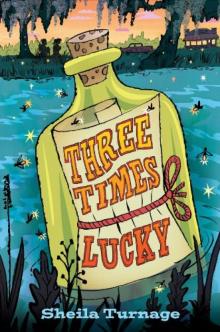
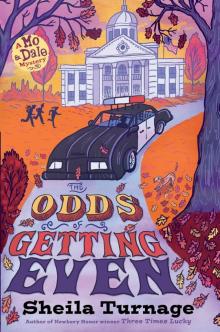
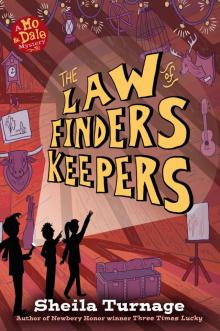
Growing up in eastern North Carolina, SHEILA TURNAGE fell in love with Hatteras Island’s shipwrecks, secret World War II history, and whispered spy stories—which helped inspire her latest book, Island of Spies. Sheila is the author of many children’s books. Her award-winning Mo & Dale Mysteries kicked off with Three Times Lucky, a Newbery Honor Book, a New York Times bestseller, an E. B. White Read Aloud Honor Book, and an Edgar Award finalist. Her follow-up, The Ghosts of Tupelo Landing, also a New York Times bestseller, received five starred reviews. The Odds of Getting Even and The Law of Finders Keepers rounded out the series with numerous starred reviews, and all four books were Junior Library Guild selections. Sheila is also the author of two nonfiction adult books, a poetry collection, and a picture book, Trout the Magnificent, illustrated by Janet Stevens. She lives on a farm in eastern NC with her husband, a very smart dog, a flock of chickens and guineas, one lonely goose, and a couple of sweet-faced goats. She still loves visiting Hatteras Island.
Discover more at SheilaTurnage.com.
What’s next on
your reading list?
Discover your next
great read!
Get personalized book picks and up-to-date news about this author.
Sign up now.
_140874740_
Sheila Turnage, Island of Spies