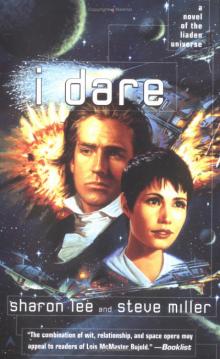
Doors Into Change, page 1


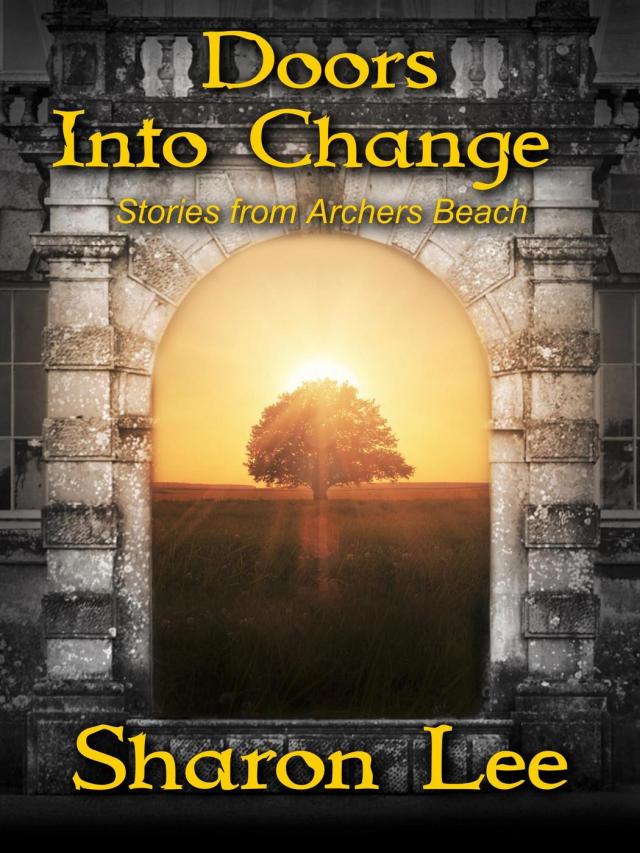
DOORS INTO CHANGE
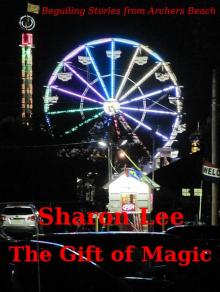
Stories from Archers Beach
Sharon Lee
Table of Contents
Title Page
DOORS INTO CHANGE
The Road to Pomona's
The Vestals of Midnight
Wolf in the Wind | Chapter One
Chapter Two
Chapter Three
Chapter Four
Chapter Five
Chapter Six
Chapter Seven
Chapter Eight
Chapter Nine
Chapter Ten
Introduction to "Wolf in the Wind" partial
Author's Notes
About the Author
Novels by Sharon Lee & Steve Miller
Novels by Sharon Lee
Pinbeam Books Publications
Thank You
Copyright Page
Copyright Page
DOORS INTO CHANGE
Stories from Archers Beach
by
Sharon Lee
#
Doors Into Change
Stories from Archers Beach
Sharon Lee
#
Pinbeam Books
http://www.pinbeambooks.com
This is a work of fiction. All the characters and events portrayed
in this novel are fictional or are used fictitiously.
#
Thanks to Intrepid Tyop Hunters
Kirsten Guyaz, Marni Rachmiel, and Kate Reynolds.
Any remaining infelicities in the text are absolutely the fault of the author.
The Road to Pomona's
"Elinor." He sighed; she was off again. You'd think she didn't want—
"Hmm? Did you say something, Charles?"
"Did I say—Elinor, we are trying here to plan our vacation—something I think we both want very much?" It was lost on her. She only looked at him, face composed, eyes empty of any hint of emotion. Of involvement.
He tried a different tack, pushing the papers and travel brochures together into a hasty pile and stacking them atop the refrigerator, theoretically out of the cat's territory.
"Listen, I'm beat, myself. Tomorrow's Saturday, we'll have the whole day to just mess around and talk about plans. It was stupid to try it tonight, anyway. Let's go to—"
Amazement stopped him. Elinor was sitting stiffly upright, face, for once, intent. "What did you say?"
"What did I—when?" He was honestly baffled.
"You said tomorrow's Saturday. Saturday. It can't possibly be Saturday . . . "
"It can't?" Charles stared. "Why can't it? I've waited a whole—"
Again, her face interrupted him. "OK, suppose you tell me what day tomorrow is."
She looked a little bewildered herself. "Well, all right—Saturday. I guess. It's just that I promised Pomona—"
"Pomona? Who's Pomona? And why'd you promise her anything? You knew perfectly well that this is the first Saturday I've had off in—HEY!"
But Elinor was already gone, racing down the short hallway to their bedroom.
* * *
The road to Pomona's is tree-lined and dim. You move for a timeless time over white gravel, the breeze that cools your face scented with roses and lilac. Suddenly, you stand out upon the hillside and there it is, set like a jewel in the very heart of the valley, an island of serenity in a sea of deep red grass ...
* * *
"Elinor? Elinor, why're you sitting in the dark?"
She stirred, focused. "I've got a headache. The light bothers me."
"Oh." He moved into the room, sat on the corner of the bed. She could just see him, a dim, slumped-forward outline, hands clenched between his knees.
"Listen, Elinor . . . ." He paused.
"I'm listening, Charles."
"I—well, look, if you don't want the vacation, or you want to go someplace else—I mean, you should say so, right? It's not like we have to—I just thought—hell, all the overtime I've been doing, we ought to get something out of it. But if you'd rather not . . . "
"Oh, no. No, Charles, Las Vegas sounds lovely—" she suppressed the mental image of hot, bright lights; too many bodies; too much noise. "I think we'll have lots of fun. Really I do."
The outline of his shoulders straightened in the dimness. "That's the truth, now?"
"Cross my heart." She moved to sit beside him; rested her forehead against his arm. "I warned you, didn't I? I'm impossible. I told you so—moody, irascible. But, no, nothing would do but that you marry the wench—" She pounded him lightly on the back with one half-serious fist. "I warned you, you bully—"
He laughed; swung an arm around to pull her close. "OK, you did. The blame's on me. Sometimes, it's almost worth it ..."
Much later, at the very edge of dreaming, he remembered.
"Elinor. Who's Pomona?"
He was already asleep when she answered, "Oh, nobody—really."
She woke before him next morning; snuck away for a quick shower; pulled on jeans and a bright red sweater and went down the hall to the kitchen, running fingers through still-damp hair.
The cat was fed first, as always, she murmuring breakfast pleasantries; he aloof, but polite. She clicked on the radio, pushed open the window above the sink and turned back, hands on hips, to frown around the kitchen. "Pancakes, I think?" and then grinned. "Why not? Saturday comes but once a week—"
Eggs, milk, and sausage were out of refrigerator like a conjuring trick; the skillet was set to heat and the coffeepot primed. She sang with the radio as she worked. The breeze came through the window, carrying the scent of fresh-mown grass from the park across the street.
* * *
The road to Pomona's is tree-lined and dim. You move for a timeless time over white gravel, the breeze that cools your face scented with roses and lilac. Suddenly, you stand out upon the hillside and there it is, set like a jewel in the very heart of the valley; an island of serenity in a seat of deep red grass. And within, Pomona herself, whose house is but a reflection of her own deep and healing peace. She busies herself, perhaps, at her spinning, or makes music upon a crystalline keyboard. Though, again, perhaps not today. For tonight there is to be celebration in Pomona's house, and there are preparations to be made. Best you not tarry, then, upon the hill; for here is one place where actuality surpasses anticipation.
"Morning, Spike!" She felt herself whirled about, mechanically returned an exuberant kiss. "Pancakes, huh? Super! Real coffee? Time for a fast shower? I'll be right back—save some for me, now!"
She was humming with the radio again by the time he returned.
They ate, Charles putting pancakes into his mouth at an alarming rate and, at the same time, chattering about the proposed trip to Vegas. Elinor pushed bits of soggy pancake and sausage around her plate, remembering to glance up every now and then, and smile.
He ran down, finally, and leaned back in his chair, third cup of coffee held reverently in his hands, and grinned at her. "My dear, you have outdone yourself. If this is what I miss by working on Saturday—"
The road to Pomona's is tree-lined and dim—
She was jerked to her feet, "—to the zoo!" Charles was laughing.
"The zoo?" The shock of transition made her stupid.
"Sure, the zoo. It's bright sunshine; we should take advantage." He leaned forward conspiratorially, "I'll buy you an ice cream." Then he was charging to the front door, Elinor in tow.
"The dishes!" she cried.
"Let the cat do 'em!"
And they raced down the apartment-house stairs and into the street, laughing identical laughter.
* * *
The road to Pomona's is tree-lined and dim. You walk for a timeless time over white gravel, the breeze that cools your face scented with roses and lilac. Suddenly, you stand out upon the hillside and there it is, set like a jewel in the very heart of the valley; an island of serenity in a sea of deep red grass. Dusk is approaching now and already candles are being lit in the windows to show the way to those few who do not know it by heart. A festival tonight, the candlelight murmurs across the valley; a celebration for our true friend, our Elinor. Come, come all, to meet Elinor; to welcome Elinor . . .
". . . Elinor. Come to bed." He sat next to her on the loveseat, reached out uncertainly. "Hey, are you all right? I mean, can I get you anything or something?" His hand smoothed her short, rough hair. "Spike? You there?"
She focused slowly, read the concern in his face, made the effort: "Too much excitement today, I guess. I'm not used to doing much on Saturdays, since you've been working. I'm a little—keyed up."
He looked relieved. "Keyed up, eh? Well, ol' Doc Charles has a cure for that, little lady. Just you stay right here one minute while I mix it up."
He vanished, and she heard him rummaging in the kitchen. His minute stretched into five while she carefully noted the signs of wear in the carpet; the pattern of the traffic light on the shade.
It had to be tonight—the Gate would only admit her fully tonight. Elinor closed her eyes, hearing Pomona's voice explaining it, over the sshussh of her spinning: "It will not be difficult. You already know the way . . . To the ones you leave on the other side—it will only look to them as if you had died."
Charles thrust a warm mug into her hand. "Down the hatch."
She swallowed obediently. Warm milk and brandy.
"All of it."
She showed him the empty mug. He took it back to the kitchen, reappeared and pulled her to her feet.
"Now to bed." A finger across her lips stifled a fledgling protest. "Don't argue with your doctor, girl; he knows best. Woman your age needs her sleep. So, c'mon; let's tuck you in."
After he had turned off the light and settled in his side of the bed, she murmured, "Charles?"
"Hmm?"
"I love you, Charles."
"I love you, too, Spike. G'night."
"Good-bye."
* * *
The road to Pomona's . . .
The Vestals of Midnight
You've been there, right? The moment when you're startled out of a sound sleep because someone is walking on your land who doesn't belong there?
Who seriously doesn't belong there?
Curled on my side, eyes closed, snugged into blankets still warm from Borgan's presence, I reached for the Land . . .
It was early—or late, depending on your inclination and service. Borgan'd left ten minutes ago, to go out for the day's fishing. Those who prospered in the dark were thinking about pulling themselves into their places for a snooze, while those who had no cause to hide from the sun's face were drifting toward wakefulness. . .
There.
I snatched at the shiver of wrongness; pushed the Land to show me; and sat up straight in bed.
There?
Who in God's name would try to sneak up on the Enterprise?
I mean, the Enterprise is on my Land – by which I mean, it's in Archers Beach, of which I am, for a bunch of complicated reasons, mostly having to do with sin, and bloodlines, and—I'm sorry—magic, the Guardian. Geography being what it is, the Enterprise is in my—call it my jurisdiction. In theory, this means it's also under my authority.
Feel free to tell that to the Enterprise. I'll wait.
Still keeping a tight fix on that sliver of wrongness on the Land, I opened my mundane eyes to my bedroom. Breccia the cat was sitting up tall at the bottom of the bed, ridiculous floof of a tail wrapped primly around her toes; her eyes serious. Outside, I could hear the ocean playing with the shore; the view out the window was grey sea-mist against dawn-grey sky.
The imminent rising of the sun was causing the stranger on my Land some concern, and they weren't making any particular effort to hide that worry—or themselves.
Which in turn worried me.
I threw back the covers, pulled on jeans, sweater, socks, sneakers; nodded to Breccia.
"Hold the fort," I told her. "Be right back."
Then I reached to the Land again, and stepped from my bedroom . . .
Into the dooryard of the Enterprise, which was shrouded in something much denser and more malevolent than mere fog; heavy with a despair that reminded me forcibly of a Black Dog.
There was magic building. Specific, sophisticated, magic, and the Enterprise was its intended target. I drew on my own power, and looked closer, seeing the sticky ball of compulsion and command revolving in the thick air; saw, more importantly, the dark figure at the heart of the darkness, cloak billowing in a breeze I didn't feel; the spell very nearly complete, spinning between the palms of their hands, spitting sticky black sparks of malice.
I took a deep breath, drew a tad more power, and spoke.
"That," I said, conversationally, "would be a bad mistake."
The Land boomed; the air crackled. The dark figure jumped, the bomb they'd created snapping out of existence with a pettish little fsst, like a wet firecracker.
A breeze rushed through the clearing, chilly and tasting of salt. The unnatural fog shredded, and I was facing a stocky woman wearing a long black gown under the black cloak, bodice laced with blood-red ribbons, sleeves dripping with crimson lace. Her face was pale and round, and she was wearing sunglasses.
"How dare you interfere with me?" she snapped.
"In the job description," I said. "I'm the Guardian of Archers Beach, and you were about to do something really stupid, which, just as a side effect, could've killed us all."
I paused, and added, in case it wasn't clear.
"You would have been included in us all."
She took a breath that strained the bright ribbons.
"That . . . entity," she said, moving a hand glittering with dark gemstones toward the Enterprise, "has stolen from me."
A word here about the Enterprise. In these parts—these parts being the state of Maine, on the East Coast of the United States—an "enterprise" is a kind of a cross between a junkyard and a flea market. You can find all kinds of stuff at an enterprise, from silver teapots to Nixon/Agnew campaign buttons; from slate chalkboards to yellowed lace doilies, to bags of mismatched Legos®.
The Enterprise in Archers Beach also deals in stuff: magical stuff, hexed stuff, stuff nobody heard of, stuff nobody wants, and stuff somebody might want 'way too much.
The assertion that the Enterprise had stolen from this nice lady didn't particularly shock me. I'd long wondered where the the Enterprise's stuff came from. Artie, the trenvay whose duty the Enterprise was, could only tell me that "things come in," from time to time, on their own schedule, and with their own ideas. He didn't know where they came from, or necessarily how they arrived. They appeared, was all. Artie's part of the business was to make certain that those things which came in with a purpose or a name attached were delivered to their proper recipients, and the rest were kept—quiet.
But that's getting ahead of things, just a little. There were courtesies to be observed between visitor and Guardian. She should have offered first, being a stranger on my Land, but I could afford to be gracious.
On my Land.
So I bowed, and said easily.
"I'm Kate Archer, Guardian of the Land; heir to Aeronymous, late of the Land of the Flowers."
I got the impression that I'd startled her; that maybe she'd blinked behind those dark glasses. If so, she recovered fast, and produced a very nice bow, indeed.
"I am Annora of Shadowood, in service to the Queen of Daknowyth."
Daknowyth. The Land of Midnight, that would be. Not quite my favorite of the Six Worlds, but it did explain the sunglasses and the concern about the coming dawn.
"So, what exactly did the Enterprise steal from you, and how would blowing it up get whatever it is back?"
Annora bristled.
"I am on the business of my Queen!" she snapped.
"You're on the business of your Queen on my Land," I countered. "Since the business of your Queen seems to include blowing things up on my Land, I'd—"
"If you had bothered to understand what I was doing," she interrupted sharply; "you would have seen that my intention was to smother everything magic-touched in this area. My . . . items, which are not so touched, would then have been easy to remove."
"That might have been your intention," I said. Admittedly, I'm not very good at spell-craft; for all I knew, her sticky bomb really had been only a fire-blanket. But smothering the Enterprise wasn't any better, in the long run, than blowing it sky-high. Worse, really. The Enterprise is used to getting its way.
"Still not a great idea to interfere with the Enterprise."
"Am I to reason with it?" Annora inquired, with a certain amount of justifiable sarcasm.
"No," I said, giving her the point; "that never works. We'll have to reason with the trenvay—the spirit of the place—involved . . . . " Which sometimes worked.
"Now, how about—"
"Kate?"
The door to the Enterprise opened, spilling yellow light into the dooryard. Annora hissed and moved a hand; the light dimmed perceptively as the shadow that was Artie came forward.
"Kate," he said again, ignoring Annora entirely.
"We got a problem."
"I should say so!" Annora snapped, and took a deep breath, like she'd remembered where she was, and continued more moderately. "You can cease to have a problem. Merely release them to me."
Artie turned his head, and considered her for a length of time just shy of insulting before turning back to me.
"Who's this?"
"This," I told him, "is Annora of Shadowood, on the business of the Queen of Daknowyth."
"Daknowyth," Artie repeated, like you might say jellyfish. He turned back to me.
"What's the trouble?" I asked, to forestall a long detour about Daknowyth, its Queen, and its history, or lack of same, with our very own Changing Land.
"Well," he said, rubbing the back of his neck in a fair semblance of bewilderment. "We got something come in, all right—couple of somethings, if it come to that—but it ain't—they ain't—in the usual way."