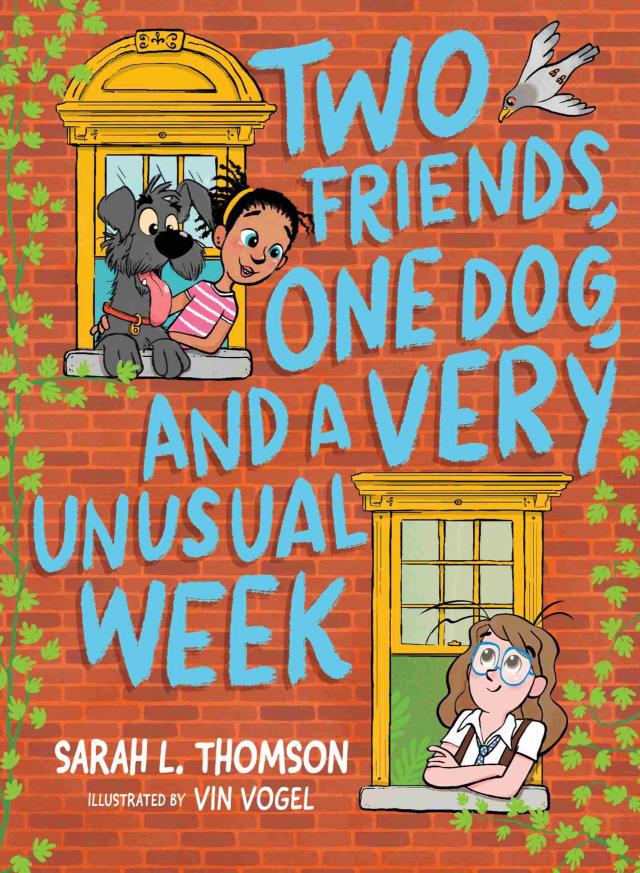
Two Friends, One Dog, and a Very Unusual Week, page 1


Published by
PEACHTREE PUBLISHING COMPANY INC.
1700 Chattahoochee Avenue
Atlanta, Georgia 30318-2112
PeachtreeBooks.com
Text © 2023 by Sarah L. Thomson
Illustrations © 2023 by Vin Vogel
All rights reserved. No part of this publication may be reproduced, stored in a retrieval system, or transmitted in any form or by any means—electronic, mechanical, photocopy, recording, or any other—except for brief quotations in printed reviews, without the prior permission of the publisher.
Book design and composition by Adela Pons, adapted for ebook
Edited by Catherine Frank
ISBN 9781682635162
Ebook ISBN 9781682635179
Cataloging-in-Publication Data is available from the Library of Congress.
a_prh_6.0_143148860_c0_r0
For Longfellow Elementary
—S.L.T.
To Riben, Amy, Jay, Don, and Alex
—V.V.
Contents
Cover
Title Page
Copyright
Dedication
Chapter 1
Chapter 2
Chapter 3
Chapter 4
Chapter 5
Chapter 6
Chapter 7
Chapter 8
Chapter 9
Chapter 10
Chapter 11
Chapter 12
Chapter 13
Chapter 14
Chapter 15
Chapter 16
Chapter 17
Chapter 18
Chapter 19
Chapter 20
Chapter 21
Chapter 22
Chapter 23
Chapter 24
Chapter 25
Chapter 26
Chapter 27
Chapter 28
Chapter 29
Chapter 30
Chapter 31
Chapter 32
Chapter 33
Chapter 34
Chapter 35
Chapter 36
Chapter 37
Chapter 38
Chapter 39
Emily Robbins’s apartment building had three floors.
Except you could also say it had four.
The first floor was where Mr. Armand lived. He was the building manager. He fixed the radiators when they broke, told everyone where to leave their recycling, and talked to the chickens that he kept in the backyard.
On the next floor were the Pinkneys. Mrs. Pinkney liked to leave notes. Notes in the stairwell. Notes on the mailboxes. Notes on the fence by the recycling bins.
PLEASE REPLACE LIDS ON BINS.
PLEASE REMEMBER THAT YOUR FLOOR IS SOMEONE ELSE’S CEILING.
CHICKENS SHOULD NOT ROOST ON RADIATORS. PLEASE.
Emily always wondered when Mrs. Pinkney put these notes up, because she hardly ever saw her around the building—or her two kids, Jonah and Penelope, even though Penelope was in Emily’s class at school.
The only time Emily had gotten a glimpse inside their apartment had been the year she was a Brownie and had knocked on their door to ask if they wanted to buy any Girl Scout cookies.
Mrs. Pinkney was very tall and very thin and very pale. Even her hair was very light blond and lay meekly and smoothly against her head. When she had opened the door, her white dress matched her skin and didn’t have one speck of dust or dirt.
“Oh no,” she said when she heard about the cookies. “We don’t eat sugar here.”
She closed the door quickly.
Emily’s father said that was obviously the reason for all the notes. “Chronic sugar deprivation,” he explained. “It’s made her oversensitive to noise. And other people. And life.”
Emily’s mom told him to hush.
On the third floor were Emily, her mother, and her father.
Emily’s mother had black hair that was almost always in a ponytail. She cooked macaroni and cheese from a box. Her father had brown hair that was always too long because he hated going to get it cut, and he cooked lasagna and curried chicken and potstickers.
Emily’s mother worked on computers in a big building downtown. Her father taught seventh grade. He had promised her that when she got to middle school, she could pretend not to know him.
The top floor of their building, the one above Emily and her family, was empty.
That’s why you could say there were four floors. But the fourth one wasn’t an empty apartment. There was nothing to make the space into somewhere to live—no kitchen or bedrooms, no sinks or bathtubs. Nothing but a big stretch of dusty wooden floor and a roof overhead that was really the roof of the whole building.
Sometimes Mr. Armand went up to make sure that no windows were broken and that there weren’t any holes in the roof. If Emily asked, he’d let her come along.
She liked it up there. While Mr. Armand checked the windows and peered at the roof with a flashlight, Emily would spin in slow circles. She would trace crescents in the dust with the toe of her shoe and imagine the things someone could do up here.
Rollerblade races. Lego creations that could go in the Guinness Book of World Records. Scribbly murals all over the walls. Riding bikes in a giant circle, leaving ghostly tracks in the dust.
Dancing to music. Telling secrets. Laughing so hard and so loud that all your muscles felt weak and your joints got wobbly and you’d have to fall over. Nobody would tell you to quiet down or hang up your coat or do your homework or set the table.
You could do all of those things in a place like this, Emily thought.
If you just had somebody to do them with.
It was a Saturday, and Emily was curled up on the window seat in the living room, waiting for her mother to take her to soccer practice. Through the window, she watched a black van pull up to the curb. Two muscly men in dark T-shirts opened its back doors.
Emily had seen what goes into and out of moving vans before. Mattresses and chairs and tables and lamps and lots and lots of cardboard boxes. Nothing very exciting.
Except this particular van didn’t seem to be holding much of that. All Emily could see inside it was a chair.
An armchair covered in moss-green velvet with a high back and sides that sort of curved around so that anyone who sat there would be in their own little green velvet cave.
Like the person who was sitting in it right now.
The only part of that person Emily could see clearly was a single skinny leg with a foot encased in a high-top sneaker.
The sneaker was covered in silver sequins and tied by a purple ribbon.
The two moving men took hold of the chair and lowered it gently to the sidewalk. They acted as if this were just part of the job to them, as if they unloaded armchairs with people in them every day.
Emily leaned out of the open window, trying to see better.
“Time to go!” her mother said, coming into the living room from the kitchen. “Hop up, shake a tail feather, let’s get going, let’s not be late, come on, Emily, get a move on!”
That was what Emily’s mother always said, even when (like now) Emily had been the one waiting for her.
She followed her mother down two flights of stairs and out onto the sidewalk. There she discovered that the person in the armchair was a girl. She was still there. In the chair. On the sidewalk.
A big red backpack with buckles instead of zippers sat next to the chair. It was so full it was bulging.
Emily slowed down to get a look at the girl.
At first it was hard to tell if the armchair was huge or the girl was tiny. She sat so far back, deep in the chair, that Emily could only get a glimpse of her. She saw black hair that frizzed around the girl’s head and eyes that were turquoise blue.
When those eyes met Emily’s, they lit up as if there were an electric spark inside them. But the rest of the girl did not move.
Not an inch.
Emily did not think that her mom had spotted the girl at all. She was walking to the car and digging her keys out of her purse and telling Emily to catch up and saying hi to Mr. Armand, who had just hurried out of his first-floor apartment.
Mr. Armand waved to Emily’s mom, but Emily could tell that he wasn’t really paying much attention.
He was rushing toward the girl, calling, “You are here, you are here!”
“Of course I’m here,” the girl answered. “I couldn’t be anywhere else and still give you a hug, could I?”
The answer could have sounded really snotty, Emily thought, but it didn’t. The girl bounded out of the chair and hugged Mr. Armand around his soft, squishy middle. She had a gap between her two front teeth that you could have slipped a penny into.
“Emily, hop in the car, it’s very disrespectful to the coach and the other players to be late, goodbye, Mr. Armand, see you soon!” Emily’s mother said.
As Emily climbed into the car, she heard the girl say, “And Otto’s here too!” Then came a really loud whistle.
A giant black dog bounded out of the back of the van. He jumped up to put hi
Emily had decided by then that the chair was huge and the girl was tiny. The dog made her look tinier still.
Mr. Armand danced a waltz with the dog while the moving men shut the doors of the van and the girl talked and waved her hands like the conductor of an orchestra and Emily’s mom drove the car away.
That evening, Emily sat at the kitchen counter with her mother, trying the latest batch of her father’s cinnamon-chip cookies. (Coconut for crispy edges and moist insides.)
As they ate, Emily listened to the noises overhead.
Footsteps. A door opening and closing. Something dragging across the floor.
“Hmm. The coconut makes them a little chewy,” Emily’s mother was saying. “Is someone moving in upstairs? When did they fix up that top floor?”
“I kind of like them chewy,” Emily said. “But I liked the kind with ground-up almonds too.”
“Maybe almonds and coconut?” her father said thoughtfully. “I saw some workmen heading upstairs last week.”
The noises had to have something to do with the girl she had seen in the green chair, Emily thought. The girl with the dog.
“Can I take some cookies to the new people?” she asked her parents. “To say hello?”
A few minutes later, with a paper plate of cookies in her hand, Emily stood on the fourth-floor landing, staring at the door that led into the attic.
She lifted a hand to knock. Then she hesitated.
It was silly to be nervous. She just wanted to see if they had a new neighbor. To say hi. To be friendly.
“To make friends, you have to be friendly,” her mother was always saying.
Emily’s hand had fallen back down by her side. She lifted it up again and tapped lightly on the door.
It flew open at once.
“Hi!” said the girl standing in the doorway. “Salutations! Like Charlotte says. You know Charlotte, right? Charlotte’s Web? Charlotte is an Araneus cavaticus—that’s a barn spider. Did you know that the biggest spider of all is the Goliath birdeater? They don’t actually eat birds that often. They do eat mice, though. It’s a good thing there wasn’t one of those in the barn with Wilbur, or Templeton would have been toast! Their legs can stretch over a foot long. Wouldn’t it be amazing to see one tap dance?”
Emily held the plate of cookies out in front of her, as if it were a dam that could block the flood of words.
“Thanks!” the girl said cheerfully. She took the plate. “Cookies! Cookies are a very good form of salutation. Do you want to come in? I figured you did, because you knocked on the door. But maybe you just came to deliver cookies. Or maybe you like knocking. Do you?”
Emily nodded. She had delivered cookies. Then she shook her head. She did not like knocking. Well, not particularly. She didn’t hate it. But she didn’t go around doing it for fun.
“You can come in and have some cookies,” the girl decided. “And you can knock on the other side of the door if you’d like. That’s Otto. He won’t have any cookies. They don’t agree with him.”
She balanced on one leg and pointed a toe at the big black dog who was standing a bit behind her. Then she backed into the room. Emily got a good look at the dog and stayed in the doorway.
“Oh,” she said. “Does he jump?”
Emily liked to pet dogs on the street and visit with them at other peoples’ houses. But she’d never had one of her own. Her mom was allergic.
And she’d never met a dog as big as Otto. He sat and regarded Emily out of eyes that were only a little glossier than his black coat.
“Certainly he jumps!” declared the girl. “Once when we were in Peru, he jumped over a fence six feet high and into a rushing river to rescue a baby llama. But he doesn’t jump up on people, if that’s what you’re asking.”
And indeed, the dog didn’t. He didn’t actually have to jump to lick Emily’s face—he just stretched his neck a little and slurped with a large pink tongue.
Emily wiped her cheek and glanced around the attic.
It had not changed much since the last time she’d been up there with Mr. Armand. The only thing that had been removed was the dust. Now the floor was shiny and the window glass was so clean it hardly seemed to be there.
At the far end of the room was the green chair. Next to it sat the girl’s bulging red backpack and a heap of something that looked like green-and-yellow yarn.
Nearby, under a window, were two silver dog bowls, one filled with food and one with water.
And that was all.
“We heard the noises and thought maybe somebody was moving in,” Emily said.
“Somebody is!” the girl said enthusiastically.
She stood with the plate of cookies in her hand, feet in their silver sneakers planted on the smooth, shiny floor. Only one of the shoes was laced with a purple ribbon. The other was tied with a piece of grubby string.
One sock was knee-high and striped red and green. The other was black and in a heap around the girl’s ankle. She had on cut-off shorts and a purple T-shirt.
The girl’s black hair zigzagged around her face in corkscrew curls. It almost seemed as if those curls could crackle with electricity. Her skin was golden brown, like tea with honey. Emily glanced briefly at her own hand, as pale as milk. Even in the summer, she never got tan. And her dark brown hair hung smooth and flat to her shoulders, nothing like the other girl’s bouncy ringlets.
But the main thing Emily noticed about this new girl was that she wore a smile so big it shut her eyes into bright turquoise slits.
“I’m Rani,” the girl said. It was a pretty name, one Emily had never heard before. First Rah, and then Nee. “It means queen. Can you help me with a hammer?”
In a flash, Rani was on the other side of the room. She picked up a hammer from the seat of the green chair and put the cookies down in its place. Emily shortly found herself reaching into a side pocket of the backpack to hand Rani a nail at least two inches long.
Rani set the nail in the wall at eye level. Then she swung the hammer. Bam! “So you know my”—bam!—“name now.” Bam! “What’s yours?” Bam! The final blow from the hammer had bent the nail into a hook. Rani skipped to the next wall.
“Emily,” Emily answered. She took a handful of nails from the backpack and followed Rani. “How come your dad’s not doing this?”
“Don’t have one,” Rani answered sunnily. Bam!
“Oh.” Emily felt herself blush. Had it been a dumb question? But Rani did not seem upset or embarrassed. So Emily tried again. “What about”—bam!—“your mom?” Bam! “She doesn’t mind if you”—bam!—“hammer nails in the walls?”
“Certainly not. There!” The second nail was now a hook as well. Rani darted to the heap of yarn on the floor. She hung one end of it over the first nail and the other over the second. The yarn turned out to be a hammock that swung from the hooks in a bright swoop, stretching from wall to wall.
Rani rummaged in her backpack and pulled something out—a picture in the frame. Swiftly she banged another nail into the wall and hung the picture next to the hammock.
It showed a baby sitting in a hammock that looked very much like the one Rani had just strung up. The hammock in the picture dangled from two scrubby trees on the bank of a muddy river. The baby had a mop of black hair and was squinting and smiling in the bright sun.
“Perfect!” Rani leaped into the hammock and stretched out. She crossed her legs at the ankles and wiggled her toes inside their silver shoes. “Pass me those cookies, will you?”
Emily turned toward the chair in time to see the dog removing a single cookie from the plate, using only his front teeth.
“I’m afraid your dog just took one,” she told Rani.
“Oh, he will do that.” Rani shook her head at the dog. He walked a few paces away, sat down with his back to the two girls, and ate the cookie in one gulp.
“He knows perfectly well it will give him indigestion, but does he care? He does not.”
Emily rescued the rest of the cookies and gave them to Rani. She settled the plate on her stomach and leaned back in the hammock, propping the heel of one foot on the toes of the other.