Penny Plain, page 1


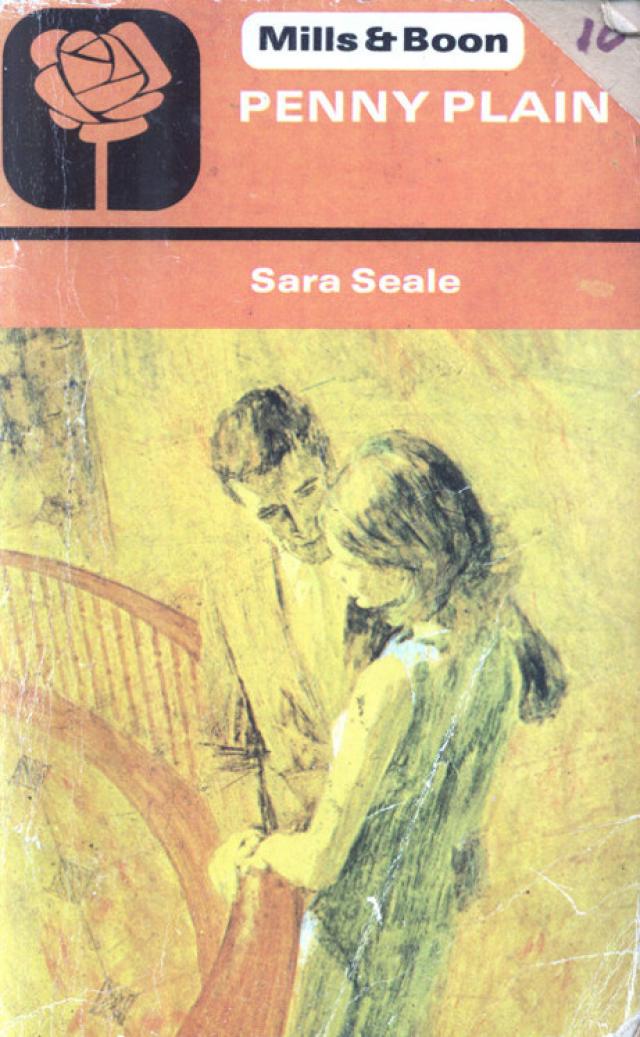
Penny Plain by Sara Seale
Emma Penelope Clay was only twenty, and inexperienced in most things except the care of the pedigree Alsatians in whose world she had been brought up — and it might have seemed like leading a lamb to the slaughter when she went to work at the Kennels of the rich, spoilt Marian Mills. But there was an unexpected streak of firmness in Emma's character, which at least helped her to hold her own with her imperious employer, But the vet, Max Grainger, was a different kettle of fish indeed. Nothing in Emma's limited experience had taught her how to regard his enigmatical attentions — and when Miss Mills sharply ordered her not to get ideas about 'her' property, Emma had not enough self-confidence to disobey. But Max Grainger had not yet had the last word...
Printed in Great Britain
MILLS & BOON LIMITED
All the characters in this book have no existence outside the imagination of the Author, and have no relation whatsoever to anyone bearing the same name or names. They are not even distantly inspired by any individual known or unknown to the Author, and all the incidents are pure invention.
First published 1967
This edition 1974
© Sara Seale 1967
For copyright reasons, this book may not be issued on loan or otherwise except in its original soft cover.
ISBN 0 263 71580
CHAPTER ONE
THE dog was sniffing about in the gutter, snatching at any morsel which might prove edible, and Emma watched it with a fellow-feeling. She, too, was hungry and, since the post she had applied for was already filled, was likely to remain so until she returned to Miss Hollis's sketchy fare in the evening. It was unkind of fate to dangle such bounty under her nose only to make it impossible to come true. It would have been pleasant and somehow right, she thought as she waited for the Chode bus, to return to the half-remembered background of her childhood. Plovers Green, in this empty hour of noon, appeared still unspoilt with its pollarded trees lining pavements of herringboned brick, the green where cricket was played in summer, and church and public house rubbing shoulders as they had for two centuries. Somewhere beyond the village must lie the old farmhouse where Emma had been born, too long ago to remember where, too long ago, she supposed, to claim anything more than a faint nostalgia for scenes described rather than remembered.
Even so, that advertisement for a kennelmaid coming at a moment when she was obliged to change her job had drawn her irresistibly, and although she had not particularly wanted to work with poodles, since the breed she knew and understood were Alsatians, locality had overruled preference. But even as she stood in the July sunshine, regretting her lost opportunity, and watching the scavenging dog, a car roared suddenly round a bend in the road, and the dog, lost its head and made a bolt for the opposite pavement.
Emma reacted instinctively without thought for
senseless folly and flung herself after the panicking mongrel in a futile attempt to snatch it back to safety and, as the car stopped with a screech of brakes, one of the wings caught her on the shoulder, throwing her into the road. She sat in the dust, dazed but undamaged. From where she sat the driver of the car looked immensely tall, not to say threatening; almost black hair and a beaky nose combined to give his face a predatory air, while a pair of light blue eyes expressed such an icy fury that she expected to be picked up and violently shaken any minute.
`What the hell do you imagine you're playing at, leaping under my wheels without any warning?' he demanded furiously. 'Do you have to pick the one moment when the road isn't clear to cross it?'
'I wasn't crossing it. Didn't you see the dog?' she protested indignantly.
'Of course I saw the dog. It's an institution here and was away on the other side before I'd even put a foot on the brake. If you had managed to check the brute you'd probably have succeeded in killing it. Are you hurt?'
The question came as such an afterthought that Emma felt her own temper rising.
'You were driving much too fast and might well have killed me,' she stated firmly.
'I was strictly within the thirty-mile limit, and if I'd killed you you would only have had yourself to thank. You haven't answered my question.'
'What question?'
'Whether or not you're hurt, of course.'
She felt her shoulder gingerly.
'I — I d-don't think so.'
'Then why are you still sitting there?'
His lack of concern backed by that unmerited air of censure seemed the final straw.
`Anyone else would at least have been sufficiently concerned to help me up!' she retorted, trying to keep a sudden quaver out of her voice. She was not seriously hurt, but her shoulder was beginning to throb, and shock and fright combined to make her feel suddenly tearful.
The corners of his uncompromising mouth began to twitch in a smile, and he stooped down to give her a supporting hand and felt her wince as her shoulder took the strain.
`Caught your shoulder, didn't I? Let's have a look,' he said more gently, and the change in his manner caused the unwelcome lump in her throat to grow alarmingly. It would be the final ignominy, she reflected, to burst into tears on a stranger's chest in the middle of the village street. He had, however, no intention of encouraging any female weakness, for, having expertly pressed and prodded, he snapped out briskly:
`You'll have the whale of a bruise, most likely, but there's no bone damage, so pull yourself together and save the tears for another time. Can I give you a lift anywhere, or is your home in the village?'
'I don't live here. I was just k-killing time until my train goes,' she said, and although his astringency had successfully stemmed the threatening tears, there was a forlorn note in her voice which made him look at her more closely.
H'm ... you could do with a drink or something,' he observed. 'I'll take you across to the pub over there.'
`Please don't trouble. I'll get something at the station,' she replied, hoping she sounded distant and assured, but he merely answered that he could do with a drink himself after being put to such an unnecessary strain and ordered her to remain in safety on the pavement while he parked his car, then he crossed the
empty street and firmly marshalled her across.
In the little bar parlour, hung with horse-brasses and sporting prints, he sat her down at a corner table and went to order the drinks without enquiring for her preference, and she watched him leaning on the counter exchanging pleasantries with the landlord who had addressed him by a name she could not catch and clearly knew him well. He came back with a small glass of brandy for her and beer for himself, and settled down opposite her, stretching his long legs under the table.
'Now,' he said, 'drink that slowly, and tell me, as a matter of interest, what you're doing in peaceful Plovers Green, killing time before your train leaves by hurling yourself to destruction after strange dogs.'
He spoke as briskly as ever, but there was a hint of humorous kindliness in his eyes which encouraged her to talk with a freedom which, considering first impressions, surprised her.
'I'd come after a job as kennelmaid, only the place was already filled, so I suppose it was second nature to try to save that dog which probably knows its way about better than I do,' she told him. 'It was especially disappointing to me, you see, because years ago my father had his kennels in these parts and I was born here.'
'Your father was a breeder?'
'Yes, of Alsatians. His kennels were famous at one time and his affix world-renowned. I'm Emma Penelope Clay, though that won't mean anything to you.'
'Oh, but it does,' he contradicted her mildly. 'The Claymore Kennels, wasn't it? So you're Clay's daughter,' he said. 'How do you come to be earning your living as a kennelmaid?'
He spoke, she thought, with the layman's usual
amused tolerance for work that might better be listed as a hobby, and answered gravely:
`It's the only way I know, and I love dogs — Shepherds in particular. Kennelmaiding isn't really just a hobby, you know — we work hard for our money.'
`And are you a good handler, Miss Clay?'
Her sense of ease vanished as she fancied a hint of ridicule in his voice. What should he know about such an art, of the skill required to present a dog with all its virtues displayed and its faults disguised?
`Yes,' she answered simply. 'My father trained me from a child and there was little he didn't know about correct presentation.'
`That was a perfectly serious question,' he said. 'I happen to know of another job going in these parts that might suit you if your claim is justified.'
As she leaned eagerly forward on the settle, her annoyance forgotten, a faint colour stained her sharp cheekbones, momentarily obliterating the negative qualities of pale skin and mouse-brown hair so that he spared a second surprised glance. He had found her at once refreshing and a little absurd, but not until now had he thought her in any way noteworthy except for a rather disturbing pair of eyes which seemed to possess the wondering, unblinking gaze of a very young child.
She was already pouring out a flood of questions, her animosity forgotten, and he answered briefly and succinctly. A young client of his had recently come from the Midlands to live here, he told her, and was building up a kennel of Alsatians, no expense spared since money was no object and only the best were kept. She was, he said, already winning well with her foundation stock and had a breeding schedule worked out, but her head girl had left suddenly and since she herself was still a comparative novice, she needed a kennel-
maid with more experience than the average junior.
/>
'I must warn you that she's the only child of a doting parent, self-made and a stickler for his money's worth, with nothing to do in his retirement but back his daughter's numerous fancies,' he finished, humourously, 'but if you can stomach a rather stinking excess of wealth and an occasional childish tantrum, you should find yourself in clover.'
`Who is she?' Emma asked, puzzled by the note in his voice.
`Her name is Marian Mills, and she's extremely pretty and extremely shrewd when it comes to assessing what she wants. She's also extremely rich.'
'Oh!'
`You know her?'
`No, but I know of her. She's been buying up every champion she can lay hands on.'
'I take it you don't approve,' the stranger said, observing the frown which that juvenile fringe of hers could not quite hide. 'Well, I suppose it's inevitable there should be jealousy when a pretty newcomer walks off with the prizes and most of the glory.'
`It's easy enough to win when you own some of the pick of the breed,' said Emma sharply. 'Even so, there's more to showing and success than a limitless purse.'
`So true, of course. You will doubtless be very good for my poor misguided little friend, should you agree to take her in hand,' he replied, and now she knew he was laughing at her.
`She may not want to employ me,' she demurred a little stiffly, and wondered if he himself might not have an eye on the rich Miss Mills's well-gilded charms.
One eyebrow rose again, a trick he seemed to adopt when refusing to be drawn.
'That you'll have to find out for yourself, if you're sufficiently interested, won't you?' he retorted. 'I should have explained, incidentally, that the latest idea is to employ a kennelmaid-cum-companion, so the choice is somewhat narrowed.'
'Live as family, you mean?'
'Oh, definitely — and share and share alike, so I understand. Miss Mills is nothing if not wholehearted in whatever she undertakes. A cushy job, I would have said, in these hard times.'
'I don't know,' she said slowly. 'Living as family has its drawbacks — I've tried it.'
'What hasn't? But comfort and an equal status has its compensations, I imagine.'
She began to feel angry again.
'Kennelmaids come from all walks of life these days,' she told him somewhat tartly. 'The fact that they can still be regarded as staff doesn't put them on a lower scale.'
'My dear young lady, what a preposterous statement!' he observed. 'I hadn't supposed you to be a snob.'
'Me — a snob?' she exclaimed, stung to the point of rudeness. 'It was you with all this condescending talk of an equal status who were being old-fashioned, not to say downright snooty!'
'How old are you?' he asked suddenly as if he was already making allowance for youthful indiscretion, and when she answered a shade defensively that she was nearly twenty with two years of kennel experience behind her, he merely nodded absently, then glanced at his watch.
'I must be off, I'm already late for my next appointment,' he said briskly, and dug about in the pockets of his jacket for a well-worn notebook from which he tore out a page. 'I'll scribble a few lines of
introduction, and write the address on the back, in case you're interested.'
He was scribbling as he spoke, folded the paper double and printed an address, then anchored it down with his empty mug and got to his feet.
She barely had time to thank him both for the drink and for the offer of a job before he was gone without even troubling to introduce himself. Anyone else, she thought, would surely have evinced some interest as to the outcome of his suggestion, but of course he would hear in time from the charming Miss Mills, so it was hardly surprising that he hadn't asked to be kept informed.
The little she knew of Marian Mills's impact on the dog world had not disposed her towards charity, but it was true, of course, that envy could flourish there as well as in any other walk of life. 'Who knows?' Emma told herself brightly, 'this may be the prelude to a beautiful friendship, and who am I to despise crumbs from the rich man's table?'
But she did not feel quite so flippant when the bus dropped her off at a pair of ornately scrolled gates an hour later. Armina Court was as pretentious as its fancy-sounding name and put you in your place at once, she thought as she walked down the long, impressive drive with its meticulously tended verges and no blade of grass or straying weed or pebble to mar its smooth perfection.
The drive terminated in an arrogant sweep round spacious lawns and shrubberies to a heavily-porticoed front door, but the house restored her nerve, for it was frankly hideous, with turrets and gables sprouting from every conceivable angle, bright red brick unmellowed by time, and its design a rich confusion of architectural blunders. It was exactly the sort of house
that a man of acquired wealth would buy in his retirement, and pay through the nose for, she thought a little scornfully, then immediately felt abashed remembering her late host's chastening remarks about snobs. As she hesitated on the front steps, she became aware of an elderly man sitting in the sun on the terrace watching her from under the brim of an ancient hat tipped over his nose.
'There's no one home,' he observed when he realized she had seen him.
'Oh,' said Emma, taking an uncertain step towards him. He looked very comfortable with his shirt unbuttoned and his braces dangling, and she wondered if he was a guest annoyed at being disturbed when he had the place to himself.
'Could you tell me when they're likely to be back?' she asked politely. 'I'm only here for the day, you see.'
'Too bad,' he grunted. 'Didn't my daughter know you were coming?'
'Your daughter? Are you Mr. Mills, then?'
'Who did you think I was, any road? Marian been spinning you the yarn that I'm the old family retainer?'
'Of course not. I — I don't know your daughter.'
'You don't? Then what are you doing here? If you're selling something you're wasting your time.'
Emma suddenly wanted to giggle, for the whole conversation seemed so unlikely, but she made a great effort to speak with firmness and assurance and said very clearly:
'I'm not selling anything in that sense, only myself, or rather my services.'
That did seem to rouse him, for he pushed his hat to the back of his head, exclaiming:
'God bless my soul, girl, Who the hell are you and
what new trick are you trying to pull on me?'
`Really, Mr. Mills, you're making it very difficult for me,' Emma replied, and could not quite keep the laughter out of her voice. 'I'm not trying to put a fast one over, I've simply come after the job.'
'Oh, you're one of these doggy folk — that explains it,' he said, sounding relieved.
'Is the post filled?' she asked, suddenly aware that despite earlier misgivings she would be very upset by a second disappointment.
'Not that I've heard, but then my daughter likely wouldn't bother to tell me if she's fixed up. Come over here and let's have a look at you,' Mr. Mills replied, and Emma stepped carefully over a well-dragooned flower bed and on to a terrace dotted with monstrous urns.
On loser inspection Mr. Mills appeared to be a stocky little man running to fat with a pugnacious jaw and surprisingly mild blue eyes. He looked as though he had omitted to shave that morning and his clothes had been selected for age and comfort rather than elegance.
`Come and sit down beside me and let's have a chat. You'll excuse me not getting up, but if I do my trousers may fall off,' he said, and this time she laughed unrestrainedly, suddenly liking him very much.
`Don't worry about the politenesses, Mr. Mills. I know that feeling of release when one's waistband has grown too tight,' she said, sitting down contentedly in the vacant garden chair.
'Do you?' he said, eyeing her slender waist with some doubt. 'Any road, I can see you're the right sort — not like some of those other young misses we've had here, either giving themselves airs or out for what they could get with as little work as they could
put in. My girl isn't all that clever at picking, I reckon. How come you've taken up this sort of fancy trade, Miss – Miss—?'