Hero of the Imperium, page 1


More tales of the Astra Militarum from Black Library
• CIAPHAS CAIN •
by Sandy Mitchell
CIAPHAS CAIN: HERO OF THE IMPERIUM
(Contains books 1-3 in the series: For the Emperor,
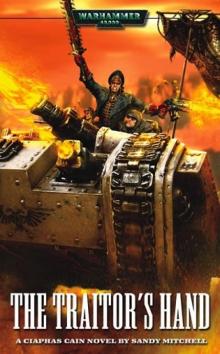
Caves of Ice and The Traitor’s Hand)
CIAPHAS CAIN: DEFENDER OF THE IMPERIUM
(Contains books 4-6 in the series: Death or Glory,
Duty Calls and Cain’s Last Stand)
CIAPHAS CAIN: SAVIOUR OF THE IMPERIUM
(Contains books 7-9 in the series: The Emperor’s Finest,
The Last Ditch and The Greater Good)
THE MACHARIAN CRUSADE OMNIBUS
by William King
(Contains the novels Angel of Fire, Fist of Demetrius and Fall of Macharius)
HONOUR IMPERIALIS
by Aaron Dembski-Bowden, Rob Sanders and Steve Lyons
(Contains the novels Cadian Blood, Redemption Corps and Dead Men Walking)
YARRICK: THE OMNIBUS
by David Annandale
(Contains the novels Imperial Creed, Pyres of Armageddon and the novella Chains of Golgotha)
SHADOWSWORD
An Astra Militarum novel by Guy Haley
STRAKEN
An ‘Iron Hand’ Straken novel by Toby Frost
ASTRA MILITARUM
A Legends of the Dark Millennium anthology by various authors
Visit blacklibrary.com for the full range of novels, novellas, audio dramas and Quick Reads, along with many other exclusive products
Contents
Cover
Backlist
Title Page
Warhammer 40,000
Introduction
FIGHT OR FLIGHT
FOR THE EMPEROR
One
Two
Three
Four
Five
Six
Seven
Eight
Nine
Ten
Eleven
Twelve
Thirteen
Fourteen
Fifteen
Sixteen
Epilogue
Footnotes
ECHOES OF THE TOMB
CAVES OF ICE
One
Two
Three
Four
Five
Six
Seven
Eight
Nine
Ten
Eleven
Twelve
Thirteen
Fourteen
Fifteen
Sixteen
Footnotes
THE BEGUILING
THE TRAITOR’S HAND
One
Two
Three
Four
Five
Six
Seven
Eight
Nine
Ten
Eleven
Twelve
Thirteen
Fourteen
Fifteen
Sixteen
Seventeen
Eighteen
Nineteen
Twenty
Twenty-One
Footnotes
About the Author
An Extract from ‘Straken’
A Black Library Publication
eBook license
It is the 41st millennium. For more than a hundred centuries the Emperor has sat immobile on the Golden Throne of Earth. He is the Master of Mankind by the will of the gods, and master of a million worlds by the might of His inexhaustible armies. He is a rotting carcass writhing invisibly with power from the Dark Age of Technology. He is the Carrion Lord of the Imperium for whom a thousand souls are sacrificed every day, so that He may never truly die.
Yet even in His deathless state, the Emperor continues His eternal vigilance. Mighty battlefleets cross the daemon-infested miasma of the warp, the only route between distant stars, their way lit by the Astronomican, the psychic manifestation of the Emperor’s will. Vast armies give battle in His name on uncounted worlds. Greatest amongst His soldiers are the Adeptus Astartes, the Space Marines, bio-engineered super-warriors. Their comrades in arms are legion: the Astra Militarum and countless planetary defence forces, the ever-vigilant Inquisition and the tech-priests of the Adeptus Mechanicus to name only a few. But for all their multitudes, they are barely enough to hold off the ever-present threat from aliens, heretics, mutants – and worse.
To be a man in such times is to be one amongst untold billions. It is to live in the cruellest and most bloody regime imaginable. These are the tales of those times. Forget the power of technology and science, for so much has been forgotten, never to be re-learned. Forget the promise of progress and understanding, for in the grim dark future there is only war. There is no peace amongst the stars, only an eternity of carnage and slaughter, and the laughter of thirsting gods.
INTRODUCTION
You quite frequently come across the phrase ‘this book changed my life,’ usually on the cover of some dubious American self-help manual with a title like I Was A Pathetic Loser Like You Until I Got Rich Preying On People’s Insecurities. I have to admit, though, that the experience of writing For the Emperor, the first Ciaphas Cain novel, had a pretty big impact on mine. I learned an enormous amount about the craft of authorship in the process, and have continued to do so as the series goes on; it’s no exaggeration to say that without Cain I wouldn’t be the writer I am today. (Whether or not that’s a good thing I leave to your judgement.) Certainly, an awful lot of people seem to enjoy his adventures, something which continues to astonish me, as, like so many authors, I write purely to amuse myself. The fact that so many readers also find these tales entertaining, and the amount of enthusiasm for them they express at signing sessions, still surprises and delights me.
Ironically, when I wrote the first short story featuring Cain, I assumed that the idea of a self-obsessed commissar was a one-joke concept, and having told it I’d be turning my attention elsewhere. But Cain had other ideas, hanging around in the back of my head, and refusing to go away. Luckily, it seemed, he’d struck a chord with the readers too; almost as soon as his first adventure, Fight or Flight, had appeared in the pages of Inferno! I was asked if I’d like to follow it up with a sequel, and no sooner had I written that than I was asked if I’d like to feature him in a novel for the Black Library.
The answer to that, of course, was ‘Yes!’ Since then, the redoubtable commissar has gone from strength to strength, with the fifth volume of his adventures appearing at the same time as this collected edition of the first three (plus some odd bits). Which is not to say that I’m getting in the least bit tired of the series; on the contrary, I already have another one planned (possibly even underway by the time you read this), and hope to continue chronicling his activities for years to come. Or at least until my long-suffering editors’ patience finally gives out.
One of the questions I’m often asked is how I manage to get away with being humorous in a universe as relentlessly grim as the one of the 41st millennium. Part of the answer is that it’s a natural human trait to take refuge from horror in humour, and Cain’s dry and ironic narrative voice seems to me to be a perfectly reasonable one in which to be recounting his memoirs. One of the pleasures of writing stories set in the Warhammer 40,000 universe is that it’s so rich and textured that it can be used to tell pretty much any kind of tale. In fact it’s only because the background is so solidly developed that the books succeed at all; I doubt that Cain would have worked half so well as a character in any other environment. Occasionally, I must admit, I get carried away and cross the line into out-and-out comedy, but when this happens I’m lucky enough to have supportive and vigilant editors (hi Lindsey, hi Nick!) looking over my shoulder and pointing out tactfully that this is, perhaps, a joke too far. Another member of the team who deserves a public pat on the back is Clint Langley, whose wonderful covers do so much to enliven these books; his illustrations capture Cain’s sardonic personality perfectly, and his rendition of Jurgen instantly became the image I see in my mind whenever he wanders into the story.
The other thing the Cain novels have which, much to the relief of the typesetters, none of the other Black Library titles do, is the notorious footnotes. Almost as soon as I began the first novel I realised that the narrative needed opening out in order to take in a much bigger picture than Cain would be able to experience personally: something of a problem with a hero who tells his story entirely in the first person! The solution was to add an editorial voice, which would interpolate additional material and explanatory footnotes; a voice, moreover, which would be waspish, self-confident and opinionated, in contrast to Cain’s frequently-expressed insecurities. To my relief the perfect candidate appeared in the story almost at once, and has continued to do sterling work throughout the series.
One of the many pleasures I’ve found working on the Cain stories has been the plethora of supporting characters who wandered onto the page for a paragraph or two and stuck around, becoming more rounded and developed as the series progressed. Following their growth from book to book has been fascinating for me, and, I hope, enjoyable for you. Especially the inestimable Jurgen, who, despite his lack of personal hygiene and social skills, has a pretty good claim to being the real hero of these adventures, if anyone ever noticed him.
Which brings me to the other question I’m most frequently asked about Cain – other than how you pronounce his Christian name (for the record, it’s kai-a-fass, which, like his surname, is a rather self-indulgent biblical joke). Is he really the cowardly scoundrel he paints himself to be, or far more courageous than he gives himself credit for? To be perfectly honest, I don’t really know, although I suspect a little of both; but that’s one of the real joys of a writer’s life. I may have invented him in the first place, inspired to some extent by Harry Flashman and Edmund Blackadder, but by now he’s become enough of a personality in his own right to keep surprising me, and long may he continue to do so.
I hope you enjoy his adventures as much as I have.
Sandy Mitchell
January 2007
FIGHT OR FLIGHT
‘Like any newly-commissioned young commissar I faced my first assignment with an eagerness mixed with trepidation. I was, after all, the visible embodiment of the will of the Emperor Himself; and I could scarce suppress the tiny voice which bade me wonder if, when tested, I would truly prove worthy of the trust bestowed upon me. When the test came at last, in the blood and glory of the battlefield, I had my answer; and my life changed forever.’
— Ciaphas Cain, ‘To Serve the Emperor: A Commissar’s Life,’ 104. M42
If there’s a single piece of truth among all the pious humbug and retrospective arse-covering that passes for my autobiography, it’s the last four words of that paragraph. When I look back over the past hundred years of cowardice, truth-bending, bowel-loosening terror, and sheer dumb luck that somehow propelled me to the dizzy heights of Hero of the Imperium, I can truthfully point to that grubby little skirmish on a forgotten mining world as the incident which made me what I am.
I’d been a fully-fledged commissar for almost eight weeks when I arrived on Desolatia IV, seven of them spent travelling in the warp, and I could tell right away that my new unit wasn’t happy to receive me. There was a single Salamander waiting at the edge of the landing field as I stepped off the shuttle, its sand-scoured desert camo bearing the markings of the Valhallan 12th Field Artillery. But there was no sign of the senior officers that protocol demanded should meet a newly-arrived commissar. Just a single, bored-looking trooper, stripped down to the bare minimum of what might pass for a uniform, making the best of what little shade the parked vehicle offered. He glanced up from his slate of ‘artistic engravings’ as I appeared, and shambled in my general direction, his boots kicking up little puffs of the baking yellow dust.
‘Carry your bag, sir?’ He didn’t even attempt a salute.
‘That’s fine,’ I said hastily. ‘It’s not heavy.’ His body odour preceded him like a personal force bubble. The briefing slate I’d glanced at before making the joyous discovery that the transport ship was stuffed with crewmen still under the fond illusion that games of chance had something to do with luck had mentioned that the Valhallans were from an ice world, so it was no surprise to me that the baking heat of Desolatia was making him sweat heavily, but I’d hardly expected to be met by a walking bioweapon.
I overrode the gag reflex and adopted an expression of amiable good humour that had got me out of trouble innumerable times during my years at the schola, as well as into it as often as I could contrive.
‘Commissar Cain,’ I said. ‘And you are...?’
‘Gunner Jurgen. Colonel sends his apologies, but he’s busy.’
‘No doubt,’ I said. The ground crew were starting to unload the cargo, anonymous crates and pieces of mining machinery larger than I was floated past on lift pallets. The mines were the reason we were here; to ensure the un-interrupted supply of something or other to the forgeworlds of the Imperium despite the presence of an ork raiding party, which had been unpleasantly surprised to find an Imperial Guard troopship in orbit waiting for a minor warpstorm to subside when they arrived. Precisely what we were defending from our rapidly dwindling foes would be somewhere in the briefing slate, I supposed.
The mine habs loomed above us, clinging like lichen to the sides of the mountain their inhabitants had all but hollowed out. To a hive boy such as myself they looked comfortably nostalgic, albeit a little on the cramped side. The total population of the colony was just a few hundred thousand, including elders and kids; just a village really by Imperial standards.
I followed Jurgen back to the Salamander, weaving through the thickening scrum of workers; he walked straight towards it, unimpeded, the miasma from his unwashed socks clearing a path as effectively as a chainsword. As I swung my kitbag aboard I found myself wondering if coming here had been a mistake after all.
The journey was uneventful; nothing so assertive as a landmark interrupted the monotony of the desert road once the mountains had diminished behind us to a low smudge against the horizon. The only thing even approaching scenery was the occasional burned-out hulk of an ork battlewagon.
‘You must be looking forward to getting out of here,’ I remarked, enjoying the sensation of the wind through my hair and revelling in the fact that perched up behind the gunner’s shield, I was mercifully insulated from Jurgen’s odour. He shrugged.
‘As the Emperor wills.’ He said that a lot. I was beginning to realise that where his intellect should have been was a literally-minded adherence to Imperial doctrine which would have had my old tutors at the schola dancing with glee. If they’d ever deigned to do anything so undignified, of course.
Gradually the outline of the artillery park began to resolve itself through the heat haze. It had been sited in the lee of a low bluff, which rose out of the parching sand like an island in a sea of grit; the Valhallans having adapted their instinctive appreciation of blizzard conditions to the sandstorms prevailing here without too much difficulty. Bulldozed berms extended out from the rockface, extending the defensive perimeter into a rough semi-circle blistered with sandbagged emplacements and subsidiary earthworks.
The first thing I made out with any clarity were the Earthshakers; even at this distance they were impressive, dwarfing the inflatable habdomes that clustered around the compound like camouflaged mushrooms. As we got closer I made out batteries of Hydras too, carefully emplaced along the perimeter to maximise cover against air attack.
Despite myself, I was favourably impressed; Colonel Mostrue obviously knew his business, and wasn’t about to let the lack of a visible enemy lull him into a false sense of security. I began to look forward to meeting him.
‘So you’re the new commissar?’ He glanced up from his desk, looking at me like something he’d found on the sole of his boot. I nodded, picking an expression of polite neutrality. I’d met his sort before, and my preferred option of breezy charm wouldn’t cut it with him. Imperial Guard commanders tended to distrust the political officers assigned to them, often with good reason. Most of the time, about all you could hope for was to develop a tolerable working relationship and try not to tread on one another’s toes too much. That worked for me; even back then I realised commissars who threw their weight around tended to end up dying heroically for the Emperor, even if the enemy was a suspiciously long way away at the time.
‘Ciaphas Cain.’ I introduced myself with a formal nod of the head, and tried not to shiver. The air in the habdome was freezing, despite the furnace heat outside, and I found myself unexpectedly grateful for the greatcoat that went with my uniform. I should have anticipated Valhallan tastes would run to air conditioning which left your breath vapourising when you spoke. Mostrue was still in his shirtsleeves while I was trying my best not to shiver.
‘I know who you are, commissar.’ His voice was dry. ‘What I want to know is what you’re doing here?’
‘I go where I’m sent, colonel.’ Which was true enough, so far as it went. What I didn’t mention was that I’d gone to considerable trouble finding an Administratum functionary with a weakness for cards and an inability to spot a stacked deck that almost amounted to a gift from the Emperor; who, after a few pleasant social evenings, had left me in a position to pick practically any unit in the entire Guard to attach myself to.
‘We’ve never had a commissar assigned to us before.’
I tried on an expression of bemused puzzlement.