All or Nothing, page 13


True Pretenses
Never steal a heart unless you can afford to lose your own.
Through sheer force of will, Ash Cohen raised himself and his younger brother from the London slums to become the best of confidence men. He’s heartbroken to learn Rafe wants out of the life, but determined to grant his brother his wish.
It seems simple: find a lonely, wealthy woman. If he can get her to fall in love with Rafe, his brother will be set. There’s just one problem—Ash can’t take his eyes off her.
Heiress Lydia Reeve is immediately drawn to the kind, unassuming stranger who asks to tour her family’s portrait gallery. And if she married, she could use the money from her dowry for her philanthropic schemes. The attraction seems mutual and oh so serendipitous—until she realizes Ash is determined to matchmake for his younger brother.
When Lydia’s passionate kiss puts Rafe’s future at risk, Ash is forced to reveal a terrible family secret. Rafe disappears, and Lydia asks Ash to marry her instead. Leaving Ash to wonder—did he choose the perfect woman for his brother, or for himself?
Warning: Contains secrets and pies.
Excerpt: True Pretenses
Chapter One
Below them in the darkness, a clock chimed half past two. “Just once, I’d like to leave somewhere in daylight,” Rafe grumbled under his breath as they crept down the stairs. “Wearing my boots. I’d like to take my trunk with me too.”
“Shh.” Their trunk and its contents were worth twenty pounds. If Ash Cohen could have brought them away safely, he would have, but they meant exactly that to him—twenty pounds. The only thing he had that he couldn’t leave behind was two feet in front of him, sulking.
His brother knew perfectly well that they left places in daylight with their trunks all the time. Only certain jobs—like this one—required sneaking off in the dead of night. But Rafe was always at his worst just after a successful swindle.
Ash supposed it was natural to feel empty and frustrated when an enterprise you’d spent weeks or months on was abruptly over. Ash himself would feel giddy, if his brother didn’t insist on ruining his mood. Now instead of fizzing like a celebratory mug of ale, his chest cavity filled with—butterflies was too pretty a name for them. Moths, maybe, dirty-looking gray-and-white ones, swarming about and clinging to his innards.
At least Rafe didn’t let pique spoil his concentration. He stepped unerringly around the squeaking, creaking places they’d scouted in the staircase, eased open the door on hinges they’d oiled, and shoved his feet silently into his boots. Ash did the same and followed his brother out into the night.
Rafe had never been able to hold a grudge for longer than ten miles, if Ash resisted the urge to cozen him. Today, it was nine and a half (calculated with their average speed of walking and Ash’s watch) before he gave Ash a sidelong, apologetic smile and said, “I could eat a whole side of beef right now.”
Ash relaxed. He wished he could be less sensitive to Rafe’s moods, but it had been this way for twenty-five years now and showed no signs of changing. When baby Rafe had smiled and waved chubby little arms in his direction, nine-year-old Ash had felt special, important, as if he could vanquish lions. Before Rafe, he’d been nothing, one of an army of little street thieves. Ash smiled back and gave his brother a shove. “I’ve no doubt you could. Giant.”
Rafe laid a large hand atop Ash’s head. “Midget.” Actually, Ash was of average height, and greater than average breadth. But Rafe towered over him, and that was Ash’s greatest pride and accomplishment: one look, and you knew he’d always had enough to eat.
And people did look. Heads turned when Rafe walked into a room, huge and golden. Dark, sturdy Ash looked like an ox or a draft horse, his brute strength meant to carry others’ burdens. Rafe was a thoroughbred. Maybe if Ash hadn’t shared so many dinners with his little brother, he’d be a giant himself, but he had no regrets.
Another five miles and they were in complete charity with one another, and probably safe enough from pursuit to buy something to eat at a crowded inn. Rafe, more memorable, waited outside with his hat low over his face while Ash bought pasties and ale to be consumed a little way down the road.
Once the food was gone, however, Rafe’s good spirits went with it. When he began worrying a worn handkerchief between his hands, Ash knew something was very wrong.
The scrap of fabric was all Ash had managed to keep when his mother died. Since he couldn’t split his memories with his brother, Ash had given him the handkerchief as soon as Rafe was old enough to safeguard it from boys wanting to steal and sell it. He carried it always but almost never took it out.
“I’m sick of swindling,” he said at last, with a heavy finality that Ash didn’t like.
“You say that after every job. You’ll be right as rain when we’ve found another flat. We always get on best when we’re working.”
“I’m sick of flats. I’m sick of a profession that hurts people. I want to be able to point to something I’ve done at the end of the day, something good.”
Ash patted his pocket. “Two hundred pounds is a damn good thing, if you ask me.”
Rafe frowned. “Other men give something back for money. They leave something behind them. We only take. I liked Mrs. Noakes.”
“I liked her too,” Ash said, stung. He liked everybody. That was why he was so good at his job. You couldn’t swindle a person you couldn’t get on with. “And she can afford to lose two hundred pounds.”
Rafe turned his head away. “It isn’t the money. Think of how she’ll feel.”
“Think of how we’d feel if we starved,” Ash snapped. “We have to take care of ourselves—”
“—because no one will do it for us, I know.” Rafe rarely raised his voice when he was angry. Most of the time, when he was trying to express an emotion other than happiness, he slowed down. It only meant he was struggling to find words, but in his deep voice, it gave every word a weight and echo, like a church bell tolling. Ash hated it. “I just want to make someone happy for a change.”
You make me happy. The words stuck in Ash’s throat. They really meant, Don’t I count? They were weak and childish, and he knew the answer was no, anyway. He had brought Rafe up to take him for granted, to believe him strong and capable and impervious to the world’s blows. He had wanted his brother to feel safe, as he himself never had. Fear, anxiety, illness, sadness—he’d protected Rafe with fierce care from them all. It seemed bitterly unfair that this was his reward.
“I don’t enjoy the work anymore,” Rafe said. “I’m sorry. I’ve tried and tried, but I find myself wishing the lies were true. That we were really shipwrecked Americans, or speculators who’d found copper on Mrs. Noakes’s land, or anything other than thieves.”
“You can’t get—”
“—too fond of your own lies, I know. But haven’t you ever, Ash?”
The dirty little moths settled back into his stomach and chest and clung. He had exactly one secret he’d never told Rafe. Sometimes he forgot about it for days on end, and when he remembered, it was worse than stepping out of a warm shop into a snowstorm.
“Once.” The word scraped his throat like a dull razor.
Rafe waited, but didn’t press him. Ash wished he would. He wished Rafe would make him tell, because by now it was obvious he’d never find the courage otherwise. “Then you know what it’s like,” Rafe said finally. “I want to leave.”
Everything stopped. The birds singing in the bare branches, the sun rising in the sky, Ash’s heart beating in his chest—they all went silent and still. “Leave?”
Rafe held his gaze, earnest and sorrowful. It was the look he gave flats when he told them their money was gone, there’d been a ship lost at sea, a horse gone lame in the first lap, a bank failure. That was what made Rafe such a brilliant swindler: he had an honest face. Ash wanted to put his fist in it. “You can keep most of the money,” Rafe offered. “I’ve thought about it. I could join the army—”
The money? Rafe thought he cared about the money? “You’ll join the army? Even you can’t be that stupid. Starve and fight and die for what? For England? What did England ever do for you? Men slice into their own legs with an ax to get out of the army!”
“Or I’ll go to Canada. I’ve got to leave, Ash.” He said it so slow and heavy it was like a judge pronouncing sentence. “I’ve done everything with you. Always. I don’t know how to stop, without stopping. I won’t be able to stick to it if you’re there to talk me round. We both know it.”
Resentment seared Ash’s throat, sticky and hot as pitch. That was gammon. Rafe was the easygoingest man in the world right up until he dug in his heels, and then there was no moving him.
Rafe was going to leave, and Ash would be alone.
Instinctively, he bought himself time. “Well, if that’s how you feel, I won’t try to change your mind.”
“Thank you for understanding. I didn’t think you’d—you’re the best of brothers.” Rafe put an arm around his shoulder, his face glowing with…relief, Ash thought. Relief that Ash hadn’t made an unpleasant scene. In spite of himself, Ash’s stupid heart eased a little, that he’d made Rafe happy. “Thank you for everything. I’ll—I’ll miss you. I’ll write you horribly misspelled letters, if you can think of a safe place to send them.”
Mrs. Noakes had been a nice woman. Ash had liked her. But she’d grown up with a family, a home and plenty of food and clothes. She’d always have those things, two hundred pounds or no.
The world had given him and Rafe nothing, and they’d proved they didn’t need it. Ash looked around at the muddy little clump of trees they stood in. The morning was cold and their breath misted in the air, but they were alive and well, with food in their bellies, good coats on their backs and good boots on their feet. The two of them against the world, and Ash would put his money on them every time. This little slice of England was all he’d ever wanted.
All Rafe wanted was to be somewhere else. Anywhere else. Now that Rafe had said it aloud, had given it shape, it made sense in a way Ash’s idyllic picture of Two Wandering Jews never had. Rafe’s depression between jobs was real, and his cheerfulness during a swindle was a brief intoxication. Ash had seen it too many times—dull-eyed, hopeless men who only found a spark of life when they could forget everything but the roll of the dice, the turn of the card, the pounding of the horses’ hooves. He should have recognized it in his brother.
When Rafe had been hungry, Ash had found him food. When Rafe had been cold, Ash had got him clothes. When Rafe had been sick, Ash had brought him a doctor. He’d begged, borrowed, bargained, whored and stolen to do it—stolen every way he knew, and then made up a few new ones. He’d made it look easy, so Rafe would never feel how close they were to starving, freezing, dying of fever in a gutter somewhere and being dumped in paupers’ graves.
Who would he even be, without Rafe? What right did Ash have to expect more than he’d already got?
What good did it do to be so angry, when he couldn’t make Rafe want to stay anyway? It was twenty-five years too late for any sleight of hand. Rafe knew exactly what life with Ash was like, and he’d decided he didn’t want it.
If Rafe wanted a new life, a respectable life, Ash would find a way to steal that for him too—one with no cannonballs or long sea journeys in it, either. And then, to keep himself from changing his mind, he’d do something he’d never done before. He’d give back something he’d stolen.
He’d tell Rafe everything.
Read the rest of Chapter One and buy the book at
roselerner.com/bookshelf/truepretenses
This novella was originally published in the anthology
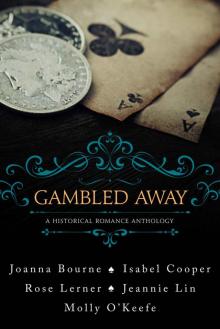
Gambled Away
Get revenge. Pay a debt. Save a soul. Lose your heart.
Spanning centuries and continents, five brand-new novellas from beloved historical romance authors tell the stories of men and women who find themselves wagered in a game of chance and are forced to play for the highest stakes of all: love.
“Gideon and the Den of Thieves” by Joanna Bourne
London, 1793 – Soldier of fortune Gideon Gage has come home from halfway around the world, fully prepared to face down a ruthless gang to save his sister. But there’s one member of the gang he could never have been prepared for: fascinating Aimée, driven from her own home by the French Revolution and desperately in need of his help.
“Raising The Stakes” by Isabel Cooper
California, 1938 — When the flute she won in last night’s poker game unexpectedly summons an elven warrior bound to her service, two-bit con artist Sam takes quick advantage. With Talathan’s fairy powers at her command, her shakedown of a crooked preacher is a sure thing…but would she rather take a gamble on love?
“All or Nothing” by Rose Lerner
England, 1819 – Architect Simon Radcliffe-Gould needs someone to pose as his mistress so he can actually get some work done at a scandalous house party. Irrepressible gambling den hostess Maggie da Silva would rather be his mistress, but she’ll take what she can get…
“The Liar’s Dice” by Jeannie Lin
Tang Dynasty China, 849 A.D. — Lady Bai’s first taste of freedom brings her face to face with murder. A dangerous and enigmatic stranger becomes her closest ally as she investigates the crime, but can she trust her heart or her instincts when everyone is playing a game of liar’s dice?
“Redeemed” by Molly O’Keefe
Denver, 1868 — After agonizing years in the Civil War’s surgical tents, Union doctor James Madison has nothing left to lose. But when beautiful, tortured Helen Winters is the prize in a high-stakes game of poker, he goes all in to save her—and maybe his own soul.
Visit the other authors’ websites to learn more about their stories.
Rose Lerner, All or Nothing