Sergeant Smack, page 14
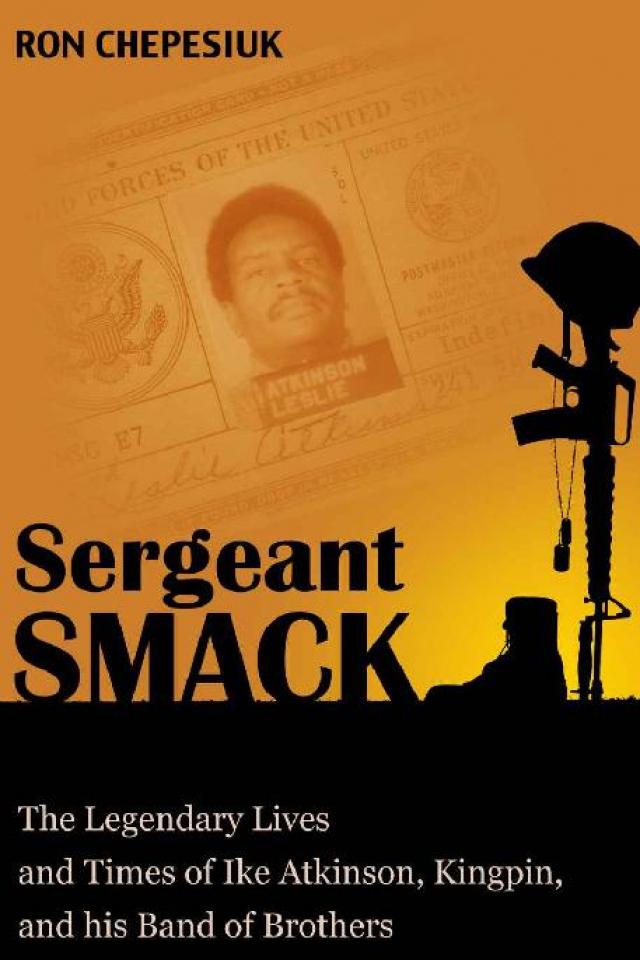


Herman Lee Gaillard AKA Peter Rabbit—A close associate of Ike Atkinson.
CHAPTER SEVEN
The Denver Connection
IKE STILL HAD to spend about eight months in jail at the United State penitentiary in Atlanta for the tax charge. Upon release, he did not miss a beat of his life on the edge. After making sure everything was okay at home in Goldsboro, Ike took a military hop to Bangkok to get his drug trafficking operation back on track. “Prison life was not as bad as I thought it would be,” Ike recalled. “I adjusted well, made friends and bided my time. Once I got out, I had no intention of joining the straight life. I continued to do the same thing.”
Life on the edge, though, would not be the same. Thanks to Ike’s problems in New York City, law enforcement agencies had now exposed his drug ring, and it would be much more challenging for him and his partner Herman “Jack” Jackson to continue their drug smuggling operation without the constant threat of arrest. Still, Ike did not feel that he had to change his modus operandi, since he saw no evidence that the authorities were keeping a close eye on him. When in Bangkok and moving around the city, Ike did take precautions to ensure he was not being tailed. Periodically, he would drive along and then suddenly pull off to the side of the road to see what cars went by and what cars may have stopped behind him. Ike cannot recall one instance where he knew for sure he was being followed. Nor did he ever feel for certain that his residences in Bangkok or Goldsboro were under police surveillance in those years, although he was not completely sure that the authorities were not spying on him. On one occasion in Bangkok, Ike saw a Thai man and a White man sitting in a car outside his home, looking kind of suspicious. But as Ike perceived the situation: You cannot get ahead in life if you begin to see danger in every suspicious looking car.
Jack was now well known to U.S. and Thai law enforcement and even U.S. legislators, who publicly decried the surging tide of heroin pouring into the U.S. from Thailand. One 1971 study prepared by the U.S. Foreign Relations Committee put a law enforcement bull’s eye on Jack’s back, identifying him by name, summarizing his alleged role in the Thai drug trade and concluding that “BNDD agents in Bangkok are of the opinion that Jackson is probably paying a Thai legislator in Bangkok.”
In May 1971, Jack Anderson, the noted investigative journalist and nationwide columnist, wrote an article about how Jackson was busy importing drugs from Thailand into the United States while out on bond for the 1969 New York drug case that evolved into a corruption case involving Dennis Hart and Richard Patch. Following up on Anderson’s report, a broadcast-media news team from the U.S. trekked to Bangkok to interview Jack about Anderson’s claim. Unruffled by the attention, Jack sounded like a diplomat deflecting a tough question, denying he had ever been in the narcotics trafficking business. Actually, Jack had to make this disclaimer because he was re-stating what he had said to defense lawyer F. Lee Bailey under oath in the Hart and Patch corruption trial, which was still ongoing.
A good question for the broadcast news team to ask Jack would have been: ”Are you an informant as well as a drug trafficker, Mr. Jackson?” On the stand under oath at the Hart-Patch trial, Jack denied being a snitch when the aggressive Bailey pointedly put that question to him.
Jack: (I’m) not a stool pigeon. I said I would tell the government my part of this thing, to cooperate with the government.
Bailey: Weren’t you going to turn in some people in the same business you were in, in exchange for something?
Jack: No, sir.
Bailey: Oh?
Jackson: No, sir.
Bailey: Did you give the government any information along the way?
Jack: I gave them some information about different things.
Bailey: You gave them names, didn‘t you?
Jack: A couple of names they already had.
Bailey: Of people you had already done business with?
Jack: No.
Bailey: Names of people in the heroin racket? Is that who the names were? How many names?
Jack: A couple.
Bailey: In connection with what offences?
Jack: With a—they asked me did I know these two particular men. I told them yes.
Bailey: Okay, and then you gave them some information?
Jack: I gave them some information to help the government stop the flow of drugs out of Thailand and into the (U.S.) country.
DEA and Customs intelligence reports indicate that Jack officially became an informant in the spring or early summer of 1968, well before the bust at the Queens, New York, residence of Pearl Parks, Ike’s sister, although the true extent of the snitching is not known. All BNDD agents who were stationed in Bangkok in the period from 1968 to 1970 and who might know something about it are dead. But according to one U.S. Customs intelligence report: “Jackson agreed to initiate cases against (Robert) Johnson and Philip Michael Galley (at the time, Johnson’s partner in drug trafficking) and to set up buys for Federal agents for them. Jackson indicated he could obtain information about Johnson from his brother in Thailand, Andrew Price, and on July 10, 1969, Jackson advised Federal agents that his brother had indicated the drug dealers, Johnson and Galley, were in Bangkok, Thailand.”
It was uncertain, though, what motivated Jack to cooperate with the Feds. Certainly, to get a lighter prison sentence for the tax case would have headed the list of reasons. Further, it was no secret to the band of brothers that Jack and Robert Johnson did not get along; in fact, they loathed each other. Jack probably had the same issue with the charismatic Johnson that he had with Daniel Burch—namely, Jack could not see somebody—anybody—getting ahead of him in life. Jack could have been trying to do to Johnson what he was suspected of doing to Burch: Get Johnson in trouble with the law and out of the picture in Thailand. Or maybe Jack was trying to string The Man along. Jack did go to the Embassy in Bangkok and report to the BNDD, which had its office there. The BNDD intelligence reports indicate that certainly happened. But the BNDD also noted that “Jackson’s information never proved reliable enough to result in the seizure of a heroin shipment that could lead to the arrest of Johnson.” In a 1976 report, the BNDD complained that Jackson never did pass on “any information of value.”
BY THE SUMMER of 1971, the Atkinson-Jackson ring was operating not just in the eastern U.S., but also in California. To set up the California connection, Ike arranged a drug deal with David Lee Brooks, a former serviceman who came to Bangkok in 1969. “When I met Brooks, he was about 25 years old,” Ike recalled. “He was good looking and the girls in our bar were always fighting over him. Jack hired Brooks to work at our club and take care of the stage during performances. He was good at it. I liked him and everybody in my family loved him.”
Ike trusted Brooks, so he had no problem collaborating with him on a drug deal when the opportunity presented itself. That happened for Ike, unfortunately, in early September 1971, when two drug dealers named Robert Lee Jenkins and John Jerry Williams unknowingly discussed over the phone the sale of heroin with a BNDD undercover agent, John Sutton. On about September 6 Williams and Eli Homer Hamilton, an associate, met with Monica Burkley in Bakersfield, California, to make the deal happen. On the same day, Williams and Burkley took a flight from Los Angeles to Atlanta and on to Florence, North Carolina, where they met with Brooks, who brought them to a hotel in Goldsboro. It was Ike’s good fortune that Brooks introduced him to Williams and not to Burkley. The authorities believed Ike gave Williams a quantity of heroin on September 9, 1971, which Williams taped to Burkley’s body. Williams and Burkley moved the heroin by plane from Atlanta to Bakersfield, California, via Los Angeles. The next day, Williams removed the heroin from Burkley’s body and proceeded to cut it into smaller packets. The same day, Williams and Jenkins delivered the heroin to special agent Sutton and they were busted.
Ike, Brooks and the others were charged with conspiracy to violate the narcotics laws. The California court set a $50,000 cash bond for Ike and for Brooks. At the arraignment and pleas hearing on December 27, 1971, both Ike and Brooks pleaded not guilty. The court set the trial for April 18, 1972, in Bakersfield.
Ike traveled to Bakersfield for the trial and stayed at the home of Joseph Coley, a boyhood friend who had served in the Navy. The situation did not look good for Ike. He knew Brooks would not talk, but he sensed that the evidence was strong against him. The authorities were confident that they finally had the case that would put the man they had nicknamed Sergeant Smack away for a long time. A big part of the Feds’ case was the testimony of Monica Burkley, who, before the trial, identified Ike from photos as being the individual who delivered one kilo of heroin to Williams at a motel in Goldsboro. When Burkley took the stand on April 18, 1972, however, she changed her story. While identifying Brooks as the man who picked her and Williams up at the Raleigh-Durham Airport on September 7, 1971, she could not identify Ike. According to Ike, he was lucky because Burkley told the truth on the stand. They had never met, but her word—if she had lied —would have been enough to convict him.
The trial lasted just one day. The jury found Ike not guilty and on April 18, 1972, the court dismissed the charges. But the next day Brooks was found guilty of conspiracy to distribute and sell drugs and was sentenced to seven years in prison. Ike arranged for Brook’s Thai wife and their children to be brought to the U.S. where they stayed at Ike’s house while Brooks served his sentence. Ike had dodged another legal bullet, but the close call did not change anything. “Once I beat the charge, I went back to Bangkok and it was business as usual,” Ike recalled.
FOR JACK, HOWEVER, another run-in with the law had a different outcome. Indeed, it was a criminal career-shattering event, which, ironically, would involve an individual approaching Jack with a plan to smuggle drugs, rather than Jack initiating the drug smuggling venture. The operation would eventually have a course-altering effect on the Atkinson-Jackson drug ring.
During the spring of 1971, Sylvester Searles and Johnny Trice were sergeants in the U.S. military assigned to the U-Tapao Air Base in Thailand. Still in his early 20s, Searles was a five-year veteran who had worked as a keypunch operator and a records shipment clerk before becoming an aircraft cargo specialist, which essentially meant he loaded and unloaded pallets of cargo and recorded the shipments. The 6’2’’ Searles, a Jersey City, New Jersey native, had a speech impediment and, at times, many times, it was difficult to understand him. So it was inevitable that someone would stick him with the nickname of “Mumbles.” That understandably explained Searles reticent nature and why he normally stuck to himself. Law enforcement officials, who later interrogated him, described Mumbles as extremely insecure and not the type of guy you would normally want to stick your neck out with on a big heroin buy.
Searles was a dreamer of things illicit. Watching goods coming and going through U-Tapao, he often thought how easy it would be to smuggle things back to America as cargo aboard military aircraft. He thought about it often because he always seemed to be broke, or at least he claimed to be.
The shorter Trice was energetic and gregarious and seemed to make friends easily. He, too, had thought about the military transport system and how easy it would be to smuggle things to the U.S. But while Trice and Searles had criminal thoughts, neither man had ever been in trouble with the law.
The two servicemen could not be described as friends, but occasionally they would talk when they bumped into each other; they lived in the same barracks at the U-Tapao Air Force Base. One day in April 1971,when both men were off from work, they began a casual conversation in front of a Coke machine in the barracks. It was a meeting of the minds, for they eventually chatted about how goods could be shipped to the U.S. to make some money. Mumbles agreed with Trice when he said: “You can send packages through the Air Force. I guess you could get rich that way.”
They discussed smuggling specific items, including stereos and marijuana, and agreed that, if the opportunity presented itself, they would try to smuggle something into the U.S. They promised to keep in touch. That same evening, Trice bumped into Master Sergeant Gerald Gainous at the barracks. Trice had known Gainous since 1967 when both men were stationed at Travis Air Force Base. With 19 years of service, the 37-year old Gainous had spent his entire adult life in the military. Sources remember Gainous as being articulate and clean-cut looking, with short hair and a strong military bearing. Hollywood handsome, Gainous had a smooth manner that made him worthy of his nickname—“Slick.” With a wife and three children, he appeared to be a solid family man, but he had met Ike in the 1970s and became friends with him, Jack and many other members of the Atkinson-Jackson drug ring. In being associated with the ring, Gainous was always on the lookout for new ways that the drug ring could smuggle heroin into the U.S.
Trice told Gainous about his conversation with Searles. Gainous agreed that it would be “nice” to figure out a way to smuggle “goods” into the U.S. using military aircraft, but he did not elaborate. A few nights later, Gainous came by Trice’s residence and asked him if he had seen Searles again. Trice said “no,” then Gainous invited Trice to Bangkok to meet “The Main Man” at Jack’s American Star Bar. Trice, of course, heard of the bar—every Black serviceman who had been to Bangkok knew about the legendary watering hole—but he wondered who “The Main Man.” was. He is William Herman Jackson, Gainous explained. Searles remembered Jack from a few years before when he was serving in Bangkok at the Don Muang Air Base in Bangkok. He was surprised to learn that Jack owned the bar.
At the meeting at Jack’s American Star Bar, Trice did most of the talking while Jack listened. Trice explained his idea for using U-Tapao as a base for smuggling items out of Thailand and into the U.S. He was a shipping clerk, Trice explained, and knew how the system worked. Trice had given Jack some interesting information, and Jack said he would be in touch with him.
Trice left the meeting with “The Main Man” excited; returning to U-Tapao, he found Searles and told him all about it. They agreed their plans could amount to something. A few weeks later, when Searles spotted Jackson in the U-Tapao terminal, he got up his nerve and approached “The Main Man.” “I got a way to ship something to the U.S.,” Searles confided. “I am broke and have no money.” Jack looked around, and then with a slightly perturbed expression, told the eager young man: “Be cool. I will see you later.”
MEANWHILE, TRICE HAD left Thailand on May 29. He was on leave and his next posting would be Tinker Air Force Base in the suburb of Midwest City, Oklahoma. A major military base, Tinker is the home of the Air Force Materiel Command Oklahoma City Air Logistics Center, which is the worldwide manager for a wide range of aircraft, engines, missiles, software and avionics and other accessories and components. Today, Tinker has more than 26,000 military and civilian employees and is the largest single-site employer in Oklahoma. The installation covers approximately nine square miles and has 760 buildings with a combined floor space of over 15,200,000 square feet.
After spending four days in California, Trice went home to Chicago to visit his mother. Not long after, Trice got a call from Gainous, who was now stationed at Seymour Johnson Air Force Base in Goldsboro. As a member of the Strategic Air Command, he had a top security clearance which, later he told a court, gave him access to a number of “privileges.” Gainous was a great contact for the Atkinson-Jackson drug ring, giving it a virtual spy within the military system.
“A guy named Sylvester Searles is talking with Herman Jackson,” Gainous told Trice: “Is that the same guy?”
“I believe so,” Trice said.
“Yeah, good,” Gainous replied. “I will write and give him your address and let him know where you are going to be. When will you be stationed at Tinker?”
“I believe I’m leaving on the 29th of June,” Trice said.
Gainous called Trice again and learned that he had got an extension on his leave and would not be departing for Tinker Air Force Base until July 6. Once Trice settled into his new posting in Oklahoma, Gainous paid him a visit to see if he was still on board with the smuggling operation. Gainous told Trice to write a letter to Searles and give him his contact information and details about shipping goods to Tinker. After Gainous left, Trice wrote two letters to Searles, sending one and throwing the other in the wastebasket. He was having big doubts about participating in the smuggling operation. Smuggling stereos and maybe a little marijuana was one thing, but heroin? He had never been in trouble with the law. Was the money really worth the risk of a long jail sentence?
IN EARLY AUGUST 1971 Searles was working in the freight section at the U-Tapao base when a tall Black male he did not know came up to him. In a low voice, the stranger said: “Somebody wants to see you outside.” Mumbles told his supervisor that he was taking a break and then followed the man to a car parked in front of the warehouse. Sitting inside the car was Jack.
“How is it going?” Jack said with a friendly smile.
“All right,” the man of few words answered.
Then in a deliberate tone Jack said: “Is everything still okay?”
“Sure,” Searles said.
Jack pulled out a letter and handed it to Searles. The letter was from Johnny Trice. Searles read the letter. It contained directions on how to ship a box to Tinker Air Force Base.
Searles was floored. How did Jack know Trice? He had never mentioned Trice’s name to Jack. Searles and Jack had a discussion about the instructions. Searles assured Jack that he understood them. They agreed to meet the next night at Jack’s American Star Bar.
When Searles arrived at the bar, he went immediately to the men’s room. Jackson came in and handed Searles a key to a room in the hotel located behind the bar. “Go there and wait,” Jack instructed. On the way to the hotel, Searles felt alive; something big was finally going to happen, and he soon would be making some real money. During the meeting, Searles, in his eagerness, tried to impress Jack, telling him about the time a man offered him $100 to ship some morphine to Vietnam. “That’s peanuts,” Jackson scoffed. “I want to ship something worth more than gold—seven kilos of heroin.” Using his hands, Jack showed Searles what size box it would take to ship that amount of contraband. He would get $15,000 upon the operation’s successful completion, Jack informed Searles.