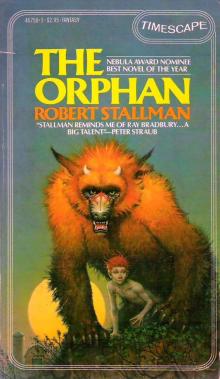
The Captive, page 1
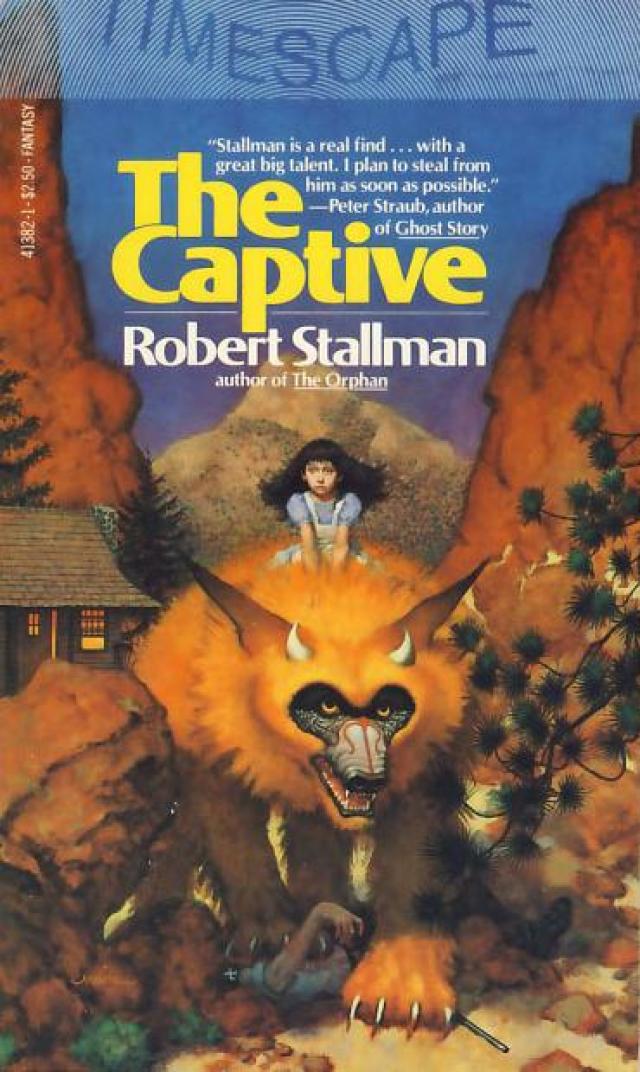


The
Captive
* * *
Robert Stallman
(The Second Book of the Beast)
For Bob and Bette,
night creatures
Prologue
If he had known the teachings of that ancient Greek, Thales, Marsh John would have agreed that all creation exists in a state of liquidity, of flux. Marsh John's brand of flux sold for a dollar and a half a jar and was clear enough to read a newspaper through by moonlight. On the edge of one of those drying up lakes that dot Michigan like bog holes in Ireland, John kept his apparatus in a lean-to concealed by a natural fall of dead trees. He was moderately proud of his business and of the fact that he handled it with the aid of a half-wit boy who could not have led the Feds back to the still even if he had got caught with a pickup of full mason jars. As for the news that Prohibition was on its way out, John would only comment sagely, "Folks got to drink," and damn the Government.
But this night, as he stepped through the swamp from one solid hammock to the next, Marsh John had other things on his mind. Since late September, he had been noticing strange tracks that might have been made by a large bear, and tonight he had found a second set. The tracks had circled an island in the swamp which held a dense stand of pines whose lower branches interlaced into a picket of horizontal spears. Fortified with half a jug of his own product, Marsh John now dropped to his knees as he reached the island. There was no way to get through that tangle of pine branches in the dark except to crawl on your knees, and John's vulnerability as he inched forward into dense darkness made his arms begin to shake so that he sat back on his haunches a minute to breathe and have another bite of the jug.
"Caint smell 'em," he whispered, putting the little jug back into his jacket. "But they in here - only place they can be."
He was about to resume his forward crawl when a sound, or rather a medley of sounds, made him snatch the slug gun from the pine needles and snap back both hammers. Somewhere on the island animals were growling, and not as if they were getting ready to fight or arguing over a kill or issuing challenges. To the now frightened and half-drunken man sitting under the interlocked branches of the pines, it sounded as if they were talking; no, maybe almost singing to each other with their snarls and grunts and long whines. The sounds grew in volume until they began to mesh like held chords of music, and the listening man felt an electric tingling run straight from his cold, wet butt right up into his scalp where it made his cap rise up over the erect neck hairs. He wanted to say, "Well what the hell?" but his throat dried up like a burned out cooker, and his eyes stared uselessly into the darkness. The long bulk of the six-cell flashlight pointed like a dog after quail, straight at the noise, but John could not move his thumb to turn it on.
His skin tingled as static charges built up around him, and he watched with horror as the flashlight, his arm, the bill of his cap, and every branch in the forest came alight with cold, green fire that rippled and snapped. And then came a burst of light and sound. A rush of wind struck the man, rolling him over backwards, down the clay bank and into the cold swamp water. Instinctively he scrabbled about for the slug gun and had got part way out of the freezing water when lights began rising through the trees like a whole carnival whirling up out of the swamp, singing with chords and harmonies that seemed both angelic and satanic. Marsh John saw the shapes rising together like multicolored banners, unearthly, twisting around each other like living things, their radiance showering down from the low October clouds in coruscations of feverish intensity. He shielded his eyes with the hand holding the old shotgun and was about to say the name of God when there came a blinding white glare followed by a detonation as of a close stroke of lightning.
What remained was only a splash of blindness on a drunken man's retinas. When his eyes had regained some sight the sky was empty, the swamp as wet and silent as it had ever been. The man stood knee deep in the cold water like one condemned by enchantment. And then his hand came down from before his eyes, the other hand groped dumbly for the jug, and he restored his brain to that familiar state of numbness that passed for his consciousness.
"Well I be a sommobitch," the man said and turned around to walk back the mile or so to his camp at the lean-to. His knees felt unaccountably weak. Get home, he thought. Forget about them bears. And he did.
On the little island something analogous to an egg had been deposited and disguised so cleverly that not even an idle hunter coming along and sitting on it could have distinguished it from the natural surroundings. But if he had camped beside it and taken careful measurements, he would have found that it grew slowly over the course of the winter months until it was many times its original size. And then, one of the first warm evenings of the following spring the egg split neatly in half, a rotten log that had suddenly come apart, and an animal rose from the pieces to stretch and look about itself. It might have been a full grown lynx or perhaps a slender sort of bear, for it had no tail. Its head was large and rounded at the back, the eyes nocturnal and green with huge pupils, and the hind legs possessed an extra joint, enabling the animal to move as easily upright as on all fours. The broad paws that would leave bear prints in the swamp mud bore retractile digits as well as talons, enabling the bear or cat, or whatever it was, to grasp and manipulate objects as can the human hand. At this moment of birth, the animal possessed a full set of memories, implanted to be released by certain emotional events, so that even though the creature had no understanding of its complete nature, its immediate goals held the force of instinct, as unquestioned as survival itself. Like the caddis fly larva, like the chrysalis of the butterfly, like the complex parasite that travels from fish to frog to mammal in its life cycle, this creature's existence was both given and provisional: living in the present according to its abilities, its life extended toward unknown possibilities.
The fauna of the swamp came to fear this new predator that knew with uncanny senses where they lay hidden, that was more swift and merciless than the wildcat or the rattler. Once mistakenly attacked by a mastiff dog that had gone savage, the strange new animal had retaliated so suddenly and effectively that the dog died with its jaws still clamped shut on a bit of tawny fur, dead before it could cry out.
After a time the creature felt restless and moved away from the swamp into the living area of humans, searching with its strange senses for something it needed, something that would trigger the next phase of its growth. Avoiding the towns, it traveled by night between farm houses, lying for hours at a time against the stone foundations as if listening, sensing somehow the people who lived in the house. The farm dogs became silent, uttering not a single growl, and crept away as the creature approached. When it found what it was looking for, the creature arranged for its own capture by the humans it had chosen, except that what the farmer found was not a fearsome beast but a helpless little five year old boy, lost and remembering nothing but his own name, but precisely the sort of child the old farmer would cherish and adopt as his own. As an orphan, the creature was cared for and loved by the farmer and his wife while it learned human ways and prepared for its next transformation. Little Robert was a real human, not a simulacrum projected by the creature from the strange egg in the swamp, a real boy with a will of his own and sometimes difficult for the creature to handle.
There came a time when the family was threatened by tramps who came to rob the farm house, and Little Robert's love for his family overpowered the creature's will to remain undetected. The transformation resulted in terror and bloodshed and the death of the farmer by a wild shotgun blast. The farmer's wife had witnessed the transformation, and although the creature she saw emerge from the boy's form was not directly responsible for her husband's death, she believed it to be a demon from hell, and she could not accept Little Robert as a human being. The boy went to live with his beloved aunt, but his foster mother would not let the matter rest until she had revealed the demon. Through hypnosis, the boy and the creature inside his mind were lulled, a command was given, and the creature emerged momentarily. Little Robert ran then, disappeared from his family.
But the creature, through the quirks and safeguards of its nature, could not take a new family. It must remain with some relative of its original choice to continue its learning. It traveled, guided by instinct, to the grandmother who lived in another state, and appeared to her in the guise of a teenaged boy named Charles Cahill. a boy of engaging personality and great charm who promised to work for his keep if she would allow him to attend school. For almost a year Charles grew in his adolescence as the creature grew in size and understanding, a double being, both creatures with wills and aims of their own. But a time came also for Charles when life betrayed him. Although he had become a local hero and respected by his friends, his own instincts, charged with power by the drives of the creature with whom he shared his existence, plunged him into the depths of shame. He refused to continue his life in that community in spite of the creature's pleadings. "The Beast," for that was what Charles came to call it, found now that it had to move again, search out a different member of the family to continue its existence, and pursue those ends which were still unknown.
He was on his way once more.
PART ONE
* * *
THE THIRD PERSON
Chapter 1
May 1936
Chicago is a disappointment. After several nights of travel, taking time out for the barnyard frolics I have been indulging in, I arrive at the Windy City, a glittering heap of lights thrown down beside a lake. From the life
"The Loop, Charles," she says, her eyes glittering in the darkness of that wild drive through the snowstorm. "The Palmer House, and Old Town, museums and restaurants, and The Lake." The muted roar of the winter wind around the madly careening car comes back to me now as I lie full length on the stones and gaze across the dark level water. Charles was such a fine boy, such a misguided Midwestern hero. I roll over and wonder with an almost nostalgic pang where Mrs. Lanphier is tonight. Once I even had a drunken dream of carrying her off to live in a cave somewhere, so seductive were her tales of life and promises of love - Charles and I were not so different in that. He loved her too, although she was as old as his mother might have been.
For a time I have a human reverie of myself in natural form making love with a frantically aroused middle-aged woman. And then I smile at myself for such a trick. Charles had dreams like that. I do not dream. My hackles bristle as I hear people approaching along the dark beach. They are lovers also, walking with arms around each other. They would not see me if I stood on my hind legs and waved. I keep their forms fixed in my spatial sense as they pass and recede along the narrow strip of sand between the Outer Drive and the stone blocks of the breakwater. There is hardly a breeze this spring night, the water extending flat as a black mirror upon which I might arise and walk north toward the next meeting with my Family. I will go when the moon has risen, when I can see its creamy reflection across that smooth black floor.
I had come into the city early this evening like a farm boy leaving behind his rural conquests, looking for something new and glamorous in this pile of stone and noise. I found in the dark streets of the South Side young men being violent and afraid, hurting each other in the dark. I listened to them gasping, cursing, striking with chains and pieces of wood, cutting with blades that flashed under the swinging streetlights. Then, in the obscurity of a park not far from here, under the statue of a man in a long coat, I clutched a late walker by his neck until he became unconscious. I shifted to human form, taking enough clothing and money to pass in the streets and walk about the city in safety. The shops held nothing I wanted, the restaurants and drinking places were dark, rancid with smoke and stifling odors, deafening with noise, dense with emotional vibrations so murderous that leavig one place I had to stop in an alley and vomit, even in that human form. Later I rested in a movie house and watched a story about a whiskery creature called a wolf-man, who was lonely and wanted for some inscrutable reason to be human. He appeared to possess many sensory advantages over the humans, but he was a sham, attacking people for no reason but his envy of their form. I felt some small twinge of identification with him, for I live as he did, secretly moving among those who would kill me. I flatter myself that I am much more presentable a creature than he with his foolish knob of a nose and little needle teeth. His connection with the power of the moon I found interesting, but the wolf-man himself was nothing more than a contrivance, a detestable, yelping cur asking to be killed. I realized as I made my way out of the theater that the story was only created to make possible the killing of the thing and showed no understanding of the true night creatures who move among men.
On the streets again, I found another sort of night creature. As I passed a dark doorway, a woman whose face was painted into a parody of femininity asked me for a cigarette. As I replied that I had none, I felt her hand touch my thigh intimately and realized what she was. For a few moments I was interested, remembering stories Charles had heard, but as she made her overtures, stroking and pressing against me, I could smell her body. Even in that human form I could smell that she had been with others recently. There was also a hint of something sick in the odor. I backed away.
"What'sa matter, big boy?" the woman said, moving toward me again.
"I, uh, I have no money," I said.
"In that silk suit? Listen, honey, you don't con me that way, and I can tell you need it tonight. Come on with Sally now and she'll show you something you won't forget."
"You smell bad," I said, backing away again.
"Why you shitty hick," she suddenly screamed. And there were more cursings and obscenities as I turned and ran away, feeling stupid and offended at the same time. I would rather, as I have these last few nights, indulge myself with any other creature. That thought cheers me in these foul streets, the memory of excited bitches, the shuddering union of horses, the happy and bellowing cow as she is mounted. And how the rush of sensation at the climax always sweeps me back into my natural form with an explosion of sensory delight as the shift occurs.
Now I wait for the moon, and then back to my Family, to Renee this time, the dark sister of Vaire, Little Robert's childhood love.
Something connects me to the Family as if they were my lost progenitors. I have no coherent memories beyond a year ago when I came into my first human form. Before that is an unformed mass, the speechless life of the young animal. I came into existence with the three rules in my mind: I am, and there is no time when I am not. Need creates form. Alone is safe. But now the sky lightens and I feel the moon as much as see its early radiance. I feel the pull it always extends when it is full, the delicate foreboding, as if there were a promise to be fulfilled. I rise and shake myself, stretch and begin trotting along the sand. Once away from the streets and the sounds of traffic I follow the shoreline around, taking to the water when I must to avoid piers and resort houses. The night is warm, the water an icy excitement as I plunge in to swim past dark buildings. The moon is high when I turn eastward and leave the lake behind, and I feel that I am going home.
***
In the outlying district of another city, this one smaller than Chicago, I have spent two nights lying close beneath the windows of their house, sensing their lives, listening to each word spoken, the angry man, the quiet woman who seems pulled in two directions by her loyalties, the little girl who is a happy presence in this troubled house. In the days I have slept in a draintile under the highway, and now I grope in a vast emptiness for the Person who will serve my need. The name comes to me as a sudden beacon out of darkness. I say it in my mouth, holding my consciousness to its quintessence in a blinding point of light. I shift. The Third Person appears.
The blond haired, eager looking young man sauntered down the long subdivision street trying to distinguish the right house out of the identical row. He smiled up at the overcast sky, seeming a bit awkward, almost childlike in his careless happiness with the world. A dog rushed out to bark at him, but the young man made a simple movement, his head cocked to one side, and the dog romped around him, yelping as if he were an old friend. His dark blue suit was just a half size too small, giving him an innocent, countrified look. His hat was set at a jaunty angle, and he whistled bits of song occasionally, looking at each mailbox along the curb.
He found the right one finally, block letters: WILLIAM HEGEL. He stopped in the warm dusk, listening to the woman's voice from an upstairs window singing softly to the little girl.
I went to the animal fair,
The birds and the beasts were there,
The big baboon by the light of the moon
Was combing her auburn hair.
The monkey he got drunk,
And sat on the elephant's trunk,
The elephant sneezed and fell on his knees,
And that was the end of the monk, the monk, the monk.
He could hear the little girl laughing as the woman's voice carried into the part about the monkey. She had a lovely voice: Renee, sister to the beautiful, golden haired Vaire whom Little Robert had adored when he lived at the farm. But that was not his memory, and he paused, confused by the intrusion into his mind of that former time, remembered not by him but by that power hidden inside him that had not quite subsided into its customary quiescence. He walked up the narrow sidewalk toward the white frame house with the little trellis around the front door.