

Empire of God, page 1


Advance Praise for Empire of God
“Robert Spencer’s historical survey of the Eastern Roman Empire argues not just that Byzantium’s extraordinary millennium-long survival saved Western civilization as it collapsed in Europe, but also that Constantinople’s uncompromising adherence to ancient values and traditions still offers a model for a contemporary America, overcome by relativism and nihilism, to rediscover its exceptional and historical custodianship of Western values. A passionate and spirited defense of Hellenism, an enlightened Orthodoxy, and the Byzantine Empire—and why especially now we should rediscover their often forgotten wisdom.”
–Victor Davis Hanson, senior fellow at The Hoover Institution at Stanford University and author of The Dying Citizen: How Progressive Elites, Tribalism, and Globalization Are Destroying the Idea of America
“Leave it to Robert Spencer to take a Byzantine topic like, well, the Byzantines, and write a concise, popular defense of them that makes even a Byzantine-skeptic like me sit up and take notice.”
–H. W. Crocker III, author of Triumph: The Power and the Glory of the Catholic Church, a 2,000-Year History
“Leave it to Robert Spencer to write a history of the Byzantine Empire that has no ideological axe to grind. Few contemporary writers care about truth—wherever it leads—as much as he does. That’s why Empire of God is as important as it is eye-opening. If you know how important history is, or you just care about understanding the roots of Western civilization—the greatest civilization ever created—you should read this book.
–Dennis Prager, nationally syndicated talk show host, co-founder of PragerU, and author of ten books, including The Rational Bible, a groundbreaking, five-volume commentary on the first five books of the Bible
Published by Bombardier Books
An Imprint of Post Hill Press
ISBN: 978-1-63758-742-3
ISBN (eBook): 978-1-63758-743-0
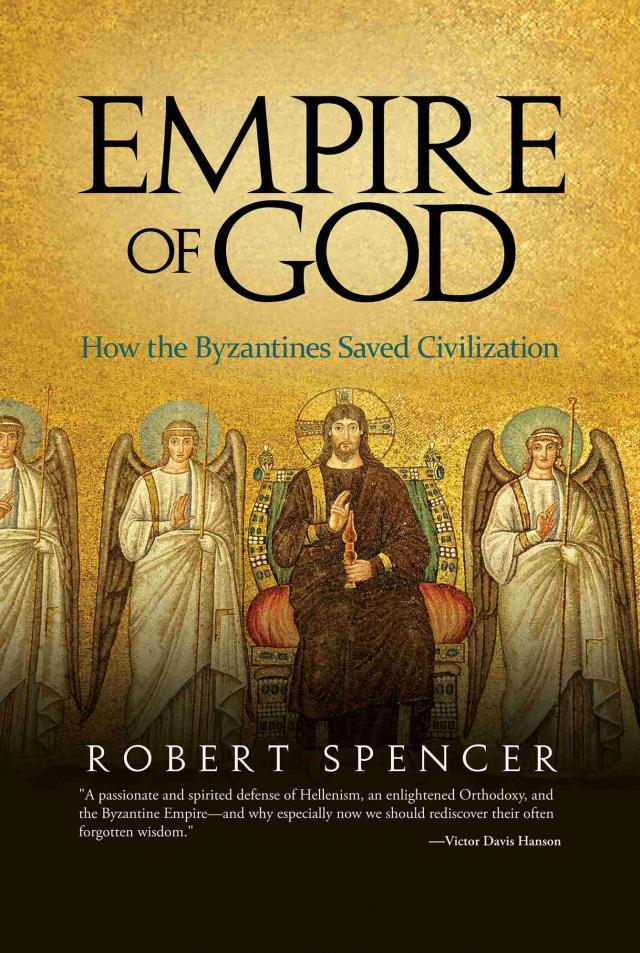
Empire of God:
How the Byzantines Saved Civilization
© 2023 by Robert Spencer
All Rights Reserved
Cover Design by Jim Villaflores
No part of this book may be reproduced, stored in a retrieval system, or transmitted by any means without the written permission of the author and publisher.
Post Hill Press
New York • Nashville
posthillpress.com
Published in the United States of America
Also by Robert Spencer
Confessions of an Islamophobe
The History of Jihad: From Muhammad to ISIS
The Palestinian Delusion: The Catastrophic History of the Middle East Peace Process
Rating America’s Residents: An America First Look at Who Is Best, Who Is Overrated, and Who Was An Absolute Disaster
Did Muhammad Exist?: An Inquiry into Islam’s Obscure Origins—Revised and Expanded Edition
The Critical Qur’an: Explained from Key Islamic Commentaries and Contemporary Historical Research
The Sumter Gambit: How the Left Is Trying to Foment a Civil War
Offered with love to all those who love the Romans of Constantinople and what they have given us
Table of Contents
Introduction: Not the Empire You Want, But the Empire You Need
Chapter One: A New Capital for an Old Empire
Chapter Two: A Christian Empire
Chapter Three: Stability
Chapter Four: Barbarians
Chapter Five: Theology and Politics
Chapter Six: The Fall of the Roman Empire?
Chapter Seven: Making the Empire Great Again
Chapter Eight: Glory
Chapter Nine: Pandemic
Chapter Ten: The Persians
Chapter Eleven: The Arabs
Chapter Twelve: The Iconoclasts
Chapter Thirteen: Testing Iconoclasm
Chapter Fourteen: Seeds of Schism
Chapter Fifteen: Leadership, Wise and Unwise
Chapter Sixteen: The Splendor of the Court
Chapter Seventeen: The Russians
Chapter Eighteen: Let the Good Times Roll
Chapter Nineteen: The Final Rupture
Chapter Twenty: Catastrophe
Chapter Twenty-One: Crusade
Chapter Twenty-Two: The Storm Before the Storm
Chapter Twenty-Three: The Beginning of the End
Chapter Twenty-Four: The Empire Strikes Back
Chapter Twenty-Five: Seeds of Destruction
Chapter Twenty-Six: Humiliation
Chapter Twenty-Seven: The Final Days
Chapter Twenty-Eight: The Christian Legacy
Chapter Twenty-Nine: Money
Chapter Thirty: Law
Chapter Thirty-One: Art and Architecture
Epilogue: Unfallen
Roman Emperors from the Founding of Constantinople to the Fall of the Empire
Illustrations
Acknowledgments
Introduction
Not the Empire You Want, But the Empire You Need
Down at the Heels
Western civilization is generally regarded as the child of Athens, Jerusalem, and Rome. That is, in the West our philosophical and political thought is derived from that of the ancient Greeks, our Christian religion comes from the religion of the Jews, and both of these came to us via Rome, that is, from the Roman Empire and the civilization and culture it created.
Western society has other forefathers as well. In 1995, Thomas Cahill’s How the Irish Saved Civilization argued for the pivotal role of Ireland in the development of Western thought and culture. The Declaration of Independence would be drastically different, or may not even have been written at all, were it not for the thought of the seventeenth-century English philosopher John Locke. America itself would be a vastly different place were it not for the sixteenth-century Protestant reformers Martin Luther and John Calvin.
The list of individuals and entities that have played a major role in the formation of the West is a long one, and the Byzantine Empire usually appears quite far down on that list. If Athens and Jerusalem are regarded as the forefathers of Western civilization, with Rome serving as their conduit, Byzantium, or Constantinople, is often regarded as the weak and ineffectual stepfather, a bit shabby and down at the heels, and certainly peripheral to the life and development of the West.
The historian H. W. Crocker III, in his sweeping 2001 book Triumph: The Power and the Glory of the Catholic Church: A 2,000-Year History, has nothing but contempt for Byzantium, writing: “Islam spread by the sword, but it also found converts—which, given its promises and its simplicity, is not surprising. It is perhaps rather more surprising that the effeminate Byzantines did not as an empire willingly submit themselves to this Eastern creed, though to the Greek mind it is possible that its very simplicity argued against it.”1 At another point, Crocker notes that “the Byzantines were not popular with the Crusaders, who regarded them, in the vernacular, as gay Greeks—effeminate, scheming, and bitchy,” and it’s clear that Crocker himself shares that view.2
Crocker is by no means alone. Another contemporary historian, Judith Herrin, notes that “the modern stereotype of Byzantium is tyrannical government by effeminate, cowardly men and corrupt eunuchs, obsessed with hollow rituals and endless, complex and incomprehensible bureaucracy.”3
This is a longstanding view: in 1953, E. R. A. Sewter, who translated the eleventh-century chronicler Michael Psellos’s Chronographia into English, wrote in his introduction that “fifty years ago, any English schoolboy who professed admiration for things Byzantine would almost certainly have been reprimanded.” This was because “the miserable Byzantines were pale reflections of decadent Greeks; their art was stereotyped, lacking in inspiration, and stiff; their form of government was static and inefficient, their literature debased.”4
As far back as the nineteenth century, the historian William Lecky was even more dismissive of the Byzantine Empire than was Crocker:
Of that Byzantine Empire the universal verdict of history is that it constitutes, without a single exception, the most thoroughly base and despicable form that civilization has yet assumed… There has been no other enduring civilization so absolutely destitute of all forms and elements of greatness, and none to which the epithet “mean” may be so emphatically applied… Its vices were the vices of men who had ceased to be brave without learning to be virtuous… Slaves, and willing slaves, in both their actions and their thoughts, immersed in sensuality and in the most frivolous pleasures, the people only emerged from their listlessness when some theological subtlety, or some chivalry in the chariot race, stimulated them to frantic riots… The history of the Empire is a monotonous story of the intrigues of priests, eunuchs, and women, of poisonings, of conspiracies, of uniform ingratitude, of perpetual fratricides.5
All of these and others who have a dim view of the achievements and legacy of the Byzantine Empire are the spiritual and intellectual heirs of Edward Gibbon, the eighteenth-century Englishman whose History of the Decline and Fall of the Roman Empire is justly renowned as a masterwork of historiography and literature. Having completed his history up to the fall of the empire in the West and the glory days of Justinian and Heraclius in Constantinople, Gibbon surveyed how much he had left to chronicle before the fall of the Eastern Roman, or Byzantine, Empire in 1453 and desp aired.
“At every step,” he lamented, “as we sink deeper in the decline and fall of the Eastern empire, the annals of each succeeding reign would impose a more ungrateful and melancholy task. These annals must continue to repeat a tedious and uniform tale of weakness and misery.”6 He saw this misery in large part as a consequence of the defects in the Byzantine character: “But the subjects of the Byzantine empire, who assume and dishonor the names both of Greeks and Romans, present a dead uniformity of abject vices, which are neither softened by the weakness of humanity, nor animated by the vigor of memorable crimes.”7 Gibbon’s material on the middle and late Byzantine eras is vastly inferior to what he possessed for his treatment of the earlier Roman Empire, and there is no doubt that this can be attributed in great part to his distaste for his subject.
That’s unfortunate enough in itself, but we also owe Gibbon for the use of the word “Byzantine” as meaning needless, hopelessly confused complication. Social anthropologist Brian Palmer explained in 2011 that “in his influential multi-volume work, The History of the Decline and Fall of the Roman Empire, Gibbon caricatured the history of the Byzantine Empire as little more than a series of shady backroom deals, backstabbing, and power grabs. (In fact, the same could easily be said of Ancient Rome—which Gibbon glorified—or the Islamic societies nearby.)”8
Gibbon’s caricature caught on: “Later historians seized on Gibbon’s portrait of the complexity of Constantinople’s ever-shifting political alliances and its reliance on rituals to maintain power distinctions.”9 As a result, “Byzantine” became a byword: “French scholar Jules Michelet was the first to use the adjective Byzantine to describe something excessively complex or subtle in his 1846 work Le Peuple, and the term had spread to nonpolitical contexts by the 1880s. (Louis Pasteur complained about Byzantine medical discussions in 1882.)”10
This usage has been remarkably persistent: “According to William Safire’s Political Dictionary, the modern use didn’t enter the English political lexicon until 1937, when Arthur Koestler—who spoke French and spent some years living in Paris—described the structure of the Spanish army as ‘Byzantine.’”11
Those who were more familiar with the Byzantine Empire itself, however, used the word to denote something strikingly different from needless complication: stability, reliability, and trustworthiness. Even centuries after the grand empire finally fell, its gold coins, referred to as bezants in honor of their place of origin, remained highly respected and prized for the stability of their gold content and value.
Stability and reliability are, in fact, more authentically “Byzantine” than confusion and obfuscation. And there is a great deal more to the legacy of the Byzantine Empire than all this derision would suggest. The Byzantines were part of the intellectual, cultural, and spiritual heritage of the Western world. While the Roman Catholic Church is often referred to as the Western Church, and the Greek Orthodox Church as the Eastern Church, the Judeo-Christian tradition is the foundation of Western civilization, and that includes Eastern Christianity. For centuries now, Western Europeans and North Americans have assumed Byzantium to be a foreign civilization, Christian at least in some form but fundamentally alien. In reality, Byzantium has a closer kinship with the West than with any other culture or civilization, and is a key element in the complex of thought that created Western civilization itself. And it is Byzantium, for all its superficial strangeness, that contains a great deal of wisdom that the confused, post-Christian West could benefit from today in order to recover a sense of itself.
Not only was the Roman Empire in its Byzantine period a key influence on the development of the West, but it is no exaggeration to say that the Byzantines saved Western civilization from destruction and oblivion and did so in numerous ways. Without the Byzantine Empire, there would be no Western civilization, and no Western world today. For seven hundred years, the Byzantine Empire stood as a bulwark between Europe and Islamic jihadis who would have swept across the continent and reduced Judeo-Christian civilization to a small remnant simply struggling to survive. The intellectual, artistic, and spiritual patrimony of Western civilization would never have been known to the world.
What’s more, when we say that Western civilization is based in part on Athens, this, too, would never have been true had the Byzantines not for centuries preserved and taught the pioneering philosophical and literary works of ancient Greece. When only a handful of the works of Plato, Aristotle, and others were known in the West, the fifteenth-century Byzantine philosopher Gemistos Plethon brought works of theirs that were preserved only in the empire to Florence and taught causes on them, doing a great deal to spark the Renaissance and Enlightenment.
Those are just two of the many reasons why it would be unwise today to follow Gibbon and the others and give the Byzantines short shrift. The ways in which they have influenced our world for the good are insufficiently appreciated today, and the lessons they could teach us have long been forgotten. The world as we know it simply would not exist without them.
The Byzantines’ unique and pivotal contribution to our world needs to be remembered now, of all times, for the West today has lost its way. In all of the West’s contemporary confusion, uncertainty, and lack of direction, there is a great deal it can and should learn from Byzantium if it is to have any chance of survival.
There is no arguing with success. If the United States were to last as long as the Roman Empire, it would have to continue as an independent country, with political and cultural continuity, until the year 2899. To maintain a unified nation-state for over eleven hundred years is a remarkable achievement by any standard, and the Romans accomplished it while facing existential threats and efforts to extinguish their polity altogether during virtually every period of their existence. The Roman achievement by no means ends there; nearly six hundred years after the demise of the empire, its influence still resonates today in a number of fields, albeit almost entirely unnoticed and unappreciated.
It’s time we took notice.
Not Byzantine
It must also be noted, at the risk of introducing some “Byzantine” confusion into this matter, that the Byzantines themselves never used that word. While the title of this book refers to “the Byzantines,” it is important to note at the outset of these explorations that the Byzantine Empire was, in fact, never known as “Byzantine” to the people who actually lived in it.
Not only did every one of the rulers in Constantinople consider himself to be the emperor of the Romans, but their subjects considered themselves to be Romans as well. Throughout the more than a thousand years of the empire in Constantinople, the rulers, the people, and the eminent writers in all fields referred to themselves universally as “Romans” and never as “Byzantines” or anything else. This creates a certain disconnect between the modern view of who exactly these people were and their own view of themselves. E. R. A. Sewter’s Penguin Classics translation of Michael Psellos’s Chronographia is entitled Fourteen Byzantine Rulers. But Psellos himself (whose name is Latinized in this edition to “Psellus”), toward the beginning of this work, refers to Emperor Basil II (976–1025) as being “invested with supreme power over the Romans” and says that Basil “happened at that time to be the most remarkable person in the Roman Empire.”12
Psellos was no eccentric, and neither is Penguin Classics. The 2010 Cambridge University Press English translation of the Synopsis of Histories by another eleventh-century historian, John Skylitzes, is entitled A Synopsis of Byzantine History 811–1057. On the first page of Skylitzes’s work, he writes of the circumstances by which Emperor Michael I (811–813) “found himself holding the Roman sceptre at the behest of the senate and people.”13 The word “Byzantine” doesn’t appear in the work of either Psellos or Skylitzes.
This is not to suggest any malice on the part of Penguin or Cambridge University Press. They were simply following the common usage of our day, as I myself did of necessity in using the word “Byzantine” in the title of this book as well. But that usage was unknown among those who are called Byzantines today.


