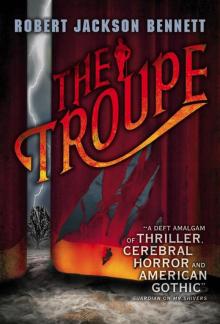
The Tainted Cup, page 1


Advance praise for
THE TAINTED CUP
“Bennett brilliantly melds genres in this exceptional mystery-fantasy….The worldbuilding is immediately involving, Bennett’s take on a classic detective duo dynamic feels fresh and exciting, and the mystery itself twists and turns delightfully. Readers will be wowed.”
—Publishers Weekly (starred review)
“Highly recommended…Introduces readers to a conspiracy of murder and skullduggery as seen through the eyes of a naive junior investigator…as his boss and mentor, the rather Sherlockian Ana, threads her way through a complex conspiracy of murders.”
—Library Journal (starred review)
“Inspired by Nero Wolfe with a bit of Hannibal Lecter added to his prime investigator, Bennett…kicks off the Shadow of the Leviathan series, which will delight fans of fantasy-infused mysteries.”
—Booklist (starred review)
“A true fantasy mystery, with a leading duo who stand with Holmes and Watson among the greats…and Bennett sets it all in a squishy, fascinating, biopunk world I’m dying to find out more about. Bring on the next one!”
—Django Wexler, author of the Shadow Campaigns series
“A classic murder mystery set against dazzling worldbuilding and sly social commentary…Robert Jackson Bennett doesn’t miss.”
—James L. Sutter, co-creator of the Pathfinder roleplaying game
“One of the wildest, most original stories I’ve ever had the privilege to explore…I am in awe of Bennett’s creativity, the intricate plotting, and this immersive world filled with mushroom air conditioners, killer trees, and giant leviathans that stretches the imagination. I loved every second of it. This is a book that has planted roots in my head for the rest of my life.”
—Wesley Chu, #1 New York Times bestselling author of the War Arts Saga
“I loved this. A twisty detective story, a weird fantasy, a thrilling adventure—The Tainted Cup is a masterstroke. I want Bennett to write a dozen of these, and send them to me yesterday.”
—Max Gladstone, New York Times bestselling co-author of This Is How You Lose the Time War
“A riveting murder mystery wrapped in a twisty conspiracy, set in a vivid fantasy world terrorized by eldritch monsters…If you love unique, genre-bending, boundary-pushing fantasy as much as I do, look no further than Robert Jackson Bennett.”
—Fonda Lee, author of the Green Bone Saga
“Original, imaginative, and suspenseful, The Tainted Cup superbly blends mystery and fantasy in this vivid, complex novel. I couldn’t put it down. Give me more of this world and these characters ASAP!”
—Meg Gardiner, #1 New York Times bestselling author of the UNSUB series
The Tainted Cup is a work of fiction.
Names, characters, places, and incidents are the products of the author’s imagination or are used fictitiously. Any resemblance to actual events, locales, or persons, living or dead, is entirely coincidental.
Copyright © 2024 by Robert Jackson Bennett
Map and ranking list chart copyright © 2024 by David Lindroth Inc.
All rights reserved.
Published in the United States by Del Rey, an imprint of Random House, a division of Penguin Random House LLC, New York.
Del Rey and the Circle colophon are registered trademarks of Penguin Random House LLC.
Library of Congress Cataloging-in-Publication Data
Names: Bennett, Robert Jackson, author.
Title: The tainted cup: a novel / Robert Jackson Bennett.
Description: First edition. | New York: Del Rey, 2024. | Series: Shadow of the Leviathan; Book 1
Identifiers: LCCN 2023039782 (print) | LCCN 2023039783 (ebook) | ISBN 9781984820709 (hardcover acid-free paper) | ISBN 9781984820723 (e-book)
Subjects: LCGFT: Fantasy fiction. | Detective and mystery fiction. | Novels.
Classification: LCC PS3602.E66455 T35 2024 (print) | LCC PS3602.E66455 (ebook) | DDC 813/.6—dc23/eng/20230828
LC record available at https://lccn.loc.gov/2023039782
LC ebook record available at https://lccn.loc.gov/2023039783
Ebook ISBN 9781984820723
randomhousebooks.com
Book design by Edwin A. Vazquez, adapted for ebook
Cover design and illustration: Will Staehle/Unusual Co.
Art direction: David G. Stevenson
ep_prh_6.2_146095922_c0_r1
Contents
Cover
Title Page
Copyright
Map
Part I: The Man in the Tree
Chapter 1
Chapter 2
Chapter 3
Chapter 4
Chapter 5
Chapter 6
Part II: The Breach
Chapter 7
Chapter 8
Chapter 9
Chapter 10
Chapter 11
Chapter 12
Part III: Three Keys and Ten Dead Engineers
Chapter 13
Chapter 14
Chapter 15
Chapter 16
Chapter 17
Chapter 18
Chapter 19
Chapter 20
Chapter 21
Chapter 22
Chapter 23
Chapter 24
Part IV: Hell and the Gentry
Chapter 25
Chapter 26
Chapter 27
Chapter 28
Chapter 29
Chapter 30
Chapter 31
Chapter 32
Chapter 33
Part V: The Shadow of the Leviathan
Chapter 34
Chapter 35
Chapter 36
Chapter 37
Chapter 38
Chapter 39
Chapter 40
Chapter 41
Chapter 42
Dedication
Acknowledgments
By Robert Jackson Bennett
About the Author
_146095922_
CHAPTER 1
| | |
THE WALLS OF THE estate emerged from the morning fog before me, long and dark and rounded like the skin of some beached sea creature. I walked along them, trying to ignore the flutter of my heart and the trickle of sweat down my neck. A faint blue light glimmered in the mist ahead. With each step it calcified into a mai-lantern hanging above the estate’s servants’ gate; and there, leaning against the walls beside the gate, was the figure of a uniformed man in a shining steel cap waiting for me.
The princeps watched me approach. He cocked an eyebrow at me, and it climbed higher up his forehead the closer I came to him. By the time I’d finally stopped before him it’d almost joined the hair atop his head.
I cleared my throat in what I hoped was an authoritative manner, and said, “Signum Dinios Kol, assistant to the investigator. I'm here about the body."
The princeps blinked, then looked me up and down. Being as I was nearly a head taller than him, it took him a moment. “I see, sir,” he said. He gave me a short bow—a quarter of a full bow, maybe a third—but then did not move.
“You do have a body, yes?” I asked.
“Well, we do, sir,” he said slowly. He glanced over my shoulder down the fog-strewn lane behind me.
“Then what seems to be the issue?”
“Well, ah…” Again, a glance down the lane behind me. “Pardon, sir, but—where’s the other one?”
“I’m sorry?” I asked. “Other one?”
“The investigator? When will she be arriving?”
I suppressed a flicker of worry. I'd dealt with this question when working other matters for my master, but doing so when the situation involved a dead body was another thing entirely. “The investigator isn’t able to attend,” I said. “I’m here to review the scene, interview the staff and any witnesses, and report back to her.”
“The investigator is choosing to proceed with the investigation…without being present?” he said. “Might I ask why, sir?”
I took him in. His short mail shirt glinted in the low light, each ringlet dabbed with tiny pearls of condensation. Very fancy. Ornate belt at his waist, slightly soft belly hanging over the buckle—a consequence of early middle age. Same for the thread of gray in his beard. Black boots highly polished, trim woven with seaweed-stained leather. The only standard-issue item on his body was the longsword in his scabbard and his dark red cloak, indicating he was an Apothetikal: an imperial officer responsible for managing the Empire’s many organic alterations. The rest of it he must’ve purchased himself, probably for a princely sum.
All this told me that even though I was a signum and thus technically outranked him, this man was not only older and wealthier than me, but he’d probably seen more in his career than I could imagine. I couldn’t blame him for wondering why the investigator had sent this twenty-year-old boy in ratty boots to a death scene all on his
“The investigator usually is not present at investigations, Princeps,” I said. “She sends me to assess the situation and uses my report to make the appropriate conclusions.”
“The appropriate conclusions,” the princeps echoed.
“Correct,” I said.
I waited for him to permit me inside. He just stood there. I wondered if I was going to have to order him to let me into the estate. I’d never given a direct order to an officer of another imperial administration before and did not entirely know how to go about doing it.
To my relief, he finally said, “Right, sir…” and reached into his pocket. He took out a small bronze disc with a little glass vial set in the center, which sloshed with black fluid. “You’ll need to follow close, sir. This gate is a bit old. Can be fussy.”
He turned to face the servants’ gate: a rounded aperture in the smooth black surface of the estate walls. Hanging on the other side of the aperture was a veil of curling, furred vines of a greenish-yellow color. They trembled as the princeps approached—a disquieting, juddering tremor—and fell back, allowing us to enter.
I kept close to the princeps as we walked through the gate, leaning down so my head didn’t scrape the top. The vines smelled sweet and sickly as they tickled the back of my neck. Likely altered to seek out flesh, and if the princeps hadn’t been carrying his “key”—the vial of reagents in his hand—then the two of us would have been paralyzed, or worse.
We emerged into the estate’s inner yards. Dozens of mai-lanterns twinkled in the morning gloom ahead of us, dangling from the gabled roof of the sprawling house set high on the hill beyond. A verandah wrapped around the home, rope nets blooming with bright decorative moss to shield windows from the morning sun. Floors wide and smooth, wood polished to a fine shine. A cushioned section sat on the eastern end—a miniature tea pavilion of a sort, but instead of a tea table there sat some massive animal’s skull, its cranium shaved off to be level. A rather ghoulish adornment for so fine a place—and it was a fine place, easily the finest house I’d ever seen.
I looked at the princeps. He’d noticed my astonishment and was smirking.
I adjusted my Iudex coat at the shoulders. They hadn’t been able to find one my size, and I suddenly felt terribly stupid-looking, packed into this tight blue fabric. “What’s your name, Princeps?” I asked.
“Apologies, sir. Should have mentioned—Otirios.”
“Have we identified the deceased, Otirios?” I asked. “I understand there was some issue with that.”
“We think so, sir. We believe it is Commander Taqtasa Blas, of the Engineers.”
“You believe it is? Why believe?”
This drew a sidelong glance. “You were informed that the nature of his death was an alteration, yes, sir?”
“Yes?”
“Well…such things can make it tricky to identify a body, sir.” He led me across a small wooden bridge that spanned a trickling stream. “Or even,” he added, “to identify it as one, sir. That’s why we Apoths are here.”
He gestured at the fog beyond. I searched the mist and spied figures roving through the gardens, also wearing coats and cloaks of dark red, all carrying what one might mistake to be birdcages; yet each cage contained not a bird, but a delicate fern.
“Checking for contagion,” said Otirios. “But so far we’ve found nothing. No telltale plants have browned or died yet, sir. No sign of contagion on the estate grounds.”
He led me to a thin fernpaper door in the estate house. As we approached I thought I heard some long, sustained sound within the mansion. I realized it was screaming.
“What’s that?” I asked.
“Probably the servant girls,” Otirios said. “They were, ah, the ones who got there first. Still quite agitated, as you can imagine.”
“Didn’t they find the body hours ago?”
“Yes. But they keep having outbursts. When you see the body, you’ll understand why, sir.”
I listened to the screams, wild and hysterical. I fought to keep my face clear of emotion.
I told myself to stay controlled and contained. I was an officer for the Iudex, the imperial administration responsible for managing the high courts and delivering justice throughout the Empire. I was supposed to be at this fine home, even if it was filled with screaming.
Otirios opened the door. The sound of the screaming grew far louder.
I reflected that piss was supposed to stay in my body, but if that screaming went on for much longer, that might not stay the case.
He led me inside.
* * *
—
THE FIRST THING that struck me was the cleanliness of the place. Not just the absence of dirt—though there was no dirt, not a smudge nor smear in sight—but there was a sterility to everything before me, no matter how elegant: the dining couches were too smooth and unblemished, and the woven silk mats laid in squares on the floor were too unspoiled, perhaps having never known the tramp of a foot. The whole house felt as cozy and comfortable as a surgeon’s knife.
Which wasn’t to say it was not opulent. Miniature mai-trees had been altered to grow down from the ceiling, acting as chandeliers—something I’d never seen before—their fruits full to bursting with the glowing little mai-worms, which cast a flickering blue light about us. I wondered if even the air was expensive in here, then saw it was: a massive kirpis mushroom had been built into the corner of every main room—a tall, black fungus built to suck in air, clean it, and exhale it out at a cooler temperature.
The shrieking went on and on from somewhere in the mansion. I shivered a little, and knew it had nothing to do with the temperature of the air.
“We’ve kept all the staff and witnesses here at the house, as the investigator directed,” Otirios said. “I expect you’ll want to interview them, sir.”
“Thank you, Princeps. How many are there?”
“Seven total. Four servant girls, the cook, the groundskeeper, and the housekeeper.”
“Who owns this estate? I take it not Commander Blas?”
“No, sir. This house is owned by the Haza clan. Did you not see the insignia?” He gestured to a little marking hanging over the entry door: a single feather standing tall between two trees.
That gave me pause. The Hazas were one of the wealthiest families in the Empire and owned a huge amount of land in the inner rings. The staggering luxury of this place began to make a lot of sense, but everything else grew only more confusing.
“What are the Hazas doing owning a house in Daretana?” I asked, genuinely bewildered.
He shrugged. “Dunno, sir. Maybe they ran out of houses to buy everywhere else.”
“Is a member of the Haza clan here currently?”
“If they are, sir, they’re damned good hiders. The housekeeper should know more.”
We continued down a long hallway, which ended in a black stonewood door.
A faint odor filled the air as we grew close to the door: something musty and sweet, and yet tinged with a rancid aroma.
My stomach trembled. I reminded myself to hold my head high, to keep my expression scowling and stoic, like a real assistant investigator might. Then I had to remind myself that I was a real assistant investigator, damn it all.
“Have you worked many death cases before, sir?” asked Otirios.
“Why?” I asked.
“Just curious, given the nature of this one.”
“I haven’t. Mostly the investigator and I have handled pay fraud among the officers here in Daretana.”