After the Revolution, page 1
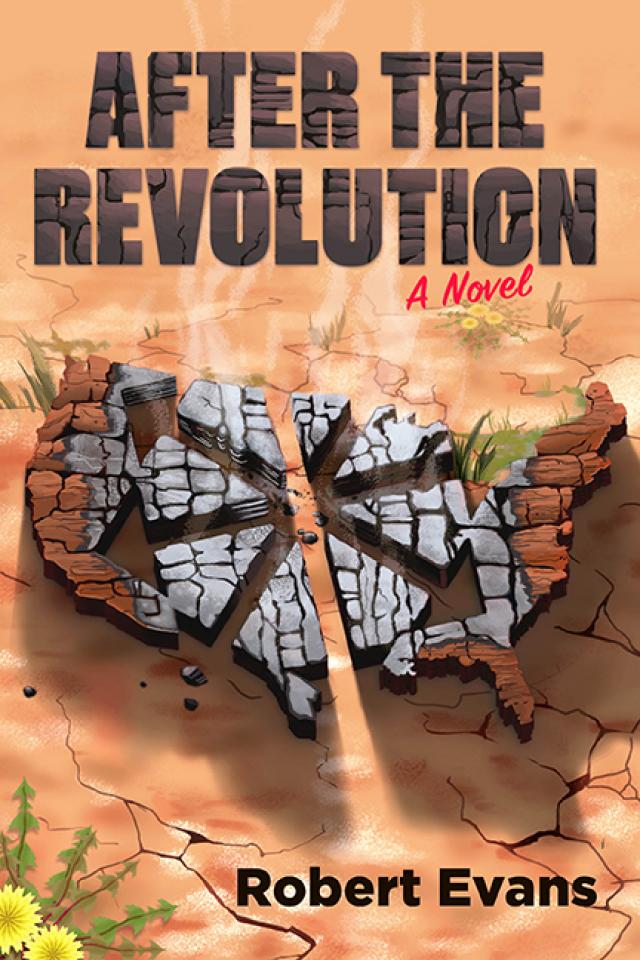


A Novel
Robert Evans
Dedication
This book is dedicated to Cynthia.
I’d furthermore like to thank Sarah and Jeremy, who took me in when I was crazy from grief and trauma. Thank you Moira, for reading my silly book and giving it crucial feedback. Thank you Tavia, for the incredible illustrations and the support. And thank you Sophie, for telling me to stop being a coward and publish the motherfucker.
Last, I’d like to thank Magenta. Without you, and the places we went together, I would not have known the things I needed to know in order to write this at all.
Richardson, Republic of Texas, 2070.
Chapter 1
Manny.
Manny smiled at the way the British journalist’s face blanched as the old Toyota hit the pothole. Reggie wasn’t used to bad roads, cars driven by actual humans, or the way the heavy metal of the gun mount in the truck bed made the aluminum frame groan. That was all familiar to Manny. He’d grown up in ciudad de muerta, back before the Lakewood Blast. Back when people had still called it Dallas.
The truck’s driver veered around the bloated corpse of a large dog lying in the middle of the road. Reggie gripped the truck bed with white knuckles and eyed the swaying ammo-belt of the 20mm cannon like it was a coiled snake. The gunner, Manny’s cousin Alejandro, grinned down at the journalist, “The suspension’s a little fucked, yeah?”
The Brit nodded, and turned greener when the technical hit another pothole. Manny supposed he should offer a comforting word to the man. That would be good business. But a louder part of him looked at Reggie’s brand-new boots and thought, “He can stand a little less comfort.” The journalist would brag about this ride for months once he got home.
Escorting reporters from the safety of Austin to the sundry hot spots of the old Metroplex was not Manny’s ideal career. Two years ago he’d been working on a bachelor’s in business administration from the University of Austin. The plan had been to get a job with Aegis Biosystems, then charm his way into a working visa and a gig in the California Republic. But the fighting had started up again and ruined all that. The culprit this time was the “Heavenly Kingdom,” a loose assortment of Christian extremist militias. They’d boiled out from the suburbs of the old Metroplex and all but broken the Republic of Texas.
The autonomous City of Austin had stabilized the situation with the help of an alliance of leftist Texan militias, the Secular Defense Forces. Beating them back had cost a lot in blood and time, and forced Manny to change every plan he’d ever made for his life.
So he’d embraced the situation and started his own business, hiring on some friends as employees. Together they’d built the best network of stringers in North Texas. His boys fed him video, contacts, and news updates, and he sold what he could to the big foreign media conglomerates. In a couple more months he’d have enough saved up that he could fuck off, fly to Europe and apply for a refugee visa.
My odds are pretty good, as long as the war doesn’t end too soon.
The technical rolled to a creaky stop in front of a checkpoint that had clearly been erected within the last few days. It was just a collapsible electronic gate and two sandbag emplacements on either side of the battered highway. A street sign nearby announced that they were on the edge of Richardson, formerly a suburb of Dallas and currently a forward position of the People’s Protection Army, a local anarchist militia. Manny could see the PPA’s red/black triangle emblem stitched onto the jackets of the soldiers guarding the checkpoint.
One of the PPA men walked up to the window and started chatting with Phillip, the driver. Phil and Manny’s cousin Alejandro were both with the Citizen’s Front, a more-or-less apolitical militia from the suburbs of Austin. Both militias co-existed under the broad umbrella of the Secular Defense Forces. The SDF had been organized by the Canadian government, to lump all of North Texas’s palatable militant groups into a single package that could be conveniently armed.
While the first guard talked with Phillip, his partner did a circuit around the back of the truck. The man was big, bulging with muscles so sculpted and prominent they had to be vat-grown, and he moved with the twitchy un-grace of a man who’d replaced his nervous system with circuitry. His weapon was a very old, very battered AR-15 with an M243 grenade launcher below the barrel. The latter was old U.S. military gear. The former had been someone’s toy before the Revolution gave America’s half-billion civilian guns a new raison d’etre.
The man moved back to the barricades when he’d finished his lap. Reggie looked up at Manny and asked, “Was he, erm…was he ‘chromed’?”
Manny smiled. That was always one of the first questions, when any foreign journo saw a trooper with a large enough build, skin with an off-shade, or who just moved a little too fast to seem completely “right.” Anything beyond basic aesthetic and medical modifications were banned in civilized countries, like the U.K.
The real chrome, the implants that would let a man lift a tank or take a rocket to the belly, that shit was locked up tight. Few national militaries even used the stuff these days. Not after the Revolution.
“He’s got some vat-grown muscles,” Manny said, in an off-handed way that suggested such things were common. “Aftermarket nerves too, probably. His stuff is low-grade. That’s why it’s so visible.”
Reggie nodded. His eyes stayed locked on the big man. He was quiet for a while before he spoke again. “You just…you live right alongside them, don’t you?”
Manny shrugged. “Everybody’s got something out here. And the wetware’s what lets us hold back the Martyrs. They’d own the whole city if it weren’t for half-vats like him.”
The journalist nodded, and his gaze stayed fixed upon the militiaman until a troubled look crossed his face. He glanced back to Manny.
“Are you, ah, ‘chromed’?” Reggie asked.
Manny smiled. “I don’t expect either of us is stock sapien, eh? But I doubt I’ve got anything you don’t.”
Reggie seemed somewhat comforted by this. “Most of what I’ve read about the really heavy mods says they cause a lot of, well, unstable behavior. That’s why…”
“That’s why this city’s such a shit hole?” Manny asked.
The journalist had the grace to blush. Manny looked away for a moment. His eyes landed on the bones of three large public housing buildings. A barrel bomb had detonated in the center of the courtyard all three shared. It had peeled away the walls, some of the floors, and the resulting firestorm had burned up everything that wasn’t concrete, steel, or rebar. For just a moment, Manny felt bad about hoping the war hung on another six months.
“The old government blamed a lot on roided-up veterans with military grade mods,” he told Reggie. “Most was just propaganda, fear-mongering. People were pissed after twenty years of plague, disaster, and poverty.” Manny shrugged. “It’s true though, a lot of chromed-up vets turned on the government. You can’t make men into gods and expect them to keep fighting for men.”
Reggie pointed back to the bulging militiaman. “I take it muscles there is pretty far from a god.”
“Nah,” Manny laughed. “He’s just a guy with too much meat-money. Gods don’t man check-points.”
The Brit was excited now. These were the questions he’d wanted to ask since they’d met yesterday. “Do you know where some of those people are?” Reggie couldn’t keep the excitement out of his voice. “Could we talk to them?”
Manny didn’t have any of those contacts, nor did he know any other fixers who did. He tried to let the Brit down easy. “Most of those folks live, uh, on the road. In between the civilized parts of Texas and the Republic of California.”
“Oh,” Reggie looked disappointed. From the bed of the truck they could see the wreckage of an old Catholic school. It bore the signs of being fortified, destroyed, re-fortified, and re-destroyed several times.
The Brit was inches from asking another question when the gate-man waved them on and the battered Toyota farted its way into drive, belching and complaining past a network of potholes until it hit a relatively straight chunk of asphalt.
“Only a few minutes now, jefe,” Manny said. “The PPA’s forward position is about five minutes out. You’ll be in ‘the shit’ then. Or at least shit-adjacent.”
The journalist’s face washed over in an even mix of anxiety and pride. One of the first lessons Manny had learned at this job was that phrases like “the shit” made rich gringo writers unreasonably excited. And excited journalists always called Manny the next time they were in-country. Giving white kids in keffiyahs a lifetime of bragging rights for surviving a couple days in his home killed his soul, just a little bit. But Manny pushed down the anger and told himself that a chip on the shoulder was a lot less useful than money in the bank.
The technical rolled off the old highway. Manny could see “23” and “Spring Valley Road” emblazoned on a weather-beaten, bullet-scarred sign. The technical pulled to the right. The gun swayed in its mount. Manny couldn’t help smiling as the Brit instinctively pulled away from it.
They rolled up to what had once been a strip mall and was now a forward operating base for the People’s Protection Army. An old laundromat, a bookstore, and a half-dozen restaurants now had their roofs ringed with barbed wire and machine-gun emplacements. Manny could see a line of bullet holes stitched across three of the shops. None of the windows were intact, but otherwise the buildings had weathered the war rather well.
Three M198 Howitzers were parked next to a taco shop that had once served the local college kids beer and cheap grub. There was a flag pole out in front of the shop, and from it hung the blue-and-white starburst flag of the SDF. Three men in uniforms stood, waiting, as the old Toyota rolled to a stop and Manny and Reggie disembarked.
Two of the men were officers in the PPA, Colonel Jakob Milgram and Major DeShawn Clark. Milgram was a boring, tight-lipped, nerdy type, but DeShawn was one of Manny’s favorite sources. He was an old infantry guy, a consummate brawler with a face full of scars and three published books of poetry to his name. He actually had a base of international fans, mostly in Spain. The third man was Hamid Mohammed, an advisor from Syrian Kurdistan. The Kurds had been giving aid to the sundry militias of the Secular Defense Forces for years now. Manny considered Hamid almost a local.
He shook hands with Jakob. Since Manny knew DeShawn better he met the man with a full embrace, and used it as an opportunity to palm the Major a packet of his favorite cigarettes. DeShawn gave him a wink and a smile. Manny shook Hamid’s hand next, and then kissed him on the cheek. Hamid returned the kiss, clapped him on the shoulder and said, “Emmanuel, my friend, you really should get out of this business. One of these days you’ll come up here and it won’t be safe.”
Manny frowned a little at the use of his birth name, but didn’t make an issue out of the matter. “There’s still a war on, right?” He smiled at Hamid. “Y’all get that shit under control, and maybe I’ll work a straight job again.” Not too soon though, he thought. The least this war can do is last long enough to get me out of Texas.
Hamid smiled back, and Manny introduced Reggie to the officers. The journalist was clearly awkward in that special way Manny had come to expect from new war correspondents. It was the norm for young writers to be intimidated by grizzled military men. Some of them got over that; Manny had worked with a middle-aged Der Spiegel reporter last week who’d probably taken as much incoming fire as Major Clark.
Colonel Milgram led them into the militarized taco shop. A brief blast of nostalgia squeezed Manny’s lungs. The place had obviously been closed since the Revolution. The drink specials and meal prices printed on the wall were given in U.S. dollars, a currency as dead as the last American president. Manny recognized ads for bands and movies he remembered from his childhood. The glass facade had shattered years ago. The kitchen had been gutted and replaced by wall-length screens displaying maps of the city. At least a dozen uniformed men and women milled around the space in small groups.
He and Reggie sat down at a long picnic table with Hamid and the two officers. Reggie set his camera up on the table. It was just a small silver sphere, but Manny knew it could record everything happening around it at a higher resolution than the human eye.
An orderly brought in three beers, Shiner Bocks from Austin, and one dark brown tea in a glass cup for Hamid. The Brit raised his glass in a friendly salute, “Thank you for meeting with me.” And then he started to ask questions. Manny leaned back in his chair and enjoyed a long gulp of cold beer. If he wasn’t needed to translate, he generally checked out during interviews.
He used the free time to activate his deck and check in on the two stringers he had working right now. David Allenby was up in Addison today, taking a Californian documentary crew on a tour of an SDF training facility. He’d messaged Manny to let him know they’d gotten through the checkpoints without any issue. Oscar Martinez didn’t have any journalists with him. He was embedded with a Republic of Texas police unit, getting footage from inside a neighborhood that had recently been “liberated” from the Heavenly Kingdom.
There were no new messages from Oscar. His last check-in had been the night before. It was probably nothing, but it concerned Manny nonetheless. What if Oscar got a better offer for his footage? He’d always been loyal before, but if that fuck from the Guardian had gotten to him…
“I’m interested in the Abrams Road bombing,” Reggie told the Colonel, and Manny’s attention swung back to his reporter. That’s an odd thing to ask about. The bombing had occurred two weeks back. It’d been big news for a couple of hours. Manny had paid one of his contacts in Raza Front for a video of a walkthrough of the wreckage. It had brought in about three grand, profit.
“The Abrams Road bombing was not a Martyrdom Operation,” Colonel Milgram sounded almost angry.
“Terribly sorry,” Reggie said, “you’re right of course. There was no driver, so no Martyr. Right?”
“Right,” DeShawn Clark said. He pulled a folded piece of white paper out of his pocket, opened it up, and smoothed it out on the table. It was a map of the DFW area, color coded to show the positions of the various militias in the region. “We operate eight checkpoints on that part of the Richardson Line,” DeShawn said as he pointed to each one. “Five of them border Republic-controlled territory. The traffic from there is mostly autonomous, and those vehicles slave themselves to our traffic management system before they can enter our territory. The other three checkpoints border territory controlled by the Martyrs. They don’t see much traffic, and they’re all heavily manned.”
Reggie was quiet for a few seconds. Manny could almost hear the gears turning in the journalist’s head as he struggled to find the words for his next question.
“Would it be fair to say the autonomous checkpoints are less secure, then?”
DeShawn smiled a thin, quiet smile. Hamid grimaced. Colonel Milgram responded in a terse voice, “The autonomous checkpoints have fewer defenders. But they border Republic territory. The Martyrs haven’t pulled off an attack on one in quite some time.”
“Was Abrams Road not one such attack?” Reggie looked eager now, like a hound following a scent.
“We don’t know who bombed Abrams Road,” Colonel Milgram said. “No one’s taken credit, but we doubt it was the Martyrs.”
“Why?” the journalist asked. Manny leaned in a little, interested in spite of himself at where this was all going to lead.
“Perhaps,” Hamid said, “you should read a bit more about this ‘Heavenly Kingdom.’ They reject all autonomous technology. They even use remote human pilots for their drones, like its two-thousand-and-fucking-three. That’s why our skies are always clear. We jam them.”
Reggie asked, “Is it possible they found some way to hack your defense system?”
Hamid laughed. “We bought this system from the Israelis. If you’re telling me one of the Martyrs’ Brigades has a hacker who can crack that, then I’m the King of Albuquerque.”
“But something still went wrong,” Reggie insisted.
Hamid’s smile turned cold. “This is war, Mr. Reggie. It’s mostly things going wrong.”
That’s where the line of questions petered out. Reggie asked them for access to the security footage from the destroyed checkpoint, and Colonel Milgram agreed to send it over.
“We’d like to speak to the survivors as well, if possible,” Manny interjected, not waiting to see if the journalist would ask. He knew those men were all stationed behind the line now, which would make for a safer, easier rest of the day than heading up to the wire.
“Of course,” Colonel Milgram said, with a smile to Manny. They said their goodbyes, and then Major Clark walked them out to their waiting Toyota. The Texas heat hit like an oven as they exited, and Manny was glad they’d be spending most of the rest of their day indoors.
DeShawn clapped a hand on Manny’s shoulder as he lit one of his new cigarettes. “It’s good to see you again Emmanuel,” he said. And then he smiled at Reggie. “And it’s nice to meet you, my British friend. I’m sorry you’ve come to the front at a boring time.”
“Why?” Reggie asked.
“Because this,” DeShawn gestured at the gun emplacements and loitering militiafolks of the command post, “this is not war, not really. Your job is to help your people, children of peace and plenty, understand what is going on here. You must teach them the language of war. And to paraphrase a dead poet, the language of war is a language made of blood. To be spoken, it must be earned.”