

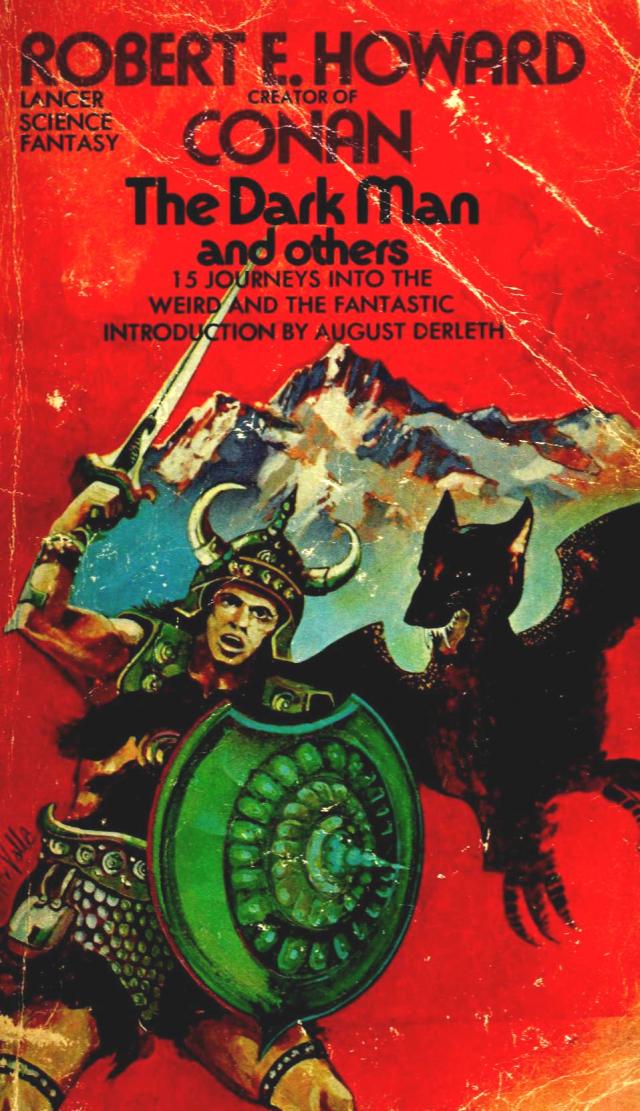
The Dark Man and Others, page 1


18-03-2024
Conversion from a new scan
ROBERT ERVIN HOWARD, 1906-1936
Most famous today for his creation of the fantasy hero, Conan the Cimmerian, Robert Ervin Howard was born and spent all his short life in Texas. He began to write at the age of 15; his first professional tale, Spear and Fang, appeared in the July 1925 issue of Weird Tales. Soon he was one of the most popular contributors to that periodical, with the Conan stories, and with such other memorable characters as Solomon Kane, King Kull, and Bran Mak Mom. He did not limit himself to fantasy, however; he also wrote a great many stories for the sports, detective, historical, and other adventure magazines of the day. He took his own life when he was unable to adjust to the imminent death of his mother.
Other Lancer fantasy and science fiction you will like …
CONAN THE BUCCANEER, L. Sprague de Camp & Lin Carter. #75-181, 95/.
The latest in the continuation of Robert E. Howards most famous fantasy series!
STAR WOLF, Ted White. #75-252, 95/.
The long-awaited conclusion to the trilogy begun with PHOENIX PRIME and THE SORCERESS OF QAR!
THE SHORES OF TOMORROW, David Mason. #75-217, 95/.
War across the time lines!
SPACE FOR HIRE, William F. Nolan. #74-778, 75/.
Dark and wacky, in the tradition of Vonnegut, TAU ZERO, Poul Anderson. #75-185, 95/.
“The ultimate ‘hard science fiction* novel” —James Blish
INFINITY TWO, edited by Robert Hoskins. #75-166, 95/.
New stories by Anderson, Clarke, Silverberg and other masters of science fiction.
Nationally distributed by Curtis Circulation Company. If not available from your local dealer, order from: Lancer Books, Inc., Dept. D, 1560 Broadway, New York 10036. Please order by book number, and enclose 10¢ extra per copy for postage and handling. No handling charge on orders of four or more copies.
The Dark Man
and others
ROBERT E. HOWARD
LANCER BOOKS NEW YORK
A LANCER BOOK
THE DARK MAN and OTHERS
Copyright © 1963 by August Derleth
All rights reserved
Printed In the U.8.A.
This Lancer edition is published by arrangement with Arkham
House. Its large sale in the high-priced hardcover edition makes possible this inexpensive reprint
The Voice of El-Lil, copyright 1930 by The Popular Fiction Publishing Company, for Oriental Stories, October-November 1930.
Pigeons from Hell, copyright 1938 by The Popular Fiction Publishing Company, for Weird Tales, May 1938.
The Dark Man, copyright 1931 by The Popular Fiction Publishing Company, for Weird Tates, December 1931.
The Gods of Bal-Sagoth, copyright 1931 by The Popular Fiction Publishing Company, for Weird Tales, October 1931.
People of the Dark, copyright 1932 by The Clayton Magazines, Inc., for Strange Tales, June 1932.
The Children of the Night, copyright 1931 by The Popular Fiction Publishing Company, tor Weird Tales, April-May 1931.
The Dead Remember, copyright 1936 by The Frank A. Munsey Company, for Argosy, August 15, 1936.
The Man on the Ground, copyright 1933 by The Popular Fiction Publishing Company, for Weird Tales, July 1933.
The Garden of Fear, copyright 1934 by Fantasy Publications.
The Thing on the Roof, copyright 1932 by The Popular Fiction Publishing Company, for Weird Tales, February 1932.
“The Hyena, copyright 1928 by The Popular Fiction Publishing Company, for Weird Tales, March 1928.
Dig Me No Grave, copyright 1937 by The Popular Fiction Publishing Company, for Weird Tales, February 1937.
The Dream Snake, copyright 1928 by The Popular Fiction Publishing Company, for weird Tales, February 1928.
In the Forest of Villefére, copyright 1925 by The Popular Fiction Publishing Company, for Weird Tales, August 1925.
Old Garfield’s Heart, copyright 1933 by The Popular Fiction Publishing Company, tor Weird Tales, December 1933.
LANCER BOOKS, INC. • 1560 BROADWAY
NEW YORK, N.Y. 10036
Table of Contents: ~
Introduction by AUGUST DERLETH
The Voice of El-Lil
Pigeons From Hell I. The Whistler tn the Dark
2. The Snake’s Brother
3. The Call of Zuvembie
The Dark Man
The Gods of Bal-Sagoth 1. Steel in the Storm
2. Gods from the Abyss
3. The Fall of the Gods
4. Empire
People of the Dark
The Children of the Night
The Dead Remember
The Man on the Ground !
The Garden of Fear
The Thing on the Roof
The Hyena
Dig Me No Grave
The Dream Snake
In the Forest of Villefère
Old Garfield’s Heart
Introduction by AUGUST DERLETH
The late Robert Ervin Howard (1906-1930) was primarily an entertainer. He drew upon a rich imagination and a thorough knowledge of his region as well as of certain areas of past time for his fiction, particularly Celtic history. Howard had within his creative capacities the ability to become a major regional writer, but he did not live long enough to permit the necessary refining process to take place, and he was doomed by a fatal flaw—the preoccupation of his father, a small town doctor in Texas, with his profession, left him so much alone in the company of his mother that he developed for her so deep an attachment that it seemed only natural for him to think that her death demanded that he take his own life, which he did.
H. P. Lovecraft wrote of him, in memoriam, as “a genuine artist’
’ who was “almost alone in his ability to create real emotions of spectral fear and dread suspense.” None can gainsay that. Whatever his flaws—and they were many—Howard took his work seriously. He was facile, as a writer, but to a certain depth, and everything he wrote was colored with his personality—rugged, hearty, not insensitive, wonderfully imaginative—and to a very real degree, he put himself into every story he ever wrote, and all his memorable characters—King Kull, Conan the Cimmerian, Solomon Kane, Sailor Steve Costigan, Bran Mak Mom, et al.—reflect Howard himself, the self-picture he had in the intimate arena of his personal fantasy.
The quality of Howard’s work varied widely. He saw himself as akin to the ancient tellers of tales, before the written word; his forte was entertainment solely, but entertainment solidly grounded in history and region. Most of his work., flowed from his typewriter ‘with ease—much to be published unchanged, some to be extensively revised, some to be discarded as unpublishable. His poetry was a diversion; as a poet Howard caused not so much as a ripple in the main stream of American poetry, for his allegiance was to such older forms as the ballad.
Writers for the so-called pulp magazines—which are no longer part of the American scene as they once were some decades ago—flowered briefly, faded, and were forgotten. The exceptions were rare indeed. H. P. Love craft was one such exception; Robert E. Howard—though poles away from Lovecraft in many respects—is another. A small, but devoted following keeps the names of such authors very much alive, and this fact in itself is tribute to the creative skill which each possessed.
The best of Howard’s work appeared in the memorial volume, Skull-Face and Others. The stories in this collection are no less readable. Like all Howards work, they carry the reader along, they involve him, and this is surely the acid test of all creative work. They include no story previously collected in a book under Howard’s byline, and they represent a few hours of pleasant, exciting, and fearful entertainment in the domain of the macabre in which Robert E. Howard always wrote with a sure hand.
The Voice of El-Lil
Muskat, like many another port, is a haven for the drifters of many nations who bring their tribal customs and peculiarities with them. Turk rubs shoulders with Greek and Arab squabbles with Hindoo. The tongues of half the Orient resound in the loud smelly bazaar. Therefore it did not seem particularly incongruous to hear, as I leaned on a bar tended by a smirking Eurasian, the musical notes of a Chinese gong sound clearly through the lazy hum of native traffic. There was certainly nothing so startling in those mellow tones that the big Englishman next to me should start and swear and spill his whiskey-and-soda on my sleeve.
He apologized and berated his clumsiness with honest profanity, but I saw he was shaken. He interested me as his type always does—a fine upstanding fellow he was, over six feet tall, broad-shouldered, narrow-hipped, heavy-limbed, the perfect fighting man, brown-faced, blue-eyed and tawny-haired. His breed is old as Europe, and the man himself brought to mind vague legendary characters—Hen gist, Hereward, Cedric—born rovers and fighters of the original barbarian stock.
I saw, furthermore, that he was in a mood to talk. I introduced myself, ordered drinks and waited. My specimen thanked me, muttered to himself, quaffed his liquor hastily and spoke abruptly:
“You’re wondering why a grown man should be so suddenly upset by such a small thing—well, I admit that damned gong gave me a start. It s that fool Yotai Lao, bringing his nasty joss sticks and Buddhas into a decent town—for a halfpenny I’d bribe some Moslem fanatic to cut his yellow throat and sink his confounded gong into the gulf. And HI tell you why I hate the thing.
“My name,” he said, “is Bill Kirby. It was in Jibuti on the Gulf of Aden that I met John Conrad. A slim, keen-eyed young New Englander he was—professor too, for all his youth. Victim of obsession also, like most of his kind. He was a student of bugs, and it was a particular bug that had brought him to the East Coast; or rather, the hope of the blooming beast, for he never found it. It was almost uncanny to see the chap work himself into a blaze of enthusiasm when speaking on his favorite subject No doubt he could have taught me much I should know, but insects are not among my enthusiasms, and he talked, dreamed and thought of little else at first…
“Well, we paired off well from the start. He had money and ambitions and I had a bit of experience and a roving foot We got together a small, modest but efficient safari and wandered down into the back country of Somaliland. Now you’ll hear it spoken today that this country has been exhaustively explored and I can prove that statement to be a lie. We found things that no white man has ever dreamed of.
“We had trekked for the best part of a month and had gotten into a part of the country I knew was unknown to the average explorer. The veldt and thorn forests gave way to what approached real jungle and what natives we saw were a thick-lipped, low-browed, dog-toothed breed—not like the Somali at all. We wandered on though, and our porters and askari began muttering among themselves. Some of the black fellows had been hobnobbing with them and telling them tales that frightened them from going on. Our men wouldn’t talk to me or Conrad about it, but we had a camp servant, a half-caste named Selim, and I told him to see what he could learn. That night he came to my tent We had pitched camp in a sort of big glade and had built a thorn boma; for the lions were raising merry Cain in the bush.
“‘Master’. ” he said in the mongrel English he was so proud of, ’them black fella he is scaring the porters and askari with bad ju-ju talk. They be tell about a might ju-ju curse on the country in which we go to, and—’
“He stopped short, turned ashy, and my head jerked up.
Out of the dim, jungle-haunted mazes of the south whispered a haunting voice. Like the echo of an echo it was, yet strangely distinct, deep, vibrant, melodious. I stepped from my tent and saw Conrad standing before a fire, taut and tense as a hunting hound.
“‘Did you hear that?” he asked. ‘What was it?’
“‘A native drum,’ I answered—but we both knew I lied. The noise and chatter of our natives about their cooking-fires had ceased as if they had all died suddenly.
“We heard nothing more of it that night, but the next morning we found ourselves deserted. The black boys had decamped with all the luggage they could lay hand to. We held a council of war, Conrad, Selim and I. The half-caste was scared pink, but the pride of his white blood kept him carrying on.
“‘What now?’ I asked Conrad. ‘We’ve our guns and enough supplies to give us a sporting chance of reaching the coast’
“Listen!’ he raised his hand. Out across the bush-country throbbed again that haunting whisper. ‘We’ll go on. I’ll never rest until I know what makes that sound. I never heard anything like it in the world before.’
“The jungle will pick our bally bones.” I said. He shook his head.
“‘Listen!’ he said.
“It was like a call. It got into your blood. It drew you as a fakir’s music draws a cobra. I knew it was madness. But I didn’t argue. We cached most of our duffle and started on. Each night we built a thorn boma and sat inside it while the big cats yowled and grunted outside. And ever clearer as we worked deeper and deeper in the jungle mazes, we heard that voice. It was deep, mellow, musical It made you dream strange things; it was pregnant with vast age. The lost glories of antiquity whispered in its blooming. It centered in its resonance all the yearning and mystery of life; all the magic soul of the East I awoke in the middle of night to listen to its whispering echoes, and slept to dream of sky-towering minarets, of long ranks of bowing, brown-skinned worshippers, of purple-canopied peacock thrones and thundering golden chariots.
“Conrad had found something at last that rivalled his infernal bugs in his interest. He didn’t talk much; he hunted insects in an absent-minded way. All day he would seem to be in an attitude of listening, and when the deep golden notes would roll out across the jungle, he would tense like a hunting dog on the scent, while into his eyes would steal a look strange for a civilized professor. By Jove, it’s curious to see some ancient primal influence steal through the veneer of a cold-blooded scientist’s soul and touch the red flow of life beneath! It was new and strange to Conrad; here was something he couldn’t explain away with his newfangled, bloodless psychology.
‘‘Well, we wandered on in that mad search—for it’s the white man’s curse to go into Hell to satisfy his curiosity. Then in the gray light of an early dawn the camp was rushed. There was no fight We were simply flooded and submerged by numbers. They must have stolen up and surrounded us on all sides; for the first thing I knew, the camp was full of fantastic figures and there were half a dozen spears at my throat It rasped me terribly to give up without a shot fired, but there was no bettering it, and I cursed myself for not having kept a better lookout. We should have expected something of the kind, with that devilish chiming in the south.
“There were at least a hundred of them, and I got a chill when I looked at them closely. They weren’t black boys and they weren’t Arabs. They were lean men of middle height, light yellowish, with dark eyes and big noses. They wore no beards and their heads were close-shaven. They were clad in a sort of tunic, belted at the waist with a wide leather girdle, and sandals. They also wore a queer land of iron helmet, peaked at the top, open in front and coming down nearly to their shoulders behind and at the sides. They carried big metal-braced shields, nearly square and were armed with narrow-bladed spears, strangely made bows and arrows, and short straight swords as I had never seen before—or since.
“They bound Conrad and me hand and foot and they butchered Selim then and there—cut his throat like a pig while he kicked and howled. A sickening sight—Conrad nearly fainted and I dare say I looked a bit pale myself. Then they set out in the direction we had been heading, making us walk between them, with our hands tied behind our backs and their spears threatening us. They brought along our scanty dunnage, but from the way they carried the guns I didn’t believe they knew what those were for. Scarcely a word had been spoken between them and when I essayed various dialects I only got the prod of a spear-point Their silence was a bit ghostly and altogether ghastly. I felt as if we’d been captured by a band of spooks.
“I didn’t know what to make of them. They had the look of the Orient about them but not the Orient with which I was familiar, if you understand me. Africa is of the East but not one with it. They looked no more African than a Chinaman does. This is hard to explain. But I’ll say this: Tokyo is Eastern, and Benares is equally so, but Benares symbolizes a different, older phase of the Orient, while Pekin represents still another, and older one. These men were of an Orient I had never known; they were part of an East older than Persia—older than Assyria—older than Babylon! I felt it about them like an aura and I shuddered from the gulfs of time they symbolized. Yet it fascinated me, too. Beneath the Gothic arches of an age-old jungle, speared along by silent Orientals whose type has been forgotten for God knows how many eons, a man can have fantastic thoughts. I almost wondered if these fellows were real, or but the ghosts of warriors dead four thousand years!
“The trees began to thin and the ground sloped upward. At last we came out upon a sort of cliff and saw a sight that made us gasp. We were looking into a big valley surrounded entirely by high, steep cliffs, through which various streams had cut narrow canyons to feed a good-sized lake in the center of the valley. In the center of the lake was an island and on that island was a temple and at the farther end of the lake was a city! No native village of mud and bamboo, either. This seemed to be of stone, yellowish-brown in color.
“The city was walled and consisted of square-built, flat-topped houses, some apparently three or four stories high. All the shores of the lake were in cultivation and the fields were green and flourishing, fed by artificial ditches. They had a system of irrigation that amazed me. But the most astonishing thing was the temple on the island.


