

When the Gods Are Away, page 1


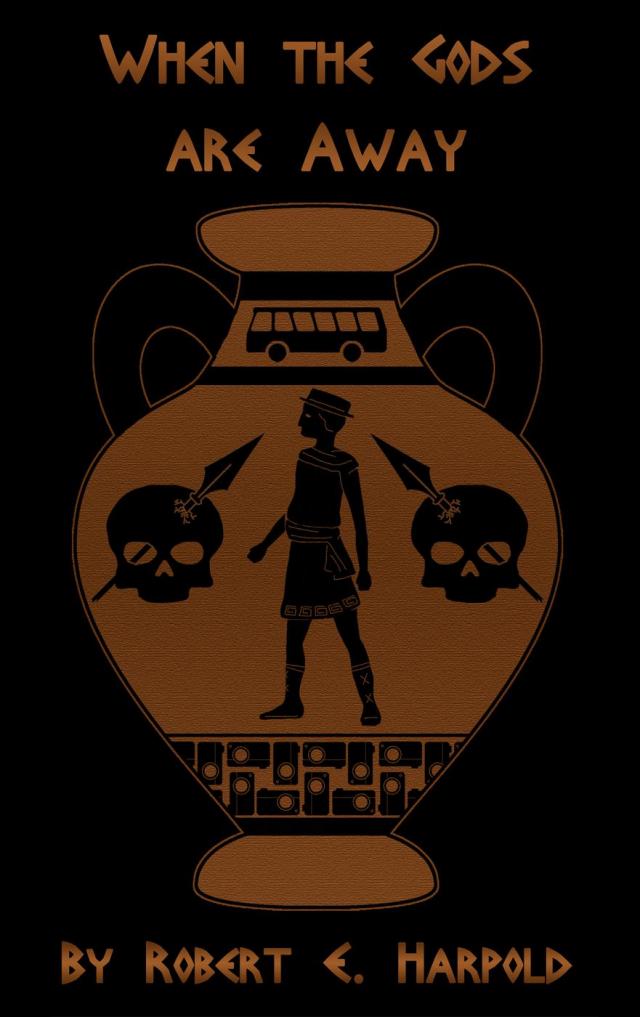
When the Gods Are Away
by Robert E. Harpold
Copyright 2021 Robert E. Harpold. All rights reserved.
Cover illustration by Amanda Fox.
Dedicated to my wonderful wife, Julie. Thank you for your constant support, encouragement, and love.
Table of Contents
When the Gods Are Away
Chapter 01
Chapter 02
Chapter 03
Chapter 04
Chapter 05
Chapter 06
Chapter 07
Chapter 08
Chapter 09
Chapter 10
Chapter 11
Chapter 12
Chapter 13
Chapter 14
Chapter 15
Chapter 16
Chapter 17
Chapter 18
Chapter 19
Chapter 20
Chapter 21
Chapter 22
Chapter 23
Chapter 24
Chapter 25
Chapter 26
Chapter 27
Chapter 28
Chapter 29
Chapter 30
Chapter 31
Afterword and Acknowledgments
Chapter 01
BLASPHEMER'S WEEK ALWAYS began with bloodshed.
Virgil bit into his baklava, the taste of sugar mingling with the aroma of corpse in a pleasantly familiar alchemy. Flakes of pastry fluttered to the tiled kitchen floor and settled beside the subject of today’s investigation, the former Nicholas Manikas. The body lay before the food-stained refrigerator, eyes open, mouth twisted in pain. One hand clutched a tub of butter and the other a corresponding knife, neither of which had proven effective in countering his assailant. Dried blood led from a pool on the tile to the gaping wound in his dark green house tunic. Probable cause of death: spear to the chest.
Not a typical death for a former police officer. The killer could expect a lethal reprisal of the most protracted sort, which characterized him as either ignorant and unprepared or dangerous and cunning. Virgil adjusted his short-brimmed hat. Dangerous and cunning, then.
Virgil crammed the remaining pastry into his mouth and knelt beside the body, trying to recall the appropriate procedures for an investigation. Everything went blank, all the notes and practice sessions disappearing as though he had sipped from the river Lethe. His professor would have been furious at all the time wasted on Virgil.
The thought of blood flooding the capillaries in Professor Lambros’ face gave Virgil the answer: examine the spear wound. His thumb covered the diameter of the slit skin, which resembled a tunic’s burst seam. As he probed the wound’s perimeter, his finger rode up and down the jagged edges as though driving along hills. Inconclusive results, then: several spear designs could have made such a shape.
As he wiped his finger on the victim’s tunic, thick boots clicked on the tiled floor. Virgil started, reaching his hands behind him to prevent himself from toppling backward. Chief Dimitriou had arrived.
Chief Dimitriou wasn’t tall in the conventional sense, but walked like he was, all weight and swagger. He wore the blue uniform of the Arestia Police Department, its golden badge depicting a skull pierced with a spear. The chief had probably come to remove Virgil from the investigation as he had for the previous six cases, always within minutes of the assignment. Maybe the removals weren’t strictly legal, and maybe Virgil should have protested more, but he hesitated to provoke someone with the city-state police department’s all-time kill record.
The chief glowered at the corpse. “Well?” The question ended there, as though complete without content or context.
Virgil opened his mouth to speak, but no sound emerged. A bad start to his seventh first case.
The chief folded his arms across his chest. “What have you got for me, Virgil?”
Virgil spread the bottom of his loose tunic across his slacks. “He died from a spear wound...”
“Obviously.” The chief’s voice sounded as though it had bathed for days in disdain before oozing forth. He glanced at Manikas’ remains with an expression of either paternal sadness or revulsion. "I hope our priest gives us more leads than 'he was killed by a spear.'”
“Priest?” The more progressive city-states near Athens used priests to aid investigations, but Virgil had never expected it from Arestia.
“Someone killed one of our own.” The chief kicked the client’s bare leg in a friendly, bruising fashion. “Even if it was just Nicholas, we will have retribution.”
Virgil continued to crouch, expecting his investigation’s death sentence at any moment. As the moments passed and the chief's expression remained unchanged, Virgil began to feel something foreign deep within his chest that might have been... hope. He gathered his nerve as though preparing to leap from a cliff into icy waters below.
“I need more...” But the chief had already turned away. “Time.”
The chief exited the kitchen. Maybe he would be more receptive to Virgil’s work for once.
Maybe Zeus will give me a pony at the next solstice celebration.
The chief seemed unusually interested in finding this murderer. Maybe it was because the victim was a former police officer. Or the chief might have an ulterior motive. The thought reminded him of something Professor Lambros would have said: "Trust no one, not even yourself."
The professor would also have beat him about the head for not checking the body's stiffness earlier. Virgil grabbed the client’s arm above the spindly wrist, applying a slight pressure to bend it upward. As the arm rotated, the butter knife slipped from Manikas’ cold hand and clattered to the floor.
Virgil's face burned. He had disturbed the crime scene and contaminated the evidence. Why am I even here? Why did anyone ever allow me to work on an important task like this? He imagined stabbing his leg with the knife over and over until the shame disappeared.
No. He couldn’t think like that. These negative thoughts were one reason his sister Chrysanthe had pressured him to start therapy. He had his first appointment tomorrow. Virgil sighed. Therapy hadn't even started, and it already wasn't working.
Virgil forced himself to focus on the corpse. Analyze the posture and tension. Muscles tight in the client’s face and neck. Stiffness in the arm? How stiff are arms normally? Virgil felt his own. Manikas' was stiffer, but not rigid. Rigor mortis peaks after, what, twelve hours? That figure put the time of death between three and six hours ago. The opening hours of Blasphemer's Week, when people indulged in vandalism, theft, and murder without fear of reprisal from the gods.
Virgil took hold of Manikas' arm, returned it to its original position with the palm facing upward, and slid the knife between thumb and fingers. Close enough. He rubbed his sore eyes, wishing he had managed to sleep for at least a few minutes before the chief's early-morning call.
"Virgil!" Even from two rooms away, the chief's voice sounded as though it came from a spot beside Virgil's ear. "Get your pudgy ass in the living room!"
As Virgil crossed the apartment’s entryway, two uniformed figures emerged from the living room and pushed past him. One applied a vigorous shoulder, sending Virgil stumbling into the wall.
"Sorry," said Virgil.
Neither officer glanced at him. Schirra, a tall woman with prominent muscles, carried a hammer and a rolled-up canvas under her arm as she strode to the front door. Stathis, one of the typical muscular goons the department preferred to hire, held a hammer and a fistful of nails. Both officers wore regulation Helios sunglasses despite being indoors.
Virgil eyed their tools. “What are—"
“Quiet.” Stathis didn’t turn as he took a position opposite Schirra.
Virgil tried to remain still as he observed them. This activity wasn't typical police work.
Schirra unrolled the canvas and handed one end to her partner. "I can't believe we're nailing crap to the door. Waste of time and talent." She accepted a nail from Stathis and placed it against the canvas’ upper left corner above the doorframe. "Remember that shoplifter we caught the other day?"
Stathis grinned. "Yeah. I like it when they struggle."
Schirra hammered the nail in place, the echoes of metal against metal reverberating in the entryway. Stathis attacked his own nail with an approach based more on force than efficiency.
Virgil covered his ears and examined the canvas. It looked like several plain goatskins sewn together. Maybe the temple priests had performed some sort of prayer over it to make it more receptive for whatever it was supposed to do. A holy goatskin or an arcane goatskin or something. “Oh! This is for the ritual.”
“Do you think we’d be nailing goatskin to a door otherwise?” Schirra hammered a nail into the bottom corner, just under the lower doorframe, as Stathis finished his first corner.
“The priest, Patroklus, said it would catch emotions or something.” Stathis knelt to nail the final corner into place. “He said it worked in other city-states. I guess the chief’s trying everything on this case. Still sounds like a bad idea to have priests involved in law enforcement. Or detectives.”
Stathis locked eyes with Virgil while hammering in the last corner. The officer didn’t look away, even when the hammer hit his thumb.
Virgil winced. “I think—"
Schirra laughed. "When have you ever thought? Here's something to think about: Nicholas might be alive if he hadn’t been fired to make room for you.”
Is that true? Virgil had been surprised his hometown p olice department had hired him, and he'd heard rumors that the Alliance had forced individual city-states to employ detectives, but he hadn't known the department had fired someone to create an opening for him.
Even when he tried to do something good, he ruined someone’s life. He owed a debt to Manikas.
“Um," said Virgil. "Was he the worst officer or something? Was that why he was fired instead of someone else?"
Schirra and Stathis stared at him as though he had just shat on their shoes.
"Sorry." Virgil took a step toward the living room. "I shouldn't have said that. I don't know what I was thinking. I'm just stupid."
The officers continued staring.
“Um,” said Virgil. “Do... do you think the priest's spell will work? You know it’s Blasphemer’s Week and th—“
“Ask Patroklus if you’re really that curious.” Stathis set his hammer down. "Now get out. Just looking at you is pissing me off."
When Virgil hesitated, Schirra pointed to the doorway. “You’re dismissed.”
Virgil nodded. “Sorry. I’ll go now. I’ll just be...” He sidled from the entryway and into the living room.
Manikas had decorated the living room in typical Spartan fashion: no wall art and few furniture items. It had a table and two severe wooden chairs, the kind that haunted the dreams of chiropractors. Chief Dimitriou occupied the nearest one. Spears, maces, and other weapons hung from the walls, positioned for easy retrieval. No vacant hooks or shelves, which meant the murderer had either brought his own weapon or had returned the weapon to its proper place after use. Training weights rested in a corner. Given the victim’s physique, Manikas must have used them for décor.
“Get over here!” Chief Dimitriou slammed a fist into the table.
“Sorry!” Virgil hustled to the spot beside the chief, though he didn’t know why Dimitriou insisted on hurrying. The ritual wasn’t ready yet.
“Schirra!” No matter how much the chief shouted, his voice never grew hoarse. “Get in here, and bring Stathis! Assuming your woman genes will let you stop interior-decorating.” He chuckled to himself.
A moment later, Schirra and Stathis entered. Schirra’s expression could have melted iron, but the chief didn’t seem to notice. She and Stathis took places standing opposite Virgil.
“I love this time of year.” The chief glared with the same effort bodybuilders put into weightlifting. “This is always our busiest week. Ever since I was elected chief, we’ve had a murder on the twenty-ninth day of Hera. Always early in the morning on the twenty-ninth, too, like the murderers were just waiting for this week.”
“My favorite time of year is the autumnal equinox,” said Stathis.
The chief grimaced. “Son, no one gives a shit.”
Stathis hid his hurt expression almost as it formed. Virgil might have felt sorrier for him if not for their previous conversation.
The chief glanced at his watch, and his frown deepened. “Stathis, text Patroklus and tell him to hurry up.”
Before Stathis could pull his phone from his pocket, shadows wavered against the far wall. Without even the shuffle of clothing or the tap of feet against stone to announce his entrance, a man emerged like the breeze from an open window. He wore a long red robe that flicked across the floor and created the illusion that its occupant glided atop a cushion of air. The man’s golden hair fell below his shoulders, swaying in time with the undulation of his robe. His eyes seemed to focus on some distant ethereal vision as he traversed the distance to Virgil and the others.
Patroklus. Virgil had seen the priest on occasion in the police headquarters hallways, but had never worked with him.
Patroklus didn’t speak when he reached them, nor did he acknowledge their presence. Instead, he took the remaining seat across from the chief and produced a mixing bowl from his voluminous sleeves. A burnt-sponge odor rose from the bowl, reminding Virgil of the herbs used when he had attended sacrifices to Ares as a child. Patroklus set the bowl on the table without making a sound.
The chief glared at the new arrival. “Ready?”
“I am.” The priest’s reply had less inflection than a computer tone.
“Good. Find me someone to kill.”
“This procedure,” said the priest, “will locate and display any strong emotions within this apartment. Those emotions will have belonged to the occupant, as he has spent much time here and his feelings will have infused the walls of this place. Those emotions might be hatred, sadness, or love, and will likely provide a clue as to what happened here. The procedure will not, however, indicate who should be killed.”
“Whatever. Just hurry.”
“Very well.” Patroklus removed a spoon from one of his pockets, stirred the bowl’s contents, then set the spoon beside the bowl. “Please join hands.”
The chief slammed his hand into Stathis’, who took Schirra’s hand. Patroklus enveloped Virgil’s hand, applying only the minimum pressure necessary to maintain contact. The chief paused and scowled before taking Virgil’s other hand, completing the circle.
Virgil had never seen functional magic before. Only pop magic, like fireworks or smoke shapes at festivals. He wondered if the priest's magic would feel more or less impressive than those colorful tricks.
“Relax,” Patroklus intoned in a soporific voice. “Free your mind and feel at peace. As the ties binding you to your body gently dissolve, close your eyes.”
Virgil watched as his coworkers obeyed, then realized he should do the same. At least, with their eyes closed, they hadn’t noticed the lapse. If they suspected him of lack of faith...
Patroklus continued speaking without pause, his words washing over Virgil like waves at the beach. “Become as one with the world around you. Let your flesh feel the air, its warmth and pressure. Feel the power flowing through every molecule.” As Patroklus spoke, a thin current of electricity traveled from Virgil’s shoulder to his fingertips, jumping between the hairs on his arm. Another line trickled down his other arm, then over his legs and chest until tingles danced atop every square centimeter of skin. Virgil squirmed and felt relieved to hear the officers shift position, too. Patroklus gave no indication he noticed the sensation.
“We are part of the world. This one and the next. The seen and the unseen. The physical and the spiritual. We have broken the barriers separating us. All is one.”
A gust of wind shook Virgil’s clothes and threatened to tear his hat from his head. He opened his eyes to slits. His colleagues were struck by the gale as well, though the curtain, shelves, and weapons throughout the room remained in serene repose. Much more impressive than festival spells.
If the ritual works during Blasphemer’s Week, though, how can anyone believe the gods have anything to do with it? Virgil closed his eyes again and buried the thought.
“We may speak with the gods,” said Patroklus in a whisper. Virgil shivered, more from the tone and events around him than at the notion of speaking to beings who might not exist.
“Wise Athena,” Patroklus droned with a voice as soothing as a seashore breeze, “goddess of truth and wisdom, hear our supplication and accept our offering. Guide us that we might learn and so bring justice to the fallen and glory to your name. Grant us the sight of powerful emotions experienced within this household so that we may better understand the tragedy that has befallen the victim.”
A dim roar crescendoed from nothingness until it filled Virgil’s ears, like the deep thrumming of an engine. Brightness beat upon him until he opened his eyes again. A faint spark popped near the priest’s head, followed by another and another until they surrounded Patroklus, shimmering.
“Our prayer has been heard,” said Patroklus. “We give thanks to Athena.” In an instant, the dim roar, the wind, and the thin electric charge disappeared as though they had never existed. Virgil lifted his head to see Patroklus’ hand float free from the circle and produce a pinch of powder from within his robe. Spreading his fingers, the priest let the powder fall into the bowl.
Once the first granule came into contact with the herbs, a blinding light burst from the bowl. Virgil shut his eyes, letting the afterimages play across the backs of his eyelids. The images faded a moment later, and he could see again.
The chief grunted. “Schirra, Stathis, check the canvas.”
The two officers jumped to their feet, Stathis following Schirra to the entryway.


