

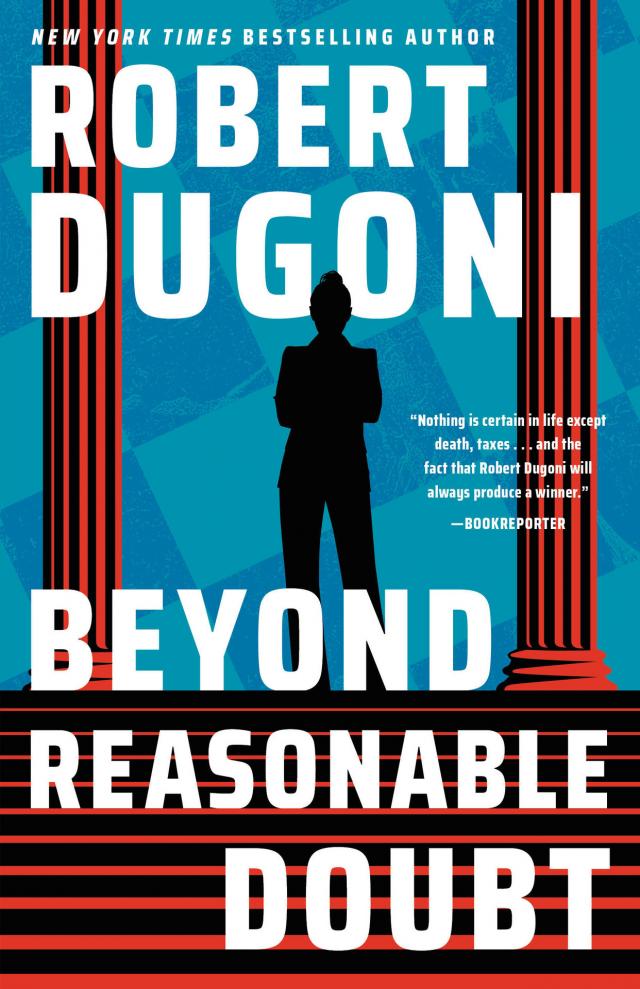
Beyond Reasonable Doubt (Keera Duggan), page 1


PRAISE FOR HER DEADLY GAME
“Fast-paced legal-intrigue gold that could be improved only by kicking off a new series.”
—Kirkus Reviews (starred review)
“Twist-filled . . . John Grisham fans will be pleased.”
—Publishers Weekly
“Justice has rarely been this compelling.”
—Criminal Element
“Another simply riveting novel from Robert Dugoni, Her Deadly Game is original, deftly crafted, and a fun read from first page to last for anyone with an interest in murder mysteries and suspense thrillers.”
—Midwest Book Review
“Her Deadly Game is one of the best murder trial tales to come along in recent years. It’s superb.”
—Winnipeg Free Press
“One of the best puzzle books ever! I raced through the pages, which are packed full of compelling characters and taut gamesmanship, desperate to learn the answer to this extraordinary thriller, which is both whodunit and how-dunit. I would follow Robert Dugoni anywhere.”
—Lisa Gardner, #1 New York Times bestselling author
“I adore Robert Dugoni’s legal thrillers, and Her Deadly Game is his best one yet. I loved Keera Duggan’s strength and her heart, which shine through the pages, and I rooted for her every step of the way through this unputdownable story.”
—Lisa Scottoline, New York Times bestselling author
“Absolutely riveting. A juicy tale that will leave readers hungry for more.”
—Victor Methos, bestselling author of The Secret Witness
“Robert Dugoni has done it again—created a twisty puzzle-box story with one of the most satisfying, jaw-dropping endings I’ve read in a long time. Part murder mystery, part courtroom drama, and part character study of fascinating chess prodigy turned defense attorney Keera Duggan, Her Deadly Game will keep you reading late into the night.”
—Angie Kim, international bestselling author of Miracle Creek
ALSO BY ROBERT DUGONI
A Killing on the Hill
The World Played Chess
The Extraordinary Life of Sam Hell
The 7th Canon
Damage Control
The Keera Duggan Series
Her Deadly Game
The Tracy Crosswhite Series
My Sister’s Grave
Her Final Breath
In the Clearing
The Trapped Girl
Close to Home
A Steep Price
A Cold Trail
In Her Tracks
What She Found
One Last Kill
“The Last Line” (a short story)
“The Academy” (a short story)
“Third Watch” (a short story)
The Charles Jenkins Series
The Eighth Sister
The Last Agent
The Silent Sisters
The David Sloane Series
The Jury Master
Wrongful Death
Bodily Harm
Murder One
The Conviction
Nonfiction with Joseph Hilldorfer
The Cyanide Canary
This is a work of fiction. Names, characters, organizations, places, events, and incidents are either products of the author’s imagination or are used fictitiously. Otherwise, any resemblance to actual persons, living or dead, is purely coincidental.
Text copyright © 2024 by La Mesa Fiction LLC
All rights reserved.
No part of this book may be reproduced, or stored in a retrieval system, or transmitted in any form or by any means, electronic, mechanical, photocopying, recording, or otherwise, without express written permission of the publisher.
Published by Thomas & Mercer, Seattle
www.apub.com
Amazon, the Amazon logo, and Thomas & Mercer are trademarks of Amazon.com, Inc., or its affiliates.
ISBN-13: 9781662517990 (hardcover)
ISBN-13: 9781662500220 (paperback)
ISBN-13: 9781662500237 (digital)
Cover design by Jarrod Taylor
Cover images: © Katsiaryna Chumakova / Shutterstock; © Greens87 / Shutterstock
First edition
To my wife, Cristina, for giving me the best life a husband and father could ever ask for. You deserve all the credit.
Contents
Start Reading
Prologue
Part I
Chapter 1
Chapter 2
Chapter 3
Chapter 4
Chapter 5
Chapter 6
Chapter 7
Chapter 8
Chapter 9
Chapter 10
Chapter 11
Chapter 12
Chapter 13
Chapter 14
Chapter 15
Chapter 16
Chapter 17
Chapter 18
Chapter 19
Chapter 20
Chapter 21
Chapter 22
Chapter 23
Chapter 24
Chapter 25
Chapter 26
Chapter 27
Part II
Chapter 28
Chapter 29
Chapter 30
Chapter 31
Chapter 32
Chapter 33
Chapter 34
Chapter 35
Chapter 36
Chapter 37
Chapter 38
Acknowledgments
About the Author
It is better to risk saving a guilty person than to condemn an innocent one.
—Voltaire
Prologue
Five Years Ago
Seattle, Washington
Erik Wei did not choose the South Lake Union restaurant for its eclectic ambiance, nor for the excellent food, nor even for its location—walking distance from work; he chose the restaurant because it was popular, which would ensure a crowd, even on a weeknight.
He chose it because he’d feel safe.
He made an eight-thirty reservation for two. Then he scanned his pass in the secure building lobby, registering the exact time he left the office. Once outside, Wei walked several blocks in the comfortable, seventy-degree temperature before he pressed the send button on his cell phone and deployed his text bomb to Jenna Bernstein, his CEO at Ponce de León Restorative Technology. He didn’t want to be anywhere near the office when she imploded.
Wei worked as chief scientist at PDRT, one of the dozens of biotech companies centered in South Lake Union. He’d earned his PhD from the University of Washington in biotechnology and nanotechnology and had fulfilled his desire to work in “the neighborhood Paul Allen built.” Allen, the deceased Microsoft cofounder and Star Trek fan, had formed Vulcan Inc. and used some of his billions to demolish old buildings and develop a state-of-the-art office and residential area, which attracted innovative start-ups and research institutions that might just change the world.
PDRT sat atop the list.
Wei’s work cell phone buzzed. A text.
Where are you?
His text bomb had landed. Bernstein. Curt. Did not sound happy.
He did not reply. His text had been clear about where he would be.
He tried to curb his imagination. He half expected to hear tires screech and see the black Escalade speed down the block and skid to a stop alongside him. PDRT security would jump from the car, hustle him inside, and whisk him away, never to be seen or heard from again.
But that only happened in the movies; didn’t it?
He picked up his pace.
In his text, he had told Bernstein his concerns and his intentions, but he also gave her the chance to meet, should she have something to change his mind. She deserved that much. Bernstein had given her blood, sweat, and tears to PDRT, and she had given Wei’s career a start.
She’d meet him at the restaurant.
He’d given her little choice.
If she didn’t, he’d speak with the regulatory agencies. It would cost him his job, and he’d likely be sued for breaching the strict confidentiality clause in his employment contract, but he no longer cared. PDRT wasn’t developing an app with bugs that could cause users minor inconveniences. PDRT sought to revolutionize medicine by commercializing tissue nanotransfection (TNT). PDRT’s product, the LINK, had the potential to inject genetic material directly into a person’s skin cells, thereby altering them, without invasive medical procedures. The applications were endless—curing or alleviating the world’s deadliest diseases and regenerating failing organs. Heretofore, Star Trek science-fiction fantasy.
Then again, flip phones and MRI machines were once Star Trek science-fiction fantasies. Technology had made those fantasies realities.
PDRT boldly touted the LINK as the “Fountain of Youth,” and the device had generated unprecedented excitement from pharmaceutical companies who desired to sell it, insurance companies hoping to dramatically cut their insureds’ medical costs, independent investors looking to make millions, and the US military, which sought to quickly cure its wounded. Just twenty-two years of age and a new University of Washington graduate, Jenna Bernstein had procured $12 million during PDRT’s first round of financing. The second round she received $150 million, the bulk coming from biotech and nanotech entrepreneur Sirus Kohl. For his financial commitment, Kohl became PDRT’s COO and CFO and a 48 percent owner. Bernstein was currently in the process of raising an additional $450 million to bring the LINK to market.
There was just one problem.
The LINK didn’t work.
Not as PDRT advertised.
Not even close.
It remained Star Trek science-fiction fantasy.
After eight years as PDRT’s chief science officer, Wei had caught wind of Jenna’s representations to this round of potential investors, and he could no longer stomach the “fake it until you make it” start-up mentality.
He entered the restaurant to the sound of crackling techno music from overhead speakers and the cacophony of animated voices from the mostly twentysomething crowd seated at metal tables or gathered at the bar. He smelled the familiar grilled shrimp quesadillas, smoked brisket enchiladas, and his favorite—tequila-lime grilled chicken. But he wouldn’t eat tonight. His stomach wouldn’t allow it.
The hostess—they all seemed young since Wei had celebrated his fortieth birthday—greeted him by name. “Good evening, Mr. Wei. Another late night?”
“Aren’t they all?” he said.
“Seems that way,” she said. “Will it just be you, again?”
Ouch. Forty and alone. He’d aged twenty years working ridiculous hours under intense pressure. “No. Tonight there will be two.”
“A date?” A faint smile—or expression of doubt—creased the woman’s lips.
“It’s a working dinner.”
“Of course. Right this way.” She gathered two menus and led him into the lively restaurant, the tables nearly full. She appeared to be headed for the back. Wei stopped her at a table in the center of the dining area, though it was not yet cleared of dirty plates, used napkins, and silverware. “What about this table?”
“It’s quieter in the back.”
“No. This will be fine,” he said.
“I’ll get the busboy to clean and set it,” she said.
Wei chose the chair facing the restaurant’s picture window, which provided a view of the street. The hostess handed him the menu as a busboy quickly cleared the table, and a waitress set fresh silverware and asked if he cared for a cocktail.
He knew that Andy Saiki, the head bartender, worked tonight. Seemed he knew all their names and schedules. “Have Andy make me an old-fashioned,” Wei said. “Tell him it’s for me.”
The waitress departed. Wei checked his watch: 8:23 p.m. The butterflies in his stomach fluttered again. He told himself he was doing the right thing.
Promptly at 8:30 p.m., the black Escalade stopped outside the restaurant windows. Wei sipped his drink. The head of PDRT’s security team stepped down from the front passenger seat and looked up and down the block before opening the back door. Jenna Bernstein exited, seemingly all legs. She considered her Apple Watch, said something to her security officer, and entered the restaurant’s front door. Several people seated at tables and standing at the bar turned their heads, recognizing the tall woman who’d recently graced the covers of prominent business magazines and been touted as “One to watch under thirty” and “One of the world’s most influential people,” but who rarely ventured out in public.
Wei stood as the hostess guided Bernstein to his table. He didn’t want the CEO, nearly six feet tall in flats, to look down on him. She was dressed in blue jeans and a crisp white blouse. She carried herself as if she were much older than her peers—her demeanor decidedly serious and seemingly impervious to frivolity.
Bernstein gave Wei the cobalt-blue, ice-cold glare PDRT’s employees said could cut diamonds before she sat across the table from him. The waitress offered a menu. Bernstein waved it away. She eyed Wei’s drink, then said to the young server, “Water. With a lemon. No ice.”
The waitress looked to Wei. He shook his head and handed her his menu.
Once alone, Bernstein wasted no time. “What is this about, Erik?” she asked, her voice controlled.
Wei cleared his throat. She knew what it was about. “I have concerns PDRT is rushing the LINK to market prematurely,” he said diplomatically. Wei had told himself he wouldn’t let Bernstein intimidate him. He was older by a decade and, because he’d started at the company’s inception, he knew the LINK’s capabilities better than anyone. He’d poured his own blood, sweat, and tears into the technology, and his reputation as a scientist was riding on the product’s success. If he didn’t get the concessions he sought, he’d quit. He wasn’t about to let the LINK’s inevitable failure taint his career.
“I read your text. Tell me why.”
For the next half hour, Wei told Bernstein his specific concerns. She listened quietly, her intense gaze never wavering, not even for a moment.
“I can’t not say something,” he concluded. “People’s lives could be at risk.”
Bernstein sipped her water and set down the glass. “You’re PDRT’s chief science officer and chief biomedical engineer. If the LINK is not progressing to your satisfaction, why didn’t you tell me about this before?”
He stifled an urge to scream. “In-house, we discuss what we are striving to achieve. I wasn’t privy to your discussions with outside investors regarding the LINK’s development. I only recently learned what you were representing to this third round of investors. Nothing, at present, can perform to the level you have represented. It is simply not yet scientifically possible. We may get there. I hope we do. But the LINK is not there, not at present. Far from it.”
“Technology is constantly evolving. Look at the Apple iPhone and watch. Today’s dreams become tomorrow’s realities.”
It was one of her sales pitches. “Yes, but the comparison isn’t apples to apples. We’re making representations that give people with illnesses the false belief they’re being treated when they are not.”
Bernstein sat for several seconds without speaking. Wei had done this dance before, in her office and in his lab. He’d spoken his mind. Now it was a game of chicken. He waited.
Bernstein let out a sigh and broke off her gaze. “Why didn’t I know about this?”
Her words stunned him. “You didn’t know?”
It seemed unlikely. Then again, given the strict compartmentalization at the company, another of PDRT’s paranoid security measures, Wei didn’t put it past Sirus Kohl to keep the LINK’s progress, or lack thereof, under wraps from the sales team.
But from the CEO?
“I understood the technology was evolving and believed we were moving forward. I didn’t know we were so far from being commercially viable,” she said.
She sounded wounded and sincere. Could Kohl have misled her?
“What do you recommend?” Bernstein asked.
Wei breathed a sigh of relief, though still cautious. He knew of Bernstein’s marketing genius. If anyone could save the company, she could. But this was an all-or-nothing proposition that could derail the multibillion-dollar idea.
“Pull back and tell this round of investors, all our investors, the truth. Tell them the dream is alive but requires more research and testing before it can go to market. Tell them we remain committed to the technology. Tell them the LINK will do all we’ve represented, but the technology is not yet there. We need more time for research and to conduct human trials. Investors won’t want to jeopardize lives. They will appreciate that we’re being prudent.”
“That’s the problem. This round of financing is critical. I’ve already raised close to three hundred million dollars in commitments. If I go back to those investors now . . . it will kill the deal. It will kill PDRT. We need to give our investors something more than a dream to make them believe our product will be commercially viable.”
“It’s not.” Wei shook his head. Part of him empathized with the young entrepreneur. PDRT was her baby. “I’m sorry, Jenna. To go to market now would be morally and ethically unconscionable.”
Bernstein sat back from the table. For the first time Wei could recall, she looked stricken, vulnerable. She’d always been poised and self-confident, the picture of calm no matter the turbulence of the waters in which she swam. She sipped from her glass and set it down.
“Who else have you told of your concerns?” she said.
“No one, yet,” he said. “I hoped you would do the right thing.”
Part I
Chapter 1
Seattle, Washington
Present Day
To those seated in the packed courtroom gallery, the jurors looked attentive, unbiased, and open to what Keera Duggan was about to say in her closing argument.
Keera knew better.


