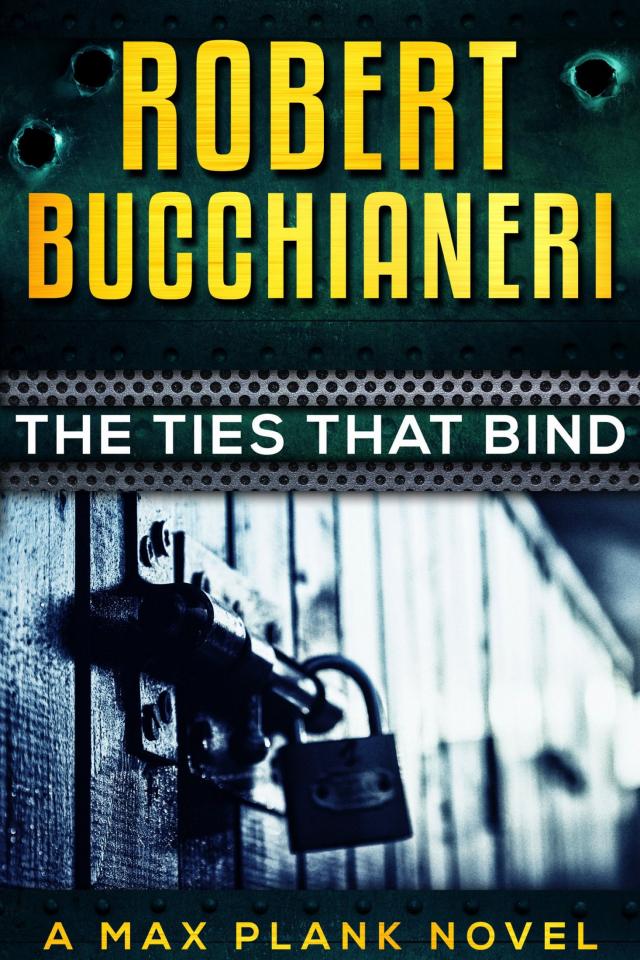
The Ties That Bind, page 15
part #2 of Max Plank Mystery Series


“Tell them I was the one that got you involved. Let ‘em hassle me.”
“Maybe they’re not gonna hassle nobody. Likely a simple overdose. Nothing that gonna cause ‘em any trouble so they won’t come botherin’ nobody.”
When I hung up, I noticed the mac ‘n cheese was smoldering, starting to blacken in the cast iron pan, the secret of my recipe, along with olive oil and cracked black pepper. I grabbed the pan and got it off the burner and spooned the gooey stuff onto plates for Frankie and me and cut some French bread to go with it along with a salad with strawberry dressing.
We ate while Frankie took turns petting Red on her lap and stuffing forkfuls of mac ‘n cheese into her mouth, talking about her day and the fact that she didn’t really hate Jack so much anymore, that he could be nice sometimes, and that he’d told her she was the best skateboarding girl he knew, and she told him she was the best skateboarder, period. She talked excitedly about coming to the airport with me to pick up Alexandra this coming weekend. Red kept on snaking his face beneath her elbow, his tongue lapping the lip of her plate.
I listened, but my mind was reeling, considering the likelihood of both Christopher and Speed’s demise being mere unrelated coincidences, remembering what I’d found in Mrs. Wambaugh’s desk, and deciding I needed to ratchet up my game significantly to get to the bottom of things before anybody else died.
My thoughts were interrupted by Frankie’s decidedly diplomatic comment, “I like your cheesy cheese mac ‘n cheese, Max. I do. But next time, it’d be easier to just make it out of the Kraft box, right? A lot easier and…it’s kinda hard to beat if you know what I mean?”
I did.
Twenty-Nine
Rachel Wambaugh no longer looked like the same woman I’d met at the tea garden just over a week ago.
Her hair was different, pulled back in a tight bun that accentuated her high cheekbones. Dark shadows, little nightmares, plagued her eyes. Her face, despite some additional makeup to cover it up, was drawn and pale.
She’d moved back into her mother’s home, at least temporarily. I knew it wasn’t safe for me to get anywhere near that house, so I arranged to meet her at Mr. Mayhew’s Coffee & Croissant Shop on the main drag in Burlingame, the Eucalyptus tree capital of the world.
I’d been there once before, and it was a large, disheveled place with booths in nooks and crannies of the idiosyncratic layout that allowed for lots of privacy. Mr. Mayhew himself, who I’d met on my previous venture, was a smiling young Brit, who unashamedly favored 1970s era dress like bell bottom pants, brightly colored baggy shirts, and platform shoes. The shop itself was full to brimming with that era’s hippie bric-a-brac. Posters of 70s icons—Lauren Hutton, Margaux Hemgways, Woody Allen, Robert DeNiro, Jack Nicholson, and Gene Hackman—covered the walls.
We sat in the most isolated corner booth tucked behind a large rubber cactus and a life-size cardboard cutout of the monster from Alien.
A coed dressed in a tie-dyed t-shirt and bright red hot pants brought us full coffee mugs, along with the almond croissants we’d ordered.
I don’t remember croissants being in favor in the 70s, but these were the best I’ve ever had, so I guess it didn’t matter.
I looked across the table at Rachel. She was staring down at her plate, her fingers playing with the edges of it, turning the saucer ever so slowly.
“I’m so sorry about Christopher,” I said, which I’d already told her on the phone. She hadn’t responded then and didn’t now. We sat in silence for a while longer.
Finally, she tapped her spoon against her cup, as if calling a meeting to order and said, “My mom blames you. She says you broke into our house. You talked to him. You harassed him.” Her voice was flat, monotone. Her sentences weren’t quite questions, nor statements-of-fact, but something in between.
“Your mother has cause to be upset. I did sneak into the house. I did try to get Christopher to tell me the truth.” I felt guilty as hell, but lurched forward, ready to take my medicine. “I was tough on him. I had no idea…but that’s no excuse. I thought he may have been Sarah’s shooter. That’s what I was focused on. It’s what I do. Sometimes I get…” My voice trailed off.
“You shouldn’t have broken into—”
“I didn’t break, I snuck.”
She glared at me. “You shouldn’t have ‘snuck’ into my mother’s house.” She paused for a long moment, gathered herself. “But, Mr. Plank, you didn’t kill Christopher. Maybe you pushed him too hard at the wrong moment. But you’re not responsible for what he did. I’m guiltier than anyone. I should have seen the signs. I’d distanced myself from him, particularly since I got involved with Sarah. I knew how much that hurt him. But I didn’t care.”
She closed her eyes, her face a mask of anguish. “I was tired. Of him. Of my mother. Of being a Wambaugh. I needed to get away from it all. Sarah offered something different. A chance to start fresh. I’d spent years taking care of Christopher, I—”
She stopped, her cheeks reddening. “Shoot,” she said. “Listen to me. I don’t know what I’m saying. I…” She grabbed the fingers of her left hand with her right, twisting them into a knot, wringing them as if they were dirty, trying to get rid of a stain. Her face cratered, tears streamed down her cheeks, her body shook.
I watched helplessly. Reached my fingers toward her, stopped.
Our waitress appeared from behind the cactus plant, took one look at us, and veered away.
Rachel sobbed once, clenched her teeth. Cursed. “Damn him,” she muttered.
Shaking, she dug into her purse sitting on the booth beside her. She found a wad of Kleenex and dabbed at her eyes and face. She blew her nose. Gathered herself.
“I’m sorry.”
“Nothing to be sorry about,” I mumbled.
I waited a little while longer before daring the questions I’d come there to ask.
“Why do you think he did it? What was going on in his life? The police have pretty much concluded that he shot Sarah and the evidence confirms…”
She sniffed, cleared her throat, and said with some authority, “He didn’t. He couldn’t have.”
“He’s your brother, so I understand. It’s hard to think of him as doing something like that. But he had cause. He was in love with Sarah, and she dumped him. And then the two of you got together. Some men just can’t handle that kind of loss and—”
“It wasn’t like that…” She shook her head, started playing with her plate again. “He never had a real relationship with Sarah. It was totally one-sided. A friendship, not a love affair.”
“Unrequited or not, it can have the same impact on the one who loves.”
“No. I don’t think so. Not this time. Not Christopher. He didn’t love her. He tried to, but it was an act.”
“I don’t understand.”
“I can’t explain. Trust me. He was my brother.” Her eyes bore into mine with such naked intensity that I wanted to look away. “I knew him,” she said, her voice breaking into a fervent whisper.
“So, because you don’t believe he really loved her, there wouldn’t have been the passion necessary to try to murder her?”
“Yes. But also, he wasn’t a murderer. He was a vulnerable, wounded, lost young man.”
I’d seen that, felt it. That hadn’t stopped me from going after him.
“Who wounded him?”
“My father. And me.”
Ay, there’s the rub. Back to the patriarch. I’d assumed most of this family’s struggles arose from Mom, but maybe not.
I waited for her to tell me more.
“Dad was brutal. He could be charming. The world, society, found him charming. But he was a weak, pathetic man. To us, his family, he was…” Her voice trailed off, tears reappeared in her eyes. She hunched down, the muscles in her neck tightening as she tried to get a grip on herself.
“…he abused Christopher. He was always putting him down, making him feel less than. Dad lived off Mom, off the family business. He hadn’t accomplished anything real in his life. It’s hard to say about your father, but he was more or less a gigolo. I don’t know if he loved Mother at all. But she loved him. She loved him too much. Anyway, I don’t know why he seemed to despise Christopher. But the verbal assault was constant. And he beat him, too. On a regular basis. By the time Christopher was a teenager, he was hollowed out, a shell of a boy, stuttering, withdrawn, afraid.”
“He didn’t seem that way when I met him.”
“He got some counseling. I tried to help him all I could. He learned how to put a face on for the world. How to hide the hurt and pain. But inside, I don’t think he ever came close to healing. A monster. That’s the word. My father was, is, a weak monster.”
Music had been playing at a low level, unrecognizable psychedelia, but now the volume rose and that avatar of all things flower power, Donovan, was singing that everyone was calling him Mellow Yellow, quite rightly.
“You haven’t seen or spoken with him for years?”
She nodded.
“How did he treat you and your mother?”
“No better. He didn’t hit my mother, but she knew not to cross him. She knew what would happen if she tried to intercede on his behalf. He never hit me,” she said, and looked away.
“Do you know what it was like cowering in my room, hiding under my sheets, while my father went after my brother? I’ve…never been able to get the sounds, the cries, out of my head. When I can’t sleep at night, I hear them all over again.”
She stared into a corner of the room, remembering the everyday horrors of her childhood home. “I’m sorry. I shouldn’t. I can’t…”
“Why didn’t—” I stopped, tried to put a plug in it.
“Why didn’t we do anything? Why? Seven and nine-year-old kids? And he’s big. Scary big. Knows how to use violence. He preys on weakness.”
“What about your mother?”
She shook her head. “Like I said, she loved him. She needed him. She had all the financial control, but it didn’t seem to make any difference. She pretended like nothing was happening. We never talked about it. She wouldn’t listen if we tried.”
“I’m sorry,” I said and felt pathetic saying it.
Her features softened. “No one can understand really. No one who wasn’t in that house. And there’s only three of us left now. The last couple of days I’ve been thinking about going to see him. Finding him. Confronting him. Telling him that he murdered Christopher.”
“Maybe you should.”
“I’m afraid. He still scares me.”
“What about your mother? Couldn’t she help? She knows where he is. She could—”
“Mother is a lost cause. She made her decisions about her life a long time ago.”
More Donovan floating in the air, singing about the impossibility of catching the wind and his lover’s love again.
I didn’t say anything for a while and neither did she.
We finished our coffee and croissants in silence, and I shifted uncomfortably in my seat. I told her that I was going out of town for a couple of days but asked if there was anything I could do for her.
“No. I promised Mom I’d go with her to make more arrangements for Christopher’s services. It’s going to be pretty private, but still there are things to do.”
“Of course.” I paused, thinking, remembering what I’d come here to ask her. “Rachel, I understand, like Sarah, that you don’t like roses. It seems odd, and I was wondering if you could tell me why—”
“Oh, Max,” she said, the muscles in her face twitched, trembled. She started sobbing, tried to regain control, but it was no good. She fell apart right there in front of me, and it took a long time before she was able to put the pieces back together again.
Once she did manage to get a hold of herself, she stood up, said, “Bye, Max,” and hurried out of the coffee shop.
Later that day, she called me back and answered my question about the roses. Her voice was faint, and she sounded like a lost little girl as she told me the terrible truths she’d been desperately hiding.
Thirty
It was a ten-hour drive from Alexandra’s house to The Palazzo resort hotel in Las Vegas.
I left at ten p.m. after tucking Frankie into bed. Meiying, once again, had come to the rescue. Frankie treated her like the grandmother she’d never known, and Meiying, in response, like the daughter her and Dao had never been able to have.
I told them both I’d be back in a day and a half, at most.
I’d contacted Marsh through our “red phone,” as we jokingly referred to it. It was actually a regular old iPhone that he’d given me. I’d been instructed not to use it unless it was the most urgent of emergencies. He’d promised that, in most cases, if I left a message on voicemail using that phone, he would return the call no matter how deep undercover he was.
I’d only used it once before in the four years I’d had it. That time, he didn’t think the emergency was dire enough, just like this time.
Nevertheless, within three hours, I had the information I needed to go push forward with my hastily constructed plan.
Without bothering to check, I’d stopped at the garage Marsh maintained on Van Ness Avenue beneath a dry cleaner he owned. I knew everybody there, so I had no problem securing the keys for my ride, a mint-condition navy blue ‘72 Ford Mustang. I’m not much of a car person, but Marsh raved about the ride. The garage held about twenty vehicles, from Aston Martins to Jaguars to BMWs along with vintage cars like the Mustang. He employed a part-time mechanic to keep them purring.
After checking traffic on my phone, I took the Bay Bridge to Oakland and then Highway 80 up past Richmond and Berkeley and onto Sacramento and into the Sierra Nevadas. Passing through Reno, I discovered, as expected, that the town fathers still considered it to be the Biggest Little City in the World.
From there, I picked up Highway 95 and rode that lonely desert road all the way into Sin City.
The desert had its own kind of stark beauty, but I had little appreciation for it that night. My thoughts kept on returning to my conversations with Rachel and Christopher and Speed and Mrs. Wambaugh and Scott Tripp and Q. Had both Christopher and Speed killed themselves? Were there deaths directly related to Sarah and the shooting, or might they have died of wounds delivered long ago?
I was still trying to make sense of how the mystery of the roses impacted current events. If the gift of flowers the day of Sarah’s shooting was mere coincidence, or the key to solving the case.
Experience told me it was more likely the latter.
I only stopped once on the way, to get coffee and a protein bar at a truck stop just outside Hawthorne, Nevada. Although it was tempting, I passed on waiting for the town museum to open later in the day. It boasted the largest collection of inert ordnance—missiles, bombs, rockets, and, nuclear weapons—in the whole US of A.
I made a note tell Marsh about it. He’d probably want to make a special trip and take photos for his Christmas card.
I arrived at the Palazzo, smack dab in the thumping heart of Vegas, a few minutes after eight a.m. The resort was surrounded by the famous Strip’s behemoths—The Mirage, The Wynn, Treasure Island, and I discovered, connected to The Venetian via the Grand Canal shopping complex, replete with gondolas.
The property was massive, labyrinthine, confusing. So, I pulled into the impressive Porte Cochere and handed my keys to the valet. An expensive way to go, but my time was short and my wallet full for the moment.
The kid who drove off with the Mustang, after expressing his delight at getting the chance to get behind the wheel of such a rare “beauty,” gave me a slip with the number seven printed on it.
Maybe it was my lucky day.
I’d soon find out.
To face down a true monster, one might well need a little help from Lady Luck.
I asked the front desk where I could get breakfast, and they directed me to the fourth floor and the Canyon Ranch Café, which promised to detox me with organic non-GMO ingredients. I felt a little offended that the reception area staff thought I was toxic.
I ordered steel-cut oatmeal, sweet potato toast, a bowl of blueberries, and a pot of coffee and kissed thirty bucks goodbye.
I ate slowly, savoring my food and the decent coffee, reading a Dean Wesley Smith novel on my phone.
At nine a.m., I took the elevator back down to the casino and sat down at a Blackjack table.
The crowd was relatively sparse at that time of day, but there were still a surprising number of people playing one-armed bandits and video slots.
Roulette and poker tables were less populated, with only a few sleepy-eyed diehards plugging away.
I had the table to myself and had fun, ending up winning enough to pay for breakfast after an hour of parrying back and forth with a smile-ready dealer. I left him a ten-dollar tip, and he wished me continued good luck.
It was 10:15, and I headed upstairs to the Canyon Ranch Spa. It was a state of the art facility and then some, including a full gym, a myriad of daily classes from yoga to Gyrontonic Expansion, a multi-sensory Aquvana water experience, plus massage, reflexology, acupuncture, shiatsu, ritual bathing and much, much more.
One-hundred-thirty-four-thousand square feet of more.
I’d read the brochure when I purchased my day pass for fifty bucks.
I flashed the pass at one of the white-frocked attendants and headed straight for the rock climbing wall.
William Fogerty scrambled up and down the short wall like he was a lizard born to it.
He was naked from the waist up, wearing a pair of tight-fitting purple stretch pants. He climbed barefoot and without a harness. He must have gotten a pardon from the club because they normally required special shoes and double bind ins for would-be climbers.
But this was no mere mortal and, besides, Marsh estimated that Fogerty, or rather, the Wambaugh Companies, paid the resort over one-hundred-thousand dollars a month to live in the Chairman’s suite, his home for the past two years. A bargain, I’m sure, for lodging that offered twenty-seven televisions, its own spa and gym, and a karaoke room. Somehow I couldn’t picture Fogerty holding a little microphone and belting out the love theme from Titanic.