macCLOUD FALLS, page 14


He walked on. The ‘Indian church’ he’d read about, and had glimpsed from his room through the zoom, stood at the south end of the village with only a little graveyard between it and the junction of new highway with old. Around it was an area of cabins, timber corrals with automobiles at various stages of decomposition. One cabin advertised, in a loose hand, Antiques.Art.Tools for Sale, around which lay an array of rusty barrels, hoses, wheelbarrows and other metal devices whose purpose was mysterious to him. A face looked from a small side window and the Scotsman realized this was the reservation, a tiny triangle of land in the middle of this huge canyon, fenced off and fenced in. This was a portal to Lyle’s time, the long sore question of land rights that had preoccupied him in his later years, when he acted as secretary and scribe to the local chiefs.
The path to the church ran through the reservation, but there was a wire fence on either side, between the two. The church was amongst its congregation here but separate from it, and worse for wear. Its timber-tiled shingle walls were spotted with lost or splitting squares, the squat bell-tower sat like some shaggy mushroom cap waiting to open – all seemed less man-made than forest-given, and looked abandoned now. The bell was still where it should be and the cross at the apex too, but there was a raven perched on top, admiring the panorama, unmoved by the transformation of tree to wood church to spirit house. He knew that the missionaries had come early to the province, of different hues and temperaments yet all driven to convert and civilize by that peculiar sense of superiority the self-convinced carried with them like a beacon. Little churches like this were the places where that boundless holy spirit focused its energies, where it was corralled, not allowed to roam and manifest in sun or moon, or beast or plant. These four square walls sent up a heavenly aspiration, from this reservation for the spirit, led by missionary voices. Multiple generations of ravens had seen them come and go, had sat crowing on the roof while they sang, and had cawed out a parting greeting when they left.
He stood and took the vista in, as this raven was doing. Beyond the actual reservation, in the distance the woman he’d glimpsed through the zoom from his room was gathering her berries at the river’s edge, bending down while, behind her, the settler community lay across the river, and behind it again, dwarfing all, bare rock mountain with only the occasional tree clinging to what little soil there was. On the other side of the path that divided sacred from secular stood a sky-blue-painted, low-roofed building with a handwritten sign – CLOUD FALLS BAND OFFICE. The sign bore the same schematic of a skinny black eagle he’d seen on the window of the old community hall. Someone had blocked off the double-door wheelchair access on the end and a kind of porch was being erected in the middle. Someone seemed to be making a new home out of the old Band office.
The land looked different on either side of the pathway, as if an invisible border based on polarised perceptions of the world existed here, as if two separate histories defined themselves along this path. One recorded 150 years of attempted settlement, of enterprises small and large, successful for a time such as the orchards; the other, centuries of moving a little here, a little there, depending on the season, but never really leaving, just moving with the natural changes, successful because of that, until it was fenced in here, next to the little church and the graveyard by the highway. The graveyard was surrounded by a low fence, now in disrepair. The soil was stony desert dirt, heaped up to cover graves. The Scotsman lingered at the gate, but didn’t go in, he’d save that for another day, but he could see the names on some of the nearest graves, surnames that matched some of those commemorated on the wall of the hall along the road.
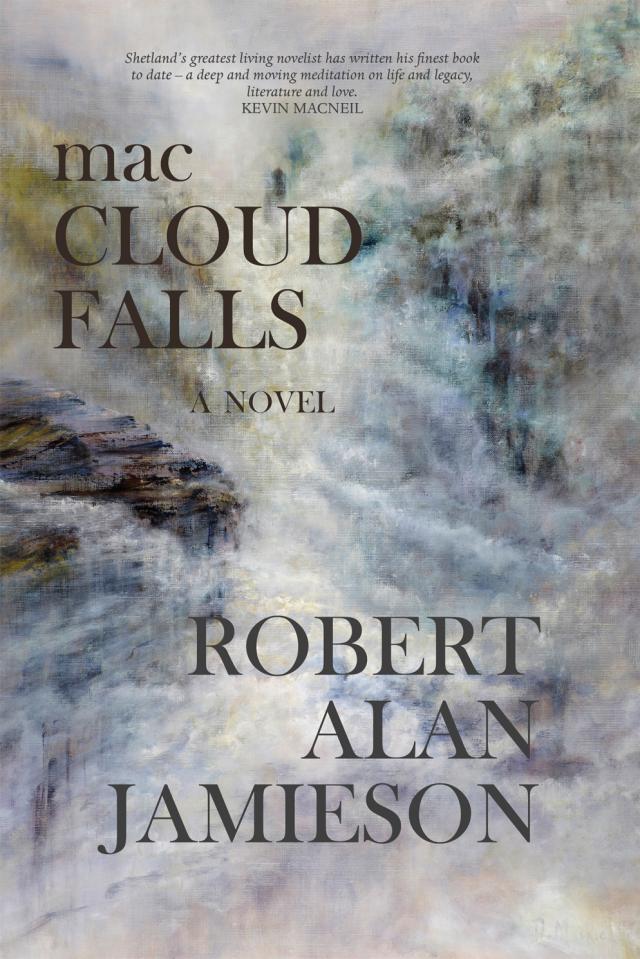
So he walked on, eye drawn to the waterfall that MacLeod had used to irrigate the poor land and bring fertility. To get there, he had to cross the river again, this time on the new bridge, the one that carried the highway around Cloud Falls, bypassing the little town that had grown there. The footpath to the side of the highway was broad, the balustrade high and he felt no urge to leap. Crossing the river, the falls came into view in marvellous fashion. It was quite miraculous how it emerged from the canyon wall, as if some Old Testament prophet had struck the rock with a rod to bring it gushing forth. He knew that it was really the outflow of a hidden creek at a point where the canyon wall had slipped, yet still it seemed a wondrous thing that this pure water should be falling so extraordinarily from the dry desert slope. It wasn’t only the fact that it was water that made it marvellous, there was plenty of that in the river, it was that it was able to be harnessed that made it so precious. The great river was too wild, too unpredictable – no man-made system could have survived its moods back in MacLeod’s day.
He clambered down the giant quarried rocks that supported the new bridge on the far side, and met the old track beneath that headed along the riverside towards the falls, walking away from the settlement and out into the wild. The road went uphill at the side of the cleft in rocks from which the water spilled. Up close, it was a powerful flow, a drop of maybe a hundred feet. He could get near enough to dip his hand into one of the pools below, to taste that pure water, and the coldness surprised him. A small hut had a sign to say that this was the local water supply and should not be tampered with. This was the lifeblood of the community even now, though MacLeod’s flumes were long gone.
He walked further up the track, beyond the waterfall. The town receded into the distance, and the scale became that of mountains and canyons, not people and buildings. From high up he could see beyond the bend in the river, southwards. He sat a while and mused on this place. Here, away from people and their engines, the landscape was closer to Lyle’s time. He imagined him arriving here, a lad from Shetland in a land just about as different as possible from the one he first knew. Lyle grew up by the sea with the salt tang on his lips, a low-lying place without trees where people huddled in ancient stone houses and eked a meagre living from a tumultuous ocean and diffident unyielding soil, where nothing grew big and the only giants were the storms, the crumbling cliffs. Here, far from the ocean, deep in a mountainous canyon, the river was master. He knew little of how it felt to live beside this torrent, but he understood how it dominated, how it was the highway in the days when the white men first came from the north, the Hudson’s Bay Company’s explorers in search of a trade route to the Pacific.
When Simon Fraser and his men first sailed through this territory in a great canoe, down the river that now bears his name – another wrong one – the N’laka’pamux believed them to be the Ones they knew from the stories, the Ones who were predicted. Fraser, they believed, was the Sun, his companions the Moon and Coyote. These strangers went on to build forts and trading posts, where the Nicola River met the Lower Thompson they called it ‘Little Forks’, and ‘The Grand Forks’ where the Nicola joined the Coldwater river – naming and claiming.
And that was how it was between the two peoples, for half a century, until the Gold Rush. Then the whites came from the south, hordes of them, mad for a strike. The canyon was over-run. Douglas’s government in Victoria tried to control it, but the flood was already in full spate, and the fever had to run its course, no intervention was possible, so swift was the contagion. And within a decade, the prospectors had moved further north, though their supplies still passed up the canyon by barge and trail.
He began his walk back towards the town, thinking that nothing is ever really lost to us as long as we remember it, and that maybe that’s what he was doing here, trying to remember, not only these lives, but the lives of those whose child he was, whose offspring he was. And even more than that, he was trying to find out what they’d forgotten, or perhaps had never known, to piece together the story.
He clambered up the rocks from old trail to new highway, and as he stood on the new bridge again, musing on the history of this place, a gentle roar approached from behind, growing ever louder, overlaying the river’s now familiar tones. At first he thought it was a truck, one of those North American giants he’d seen from the Greyhound, but as it got nearer it sounded more like some kind of swarm. Turning, he saw a crowd of motorbikes, big machines, a biker-gang, come rolling onto the far end of the bridge in formation.
As they passed, deafening him, a sense of power emanated – men and machines, conquering the landscape, an echo of Sigurd and his mechanical pulleys. A fleet, a posse, a chapter, of chrome and gas, of mirror and shades, cruised by. He had the camera in his hand and, as the bikers streamed away to the other bank, he took a picture as the last two bikes passed. The guy nearest raised his gloved middle finger and when the Scotsman checked the picture on the viewer, it was perfectly focused in shot. Otherwise it was a flock of shades, a herd of leather, a shoal of shiny chrome roaring up the highway, issuing a collective roar that echoed through the canyon. The air shimmered heat as the vision passed. Streaky gas exhaust fumes hung above the asphalt as the last bike rounded the bend and disappeared.
The roar slowly faded and then the river’s rush emerged from where it had been hiding in the engine noise, almost a hush now by comparison. That gloved middle finger, a greeting, a beckoning, a threat, hung in his mind. He seemed to have no choice but to follow, like a child who had seen the circus pass through town for the first time, both scared and captivated by the strange glamour of the chapter’s procession.
The great highway he’d travelled aboard the Greyhound the day before, he now walked, keeping to the kerb. For a while it was quiet, and then a large crimson truck passed, a Ford with the legend FX4 OFFROAD on its rear wing. A couple of guys sat in the back, leaning against the cab, and they stared at him, said something and laughed as the truck pulled away. It struck him how walking here in the interior, where trucks and cars and bikes were essentials, must mark a person out as odd, as some poor demented creature not capable of operating a vehicle.
Here, where he wore sandals, shorts and a baseball cap, gear he’d hoped might help him blend in with the locals, walking alone along the highway was enough to show him to be a stranger. It was a thing not done. Even the great rocky face of the mountain they called The Chief seemed to frown down at him, quizzically.
Despite that, walking along the highway meant he could see over the bypassed township below, and at that slow pace he could study it without appearing to spy. But it was getting pretty hot as the sun finally rose above the canyon wall. There was a kind of motor graveyard at this end, where a beat-up yellow school-bus, a few small lorries and trucks were jammed in together just below the riverside railway embankment. One lorry at least seemed to have been moored there, its box trailer concreted into the ground, and he reckoned none of them were going anywhere again, other than slowly down into the shallow desert soil, atom by atom. Another shack had accumulated a forest of pipes and hoses and ladders around its entrance, topped off with an impressive display of antlers nailed above the door, and at the far end a long trailer home had a large Canadian flag planted at its side, though it hung as if wilted and hid its maple leaf. Another low prefabricated building had a rough hand-painted sign which read:
Community Spirit
includes everyone
use at your own risk
It didn’t look as if anyone had taken up the invitation in a decade or so.
The grey asphalt of the highway with its white and yellow lines stretched out ahead of him. He kept walking, passing a small garage business set back from the road at the foot of the mountain, old cars and trucks lined up outside. He took some photos from the road but didn’t stop. He kept on, past an abandoned motel, a fragment of punctured tyre, a triangular yellow road-sign with the black outline of a very upright Stetson-wearing tractor driver who seemed joined to his vehicle at the waist, like some weird centaur.
In the heart of the settlement, the houses looked better maintained, their painted wooden exteriors glistening in the sun. And then, rather incongruous amongst the squared-off settler dwellings, he spotted a bunch of bound poles emerging from the apex of a canvas triangle, the unmistakable top of a tipi. This time he stopped to take a photo and, using the zoom, was able to make out the pattern on the cloth, a single purple stripe above a circle of roundish white shapes. When he studied them, he recognised the sequence of the lunar cycle as the moon grew slowly from new towards full. Below that, on a base of white, a shape that could have been a branch or an antler seemed to support the moon. It was a smart design, tasteful muted greys and pinks. The tipi looked altogether contemporary and relatively new.
He walked on. Another sign appeared, this time a yellow square with the silhouette of a ram and the words CAUTION BIG HORN SHEEP NEXT 4 KM, but he kept walking, half hoping he’d sight one of these fabled beasts, feeling the heat of the day begin to burn his neck. The thought of a cool drink began to nag at him. He knew there were a couple of places, a motel and a pub, and the image of a beer took tempting shape in his mind. In the distance he could make out a sign, and as he approached he saw that it said
RUMOURS
BEST FOOD IN THE CANYON
BREAKFAST $6.49
A couple of cars were parked at the side, a big old Cadillac with a sign behind the windshield that invited OFFERS and a Mercedes, but when he tried the restaurant door it was locked, and a small sign pinned there said CLOSED. No explanation or indication how long it had been closed, or whether it was likely to open again. The image of the waiting beer faded a little, his throat was now on fire like it had been during the days of the radiotherapy. A picture of a giant ice-cream cone teased him. But another sign on a long, low, almost window-less log cabin surrounded by a timber fence a little further down the slope towards the town offered fresh hope:
VALHALLA
PUB
Below the main sign, someone had added a smaller improvised one that said ‘GO CANUCKS GO!’ Ice hockey fans, obviously.
The log cabin looked as if it was open, as if it must sell beer, and so he made his sweaty way down the road off the highway towards the township. The car-park came into view, and there he saw the motorbikes that had passed him just an hour or so before, now parked up, a mass of chrome and leather, a herd of frozen steeds tethered obediently outside a saloon. There must have been thirty of them. So this was where the chapter had stopped their roar. Here, where the beer he now fetishized could be obtained, and him in this strange garb, the clothes he’d thought would help him blend in, with his camera slung over his shoulder. He smiled, thinking of the gloved finger, but he was so thirsty, so overwhelmed by the heat of desert noon, he headed towards the door.
He pushed the heavy solid wood. It swung slowly open on gloomy interior walls of undressed logs, and the sound of heavy metal, deep voices talking and laughter spilled out. But the bare wood had been highly decorated by an array of pictures and memorabilia. It was a shrine to all things motorcycle, as gaudy inside as the outside was plain. As he looked around the cavernous timber walls seemed to spin away, opening a chamber that seemed much bigger than the frame. The chapter were sitting and standing around a group of tables in front of a corner stage, above which hung a giant screen showing a music video. It looked like ZZ Top.
On a raised dais along the far wall, a perfect motor machine stood above all on the altar of worship in this temple to the god of rides. The chrome gleamed in a spotlight that shone down from above, and the red leather seat looked plush and moist like flesh. The handlebars, if that was what they called them here, stood high and proud, like the horns of a bull or a bighorn sheep, but horns with large mirrors. On the side of the bike, along the gas-tank, a glistening logo spelled out Harley Davidson.
Below and around this impressive shrine, the gathering of bikers drank lager beers, while a young waitress in high heels and short skirt distributed pizza which they hungrily scooped up from the giant chrome platters she bore towards them from the bar. At first no one looked around as he entered feeling half-naked and completely out of his element. He didn’t cross the floor of the cabin, but sat on a stool at the far end of the bar by the door. He took off his cap and waited. The barmaid, a matronly woman wearing glasses, was pulling pint after pint of lager, and talking loudly to her customers as if they were old friends. He couldn’t hear what they were saying over the sound of MTV, or whatever channel it was that dominated the big screen, but the sound of loud guffawing carried across the length of the long wooden bar to him. A middle-aged man with a long blond pony-tail emerged from the back carrying still more platters of pizza, which he set on the counter, from where the girl took them to the waiting hungry.
From his vantage point, he stole glances at the company and noticed they were far from a rough, scarred crowd. Their leathers were clean, new-looking, and those who’d shed their outer skins revealed t-shirts that looked neatly pressed. The badges and chains that decorated their gear were brightly polished, their tattoos artistic, not the kind a biker might have carved into his arm in some fit of frenzy. It seemed as if even their scars might be delicately sewn.
At last the matron finished pulling pints, and acknowledged his presence with a nod. ‘Be with you in a minute,’ she called over. He nodded back and smiled, began fiddling with his wallet, desperate for liquid.
‘So, what’ll it be?’ she asked, finally.
‘A beer, please.’
‘Molson?’
He didn’t know what that was, but answered in the manner he was getting used to. ‘Sure.’
She wasn’t fooled. ‘You British?’
He shook his head. ‘No, Scottish.’
‘Scottish?’ She smiled. ‘My grandfather was from Glasgow!’