Reclamation (Book One of the Art of War Trilogy), page 7
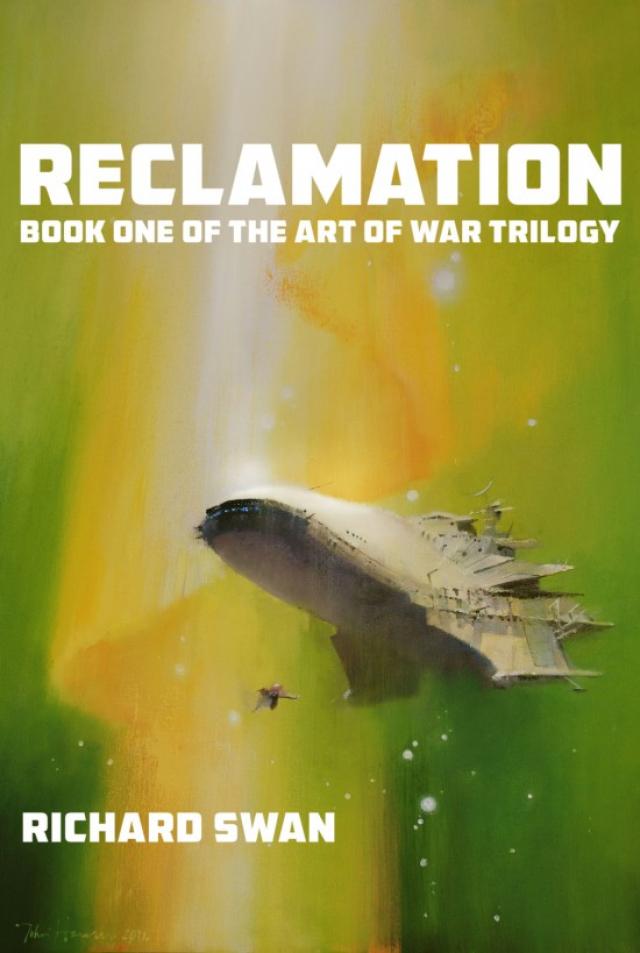


‘Karris…’ she said, realising that the comlink, as well as a lot of the module’s ancillary functions, was starting to crack under the intense strain of the provari LRIS. ‘That cruiser is prosecuting kaygryn military targets.’
‘Just stay put for now, Lyra,’ Haig replied, the feed fading in and out. ‘Vance is trying to hail them.’
A painful jolt of adrenaline fired through her system. The astrograph gave one more whine and then cut out. The VI’s predicted strike trajectory put the next shot directly on top of the kaygryn militia still struggling up the rain-soaked mountains. They were less than half a kilometre away.
‘Exfiltrating!’ she announced, her heart pounding in her constricted chest. A deep, animal terror was taking root inside her as she launched out of the command chair and made for the locker on the far side of the module.
‘Hol… osition…’ Haig’s voice came through before the link died under the pressure of the cruiser’s electronic warfare pods.
Lyra ignored him. The provar probably wouldn’t shoot at the kaygryn while she was there, not unless they wanted to start a war with the UN; the only problem was they couldn’t see her. The module was refraction shielded from the entire LRIS spectrum and could withstand the most intense orbital scrutiny for upwards of an hour. What was worse, it took almost as long for the shielding to wear off after being shut down, ruling out the possibility of pre-emptively revealing it.
She began to weep as pure panic gripped her. She yanked open the locker to reveal a full UNIS-issue MG-14 Mantix suit, a form-moulded cocoon of armour, exoskeleton and cutting-edge sensor suites. Frantically, she pulled the leg sections of the suit free and stuffed her feet into them, tearing off her left large toenail in the process. The pain of it didn’t register, even as blood began to squelch between her toes. The imagined itch of the provari targeting laser was all she could feel now.
Hot tears streamed from her eyes as she snapped the waist lock closed and pulled the torso section free from the locker rack, slotting it into the exoskeleton’s upper spinal plug. The suit was deceptively lightweight, given that its nanogel matrix had a shockwave dissipater which would protect her from everything short of hypersonic projectiles. She hastily snapped the thorax locks closed, her fingers shaking and fumbling. Somewhere in the back of her rational mind, she vaguely recalled training for exactly this eventuality, many years before in a pitch-black room on Earth – one rapidly filling with water and alive with the sound of blaring alarms and screaming comrades. They had joked about how absurd the simulation was.
She pulled each of the arm and shoulder sections free and donned them, then the gloves and finally the helmet – which she then remembered she was supposed to have put on first. The HUD flickered into life and synced with her IHD and the module’s on-board computer, the helmet storing most of the raw data in its own hard drives, but Lyra didn’t wait for the upload to complete. Forgoing the hefty railgun within the locker, she punched the emergency door release and broke into an exoskeleton-powered sprint, through the explosively ejected door and out into the torrential rain currently lashing the entire peninsula.
Aided by the Mantix visor, which had plotted out a course for her down the mountain, she made it nearly one hundred metres before the second rail strike hit. A beam of pure white light stabbed through the clouds above, the thick black thunderhead corkscrewing down around it like a tornado. The blast hit the kaygryn columns with needlepoint accuracy, vaporising them in an instant and burying them under several thousand tonnes of Tiberean Mountain rock.
The Mantix absorbed the worst of the force with its inbuilt nanogel matrix, but it could do nothing to prevent Lyra being hurled off the plateau by the overpressure at close to a hundred kilometres an hour. Unfortunately, UNIS-issue armour didn’t contain inbuilt microjets or even a parachute. Instead, it secreted sedatives into her bloodstream to lessen the terror of her unhindered freefall and readied its impact-trauma protocols. It estimated she had a seventy-seven per cent chance of surviving the landing intact.
Once the Mantix logged that she was to land in an area of jungle three hundred metres below her take-off point, it revised the estimate down to thirty per cent.
As soon as it realised she had been decapitated by a branch, it revised it further down to zero.
TIP OF THE SPEAR
‘There were two of them. The first killed over a thousand of our men before it and its drones expended the last of their ammunition. It only stopped after we were able to pry it open with two hulgyrs and kill the pilot. The second killed both hulgyrs and lasted for most of the afternoon. We had to kill him with orbital fire when it became available. We surrendered once we learned they were sending four more.’ (trans.)
Quorl Marshal Exvonsa’s war crimes testimony on the Gorman-Valstar mk.11 Goliath, following the Insurrection on Merisgard
The United Nations Armed Forces base on Anternis lay just beyond the northern boundary of the city, a small, low-tech military installation containing troop quarters, basic training facilities, an STOL landing strip and a three-hangar vehicle bay. When Anternis had been a teeming hub of galactic trade decades before, with its favourable taxation rates and relative astrographic obscurity, the base had been a hive of activity, its UNAF personnel akin to a corporate army ensuring the smooth operation of the international economy. Now it existed as little more than a tick box for military units on soft rotation, an easy and comfortable stopover with warm, tropical weather and an almost non-existent training regimen.
It was a lethargic standing which did not suit its incumbency at the centre of galactic attention, and by the time Vondur reached the base, much of Anternis was in a visible state of panic. Some civilians who had seen the kaygryn corvette and its destruction were already following post-Hadan’s Reach civil contingencies and heading for orbital bombardment shelters deep within the bedrock. His high-speed journey through the streets of Anternis City had demonstrated, however, that many were simply content to run around in blind terror. He had some sympathy for that, since he himself had experienced the feeling of raw helplessness as unopposed naval forces cruised through orbit hundreds of kilometres above with the power to raze continents at the touch of a button. That didn’t stop his lip curling in distaste as shop windows were smashed in and the first wave of looting began.
His IHD automatically warned him that he was being invasively scanned on approach, an annoying reminder that the base was legally obliged to provide to everyone. He brought the jeep to a stop just short of the main gate, and a guard in full UNAF-issue Mantix exited his station and confirmed Vondur’s identity through the suit’s inbuilt sensor suite.
‘This weather,’ the guard mumbled as he punched the gate release, the banality of the statement so perfectly juxtaposed with the severity of the present situation that Vondur found himself concurring without even thinking. It was only then he realised how soaked he was; the jeep’s footwells were sloshing with a good three inches of water.
He gunned the engine and drove straight out across the empty landing strip towards the vehicle hangar while all over the city orbital-raid sirens wailed into life. Vondur knew that most of the shelters were practically obsolete, given that they hadn’t been upgraded since the colony’s founding. Decades of token maintenance and a lack of investment meant that they also only had capacity for about a quarter of the population – not that any of it particularly mattered. Given the needlepoint accuracy with which orbital strikes could be effected, the only reason for a high civilian death toll would be if it was intentional – in which case, a few de Havilland Crust Busters would do the trick, bunker or no.
The jeep shot over the wide, rain-slicked strip, kicking up twin fountains of water in its wake. The air was cooler now as the evening slipped further into twilight, and he shivered as the wind plucked at his soaked clothes. In less than a minute he had reached the end of the runway and pulled to a stop outside one of the drab green vehicle hangars that contained the squadron’s Goliaths. He grabbed his duffel bag from the back seat and threw the door open, opening a link to Vance as he did so.
‘Commander,’ he said, striding over to the door of a squat, olive-green building marked ‘OP-PREP’ in red lettering.
‘Captain,’ Vance replied. ‘We’re in briefing room one. As quick as you can, please.’
‘Roger,’ Vondur replied, terminating the link. Moments later, the world around him turned white. Everything was thrown into sharp relief as a second sun erupted in the evening sky, accompanied by an almighty crack that triggered his IHD’s audio dampers.
‘Jesus Christ!’ he shouted, whirling round to see a second rail strike stabbing into the Tiberean Mountains. He clasped his hands behind his head, staring in disbelief as the beam dissipated, leaving a vertical contrail in its place. Above the wailing of the city bombardment sirens, more base alarms trilled into life, and at the end of the landing strip, he could see vehicles laden with Mantix-clad troops gunning away from the base, accompanied by swarms of overhead drones.
Swearing under his breath, he tore himself away and turned back into the building, heading right and down the corridor, leaving a trail of rainwater in his wake. Within twenty seconds he reached the briefing room. He shoved open the wooden door to find his entire squadron sitting inside, all clad in full pre-flight gear.
‘Captain, sit down,’ Vance said immediately. He was a short, portly man, moustached and dense with what had once been muscle, wearing olive-green shorts, an olive-green shirt with sky-blue epaulettes, and a pair of khaki boots. His uniform was dark with sweat.
Vondur sat down heavily. In front of him, concentric horseshoes of desks led down to a green linoleum floor where Vance stood, illuminated from behind by a five-metre tac screen currently split between several live drone feeds. The second kinetic rail strike Vondur had seen from outside was being replayed fivefold to his squadron, with dozens of subsidiary holos providing reams of secondary information on the blast. Many of the screens were pulsing discordantly with warning graphics so that Vance looked like he was standing, oblivious, in front of some kind of military-themed rave.
‘For the captain’s benefit, I’ll quickly run through that again,’ Vance said, firing him an irritated look. Vondur’s sodden, dishevelled appearance did nothing to alleviate the reproach. ‘I have spoken directly with General Gordon Pike at SOC Vargonroth. While he did not delve into very many specifics, the gist of it is this: there is a provari cruiser in our low-orbit band. It is currently prosecuting what appear to be exclusively kaygryn targets, for reasons apparently known but classified.’ He rolled his eyes at that. ‘High Command is naturally concerned that, given our proximity to Vos’Shan, we may soon become inadvertent targets ourselves. In light of that fact, current orders dictate that we are to prevent any kaygryn personnel, civilian or military, from crossing the border.’
He performed a sharp waving motion with his left hand, and the holo behind him transformed into a satellite image of the Tiberean Mountains. ‘Provari LRIS has junked all our satellites, as one could expect, so this is an historic image. Nonetheless, the topography remains largely unchanged – though only largely, and only for the moment.’ He added the last comment with a wry smile, which drew some laughs. Vondur himself wasn’t quite ready to join in with the gallows humour while kinetic rail strikes continued to tear two hundred-metre craters out of the Tiberean Mountains.
‘And… the border,’ Vance murmured, watching as a red line superimposed itself across the satellite image. He pointed to it. ‘Anternis is closed for business, gentlemen. Your job is to make sure it stays that way.’
‘If we’re to patrol the border,’ Lieutenant Jarvin asked, Vondur’s second-in-command, ‘isn’t that going to put us directly in harm’s way? The suits are good, but even at medium range, they’re not going to take that kind of punishment.’ He shrugged. ‘It seems to run contrary to Vargonroth’s intentions.’
Vance shrugged back at him. ‘As long as you stay south of the border, there is no reason to think you’ll be hit. SOC has assured me that the provar won’t strike with UN forces in the area.’
It was little comfort. Even the overpressure from kinetic rail strikes was lethal. Vondur had seen what it could do to a Goliath on New Carthage.
Vance turned back to the satellite map. ‘The main passes are here and here,’ he said, indicating the only two lower-altitude crossing points that civilians could realistically attempt to use. ‘You’ll split into three fire teams, two at each of these points, one in reserve… here.’ He circled an area using his IHD’s fingertip interface. ‘Captain, I leave the make-up of the fire teams to you. Please, try to keep civilian casualties at nil, gentlemen. That is if any of them are stupid enough to attempt to cover a mountain range, in a storm, at night.’
‘What about military targets?’ one of the pilots, Cox, asked. His personal holo terminal was displaying a mosaic of known Vos’Shan’i military technicals.
‘If you feel as though they will draw orbital fire into your AO, then you are cleared to pre-emptively engage any targets, military or otherwise. One can only assume you all know that as a legitimate course of action available to you under the Galactic Convention on the Rules and Conduct of Warfare…’ He offered a sardonic grin when no one answered. ‘Good. Please do try and just wave them off first, though,’ he said, waving his own hand. ‘I don’t want a bloodbath if we can help it, understood?’
A disjointed chorus of affirmatives answered him.
‘Outstanding,’ Vance said tersely. ‘This is a dynamic situation, gentlemen, and unprecedented in the recent history of Anternis. Expect orders to change at short notice.’ He deactivated the large holo. ‘Callsign is “Gatekeeper”. Base is “Thunderhead”. Operation is “Beacon”. All clear? All right, dismissed.’
They all stood and made for the door. Vondur let everyone out first, returning their nods and acknowledgements, and then followed. In the corridor, Jarvin turned to face him.
‘What’s the plan?’ he asked. He was clad in the same pre-flight gear as the rest of the men: a black, form-moulded nanotech suit that looked like a second layer of thick, rubbery muscle. It encased the entire body, ending at the neck in a Mantix gorget interface where the helmet, once in place, would fasten to form a pressure lock.
‘Stay out of the way of those provari KRSs,’ Vondur murmured, his face grim.
Jarvin nodded slowly, sucking his teeth. ‘Yeah,’ he said after a while. ‘Don’t want to end up like we did on New Carthage.’
Vondur grimaced. ‘No,’ he said, recalling the crumbling tower blocks and constant, unending rain of the ruined world. ‘We don’t.’
Jarvin and the rest of the squadron made straight for the vehicle hangar at a brisk pace while Vondur headed for the locker room. Inside, he stripped off his sodden clothes, vac-dried for twenty seconds, then donned his own pre-flight suit. During training, they were supposed to spend up to thirty minutes performing detailed visual and electronic diagnostics of the suit. Instead, he cast a perfunctory eye over the torso area, then had his IHD run an analytic subroutine that would pick up on any glaring issues.
He snatched his helmet from the top shelf of his locker, slammed the door and jogged out of the room, his IHD automatically syncing with the suit so that the thick interface layer became an extension of his own body. He had described the feeling in the past as being painlessly burned alive as the suit’s nanotech interface reached out and connected with his nerve endings, though in truth he was so used to it that it felt like little more than growing a new layer of skin. The end result, once the sync was complete, was a slightly heady sensation in which all his senses were vastly amplified: the rain became a ceaseless cacophony of drumming, the cold linoleum of the floor turned to ice against the soles of his feet, and the dull olive walls became a corridor of polished emerald. Consequently, his IHD began to passively monitor the heightened input to prevent sensory overload.
He reached the entrance to the armoured hangar and punched in the manual code lock. The door slid open to reveal a vast open space, echoing with the static crackle of plasmastats powering up and pungent with the smell of liquid fuel exhaust. The floor for the most part was bare concrete demarcated by a number of gaudy orange-and-blue warning markers, while the walls rose fully thirty metres high, painted in the same drab olive-green as most of the rest of the base. A trio of gigantic grey Valstar loaders, bulbous military air freighters stained with exhaust fumes and grit, took up one-half of the room. The rest of the hangar was taken up with hundreds of tonnes of equipment and ordnance, tended to by buzzing drones and automated loader mechs.
In the centre of the hangar were the seven GV11b Interdictor-variant Goliaths which made up the squadron under his command. They were aptly named. Each was a three-metre, humanoid tank, clad in thick plates of diamond-reinforced armour and replete with LRIS-proofing, force shielding, atomic weaponry, a full complement of slaved offensive, defensive and orbital reconnaissance drones, a Sauben V591 Hydra surface-to-orbit missile battery and twin Royce-Khan plasma-powered jet packs with a thousand-kilometre range. It was said that the only thing in the UN more expensive to build was a planetary colony and the only thing more advanced, a starship. It was such a versatile design that it was the only piece of military hardware in recent memory to have been copied by the provar.
Vondur smiled to himself as he approached the behemoth, drinking in its impressive lethality. It was currently being serviced by one of the few engineers on Anternis qualified to do so, assisted by a dozen maintenance bots and surrounded by a cloud of diagnostic holos. She was standing on a two-metre platform in oily blue overalls, performing a number of pre-flight system diagnostics. Below her, watching intently, was ZEN.