Something Bad, page 1


DEDICATION:
For Tricia, Erin, Jake and Alison—my lifeblood.
And to my brothers, David and Bob (Ooglie
Googlie—sorry Bob, had to do it). Finally,
this is for our late parents, who live through us.
Published 2007 by Medallion Press, Inc.
The MEDALLION PRESS LOGO
is a registered tradmark of Medallion Press, Inc.
If you purchased this book without a cover, you should be aware that this book is stolen property. It was reported as “unsold and destroyed” to the publisher, and neither the author nor the publisher has received any payment from this “stripped book.”
Copyright © 2007 by Richard Satterlie
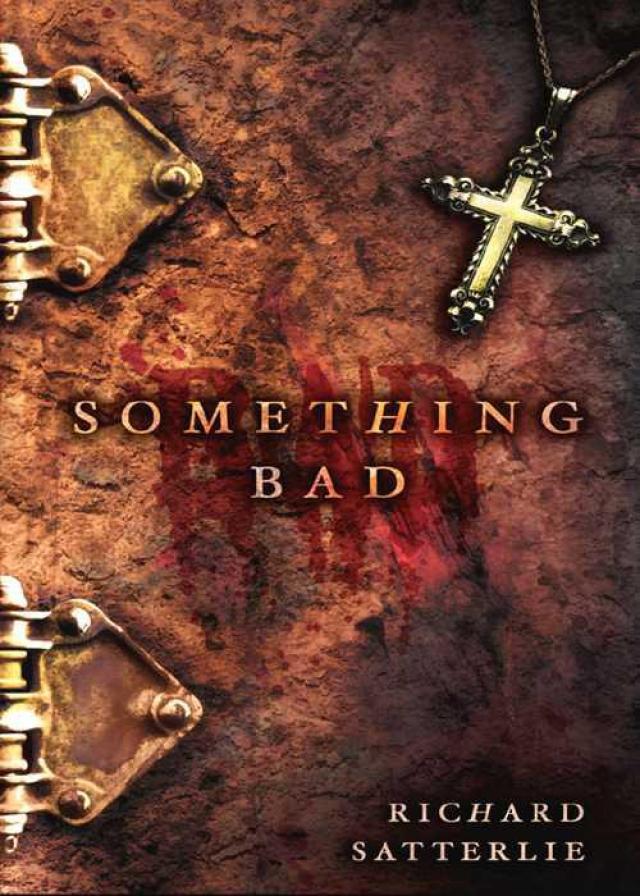
Cover Illustration by James Tampa
All rights reserved. No part of this book may be reproduced or transmitted in any form or by any electronic or mechanical means, including photocopying, recording, or by any information storage and retrieval system, without written permission of the publisher, except where permitted by law.
Names, characters, places, and incidents are the products of the author’s imagination or are used fictionally. Any resemblance to actual events, locales, or persons, living or dead, is entirely coincidental.
Typeset in Adobe Caslon Pro
Printed in the United States of America
10 9 8 7 6 5 4 3 2 1
First Edition
ACKNOWLEDGEMENTS:
I thank Tricia for her patience in putting up with me through all of my late night writing fits, and for being my main reader and critic (and main everything else). I also thank Alison—my other main reader, and a devout fan of the genre. Heidi Ernst deserves special mention. It was her strange quote on the screen saver of our laboratory computer that triggered this story, and my high-dive belly-flop into fiction writing. A hearty thank-you goes to Sandy Tritt, a master at turning rough wood into smooth planks. Her tool marks are all over this story.
Table of Contents
Chapter One
Chapter Two
Chapter Three
Chapter Four
Chapter Five
Chapter Six
Chapter Seven
Chapter Eight
Chapter Nine
Chapter Ten
Chapter Eleven
Chapter Twelve
Chapter Thirteen
Chapter Fourteen
Chapter Fifteen
Chapter Sixteen
Chapter Seventeen
Chapter Eighteen
Chapter Nineteen
Chapter Twenty
Chapter Twenty-One
Chapter Twenty-Two
Chapter Twenty-Three
Chapter Twenty-Four
Chapter Twenty-Five
Chapter Twenty-Six
Chapter Twenty-Seven
Chapter Twenty-Eight
Chapter Twenty-Nine
Chapter Thirty
Chapter Thirty-One
Chapter Thirty-Two
Chapter Thirty-Three
Chapter Thirty-Four
Chapter Thirty-Five
Chapter Thirty-Six
Chapter Thirty-Seven
Chapter Thirty-Eight
Chapter Thirty-Nine
Chapter-Forty
Chapter Forty-One
Chapter Forty-Two
Chapter Forty-Three
Chapter Forty-Four
Chapter Forty-Five
Chapter Forty-Six
Chapter Forty-Seven
Chapter Forty-Eight
Chapter Forty-Nine
Chapter Fifty
Chapter Fifty-One
Chapter Fifty-Two
Chapter Fifty-Three
Chapter Fifty-Four
Chapter Fifty-Five
Chapter Fifty-Six
Chapter Fifty-Seven
Chapter Fifty-Eight
Chapter Fifty-Nine
Chapter Sixty
Chapter Sixty-One
Chapter Sixty-Two
Chapter Sixty-Three
Epilogue
CHAPTER
1
Boyston, Tri-Counties, 1982
GABE LEANED FORWARD in the confessional and eased the door open a crack. Light from the church flowed into the dark chamber in a narrow slash. He squinted the altar into view. In two years of early morning visits to the All Saints Catholic Church, Father Costello had never been late.
That wasn’t the only thing wrong with today. The air carried an abnormal chill for this far into the spring. Gabe had overheard his father talk about it—this growing season had more than its fair share of unexpected thunderstorms and strong, dust-laden winds. And then there were the fogs. They rarely extended more than a mile from the swamp up north, and hardly ever as far as Boyston. But this year, they were enveloping the town two or three times a week. Today’s was a doozy.
Gabe squirmed in the confessional, which he jokingly called the inhouse. It was the same size as the outhouse his grandfather had built at their farm. And even though the farmhouse had indoor plumbing, his father had maintained the structure for sentimental reasons—to teach a lesson on appreciation for what one has, his father had often said.
Gabe pushed the door open a little farther, enough to open a crack on the hinge side. Enough to get a view of the massive double front doors of the church. Nothing there either. He let the door slide shut. The hard wooden seat, and the near blackness, would help him think of another sin or two.
He wasn’t Catholic but he liked the idea of confessing his sins. The recurring comfort of the lifted burden and the cleansing feeling of official acknowledgement and forgiveness gave him a sense of reverent calm. As he had done so many times, he had left home early to ride his bike to town to confess his week’s worth of moral hiccups to Father Costello before heading up the street to join his family at the Lutheran church service.
Their interactions didn’t have the formality of the official sacrament. Father Costello was just a good friend. In the confines of the dark confessional, with a screen between him and the good father, twelve year-old Gabe could talk about anything, especially things he was uncomfortable discussing with his real father.
A door slammed and an unrecognized, high-pitched voice brought Gabe out of his search. It came from the back room, behind the altar. He pushed on the door and squinted at the business end of the church. For an unsettlingly long time, no one appeared, but he could hear the voice, muffled, at a distance.
I could run for it, he thought. But the inhouse was closer to the altar than the front doors, and the huge latch that bolted the doors was hard to throw open in a rush. His mind was made when the door of the back room opened and Father Costello walked out, in full white robe, followed by a small man, only three-quarters of the Father’s height. The small man leaned forward as he walked, apparently to counterbalance a half-full gunnysack that was slung over his right shoulder. A red stain wimpled the bottom of the sagging sack.
Gabe slid his butt back on the inhouse seat and closed the door to the narrowest crack that would allow a view of the two men. His breathing echoed in the small, dark space, so he switched to mouth breathing to avoid the occasional nose whistle that sounded an exhalation.
The small man dropped the sack on the first step of the altar and walked to the side of the church, out of Gabe’s sight. He reappeared in only a few seconds, carrying a bare metal chair that he unfolded and placed at the front, center of the altar. He motioned to Father Costello, who walked to it, robot-like, and sat, feet together, hands on his thighs.
Gabe leaned closer to the gap. Father Costello’s eyes seemed to follow the small man, but they were wide, unblinking, like the eyes of hypnotized people in the old black-and-white television movies.
The small man reached into the sack and pulled out a limp animal. It looked like a dog. He placed it on the top step, to Father’s right, and fished his arm into the sack again. Over the next minute, he pulled two more animals from the bag. One was definitely a cat. Then, he brought the sack to the center of the altar, right in front of Father Costello, and reached in. The bottom of the sack went limp when the object was lifted.
Gabe’s forehead pressed into the door as he strained to see, but his visual angle, and the railing of the first row of pews, prevented a clear view. Whatever kind of animal it was, it didn’t have fur. He was sure of that. The brief glimpse he got was of an animal about the size of a small dog, but with grayish-pink, wrinkly skin. Once it was set down, all he could see through the wrought iron railing was the tip of one of its appendages. He stopped down his eyes with an exaggerated squint, but the image still blurred.
An idea struck—a trick from school that allowed a better focus at a distance. He pinched the tips of his two thumbs and two forefingers together into a square and peered through the pinhole created by the space between the tips of the four digits. The view of the altar sharpened, but it didn’t help. The obstructions still prevented a full view. He pushed the door open a little more with his forehead and looked through his fingertips again. A little more came into focus. He pushed farther. When the image cleared, an involuntary breath sucked his lungs full. His back hit the rear wall of the inhouse just as the slit of light narrowed and extinguished. Knees to his chest, he strained for his next breath. He thought he saw toes.
Gabe’s mind swirled, accompanied by a dizziness that nearly turned the feeble light that seeped around the edges of the inhouse door to pitch black. When the sensation passed, he leaned forward for another peek.
This time, his vision was tuned to an acuity that was almost painful, as if vision were his only fully functional external sense. It was silent in the church, and there were no smells.
In the close quarters of the inhouse, Gabe’s internal world was anything but quiet. The lub-dup of each heartbeat reverberated as if branches of his heart extended to every part of his body. And the tensile stretch of his lungs, on each inhalation, felt like the rasp of wood dragged across cement, until it gave way to a twang of elastic recoil and an exhalation. In the darkness, he was keenly aware of the position of his own body parts—every joint spoke to him of its position—and he knew if he moved one, it would scream its swing.
He inched the door outward to enlarge the crack and gasped again.
Father Costello sat perfectly still on the bare metal folding chair. All around him were animal parts and blood. The pieces were so small, and so carefully carved, it was impossible to tell what they had been in life. Gabe saw they half surrounded the priest in an arc that ran from one end of the altar to the other, and that they were being purposely arranged, as if to highlight the altar, or to degrade it.
Gabe’s eyes flicked to the artist, who was engrossed in his work on the carpeted canvas. The strange looking little man didn’t change his evil grin as he went about his task. Precise and efficient at his craft, no blood seemed to spill beyond where he wanted it to go. The knife he wielded appeared sharp enough to cut through bone without perceptible resistance, and it cut so swiftly blood flowed from its cuts without the slightest splatter, forming enlarging, smooth-edged pools. Everything was rounded—the pieces of flesh, the pools of blood, the semicircular arrangement of parts around the altar. Just like the features of the little man, there were no sharp edges.
Gabe was mesmerized by the developing masterpiece. And by the way the little man carefully placed each new severance and then paused to scan the altar, as if he were gaining a wide perspective on his artwork.
Gabe pinched himself. The pain was real. Blood flowed from each of the little man’s cuts—it was real. This wasn’t a dream.
When Gabe regained his focus, the little man was at the far side of the altar. With a stiff-necked spin, the man shuffled up to Father Costello, his evil grin unchanging, like a painted on clown face. A small voice echoed, the only sound in the cavernous church.
“You don’t want to miss this part.” The man’s lips barely moved when he spoke. “I’ve saved the best for last.”
Father Costello didn’t react. Not even an eye blink.
“That’s right, Father. You look right here. You think you’ve defeated me? I can assure you that I always take the game in the end.”
The man lifted a gold communion chalice toward Father Costello.
“This is HER blood, shed for me because of your sins.”
He extended both of his arms, so his small body formed a cross, with the chalice still gripped in his right hand. A loud “Ha” sound reverberated in Gabe’s ears, and the chalice flew from the man’s still hand. It impacted the Father’s chest with a dull thud, spilling its crimson contents down the front of his white robe and up onto his neck and face.
Gabe’s eyes widened and the scene blurred, then came back into sharp focus. Droplets of blood fell to the carpet in slow motion. One drop suspended from the priest’s chin for an agonizing instant, gaining volume, before releasing, then splattering onto the lap of his satin robe.
The little man stepped forward and picked up the chalice and turned it in his grip, inspecting it from every angle. “Now, for the final touch to my masterpiece.”
Gabe wanted to look away. To curl up in the corner of the inhouse and turn his mind to another time and place. But it wouldn’t turn. He felt the same sense of perverse curiosity that captured him a year ago when he had witnessed a head-on collision on State Route 27. A passenger in one of the cars went through the windshield, all the way to his ankles, and his leaking, lifeless body colored the white hood with streaks of maroon, like painted-on flames of a hot rod, but going in the wrong direction. He had felt sickened then, but he couldn’t look away.
Gabe’s eyes flicked to the animal pieces and their surrounding pools. The blood that spilled on the royal blue carpet drew the red and blue hues to a neutral, dull gray. But the blood that adorned the white, satin robe of the priest emitted a metallic sheen that resonated to an intensity that was hard to look at straight on. His eyes returned to the primary actor in this gruesome play.
The little man reached down and pulled Father Costello’s left hand from its resting place on the father’s thigh, and turned it palm up. He placed the stem of the chalice across the palm and pushed the father’s fingers closed around it, then gently lowered the hand back to the thigh. When the little man stepped back, Father Costello’s grip on the chalice had a slight tremor, like he was straining, strangling it.
“You’re ready, now,” the man said. He pivoted and ambled toward the front doors of the church. “I’d like to stay and watch the show, but my services are needed elsewhere. I hope to see you again, later rather than sooner.” The church doors unlatched with a dull metallic clunk.
Gabe jumped. Nudging the inhouse door, he peered toward the front doors. Pressing his head a little closer to the hinge-side crack, so his forehead was against the door, he strained to expand his field of view.
Something hard smacked against the door and slammed it shut. Gabe screamed. His head ricocheted off the sidewall, and then the back wall of the confessional, and he slumped to the floor with a loud thud. His head spun and a stinging sensation crept up his back.
The door of the cubicle swung wide open, and the invading light lent more confusion to his sensory world. Both hands extended toward the light—he tried to shade his eyes and fend off the blurred image at the same time. He squinted between his spread fingers. A small, round head hovered above him. It was backlit with the harsh light of the church, but he made out high arching eyebrows and a strange, tight-lipped grin. And the scars. Both corners of the mouth had thick scars that turned upward, forcing the face into the wicked smile. But the rest of the face didn’t smile. The eyes were black with anger. Or evil.
Gabe pulled his knees up to his chest and folded his arms over his head and face. And prayed.
A high-pitched voice came from above, with a Yankee accent. “You’ll forget what you saw today if you know what’s good for you.”
The spin of Gabe’s world accelerated and then went dark.
He didn’t know how long he’d been out, but it was dark again in the inhouse. The church was still. Too still. Then, a commotion registered, muted, off in the distance, as if filtered to a cacophony of unrecognizable frequencies. He peeked through the door crack, at Father Costello, who sat paralyzed, eyes wide. This time, the scene was surreal.
The sun had broken the sills of the east windows, casting multi-colored beams across the altar through stained glass images of saints, who stood glaring in disgust. Faint noises of a gathering congregation filtered through the windows and closed doors of the church. Gabe wanted to run, but he didn’t dare.
The din increased with each passing second, and he imagined the impatient group, awaiting the traditional and symbolic opening of the church doors. A doorknob turned, and a muffled voice echoed. “It’s unlocked.”