Playground, page 1


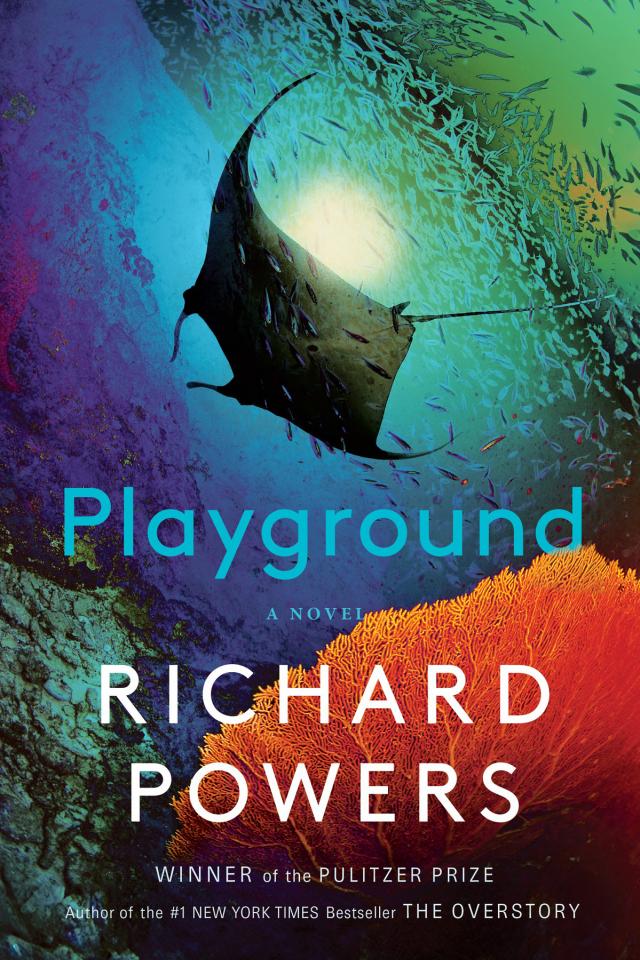
PLAYGROUND
A NOVEL
RICHARD POWERS
For Peggy Powers Petermann
(1954–2022),
who gave me a book on coral reefs
when I was ten.
And for RayRay, old friend:
Seven hundred and fifty thousand—
no, make that a million thanks.
PLAYGROUND
BEFORE THE EARTH,
before the moon,
before the stars,
before the sun,
before the sky,
even before the sea,
there was only time and Ta’aroa.
TA’AROA MADE TA’AROA. Then he made an egg that could house him.
He set the egg spinning in the void. Inside the spinning egg, suspended in that endless vacuum, Ta’aroa huddled, waiting.
With all that endless time and all that eternal waiting, Ta’aroa grew weary inside his egg. So he shook his body and cracked the shell and slid out of his self-made prison.
Outside, everything was muted and still. And Ta’aroa saw that he was alone.
Ta’aroa was an artist, so he played with what he had. His first medium was eggshell. He crunched the shell into countless pieces and let them fall. The pieces of eggshell drifted down to make the foundations of the Earth.
His second medium was tears. He cried in his boredom and his loneliness, and his tears filled up the Earth’s oceans and its lakes and all the world’s rivers.
His third medium was bone. He used his spine to make islands. Mountain chains appeared wherever his vertebrae rose above his pooled tears.
Creation became a game. From his fingernails and toenails, he made the scales of fish and the shells of turtles. He plucked out his own feathers and turned them into trees and bushes, which he filled with birds. With his own blood, he spread a rainbow across the sky.
Ta’aroa summoned all the other artists. The artists came forward with their baskets full of materials—sand and pebbles, corals and shells, grass and palm fronds and threads spun from the fibers of many plants. And together with Ta’aroa, the artists shaped and sculpted Tāne, the god of forests and peace and beauty and all crafted things.
Then the artists brought the other gods into being—scores of them. Kind ones and cruel ones, lovers and engineers and tricksters. And these gods filled in the rest of the unfolding world with color and line and creatures of all kinds—land, air, and sea.
Tāne decided to decorate the sky. He toyed with the possibilities, dotting the blackness with points of light that spun around the center of the night in great pinwheels. He made the sun and moon, which split time into day and night.
Now that there were days and months, now that the world was sparked with branching and unfolding life, now that the sky was itself a work of art, it was time for Ta’aroa to finish his game. He fashioned and split the world into seven layers, and in the bottommost layer he put people—someone to play with at last.
He watched the people puzzle things out, and it delighted him. The people multiplied and filled the lowest layer like fish fill up a reef. The people found plants and trees and animals and shells and rocks, and with all their discoveries they made new things, just as Ta’aroa had made the world.
Growing in number, human beings felt hemmed in. So when they discovered the portal that led up to the level of the world above theirs—the doorway that Ta’aroa had hidden just for them—they pried it open, passed through, and started spreading out again, one layer higher.
And so people kept on filling and
climbing, filling and climbing.
But each new layer still
belonged to Ta’aroa,
who set all things
moving from
inside his
spinning
egg.
........
It took a disease eating my brain to help me remember.
The three of us were walking home from campus one night in December, almost forty years ago. The year that Ina first set foot on a continent. We had seen a student production of The Tempest and she’d sobbed through the whole last act. I couldn’t for the life of me figure out why.
Rafi and I escorted her back to her boardinghouse, a dozen blocks from the Quad. Ina wasn’t used to square blocks. They disoriented her. She kept getting turned around. Everything distracted her and stopped her in her tracks. A crow. A gray squirrel. The December moon.
We tried to warm her, Rafi and I, one on each side, each almost twice her height. Her first-ever winter. The cold was homicidal. She kept saying, “How can people live in this? How do the animals survive? It’s insanity! Pure madness!”
Then she stopped in place on the sidewalk and yanked us both by the elbows. Her red face was round with awe. “Oh, God. Look at that. Look at that!” Neither of us could tell what in the world she was seeing.
Little pellets were dropping through the air and landing on the grass with a faint click. They stuck to the ends of the frozen blades like white, wet flowers. I hadn’t even noticed. Nor had Rafi. Chicago boys, raised on the lake effect.
Ina had never seen anything like it. She was watching bits of eggshell fall from the sky to make the Earth.
She stood there on the iron sidewalk, freezing to death, cursing us in joy. “Would you look at that? Look at that! You stupid shits! Why didn’t you tell me about snow?”
Ina aroita went down to the beach on a saturday morning to look for pretty materials. She took her seven-year-old Hariti with her. They left Afa and Rafi at the house, playing on the floor with toy transforming robots. The beach was only a short walk down from their bungalow near the hamlet of Moumu, on the shallow rise between the cliffs and the sea on the eastern coast of the island of Makatea, in the Tuamotu Archipelago in French Polynesia, as far from any continent as habitable land could get—a speck of green confetti, as the French called these atolls, lost on an endless field of blue.
Born in Honolulu to a Hawaiian petty officer first class and a Tahitian flight attendant, raised on naval bases in Guam and Samoa, educated at a gigantic university in the American Midwest, Ina Aroita had worked for years as a maid for a luxury hotel chain in Papeete, Tahiti, before boating 150 miles over to Makatea to garden and fish and weave and knit a little and raise two children and try to remember why she was alive.
Makatea was where Rafi Young caught up with her again at last. And on that island, the two of them married and raised a family as well as they could, away from the growing sadness of the real world.
Four years on Makatea convinced Ina Aroita that she was alive for the sole purpose of enjoying her moody husband and their two children, her crab boy Afa and her timid dancer Hariti. She grew things—yam, taro, breadfruit, chestnut, eggplant, avocado. She made things—shell sculptures and pandanus baskets and mandala-painted rocks. Sometimes one of the handful of tourists who sailed to Makatea to see the fabled ruins or climb the spectacular cliffs would buy a piece or two.
Ina Aroita built her beachcomber assemblages in her yard, turning the fringe of jungle behind her restored cottage into an open-air museum for no one. Tendrils of Homalium and Myrsine grew over her work and covered it in green, the way the jungle buried the island’s rusted engine parts and remnant railroad from the time of the phosphate mines.
On that Saturday, mother and daughter combed through the stretch between high and low tides, sifting for riches. The treasures were plentiful: clam and crab and snail shells, pretty bits of coral and obsidian polished by the merciless surf. They walked across the salt-sprayed rocks down to where the waves broke. Troves of incredible loot hid everywhere in plain sight.
Hariti found a flat blue stone that sparkled when she wetted it.
“Is it a jewel, Maman?”
“Oh, it’s a jewel, all right. Like you!”
The girl decided it was safe to laugh. She stuffed the stone into a mesh bag to bring back up to the house. Later, she and her mother would plan together what to make with all their smooth, speckled, shining things.
While they searched, Ina Aroita told her daughter all about Ta’aroa.
“Can you believe it? He built the world out of shells from his own egg!”
Ina had learned the tale from her own mother, at the soft-serve shack on Waikiki Beach two miles down from Diamond Head, when she was seven years old. And now she taught it to this new and strange seven-year-old artist who badly needed myths of bold enterprise. The world with all its bright and surprising contents was created out of boredom and emptiness. Everything started by holding still and waiting. The perfect story to tell such a dark and anxious child.
Ina was just getting to her favorite part, where Ta’aroa calls up all the artists to help him, when Hariti let loose a bloodcurdling cry. Ina scrambled over the rocks toward her daughter, searching everywhere for the threat. There was always a threat, with Hariti. Her birth parents had died just as she was reaching the age of memory, and she never forgot that the world was forever poised to take everything.
Whatever the threat this time, Ina couldn’t see it. Nothing on the length of that beach had the power to harm them. The coast was truly clear, all the way up the curving shore and around the headlands to the ghost settlement of Teopoto at the island’s northern tip. And still Ina’s excitable girl froze in place, wailing.
The terror lay two steps in front of Hariti’s small bare feet. In a shallow pit on the beach lay the corpse of a bird. Its limp wings draped, its legs sprawled, and the beaked head hung helpless to one side: an albatross, dead for a long time. It was not fully grown, for the wings of a full-grown albatross would have stretched twice the height of Ina Aroita. Still, the bird spread over the beach, almost as big as Hariti.
The soft parts had dissolved into a golden outline against the gray sand. The pinnate remains of the rotting wings looked like dried palm fronds. Two great sticks—the creature’s humeri—came out of the empty shoulder sockets. The silhouette still struggled to rise and fly away.
A chunk of sternum and the slim brown bands of friable rib enclosed what was left of the bird’s abdomen. Inside that chest, immune to decomposing, lay two fistfuls of plastic pieces.
Hariti screamed again and kicked sand at the dead thing. She took a step toward the carcass in disgust, as if to tread on the remains and grind them into the beach. Her mother tugged her back, too hard. But the shock of being yanked back and held tight at last halted the girl’s howling.
“What happened to it? Why is that stuff inside?”
She asked in English, a new habit that Ina Aroita was trying to break.
“Il a mangé un truc qu’il n’aurait pas dû.” It ate something it shouldn’t have.
“Like junk food?”
“Yes.”
“Why? Why did it eat junk food, Mom? It’s a bird. Birds eat good food.”
“It got confused.”
Ina’s every answer made the world more terrifying. The girl pressed her wet face into her mother’s bare thigh.
“It’s creepy, Maman. Make it go away.”
“It’s a creature, Hariti. We should give it a good burial.”
That idea took hold of the girl, who loved both rituals and digging in the sand. But as Hariti started to drop handfuls of ground-up coral and shells onto the cadaver, Ina Aroita stopped her again. Ina reached her hand into the chest of the decomposing bird and drew out two bottle caps, a squirt top, the bottom of a black film canister at least fifteen years old, a disposable cigarette lighter, a few meters of tangled-up monofilament line, and a button in the shape of a daisy.
She popped the colored hoard into their mesh bag, alongside the morning’s other treasures.
“Nous pouvons faire quelque chose avec ceux-ci.” We can make something with these.
But she had no idea what.
They shaped the grave into a mound, round and smooth. Hariti wanted to put a cross at the head, like the graves in the island’s two churchyards. So they made a cross out of hibiscus twigs and pushed it into the sand. Then they lined the mound with green snail shells and small yellow pebbles.
“Say a prayer, Maman.”
Ina paused over the choice of languages. This confused bird might have come all the way from Antarctica, via Australia or Chile. It had lived its life mostly on the water. Ina said a few words in Tahitian, because French and English didn’t seem right and she knew too little of the many strains of Tuamotuan to say anything useful.
Fifteen minutes after their brief service, Ina’s daughter was skipping down to the waves again, finding new jewels, as if death by plastic ingestion were just another inscrutable myth, as mysterious as a god huddled up in a spinning egg before the beginning of the world.
........
I’M SUFFERING FROM WHAT we computer folks call latency. Retreating into the past, like my mother did in her last years. This curse doesn’t always run in families, but sometimes it does. Who knows? Maybe my mother had it, too. Maybe the undiagnosed disease lay behind the accident that killed her.
As more recent months and years grow fuzzy, the bedrock events of my childhood solidify. Closing my eyes, I can see my first bedroom high up in the crow’s nest of our Evanston Castle in more detail than memory should permit: the student desk cluttered with plastic sharks and rays. The shelf of deep-sea books. The globe of a fishbowl filled with guppies and swordtails. The closet piled high with masks and snorkels and dried sea fans and chunks of coral and fish fossils from the Devonian Period, bought at the Shedd Aquarium gift shop.
On the wall above my bed hung a framed article from the Trib dated January 1, 1970: “First in Line for the New Decade.” I must have read that thing a thousand times, growing up. The black-and-white picture showed me, newborn Todd Keane, delivered in Saint Francis Hospital, Evanston, in the barest fraction of a second after midnight, staring at the camera with infant bafflement, trying to focus on the great mystery looming up in front of me.
Mr. First in Line: My parents called me that for years. It put some pressure on me when I was small. An only child, I took the title and the birthright seriously. I bent under the obligation to become the first person to reach the Future.
And here I am, successful at last.
MY MOTHER DIDN’T WANT to wreck her perfect body with childbirth, but my father needed someone he could play chess with at home, any time of day or night. I don’t know how they settled the matter. Maybe rock, paper, scissors. Feats of skill. Moot court or Oxford-style debate. Maybe I was born by a roll of the dice.
One continuous war game between the two of them dominated my entire childhood. Their tournament was driven as much by lust as by hatred, and each of them took their different superpowers into the fray. My father: the strength of mania. My mother: the cunning of the downtrodden. I was a precocious four-year-old when I realized that my parents were locked in a contest to inflict as much harm on each other as possible without crossing over the line into fatality—just enough pure pain to trigger the excitement that only rage could bring. It was a kind of reciprocal autoerotic strangulation of the soul, and both parties were generous givers and grateful recipients.
My father was a quick man, so quick that he found much of the rest of the world tedious. He worked in the pit at the Chicago Board of Trade, in the age before electronic trading. A warrior of the open-outcry system, he stood in the heart of the octagon as the furious waves of capitalism crashed all around him. Casting a cold eye on others’ fears and turning them to a profit, his brain knew no difference between thrill and stress. Keeping his head while others swelled and broke, making and losing insane amounts of money all with little twists of the palm and flicks of the finger (backed up by delirious screaming), had long ago flooded his cortex with so many surging neurotransmitters that he could no longer function without constant low-level threats to his well-being. These my homemaker mother dutifully supplied.
Other doses took the form of a souped-up 450SL convertible, a Cessna Skyhawk that he kept at Midway and liked to take out in rough weather, and a mistress who carried an unregistered Smith & Wesson Model 61 in her Louis Vuitton leather shoulder pochette.
My mother was a closet romantic. When she found out about my father’s secret life, she hired a private detective to hunt down a boy who had doted on her at New Trier High School and who went on to play utility infielder in the Cubs’ farm system for several years before buying into an AMC dealership in Elk Grove. She was constantly breaking up and furiously reuniting with this man in semi-public places, all but begging my father to put an end to it. My father rose lovingly to the bait, time and again.
Don’t get me wrong: If being rich meant having feckless parents, I accepted that. I loved being rich. The consolation prizes were many and outstanding. But I hated my father for betraying my mother, and I hated my mother for betraying me. I wasn’t old enough yet to know how to pretend that everything would be fine. The secret seemed to be to find some other place to live.
I found that place under Lake Michigan. When my mind raced and the future rushed at me with knives, the only thing that helped was looking out from the castle and seeing myself walking across the bottom of the lake.
All dramas sounded muffled, under the water. I knew this from summers on the Lee Street and Lighthouse Beaches. All friends and foes looked fluid and subdued, crawling through liquid resistance with a languid blue-green cast. On the floor of the lake, there were no people. I couldn’t imagine a better place to live.
MY FATHER WRECKED HIS BACK while skiing with his mistress in Big Sky. He came within millimeters of full paralysis. The pain crippled him, and he needed immediate surgery. My mother took me to Montana to see him as he never was—prostrate and almost benign. They gazed at each other and grabbed hands, fused again by near-disaster. But the minute the ICU nurse stepped out, they were at each other’s throats.