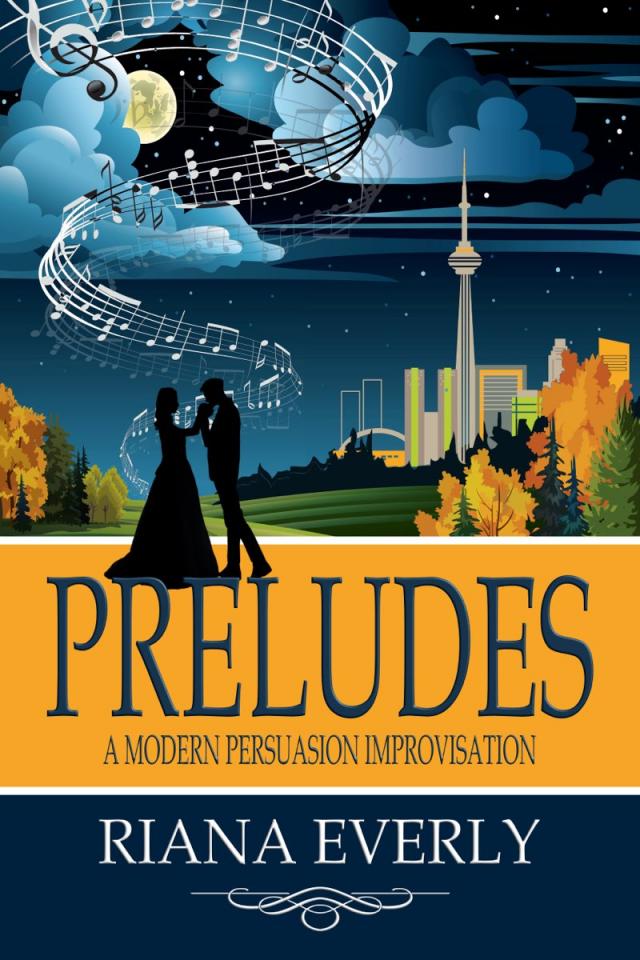
Preludes, page 31


And, in the morning when Anne opened her eyes, Fred was there beside her, a look of pure serenity on his handsome face. They would be torn apart no more.
Chapter Thirty-Two
Finale
“Are you sure she won’t mind?”
Fred hugged Anne to his side as they rode up in the elevator to Sophia and Jeremy’s condominium unit. His arm felt good around her shoulders; it was exactly where it belonged. She leaned into him and looked up with a grin.
“She won’t mind at all. When I texted her earlier, I said I was bringing a friend to her little tea party, and her only concern was whether my friend preferred chocolate or fruit. And no, to answer your next question, she doesn’t know it’s you. I want to see her face when we tell her. I’m quite sure she thinks I meant William.”
“William who?” he teased.
She raised her eyebrows at him. “I have no idea. I don’t remember any William at all.”
This was met by a kiss that only ended when the elevator gave its gentle rock, telling them they had reached their floor.
“Minx. I’ll deal with you later.”
Anne giggled. “Only after I deal with you. Is my hair a mess?”
Fred’s gaze was dreamy. “In my eyes, it’s always perfect. But you are perfectly tidy for your adoring public, too. Come along. Let’s go and meet our fate.”
Jeremy answered the door. He kissed Anne’s cheek and gave Fred an assessing stare before inviting both inside. “Come on inside. Soph will be out in a moment. It’s still cold for a February evening, so we have a tureen of hot apple cider as well as the usuals. Let me take your coats. I’ll let Sophia know you’re here.”
They were the first to arrive, by Anne’s planning, and for now, they had the spacious living room to themselves. They stood a bit apart. They had no need to touch physically right now. They were connected at a far deeper level. The air around them was warm and tingling with quiet electricity. They were, in all essential ways, one.
“Anne, darling!” Sophia’s voice came from down the hallway. “What little gem do you have to tell me? Who—” She sashayed into the room and stopped short. “Frederico! What a surprise. Did you run into Anne coming over? Did you…? Oh!”
Understanding dawned.
“Annie, darling? I expected you in tears, not like this. Tell me there is a reason you’re glowing so brightly I don’t need the lights on. What little secret do you have? I don’t think I’ve ever seen a smile like that on your face.” Her eyes assessed Fred more keenly than had her husband’s, and she returned to them both with a look of great pleasure. “The two of you…?” Her eyebrows moved suggestively.
Anne just grinned in response.
“And William? What was that all about? You two seemed like you were heading somewhere.” Her face clouded momentarily. “Have you heard…? I was afraid you’d be devastated—”
Devastated? What did her friend know? No matter. William was hardly a memory now.
“I tried to tell you, Soph. It was nothing with William. It never was anything. He was all style and no substance. And I recently learned some things about him that quite convinced me I wanted nothing to do with him at all.”
A sudden look of relief rushed over her friend’s face. “After what I heard today, Anne, I think that is the wisest thing you’ve ever said. Well,” looking from Anne to Fred and back again, “perhaps the second. Come and sit. We’ve had news that affects both of you.”
Jeremy was at the bar and in a moment, the four were sitting with drinks at hand. Jeremy took up the tale.
“It seems there have been some, er, irregularities with our friend, Mr. Barnett. His business dealings were not all quite above-board, as they say.”
“I know. I think we have Fred to thank for that.”
Jeremy’s face took on a shrewd look. “Is that so, Maestro? Interesting. You can explain later, but I suppose we should thank you.”
Fred shook his head. “Not me. A friend of mine did the legwork. I just suggested the direction he should start looking. I have to admit, I was not quite expecting the dirt he dug up. It might prove embarrassing to the orchestra, and I’m sorry about that.”
“Never you worry, Fred. We’d rather know. This way, we can be proactive. He’s already been removed from the board, and if we need to address this, we can say we acted as soon as we learned there was something shady going on. There are rumours about criminal charges coming forward as well for fraudulent activity. One of our members is a lawyer and said something about his accounts being frozen, but, well, rumour is just rumour. Still, our old friend is facing a bit of trouble, it seems.”
Sophia pinched her lips. She clearly had more to say.
“There is something else you should know. I… I heard this about Kevin Walters. It’s a bit of a grapevine, but my sources are usually trustworthy.”
“You’ll keep this quiet?” Jeremy phrased it as a question, but it was an order. Both Anne and Fred nodded.
“It seems that Walters’ wife, Penny, has, er…”
“Run away with William Barnett?” Anne finished.
Jeremy and Sophia turned to her with wide eyes. “How did you know?”
Anne laughed. She had not found this at all amusing at the time, but now, just a week later, it seemed inane, ridiculous even. How could she ever have thought enough of William that she was surprised by this? She wasn’t even hurt anymore. A bit angry, perhaps, at having been used so cruelly, but she knew now he had never had enough of a hold on her heart to injure it.
“I smelled her. That gala, before Christmas, when William came back late after one of the courses, he smelled of perfume. It was a very distinctive scent, blue and purple, with flecks of amber. When I shook hands with Penny at the gala, I smelled the same perfume. It was unmistakable. You can’t transfer a scent like that by shaking hands. They must have been… more intimately involved behind some potted plant somewhere.” She paused and sighed. “Poor Kevin.”
Sophia clucked. “That must hurt. But if that’s the sort she is, he’s better off without her.”
There was a moment of comfortable silence between the four. Then Sophia sat up pertly in her chair. “We have a few minutes before the others arrive. Sarah is in the kitchen getting everything ready, so you can spill. You two? What? How?”
Anne beamed at her friend. “The ‘what’ is simple. Us. We are what. It’s always been us, despite all those years apart. I always knew I’d never find anyone like him.” She reached across the small space to take his hand again.
“And how,” Fred’s face took on that blissful expression again, “is a story for our grandchildren. Anne,” he leaned forward conspiratorially, “wrote me a love song!”
Sophia clapped, and Jeremy called out his approval.
“And she had the orchestra play it for me. She stepped up to the podium, took my baton, and waved it at them. And they played the music she set in front of them. They had no idea what was happening, but I knew, from the first note, I knew. No one has ever written a love song for me before.” His eyes met hers and she was lost in their deep brown depths. With an effort, she pulled herself away to return to her friends.
“Perhaps I did,” she confided after a moment. “But that was only after he did what he said he would never do. He wrote me poetry!”
“A poet? How lovely. And romantic.” Sophia’s voice was everything enchanted.
“Oh no! My poetry is dreadful. I am far better with a stick than with a rhyme. But it was enough.”
“What’s next for you two? You have a past, but I don’t want to assume…”
“We’re taking it slowly,” Anne replied, “not because we aren’t sure, but because we want to do it right. We want to make sure we are both completely ready for every step, no matter how or when it comes. When Fred goes to Vancouver next month for his guest conductor gig, I’ll join him…”
“And when Anne goes to New York in April to talk to the people there about the television miniseries they’ve approached her about, I will join her.”
Jeremy clucked his approval. “So, none of my business, but will you get married again?”
Anne turned to Fred and the two of them burst out laughing. “You tell them, Annie.”
“No, you can.”
Fred turned on his brilliant grin, the one that delighted audiences around the world, and announced, “we can’t do that. You see, we never really divorced. We started proceedings, but we never finalised the paperwork. It’s still sitting in some lawyer’s office somewhere, waiting until it was necessary. We’ve been married all this time.”
“Then a toast, before the others arrive.” Sophia leapt from her chair. “To Fred and Anne. May you always make beautiful music together.”
“To Fred and Anne. Congratulations!”
And as the doorbell rang and Sarah in the kitchen started bringing out hors d’oeuvres and little cakes, Anne stepped into the arms of the man she had loved for so long and gloried in the feel of him.
“To us. This was our introduzione, our beginning. Now on to the symphony of our lives. To you, Fred.”
He didn’t reply because he was too busy kissing her.
Epilogue
Glorioso
The concert hall still rang with the reverberations of the ultimate chord of her symphony, bold and triumphant. The musicians had not yet breathed their release after that final exultation of sound and perched on their chairs in that exquisite moment between action and repose, frozen in time, a tableau to be captured. Apart from the fading echo of that great, triumphant chord, the hall was absolutely silent.
On the podium, Maestro Frederico Valore took a deep breath and lowered his baton, and at once, the crystalline stillness exploded into a tidal wave of applause. Where a second ago, full silence reigned, now the massive space rang with the thunder of a thousand hands and cries of Bravo! from all parts of the auditorium.
Fred turned around to face the crowd and take his bow. His face was exultant, his brow shining with the beaded perspiration generated by the energetic command of a forty-five minute long oeuvre. Anne’s symphony.
The waves of applause continued and the orchestra members stood to take their own bows, first the entire ensemble and then section by section. Fred motioned for particular soloists to stand for the audience’s adulation—the oboist, the concertmaster, the principal violist, Louisa in her role as first French horn, the first trombone—and then he brought the entire group to their collective feet once more.
And still the applause rang with no sign of slowing.
“Go up!” Sophia nudged Anne’s side. “He’s gesturing for you. It’s your turn.” She all but pushed Anne from her seat in the front row of the audience. Anne was ready for this. It was quite expected, after all, and she was prepared for her moment in the spotlight.
Behind her, Jasmine and Connor called their words of encouragement, and even Marie, to her other side, looked impressed. “It was really rather nice, Anne. I don’t think I could have done that.”
Anne rose to her feet and strode to the stairs at the side of the stage, then climbed them in three easy steps. She looked good tonight, and she knew it. No more dark blues and muted blacks. Black was for the performers. Tonight she wore bright red. Sophia had convinced her that this shade was all but made for her, and even Anne had to agree. The brilliant colour brought out the delicate beauty of her complexion rather than overshadowing it, and she felt… powerful.
She bowed to the orchestra and mouthed a huge “thank you” before continuing to the podium. Once there, Fred grabbed her hand and turned her to the audience, lifting that hand high above their heads in a gesture of triumph.
If anything, the thundering appreciation grew louder. Red to match her dress, sparks of gold and flashes of emerald green, the sound rushed through her and boosted her. Could she smile any wider?
The orchestra joined in the applause and a little girl in a lacy white party dress danced onto the stage from the wings to hand Anne a huge bouquet of flowers. And beside her, Fred stood tall and beaming, his sweat-damp face a picture of pride and elation.
“You did it, Anne.” He whispered, although with the noise from the seats there was no need to be quiet. “Your symphony is a masterpiece.”
“And you conducted it perfectly. Every note was exactly as I hoped.” Could the audience see the adoration in her eyes? She hoped so. Everyone should know how much she loved this man.
Fred caught her hand in his again and raised his arm in appreciation of the applause and in glory. The ring on Anne’s finger caught the bright spotlight and sparkled in a cascade of sound and colour.
Soon they would go to the reception. Soon they would make the announcement of their official celebration of marriage, albeit eight years after the fact. Soon they would speak to their fans and celebrate with their friends.
But now, for this moment, they stood here together, she and her beloved Fred, on stage between orchestra and audience, together in music and together in love, and life was truly wonderful.
* * *
The End
Notes
This novel has allowed me to explore some of my great loves: music and the world of the orchestra, Toronto, where I live, and my favourite of Jane Austen’s fabulous novels, Persuasion. Through the creation of this work, and through my research, I also discovered some new loves, including the poetry of E. Pauline Johnson.
* * *
I am a musician and have played in orchestras since I was a child. From those very early student groups to professional ensembles playing Brahms and Mahler, orchestras have fed my soul. I have not written much about individual pieces of music (other than my protagonist’s fictional ones), but I have referenced several. Here is a list of some of these pieces, if you wish to look for recordings. All are readily available on various streaming platforms.
J.S. Bach - Brandenburg concertos
W.A. Mozart - String quartets (all of them. They’re wonderful)
G. Holst - The Planets
L. van Beethoven - Symphony #5
J. Brahms - Quintet for piano and strings, op.34
J. Brahms - Symphony #3
J.S. Bach – Sonata #4 for violin and harpsichord
W.A.Mozart - Violin Sonata No. 21, E Minor, K. 304
I moved to Toronto as a university student, and had no real love for the city at the time. It was big and brash and soulless, or so I thought. But the passage of time has changed these first impressions, and I have come to see the city for what it is beneath the glass-and-concrete exterior. It is a network of communities that welcome you in, a multicultural hub where the world is just a subway stop away, and a thriving centre for the arts. From movies and television, to first-rate theatre, to a fabulous music scene, Toronto has everything at a world-class standard. It is no stretch to believe that a famous young composer could live here, or that my fictional orchestra could attract a principal conductor with a global reputation.
Updating Austen is a most delightful challenge. Her characters are so beautifully drawn they are timeless, and those same loves, losses, heartbreaks and victories that her characters experienced two hundred years ago still resonate.
Still, some changes must be made to reflect the current times and settings of a modern interpretation. Some of those changes in this novel are the names of some characters. Where Miss Austen gave us no name, that was easy. But in other cases, I had to make some decisions.
Frederick Wentworth, for example, is no longer a navy captain, but an orchestra conductor. Given the glorious heritage of music in Italy, and Toronto’s huge Italian community, I have made him Italian, born in Canada to an Italian-speaking family, full of love for his city, his heritage, and his music. But Wentworth is not an Italian name. So, I translated it, or, rather, part of it. “Worth” translates roughly as “Valore,” and that became Fred’s new name. Move over Captain Wentworth. You are now Frederico Valore.
William Elliot was another challenge. In Austen’s world, marrying within families was not at all uncommon, and especially in the case of Persuasion, where cousin William Elliot is in line to inherit Sir Walter’s baronetcy. That would strike readers as odd, if not creepy, in a modern novel, and so I made him a stranger. And what to call a man who wants to be a baronet? Barnett, of course. And thus, my handsome businessman was born: William Barnett.
Other changes are simpler. Mary becomes Marie, which is just a bit more in keeping with modern fashions for names, and Captain James Benwick is now Ben James. Hopefully a few different names will not impede anyone’s enjoyment of the story.
E. Pauline Johnson
* * *
Anne Elliot is a Canadian composer, and I wanted her to base one of her commissions on Canadian poetry. I wanted something steeped in tradition, but also modern and forward-looking. And I wanted poetry that sang to my soul. I hunted and I searched and I scrounged and found nothing that really called out to me. And then I saw a name I knew. E. Pauline Johnson.
I’d heard of her before and certainly knew her photograph, but had never really taken the time to read her poetry. So I sat down with a collection and began to read. Oh, how glad I am that I did! This was exactly what I wanted. Her poetry is rooted in the land and in her indigenous North American traditions, while still speaking to European sensibilities. And most importantly, it sings. It sings to my soul. I am not a particular aficionada of poetry, as much as I appreciate it, but sometimes something just reaches out and grabs me. And this is exactly what happened. As I read her words, melodies formed in my head. I can just imagine the fabulous riches a real composer could find in her work.
Emily Pauline Johnson was born in 1861 in what is now Ontario, Canada. Her father was Mohawk and her mother English, and she often went by her Mohawk name, Tekahionwake, meaning Double Wampum. Despite the inherent prejudice her parents faced from their mixed marriage, she was brought up in comfortable and culturally rich circumstances. Her father, George, was chief of the Six Nations, spoke English, French, German, and the languages of the Six Nations Confederacy, and worked as an interpreter and cultural liaison between the federal government and the indigenous peoples of the area. Her mother, born Emily Susanna Howells in England, came from a family known for their interest in the literary arts. Due to a large extent to George’s reputation, their home was often host to quite distinguished guests, such as the Marquess of Lorne, Lord Dufferin, and Princess Louise, and Pauline’s elegant manners owed much to this aspect of her childhood.