The Widow's Modiste, page 1


The Widow’s Modiste
Copyright
Copyright © 2022 by Renee Dahlia
All rights reserved.
No part of this book may be reproduced in any form or by an electronic or mechanical means, including information storage and retrieval systems, without written permission from the author, except for the use of brief quotations in a book review. No part of this book may be used for the purpose of training artificial intelligence systems. For permissions contact renee at reneedahlia dot com.
This is a work of fiction. Names, characters, places, and incidents are the products of the authors imagination or are used fictitiously. Any resemblance to actual personas, living or dead, businesses, companies, events, or locales is entirely coincidental.
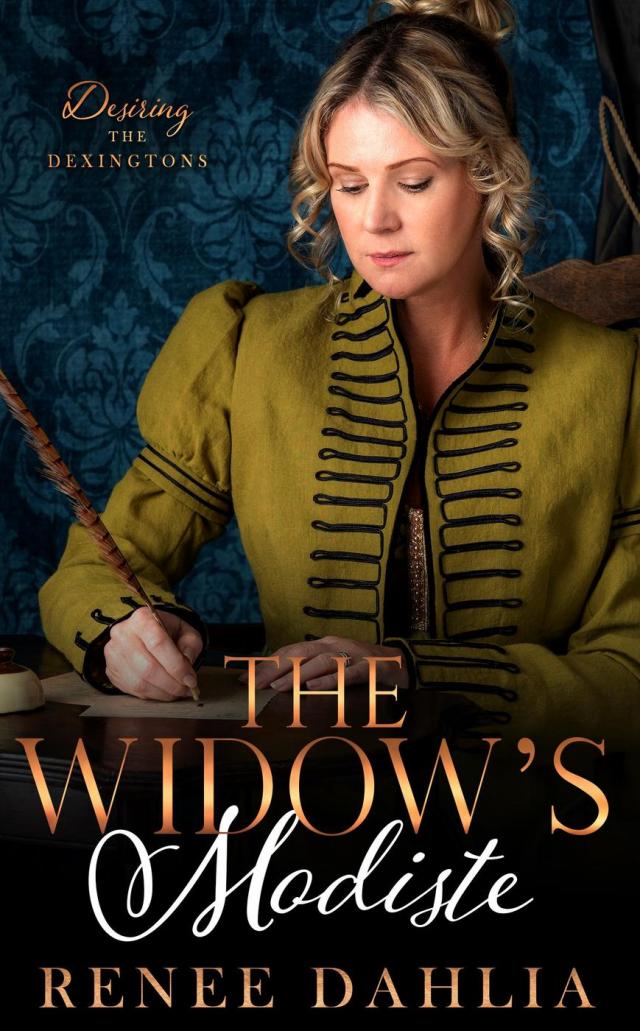
Cover by Sarah Paige at The Book Cover Boutique
Also by Renee Dahlia
BeST
Count Me In
Strum Me Hard
Tune Me Up
Bisexual Sing Team
Desiring The Dexingtons
Love Wasn't Built In A Day
The Secret Life of Spinsters
The Highwayman's Surprise Bride
The Summer of Second Chances
The Widow's Modiste
Gamble Racing
Driven To Distraction
Driven By Passion
Driven By Ambition
Driven To Protect
Great War
Her Lady's Melody
Her Lady's Fortune
His Lord's Soldier
Kapow
Out of Her League
His Buxom Beauty
Craving His Spotlight
Her Pregnant Rival
Seraph's Burlesque Club
Show Up
Show Off
Show Queen
Show Time
Show Dance
Standalone
The Shipwrecked Earl's Bride
Watch for more at Renee Dahlia’s site.
Table of Contents
Title Page
Copyright Page
Also By Renee Dahlia
The Widow's Modiste (Desiring The Dexingtons, #5)
Foreword
Chapter 1
Chapter 2
Chapter 3
Chapter 4
Chapter 5
Chapter 6
Chapter 7
Chapter 8
Chapter 9
Epilogue
Sign up for Renee Dahlia's Mailing List
Also By Renee Dahlia
The Widow’s Modiste
Renee Dahlia
A bored widow, an incredible dress, and a modiste with a secret.
Jacinda Dexington wants to take her modiste shop to the haut ton, so when a client gives her tickets to the Soho Club’s Contrary Gods masquerade ball, she wears the outfit herself. It’s a sensation and everyone wants to know who created it. But only one person offers her refreshments... and a little bit more.
Lady Merryam, widowed and bored, only attends the Soho Club’s latest ball to help raise funds for her son’s orphanage. The last she expects is a one night stand with the mysterious woman wearing ‘that’ dress. Could spending more time with her be the answer to her ennui?
About the author
An avid reader, Renée Dahlia writes contemporary and historical queer romance. Renée is a bisexual cis woman who is fascinated by people and loves to explore human relationships, with a side of humour, through her writing. Renée has a degree in physics and mathematics, using this to write data-based magazine articles for the horse racing industry. Her love of horses often shines through in her fiction, and she loves a good intrigue and to escape the real world in the pages of a book. When she isn’t reading or writing, Renée spends her time with her four children, usually watching them play cricket.
Foreword
Welcome to THE WIDOW’S MODISTE, a Regency era sapphic romance novella. One of the DESIRING THE DEXINGTON novellas, this book features Jacinda Dexington, a modiste.
If you love age gap lesbian romances with a Regency flair, this is the novella for you.
This book is written in Australian English and some spelling and phrases may be unfamiliar to American readers.
If you are keen to keep up to date on new releases and, more importantly, sales, I recommend you sign up to my newsletter, or follow me on social media.
Social Media Links
Patreon
romance.com.au
BookBub
I hope you enjoy reading this book!
Renée
Chapter 1
December 1818
Jacinda could’ve done with a glass of ratafia and a snooze, but the Contrary Gods themed masquerade ball at the Soho Club had her and her team of seamstresses working their fingers to the bone making enough costumes. The ball was tonight and there were still three costumes to be finished and delivered in the next four hours. She threaded another needle and reminded herself that she was living her dream. A modiste in London—Madame Fabriquer—designing clothes for a client list filled with the nouveau riche. All she needed now was to break into the haut ton, and design for duchesses and royalty, because then her designs would be seen in all the newssheets and she would’ve truly made it.
“Miss Dexington, there’s a servant at the door with a message for you.” One of the youngest seamstresses, Jane, poked her head into the sewing room.
“If that’s Lady Shropshirebury, tell her we will deliver her outfit in an hour as agreed.”
“You have to come.”
Jacinda placed her work carefully on the table and stood up. She stretched out her fingers as she walked towards the back door and took the written message from the servant.
My apologies. Lord S. has returned from the continent. Please find enclosed my ticket as compensation. Yours.
Well, that didn’t explain much. “Thank you.” She handed the servant a coin and closed the door, before leaning back against the wall. Three weeks of work on Lady Shropshirebury’s costume was completely wasted; not to mention the cost of the fabrics. The incredibly delicate muslin they’d used didn’t come cheap, nor did all the embroidery work they’d done on the bodice.
“What’s the matter? You look like you’ve eaten a rotten fish.” Margs poked her head into the hallway leading out to the back door. Jacinda handed Margs—her business partner—the note and the ticket. Margs did all the practical parts of their business, leaving Jacinda free to talk to customers and create wonderful designs for them.
“Lady S better bloody pay her bill. I’ll write her an invoice that doesn’t mention the ball, since her husband obviously can’t know she intended to attend.” Margs scoffed. “You should go. You’d look mighty pretty as the Fates.”
“No. I couldn’t.” Jacinda was too tired to attend a party known for lewdness and profanity. As much as she loved people, a party like that would take a lot of energy and she was trying to run a business. Her focus had to be on that, not the frivolous parties of her clients. She’d spent four years building up Madame Fabriquer into a personality; the absolute must-have modiste for the wealthy elite. She couldn’t risk her reputation at one of their own parties. Could she?
“It’d be good for business.”
“How so?”
“Research. You’d get to see what they actually do at these fancy parties.” Margs had that calculating look on her face, her dark brown eyes narrowed. “You are young and pretty. Go and enjoy yourself for a change.”
Jacinda stretched out her hands. “You are young and pretty too.”
“Neither of us are that young.” They were both seven and twenty. “Go.”
“But...”
“No. This is an opportunity.” Margs used her fierce voice and Jacinda nodded. If anyone knew an opportunity and how to exploit it, it was Margs. Not because she was ruthless—although that was part of it—but because she understood that life didn’t give you anything and you had to fight for it. If Margs said this was an opportunity, Jacinda wasn’t going to argue with her. Margs’ mother was a servant for a Duke, and Margs had learned to read and write while cleaning up after the Duke’s legitimate children. She knew how to exploit opportunities and she knew that life didn’t gift you anything, especially not if your mother was African, or if you were poor. Jacinda had a much more privileged upbringing, by comparison, being from a manufacturing family who’d been in Manchester since the beginning of time. She’d brought her passion for dressmaking to London and employed Margs to do the accounts. It had been quickly apparent that Margs understood how to engage the right type of customers, and Jacinda had promoted her and given her half the business as collateral to make sure no other business poached her. Margs had taken Jacinda’s vision and created a profitable business far beyond Jacinda’s dreams.
In short, Jacinda trusted Margs’ opinion. “Then we’d better make the adjustments so the costume fits me.” It was time to make the most of Lady S’s inability to attend the Soho Club ball.
Margs nodded. “Luckily the design will work for most shapes.”
“The current fashion for high waists is flattering to most women.” Jacinda loved how the current gowns put the focus on the fabric, rather than the physical shape of the woman wearing the dress. The bodice would pose a problem, with Jacinda being much less endowed than Lady S.
“Come on. Let’s get you dolled up for a party. It’s time to get more customers for Madame Fabriquer.”
“Fine.”
“Hey, none of that. Put on your best smile for all those customers we are going to get. It’s time to expand the business, meet new people...”
“Have a growth mindset?” Jacinda teased. Margs liked to come up with her own phrases for expanding their business, and that one was one of Jacinda’s favourites.
“Yes. I’ve seen how much money these Dukes and their like have. I want some of it for me.”
Jacinda pulled Margs into a quick hug. “Like you’ve often said, the best revenge is to thrive.”
“Bloody yes.” Margs took Jacinda’s hands and stepped out of the hug. “Now, let’s make you into the Fates. You can carry the threads of all these men’s lives and their fortunes."
"Time to transfer their fortune from them to us?" Jacinda grinned at her business partner and friend.
“Definitely.”
“Let’s get the other costumes completed and delivered, then we’ll focus on me. If I’m late, I can make a grander entrance.” Jacinda could do this. She could draw all the attention to her and her costume. She’d make sure everyone knew who made it; she wanted everyone whispering—shouting—about Madam Fabriquer and how creatively brilliant she was. She wanted everyone in the ton wearing her designs, and if they weren’t, she wanted them to be talking about how much they wished they could afford her work. With their success, Margs could purchase her own security—and that of her mother—without the need for a husband, and Jacinda’s satisfaction in seeing her clever friend thrive would be complete.
Five hours later, Jacinda stepped out of the hackney with Jane carrying part of her costume to keep it out of the muck of the street. Her face was mostly covered by a mask; an ostentatious creation made of Papier Mache, painted navy blue with gold leaf brushed on to emphasis her eyes. Well, Lady S’ eyes. The mask didn’t quite fit her own face properly; she was taller and narrower than Lady S, even in the face, but they’d tied it on tight, so it shouldn’t slip. The design of her dress was fortunate in that it could be easily altered for her size. The bodice gaped on her; she’d contemplated stuffing her bosom with fabric to fill it out, but in the end had merely found a better solution. The original bodice was low cut, designed to display Lady S’ spectacular bosom with paste jewels sewn into the edging to catch the light. It tucked tight under her bosom, as was the current fashion, and fell to the floor in a way that reminded Jacinda of a chemise rather than the outer garment of a dress. Because The Fates in Greek mythology represented human destiny through the threads of life, the entire dress was covered in a network of thick cords, a finer version of nautical ropes. Jacinda had needed to be, quite literally, tied into the costume by Margs, with rope threaded in a cross-hatch pattern over her decolletage and bosom. From under the bosom, several ropes hung loose forming almost a gown of its own, or rather the representation of a gown. It reminded Jacinda of a spider web, in that the ropes looked like they might catch an unwilling—or willing—participant. A thinner rope had been used along her arms, woven around her biceps, all the way down past her elbows, finishing just before her gloves.
She handed her ticket to the man standing outside the Soho Club. If it wasn’t for the long line up of carriages and hackneys, and the man reading tickets, she wouldn’t have known this building housed anything but a residential home. There was no sign, nothing gave away that this was one of the clubs whispered about by her clients. She fully expected debauchery on entering the place, and she wasn’t quite sure how she might manage to avoid getting entangled. Ha, she was literally wearing a rope dress with an almost translucent muslin underneath as the only protection from the world. In certain lights, she knew people would be able to see all the way through the fine muslin of the costume. She’d worn cotton drawers as a nod to privacy, for all the good that might do.
“Thank you, Jane. Be sure to get home carefully tonight.”
“I can stay if you need, Madam.”
“No. Half of the people in attendance are clients at Madam Fabriquer.” Jacinda hoped that wasn’t quite true because she needed to woo the haut ton, not her current clients. She didn’t need to tell Jane that she’d be safe at the party. It wasn’t exactly true. She had no clue as to her safety at this type of event, as she’d never attended anything quite like this. But she reassured Jane, not wanting to lie—at least not outright—to one of her seamstresses. She ignored her racing pulse and the clamminess on her palms. It was time to do business.
Chapter 2
Phoebe, the dowager Viscountess Merryam, loved being a widow. Her life continued to improve with age; all the things that had been too scandalous when she’d been young were now seen as irrelevant and not worthy of gossip. Most likely this was because she’d already achieved the only thing a woman was supposed to do—produce a male heir for the title—and now most people didn’t see her. It didn’t bother her, not being seen, because she had plenty of money and no man to tell her what to do, and she could say all the outrageous things she’d always held back.
Tonight she was dressed as Hephaestus, God of Fire, for the Contrary Gods themed masquerade ball at the Soho Club. She’d initially thought about going as Poseidon, then dismissed the idea as desperately boring, and besides, if she was going to dress as a man, she wanted to blaze fiercely. The blacksmith at her son’s estate had helped her craft a costume, literally born of metal and fire. She wore leather breeches that stopped just below her knee with metal buttons, and a bright red tailored waistcoat that emphasised her breasts. Her only concession to her femininity were the long strips of fabric—painted Chinese silk—hanging from her under-shirt, almost like her shirt was a skirt, but too irregular and not covering nearly enough of her legs to achieve modesty. Her mask was formed in the forge, as were the chains and buckles and the cravat pin which was shaped like a flame. She adored her outfit and the freedom of walking around the room in breeches. No wonder men ruled the world if they spent their time wearing clothing that didn’t restrict their movements, and more than that, clothing that encouraged them to stride about, demonstrating exactly how they owned the world.
As she stood in one corner listening to Lord P. talk incessantly about bloody turnips, she scanned the room. It was the usual suspects. Boring. If it wasn’t for the simple fact that this ball raised money for the local orphanage—a charity begun by her son and his wife—she wouldn’t have bothered to come. Perhaps she ought to find some young Lord or Lady to take on a Grand Tour. Get away from London and the suffocating, stifling society and go on an adventure. Even as a widow, she couldn’t really travel by herself. It wasn’t exactly the done thing. There was still only so much a woman in this society could get away with. This was supposed to be her time to thrive, not still be fighting against the stifling rules of society.
A woman walked into the room and Phoebe could have sworn that the very air in the room changed. People turned and stared. Phoebe had never seen a costume like it. As she moved, Phoebe could’ve sworn she could see almost right through the fine muslin to the slender body underneath. She forced herself to stop squinting, peering, at the woman. Did she have any idea how erotic she appeared with those ropes lashed over her chest? Surely, she must. Her mask hid her face completely; none of the cheeky half-masks worn by most people here who merely wanted the pretence of anonymity.
“Goodness.” Lord P stopped talking about turnips and started walking towards the vision, and Phoebe followed him. She was compelled to get closer to that dress and the woman wearing it. And judging by the movements in the room, she wasn’t the only one.
By the time Phoebe had crossed the room, a crowd had gathered.
“Oh, you are too kind. ... Of course, Madame Fabriquer created it for me. ... I don’t know, she’s terrible exclusive.” The woman had a soft high-pitched voice with a slight squeak to it and Phoebe tried not to shiver delicately at the memories the sound released. Years ago, when she’d been a diamond of the first water in society, she’d dallied with another girl who’d had a similarly naïve voice, only to be quickly married off to Viscount Merryam. Fortunately the marriage had been a good one. Merryam had the good sense to realise that he’d won a prize in her, and he treated her with respect. She’d been lucky when so many young women weren’t.