Crocs, page 12


“Turn that freakin’ thing off, you nitwit!”
Leon’s voice.
His partner replied, “Boss—there’s something out there. You didn’t see it? Take a look. Big, bright-red eyes!”
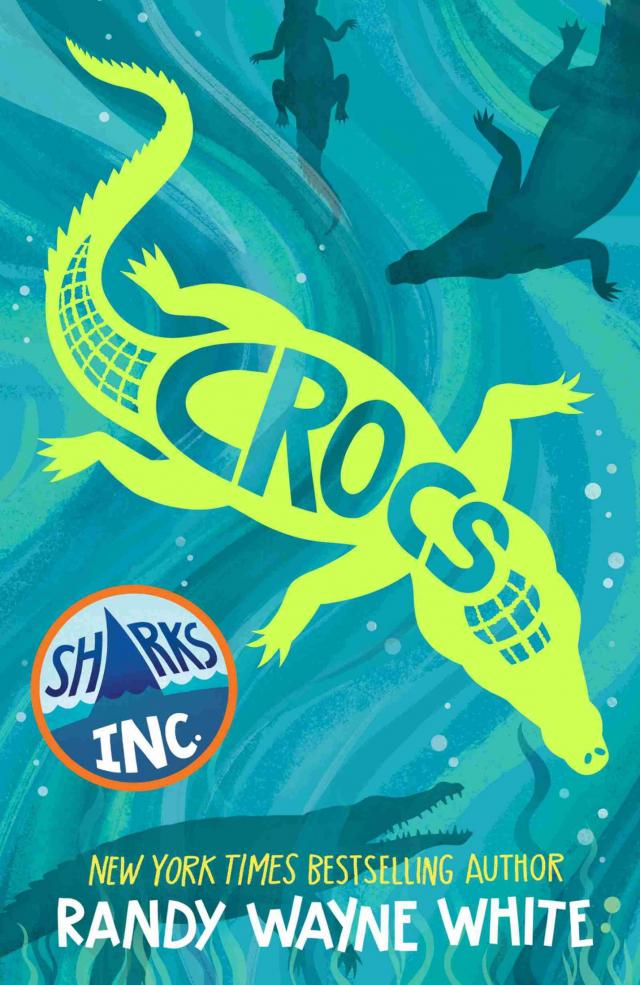
The light panned along the surface. Luke followed the beam and gulped. The mother crocodile, with her huge head and blazing eyes, was visible in the distance, swimming at high speed.
“You’re drunk,” Leon growled. “I don’t see nothin’. Get in the water. Take your knife and convince those brats to come back here.”
“But, boss—”
“Just do it!” the big man shouted. “Or we’re both gonna end up in jail.”
Luke pulled himself to the bottom and pushed off. This time he surfaced next to the cabin cruiser. The big boat had sunk as far as it could in the shallow bay. Its engines and rear deck were flooded.
The front of the cruiser angled skyward, held by the piling that had pierced the hull. A single rope hung from the railing. Maribel had looped it there after throwing one of the orange life jackets in an attempt to help the men.
Instead they had used the rope to tie the dinghy to the cruiser so the tide wouldn’t carry them away.
Luke unsnapped his knife so it was ready when needed. Silently, he followed the rope to the rubber boat and peeked over the side. Leon sat with his back to him. At his feet was the garbage bag.
A bellowing WHUFF vibrated from the distance.
“What the heck was that?” Donny whispered. He switched on the flashlight again. Fog, a curtain of water droplets, became a mirror. The light blinded them both until Leon sat up straight.
“Whoa!” he said. “I saw it—two big red eyes. What is that freakin’ thing?”
Fear raised Donny’s voice into a trembling soprano. “I don’t know, boss, but it’s huge. Oh lord … and it’s coming this way. We’ve to get out of here!”
Finally, Leon figured it out. The mother crocodile had heard the chirping cries for help. She had chased the men before, but this time they had only paddles, not a fast outboard motor.
“Dump that freakin’ bag, quick,” he yelled. “Those baby crocs—that’s all she wants. Move your butt! I’ll untie us.”
Luke ducked underwater when Leon spun and lunged for the rope. He waited until the dinghy drifted free to pull his knife. When he surfaced, the big man was swearing at his partner, screaming, “I meant dump them overboard, you idiot! Not in the boat! Now we’re really screwed.”
Baby crocodiles were skittering around Leon’s feet. The rattlesnake was there, too. It seemed confused. Instead of coiling, the snake glided across the deck, over the side, and landed in the water near Luke.
Knife raised, the boy whispered, “It’s me. I won’t hurt you. Your home’s not far from here.”
The snake’s tongue tasted the air near Luke’s arm. The taste must have seemed safe and familiar. The rattler balled itself into a turn, then skated away, doing figure eights across the surface.
“Paddle, boss! Paddle!” Donny begged.
It was Luke’s last chance to stab a hole in the rubber boat. He raised the knife higher, then stopped. No, he decided. This is between them and the crocodile.
He gave the dinghy a push and swam back to Maribel.
“Did you do it?” she asked. She had to raise her voice because the men were screaming at each other. “I couldn’t see much because of the fog.”
Before the boy could answer, they heard a lionlike growl and the gnashing of spiked teeth. Water exploded into a series of wild splashes.
“Help me, boss. Throw me a rope or something!” It was Donny’s voice.
Luke cupped his hands to his eyes. Leon was hanging on to the sinking dinghy. Donny was close enough to the cruiser that he didn’t need additional help.
The giant crocodile had gathered a cluster of babies on her head. With a sweep of her tail, she swam toward the dinosaur-shaped tree and into the fog.
“Let’s find Sabina!” Luke gasped, almost out of air. He was untying the orange life jacket and backpack from the piling. “Start yelling her name. Those guys won’t bother us again.”
They pushed away from the pilings with their life vests inflated. Tidal current, fast as a river, swept them bayward, into the shallows. Maribel took the lead. When her feet touched bottom, she waited for Luke to catch up.
“Sabina!” Several times, she hollered her sister’s name.
Luke tilted his head and listened.
“Did you hear that?” he asked. His shirtsleeves dripped water when he pointed to a darkness that was an island. “The goose—Carlos. She’s somewhere over there.”
Maribel waded ahead through shallow water. The sun was higher now, a yellow disc dimmed by a drizzling haze. She was shivering in her soaking clothes.
For a long time, it seemed, they searched. Another ten minutes passed before Luke stopped and pointed again. “Look—there’s Sabina, out there in the middle of the bay. She’s either lost or … Hey—you don’t think she’s sleepwalking again?”
It took Maribel several seconds. Because of the fog, her sister appeared to be walking on the water’s surface.
“Sabina—wait!” she pleaded, and took off, splashing through the shallows. With her long legs, she left the boy far behind.
Luke was breathing hard when he caught up.
“Her head’s bleeding. She needs an ambulance,” Maribel sobbed. “Now we’re all lost—and I have no idea which way Captain Pony’s house is. Do you, Luke?”
Surprised by the question, the boy did a slow turn. “Me? Are you kidding?”
Sabina was battling to break free of her sister’s embrace. “Let me go!” she demanded. “You might be lost, but Periwinkle’s not.”
“Who?”
“Her,” the girl sputtered while she pointed. “That’s who I’m following. Periwinkle is Pony’s dead sister. She knows where the deep spots are, so you’d better hurry or we’ll lose her.”
Luke tracked Sabina’s gaze to a curl of child-sized gray that seemed to plow a slow path through the fog. But it was the wind. Had to be. There was no person there.
Maribel gave the boy a hopeless look when her sister pulled free and charged away.
“A concussion, maybe?” he asked in a whisper. “She’s imagining crazy stuff. What are we gonna do?”
“Catch up and find help,” Maribel replied. She was already moving, Luke close behind. “When we see land, I’ll run ahead and find a house—or flag down a car or something.”
There was no need. By the time they caught up with Sabina, Captain Pony’s dock and little boat were visible through the mist.
The goose was on the beach as if waiting for them.
Something else was there, too—a canoe, Maribel thought at first.
No. It was the saltwater crocodile. The croc lay beneath the gnarled old buttonwood tree, mouth open, jagged teeth visible, while her babies chirped from atop her back.
It was Luke who noticed the rubber dinghy—what was left of it anyway. It resembled a deflated beach toy.
“Stop!” he warned. “That jerk Leon and his buddy got here first. We’ve got to run into the mangroves and hide.”
Even Sabina started to follow until they heard a man say, “You gonna let that brat call you a jerk, Leon?”
The three members of Sharks Incorporated stopped and turned. The voice seemed to come from the low limbs of the buttonwood tree—and there they were, Donny and Leon, trapped only a few yards above the crocodile’s head.
“You nitwit, just shut up,” Leon groaned. Then he said, in a fake tone that was syrupy sweet, “Hey, kids, glad you’re okay. We were worried. Really! Is there a way you can help us—without calling the police?”
TWENTY-THREE
POACHERS ARRESTED, CROC EXPERTS ARRIVE
“That was Sabina’s mother,” Doc Ford told Luke. He was pocketing his phone. “It’s good news. Her head needed a few stitches, but there’s no concussion. She’s gonna be fine—probably home tonight. If not, Maribel will stay with her at the hospital. Hannah will pick them up tomorrow.”
They were on the porch of Captain Pony’s old house, just the two of them. It had been a wild morning of nonstop activity.
“They’d miss tonight’s Halloween party,” the boy replied. “And tomorrow’s Sabina’s birthday.” He waited a thoughtful moment. “I’m glad she doesn’t have a concussion. Sort of surprised, though, after some of the strange stuff she said. Do you think the gold medallion Captain Pony told us about is real? And that strange girl? Sabina thinks so.”
Doc cleared his throat before speaking. “You’re talking about the ghost Sabina claims she saw?”
“Yeah, supposedly,” Luke said. “I didn’t see anyone. Maribel didn’t, either. The girl—or whatever she was—told Sabina that she would find the medallion if she looked in the right place.”
“I hope she does,” the man replied. “That gold medallion is well documented. It belongs in a museum.”
This made sense to Luke.
Doc continued, “The sad thing is, treasure hunters have been digging up Calusa mounds for years looking for gold, which is just stupid. Native settlers had no gold. From what I’ve read, the medallion was probably made from a Spanish coin. And there were few, if any, pirates on this coast. So there is no buried treasure to find.”
“What about her seeing a ghost?” Luke asked. “And a tunnel that could take us back in time? That’s not possible, is it?”
The biologist had a nice way of smiling when being careful not to hurt someone’s feelings. “A time tunnel? No, afraid not. The same with ghosts, in my opinion. It’s a fun idea and all, but…” He shook his head and covered his smile with a hand. “Let’s just say Sabina has a very active imagination. Creative. In her head, she pictures what others can’t see. It’s the same with most artists, inventors, people like that. Creativity is a great gift—something I wish I had.”
“Me too,” Luke agreed. “I’d love to see a ghost. Or go back in time five hundred years.”
“Wouldn’t that be great?” the man replied. “Get a firsthand look at how the Calusa people lived. Things have changed since then. The sea level would have been a lot lower. And there’d be animals that haven’t been seen in Florida for a hundred years or more—monk seals. Ivory-billed woodpeckers. And more great white sharks, because seals were so common here.”
Doc went through a list of extinct or endangered species before adding, “That’s historical fact, not fantasy. See, Luke, there’s so much to learn about the real world—this bay, the oceans—I don’t waste my time on fairy tales.”
“Makes sense,” the boy said. “But Sabina claims the time tunnel is real. I can usually tell when she’s lying, and she wasn’t. She had to have seen something that convinced her. I wonder what it was.”
“She didn’t tell you?”
“Not the details. She started to but got mad when I laughed. That Sabina’s got a temper. Thing is … there are times I really do believe her. A lot of the weird stuff she says turns out to be true.”
“Understandable,” the biologist said. “You’re teammates. Trust is important. Sometimes there’s not much difference between what’s real and what’s not—if a person believes.” He got up from his cane-backed chair. “Did you hear a truck drive in? That could be my friend the crocodile expert.”
Yes, it had been a wild, action-packed morning they had just experienced. There had been police cars, a police boat, and an ambulance, all with flashing lights. Next there were a lot of questions from officers in uniforms. Sabina had been bundled onto a stretcher—despite her protests—while Doc had distracted the crocodile long enough for police to arrest Leon and his partner, Donny.
Seeing the police cuff those two creeps and lead them away had been the most exciting part of the day—so far. Kind of scary, too. Leon, before ducking into the squad car, had given Luke and Maribel a nasty, burning look.
“I think he’s threatening us again,” Maribel had told Detective J.D. Miller when it happened. The detective was another friend of Doc’s. He was a nice man who had learned to trust the kids when they’d helped bust a band of shark poachers that summer.
“Put those two losers out of your mind,” the detective had replied. “Our water-patrol guys found about fifty rare turtles on that fancy boat they claim you wrecked. Mostly diamondback terrapins. And we expect to find more evidence when we search Leon’s house.”
A year ago, Leon had been found guilty of selling more than four thousand rare reptiles on the black market, the kids learned. A half-million dollars’ worth. Poaching had made Leon rich.
With a smile, the detective had added, “But this time the judge will put those guys away for a good long stretch. The turtles, plus Maribel’s video of them netting baby crocs, will be more than enough. Crooks like them are going to learn not to mess with the members of Sharks Incorporated.”
Luke still felt good about that. He’d been up most of the night but didn’t feel tired. No way. It was nice hanging out with the biologist. And there was more excitement to come.
“Yep,” Doc said, going down the porch steps. A white pickup truck had pulled into the yard. “That’s my friend Doctor Frank Mazzotti. A great guy—you’ll like him. Hmm. Looks like Frank brought only one helper. But if it’s the person I think it is, that’s more than enough. They’re two of the country’s most respected experts on American crocodiles.”
Looking over his shoulder, the biologist added, “It’s a good thing you stuck around, Luke. Get some gloves on. Are you ready to catch and tag that saltwater croc?”
TWENTY-FOUR
LUKE HELPS TAG A CROCODILE
The noon sun had burned the fog away. The crocodile lay on the sand near the buttonwood tree. Several baby crocs jetted into the water when they heard the scientists approaching. But the mother didn’t budge. As a warning, she slapped her head against the sand, hissed, and opened her jaws wide.
Dr. Frank used his hand to signal: Stop. He was a large man in loose pants and a baggy blue shirt. He wore red-tinted prescription glasses. Tufts of gray hair curled out from beneath his floppy hat.
“Stay back for a sec,” he said. “Laura and I will tell you when we need help—if we need help. We’ve done this a lot. No one gets hurt. That’s the important thing. For us and the crocodile.”
Laura was Dr. Laura Brandt, a regional scientist for the US Fish and Wildlife Service. Dr. Laura was slim and athletic, and also dressed to avoid the sun. Over one shoulder she carried a bag that contained electrical tape and a bunch of other stuff. Dr. Frank carried a long pole with a wire noose on a swivel taped to the end.
Luke realized that Maribel and Sabina would feel left out if he didn’t get video of what happened next. He sprinted to the porch and returned with the waterproof camera.
Dr. Frank was explaining the situation. “Let the croc calm down for a minute. We don’t want to spook her into the water. If she does go in—and she might—that will require a whole different capture-and-tag technique. We’d need to use a walk-through snare, maybe. Or floating nets. It’s a lot more complicated.”
As the man continued speaking, Luke raised the camera and touched Record.
“Crocs aren’t as aggressive as alligators,” the expert explained. “A gator, if you use a head noose, will practically tear your arm off—even with a breakaway noose like this one. A gator will roll and keeping rolling. Most crocs, though, only roll a couple of times before they settle down. Ask Laura. She’s dealt with a lot of ornery alligators.”
Dr. Laura replied by speaking to Doc Ford. “I’ll circle closer to the croc’s head. Once Frank gets the noose on her, I’ll cover her eyes with a towel and tape the jaws closed. That’s where you come in. We might need some help getting her tied. But stay away from her tail.” She looked at Luke as she said this.
“Could break your leg or crack a rib,” Dr. Frank warned. “If we do everything right, the croc will be free and on her way in no time at all. No lasting stress, perfectly healthy. She’s probably lived sixty years or more in the wild, and we sure don’t want to hurt her now.”
Luke watched the experts go to work through the camera lens. It was so exciting he was tempted to stop recording and use both eyes. But he kept the camera steady. The crocodile fought back at first, then lay still after her jaws were taped shut and her legs were tied.
Working smoothly, the scientist took all sorts of measurements. Dr. Laura dictated the details into her phone while Dr. Frank shot photographs. They hunched over the animal with what might have been a medical kit. Luke couldn’t be certain and didn’t want to interrupt.
“She’s a big one,” the man announced. “Three-point-four meters—more than eleven feet long. And heavy. Well over five hundred pounds, wouldn’t you say, Laura?”
Dr. Laura was doing calculations on her phone. “Closer to three hundred kilos,” she replied.
“The metric system,” Doc Ford translated for the boy’s benefit. “That’s almost seven hundred pounds. About ready to mark and tag her, Frank?”
His friend took this as a signal. He summoned Luke, saying, “Do you have gloves on? Good. Put down that camera for a few minutes and give us a hand.”
The men straddled the crocodile while Dr. Laura steered Luke closer to the animal’s back. They knelt. She unrolled a bag of tools and pointed. “See the two rows of scales along the croc’s tail? They’re called scutes.’”
“Scutes?” the boy repeated to fix the word in his head. To him, the jagged scales resembled rows of teeth on a buzz saw.
“The scutes are pretty much the same on every croc in Florida,” the scientist explained. “If we remove a couple, though, the missing scutes will make the animal easier to identify. Not just any scutes. We keep records—like a sort of code.”
Dr. Laura continued, “On this crocodile, we’re going to remove the third scute from the left row of her tail. It won’t hurt her a bit. Hand me that knife.”