

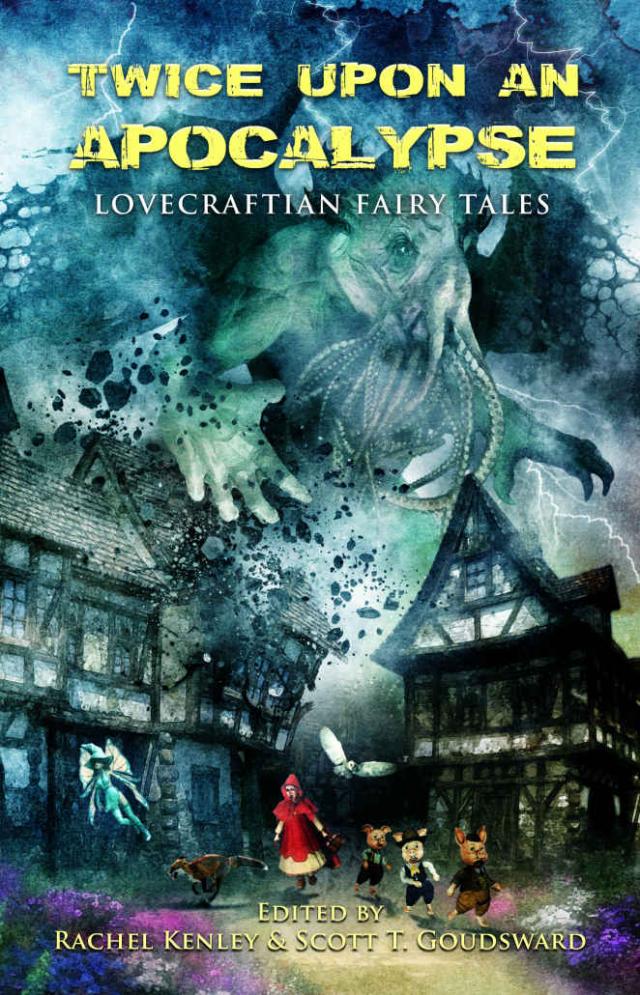
Twice Upon an Apocalypse- Lovecraftian Fairy Tales, page 1


OTHER ANTHOLOGIES BY CRYSTAL LAKE PUBLISHING
Gutted: Beautiful Horror Stories
Tales from The Lake Vol.1, Vol.2, and Vol.3
Children of the Grave
The Outsiders
Fear the Reaper
For the Night is Dark
Or check out other Crystal Lake Publishing books for your Dark Fiction, Horror, Suspense, and Thriller needs, and join our newsletter while you’re there.
Copyright 2017 Crystal Lake Publishing
Be sure to sign up for our newsletter and receive a free eBook
All Rights Reserved
Cover Art:
Ben Baldwin—http://www.benbaldwin.co.uk
Layout:
Lori Michelle—www.theauthorsalley.com
Proofread by:
Amanda Shore
Guy Medley
This is a work of fiction. Names, characters, businesses, places, events and incidents are either the products of the author’s imagination or used in a fictitious manner. Any resemblance to actual persons, living or dead, or actual events is purely coincidental.
No part of this publication may be reproduced, stored in a retrieval system, or transmitted in any form or by any means, without the prior permission in writing of the publisher, nor be otherwise circulated in any form of binding or cover than that in which it is published and without a similar condition including this condition being imposed on the subsequent purchaser.
FOR EXCLUSIVE CONTENT CLICK ON THE IMAGE BELOW!
TABLE OF CONTENTS
INTRODUCTION
Once Upon a Concept
THE PIED PIPER OF PROVIDENCE
William Meikle
THE THREE BILLY GOATS SOTHOTH
Peter N. Dudar
LITTLE MAIDEN OF THE SEA
David Bernard
THE GREAT OLD ONE AND THE BEANSTALK
Armand Rosamilia
IN THE SHADE OF THE JUNIPER TREE
J. P. Hutshell
THE HORROR AT HATCHET POINT
Zach Shephard
THE MOST INCREDIBLE THING
Bracken MacLeod
LET ME COME IN!
Simon Yee
THE FISHMAN AND HIS WIFE
Inanna Arthen
THE LITTLE MATCH MI-GO
Michael Kamp
FOLLOW THE YELLOW GLYPH ROAD
Scott T. Goudsward
THE GUMDROP APOCALYPSE
Pete Rawlik
CURIOSITY
Winifred Burniston
THE ICE QUEEN
Mae Empson
ONCE UPON A DREAM
Matthew Baugh
CINDERELLA AND HER OUTER GODFATHER
C.T. Phipps
DONKEYSKIN
K.H. Vaughan
SWEET DREAMS IN THE WITCH-HOUSE
Sean Logan
FEE FI OLD ONE
Thom Brannan
THE KING OF THE GOLDEN MOUNTAIN
Morgan Sylvia
THE LEGEND OF CREEPY HOLLOW
Don D’Ammassa
BIOGRAPHIES
INTRODUCTION
Once Upon a Concept
As I write this, the new television season has dropped on us like a curse from Heaven, bringing with it a cornucopia of new and returning series that cannibalize—um, er, uh . . . make that draw their inspiration from—fairy tales of old. We have, for instance, Grimm; Once upon a Time; and Sleepy Hollow. These past couple of years have also seen “re-imagined” fairy tales hit the big screen with all the power of an instant tax write-off: Oz the Greatand Powerful; Hansel and Gretel: Witch Hunters; Jack the Giant Killer; Snow White and the Huntsman; Maleficent; Cinderella . . . I’m sure I’ve overlooked a few, but you get the idea.
All of the above have sprinklings of admirable qualities—stunning visuals, some sharp performances, moments of genuine cleverness, scenes so beautifully choreographed they look almost like a ballet (in the case of something like Hansel and Gretel, an absolutely ludicrous ballet)—but for each successful element, there remains at the core of each this sense that its creators seem to harbor an obstinate belief that they are re-inventing the wheel; the creators of the two Once Upona Time series seem to me particularly guilty of this because even though both nicely maintain the less-than-whimsical tone of the tales from which they draw their inspiration, the concept of the real world being invaded by the fantasy world (and vice-versa) is presented as something that has never been applied to fairy tales before, and as a result, many of the twists and turns of the plots cause me to respond with a “Yeah, and . . . ?” rather than a gasp of surprise.
Another inherent difficulty that most of them have yet to overcome (I subtract Sleepy Hollow from this simply because it had the good sense to throw canon out the window from the start) is the grafting of modern-day sensibilities into the fairy-tale worlds—not as the result of reality and fantasy infecting one another (which would make sense) but rather presented as if these sensibilities and moral codes had always been this way, even before the two worlds began to interfere with one another. If the idea of Sleeping Beauty being an independent human being who doesn’t need to be rescued by a prince’s kiss or Rumpelstiltskin suffering from onion layers of deeply-rooted emotional trauma had been the result of quantum intrusion—that is to say, of their modern-day counterpart affecting the contemporary social awareness gleaned from present-day experience when the two of them “crossed beams,” so to speak—I’d have no problems with it. But when such elements are presented as already being present in the fairy-tale world, it doesn’t amount to re-imagining as far as I’m concerned; it amounts to lazy storytelling whose creators don’t see any problem grafting anachronistic pop-psychology into a time and place where it would not have naturally evolved.
I keep hammering this point because the well-defined, almost vindictive morality at the heart of traditional fairy tales is, to my mind, the single most important element they possess—how could one otherwise attribute such terms as “timeless” to them? This timelessness doesn’t stem from the cleverness of their telling but is a result of central universal themes that remain unchanging; subtract the “ . . . and the moral is . . . ” element from any fairy tale, and it ceases to be a fairy tale, merely the echo, a wisp, a what-became-of-it. The Brothers Grimm, Charles Perrault, Hans Christian Anderson, may very well have been critics of the social upheavals of their times, but they were also, first and foremost, hard-core moralists when it came to the stories they told; even Oscar Wilde’s stories written for children were very much grounded in deceptively simplistic but nonetheless resonating truths depicted in unapologetic black and white terms (read Wilde’s “The Star Child” or the devastating “The Happy Prince” if you don’t believe me—and make sure you have a few tissues nearby when you read the last lines).
File all of this away for a few moments; we’ll come back to it soon enough.
Let’s briefly address the current (and, hopefully, fading) trend of “mash-ups”—the type of fiction characterized by taking a pre-existing text of literature and combining it with a different genre—behold Prideand Prejudice and Zombies, the novel that is credited with starting this trend. Don’t get me wrong; I am not necessarily against mash-ups in theory: it’s the vast majority of their at-best misguided results that drive me to despair. The idea of a mash-up can work well if the one doing the mashing begins with two dictums in mind: 1) I am not reinventing the wheel; the best I can hope for is a clever variation that pays homage to the original work while casting an amusing parallax view to the proceedings; and, 2) I am not, repeat not, going to mine the original’s prose to fill in the gaps of my narrative; I am instead going to employ its central conceit and combine it with something else in order to not re-invent the wheel.
I almost added a third dictum: Mash-ups never work at novel length; novella and short stories only, please. So let us imagine how the thought process behind Twice Upon anApocalypse must have worked:
1) End of the world stories are always popular
2) Fairy tales are always source material
3) Can this be done to something other than zombies?
4) Maybe. So we want to do an anthology of apocalyptic stories based on traditional fairy tales but don’t want zombies
5) Sounds like horror/dark fantasy to me
6) Okay, yes, horror/dark fiction it is then
7) But what kind? Quiet? Extreme? Psychological? Cosmological?
8) I say all of the above
9) Say what?
10) Three words: Howard Philips Lovecraft
And there was much rejoicing—and why shouldn’t there have been?
The idea of taking a traditional fairy tale and setting it in Lovecraft’s universe seems so inspired that it has to already have been done, right?
Not that I’ve been able to find, and I’m pretty well-read. I mean, good grief, Charlie Brown—how could one want to retell “The Fisherman and His Wife” and not have it set in Innsmouth? You’ll find that story in here, and it plays that concept to the hilt. Ichabod (though not Crane) shows up on the campus of Miskatonic University. A brilliant 10 re-imagining of “Donkeyskin” shows up here in a most disturbingly Lovecraftian form. Charles Perrault’s “Cinderella” gets one hell of a macabre makeover for her . . . let’s call it her “date” with Yog-Sothoth.
You’ll find re-imaginings of “The Snow Queen,” “Ja ck the Giant Slayer,” “The Little Mermaid,” and several other well-known tales herein, all of them dropped without warning or apology into Lovecraft’s cold and merciless universe.
It wasn’t until I was halfway through Winifred Burniston’s unnerving “Curiosity” (based on Perrault’s “Bluebeard”) that I realized what a stroke of genius it was to combine these heavily moralistic fables with Lovecraft. In Lovecraft’s universe, there is no room for morality; it, like love, like prayer, like individual purpose, like everything else that we associate with a fulfilling life that goes beyond just breathing and taking up space, all of it is meaningless because this particular universe doesn’t give a damn. It is a cold, uncaring place with no concept of mercy or compassion and even less use for these things if they did exist. Placing these stories with their black-and-white morality into a world where virtue, ethics, courage, decency, and goodness are at best cruel jokes freed the writers from having to worry about the moral core of their chosen fairy tale being compromised because here, here that moral code is D.O.A., the characters just don’t know it yet, so the core remains unaltered.
I will be honest; when first approached to write this introduction, I was a bit skeptical of everyone’s ability to pull this off: I now gratefully bake that skepticism into a pie full of crow and heartily dine on it. Twice Upon an Apocalypse is one of the most refreshingly inventive, entertaining, thoughtful (and thought-provoking), not to mention unnerving anthologies I’ve read in years; that each writer manages to seamlessly blend their chosen fairy tale with Lovecraft’s world of shambling subterranean eldritch horrors is in and of itself quite an accomplishment and would by itself be reason enough to savor this collection from cover to cover; that they also manage to merge these with distinctly individual narrative voices and pack their narratives with impressive (and sometimes jaw-dropping) variations (I won’t use the tired term “twists”) only strengthens this collection’s success; but when you realize, as I did, that by taking two well-known and -respected genres and “mashing” them together, each writer has created something that seems like a third race of tale, born from the fusion of two genres that are not usually associated with each other.
This anthology is a celebration not only of Lovecraft and fairy tales but of the creative process itself. It is, to my mind, a triumph, and you know why? I’ll end on this disclaimer:
No wheels were re-invented in the making of this collection.
—Gary A. Braunbeck, Lost in Ohio
THE PIED PIPER OF PROVIDENCE
William Meikle
Based on The Pied Piper of Hamelin by Robert Browning
Once upon a time, on the shores of a great ocean in the north of the American continent, lay a town called Providence. The citizens of Providence were honest folk who lived contentedly in their gray stone houses. The years went by, and the people grew very rich. Then one day, an extraordinary thing happened to disturb the peace of this sleepy town.
All summer, there had been portents in the sky, and country folk talked of strange beasts roaming the hills to the north and east of the town. Being city dwellers and modern men, the councilmen of Providence would have no truck with such superstition. It was not until autumn that they were forced to pay closer attention to what was happening on their doorstep, and by then, it was too late.
The first indications something was amiss came when the local constabulary started to receive reports of missing cats. That in itself was not unusual in a city where the countryside was lush and wild just beyond the town limits. The borders were like a magnet that drew feline hunters to the woods to explore their wonders. But normally, those explorers would return to their homes of an evening, lured by the promise of food that could be procured more easily. Over the course of the first week of October, more and more cats stopped returning home. By the end of the month, there was not a single cat left in the town.
The first baby was bitten a day later.
***
At first, the authorities suspected a wild animal attacked the child, something from the woods that had been given its opportunity by the strange disappearance of the cat population. But it quickly became apparent that whatever had bitten the baby was also the cause of the decline in felines.
Old lady Malcolm was the first to see them when, on descending into her cellar late in the evening, she was attacked by six large rats, which bit her most grievously before she managed to fight them off with a broom.
It was not long after the rats grew bold enough to be seen in daylight. Soon, reports came in from all over town of rats in the grain stores, rats in the butcher’s meat locker, rats in basements, and rats in the walls.
A council meeting was convened in the Town Hall. John Berryman, the mayor, called the meeting to order . . . just as a whooshing scraping noise filled the room. Tapestries writhed, and mortar trickled from loose stone before the sound finally subsided, rushing away to subterranean depths.
“What’s to be done?” Berryman asked. “Has anyone called out the dogs?”
“There are no dogs,” George Priestley said. “They’ve all gone. Either run off or scared off.” Councillor Bill Timmings laughed nervously and scratched at a fresh bandage on his hand, the result of trying, unsuccessfully, to shoo a rat from his bedside the night before. He held up the hand to show the others.
“The thing was as big as any of the dogs,” he said. “And twice as bold. If they’re all like that, it’s not dogs we need but a miracle.”
Fresh screams rose from outside on the streets as if to counterpoint his argument. As a man, the councilors rushed to the window and looked on a scene of terror. Initially, it appeared as though a heaving black carpet of fur was making its way down the thoroughfare, then they saw, only too clearly, the rat pack had broken out into the open.
They ranged in size from only a few inches to great beasts as big as dogs, all with too-red tongues and pink, hairless tails that swayed obscenely in the air. Townspeople fled in the face of this new assault.
The councilmen watched, white-faced, as an elderly lady tripped, fell, and was engulfed, a pale arm waving feebly before being splattered red then devoured in seconds.
The council turned, ashen-faced, from the window, trying to blot out the few remaining pathetic screams.
“What’s to be done?” the mayor whispered.
No one answered for the longest time, and they were saved doing so by a heavy knock on the chamber door. It swung open to reveal the most preposterous figure standing in the doorway, a wizened old man, bent with age, dressed in a leather outfit dyed in bright, gaudy shades of red, green, yellow, and purple.
The old man’s face was too long, too thin, exaggerating the size of his teeth, particularly the front two, which seemed too large for his mouth and hung over his lower lip. Coarse, black hair fell in a cape down his back from an almost bald head, and pink eyes peered from beneath heavy brows. As he came forward into the chamber, he walked stiffly as if unsure on his feet. His pale pink hands were clutched tightly to his chest, carrying a pair of thin wooden flutes.
“And who might you be?” the mayor asked.
The wizened figure bowed at the waist.
“I am Rattenfänger Van Hameln,” he said, his voice a high, thin whine. “And I have come to do you a favor.”
***
Of course, the councilmen’s first thought was to have the strange newcomer escorted from the chamber, but before they could call for the ushers, a great skittering and whispering rose up inside the walls around, above, and beneath them. The tapestries bulged again, as if many small shapes pushed against them from the other side, and bricks trembled and shook, threatening to fall from their places in a wall previously thought solid and impervious. The councilmen quaked and trembled before this fresh onslaught as the air filled with high, frantic shrieks and squeals.
Just as the noise threatened to reach a crescendo, von Hameln raised the flutes to his lips and stared to play.
The mayor felt it first through the soles of his feet, but soon, his whole frame shook, vibrating in time with the rhythm. His head swam, and it seemed as if the very walls of the chamber melted and ran. The room receded into a great distance until it was little more than a pinpoint of light in a blanket of darkness, and he was alone in a vast cathedral of emptiness where nothing existed save the slow, almost mournful singing of the flutes.


