Skull and Crossbones (Flint & Co Paranormal Investigations Book 3), page 1


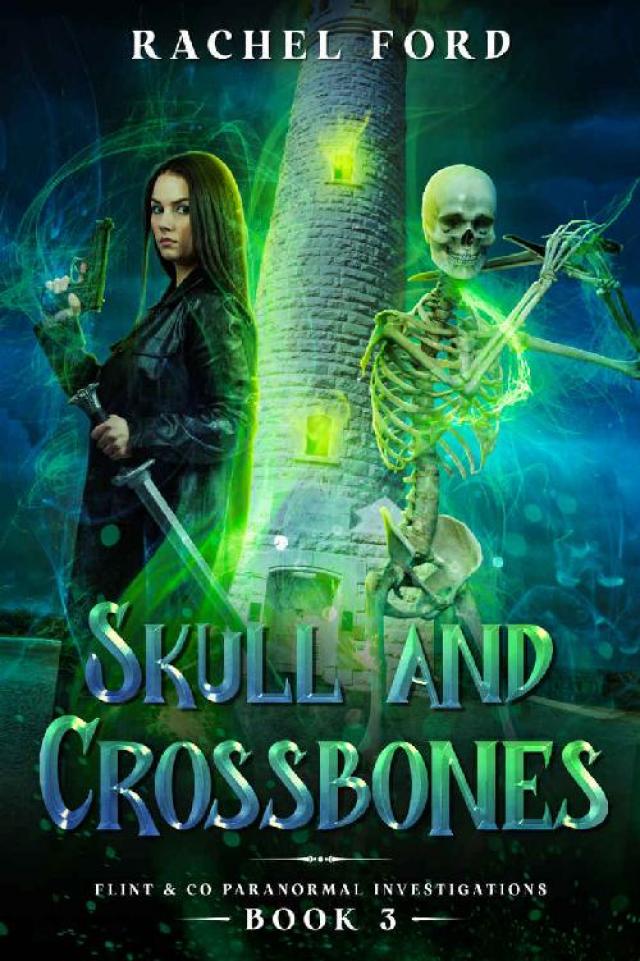
Skull and Crossbones
Flint & Co Paranormal Investigations, Book 3
By Rachel Ford
Chapter One
When Gregory Walker, aka the Southside Stalker, escaped from his handcuffs in a hospital room, killing a nurse in the process, Chief of Police Clarence Allen advised me to pack up and leave the city for the duration of the manhunt.
My good friend, Agent Sean O’Donnell of the FBI, advised me that he could put myself, my fiancée Natalie Lyons, and my business partner Jack Flint in a safehouse while the joint taskforce of the FBI and New Boston Police Department searched for the Southside Stalker.
I refused. Jill Wallace didn’t run and hide. It wasn’t in my DNA.
Sure, Walker had already vowed revenge on me for disrupting his busy schedule of homicide, but I’d helped bring him in the first time. I was the reason he’d been in the hospital at all.
I wasn’t going to sit out a second manhunt.
And then Walker torched my house in the middle of the night. Natalie heard a smoke alarm, and woke us before we both wound up flambéed in our beds.
But it’s a jarring thing to wake up to the room full of smoke, and flames creeping under the door. My resolve started to waver.
After sixteen hours talking to police officers, fire investigators, and insurance agents, it had just about crumbled. Still, I tried to remain strong. Flint & Co Paranormal Investigations wasn’t going to run itself.
Which is what I told O’Donnell when he called to reiterate his offer. “We’re just starting to get on the map, Sean. If I bail now, who knows what’ll happen. We could be back at square one.”
“Maybe. But is it worth dying over?” he asked.
“Easy for you to say. You’re not the one who has to pay the mortgage.”
“Well, neither of us do now,” he pointed out. “From what I hear, your house is a total loss.”
“It’s not a laughing matter.”
“I’m not laughing,” he said. “My point is, nothing’s worth dying over.”
“I’ll be fine,” I said.
He sighed. “Stubborn as usual. But even if you think it’s worth your life, is it worth Nat’s?”
“That’s below the belt, O’Donnell.”
“And that’s not an answer,” he said. “You could have both burned to death last night.”
I sighed. I was bone tired, and my mind seemed to have slowed to a snail’s pace. “We’ll get a hotel room.”
“First place Walker will look.”
“Then we’ll move into the office, just temporarily, while insurance figures something out. That way we can keep working.”
“Actually, I was wrong. That’s the first place he’ll probably look. Then the hotels. For pity’s sake, Wallace, stop being so damned pigheaded. Let me put you in a safehouse.”
I wavered for a long moment. I stunk of soot. I’d lost most of my belongings. Nat – the woman I loved – had almost died. But I really did need the money. “I can’t,” I said. “The business –”
“Oh for God’s sake,” he snapped. “Fine. Now that I’m in charge of the New England division –”
“Wait,” I interrupted, “when did that happen?”
“There was a big shakeup after the Vandermeer case. Some people went up, some went down. I was one of the ones whose star rose.”
“Wow. Congratulations.”
“Yeah, well, since I couldn’t have done it without a certain stubborn fool, I’ll tell you what. I have an out of state safehouse that I can assign to you.”
“I told you –”
“And,” he interrupted, “it’s right next to a case I’m supposed to put an agent on. Since I don’t have the manpower, and I do have the discretionary budget, how about this: I hire you and that partner of yours to investigate the case.”
“What case?”
He paused. “Honestly, I haven’t had time to go over the details yet. Some kind of suspicious activity on the coast.”
“Coast of where?”
“Coast of never you mind. The whole point of a safehouse is no one knows where it is. You take the job, you’ll get all the details.”
“Fine,” I said. “So it’s suspicious activity along the coast?”
“Yes. Just a few miles from the safehouse. I’d employ you two turkeys fulltime. You’d run surveillance for me. Nothing more than that, so no added risk. You keep an eye on the beach, and you stay well away from Walker. And you get paid.”
“Fulltime?” I asked. I was really wavering now. “Our standard rate?”
“Plus expenses. And room and board is free, of course. The safehouse is fully furnished, and stocked with basic groceries and toiletries. It’d be like a working vacation.”
I thought long and hard. As much as I wanted to find Walker, the manhunt seemed to be going nowhere. The police had no leads, the FBI had no leads, and I had no leads.
“Come on,” he urged. “You’re telling me Nat doesn’t deserve a vacation, after everything she’s been through?”
So it was that three days later, Natalie, myself and Jack Flint – Flinty Jack, as his friends knew him – were all standing on the deck of a ferry, heading to an FBI safehouse on Boar’s Island. A trim, tall man called Hamilton – Special Agent Arthur Hamilton, of the Federal Bureau of Investigation – accompanied us.
Boar’s Island was one of the larger Casco Bay islands off the coast of Maine. We’d boarded the ferry in Portland, and stopped at several of the other islands along the way to pick up and drop off passengers.
Now, as we approached our destination, I felt my first twinge of concern, my first hint that maybe I hadn’t made the right call after all.
A quaint, postcard bay stretched out in front of us, with brightly painted wooden buildings – and a town that was smaller in entirety than the little neighborhood where Nat and I lived in New Boston.
“The island,” Hamilton told us, “isn’t named for wild pigs, by the way. It’s named for Edward Boar, a pirate who prowled the East Coast back in the 16th century.”
“A pirate?” Nat asked.
He nodded. “He was from Ireland, originally. Came over here, got a ship and crew together. Then he met a woman – a fisher’s daughter. Fell in love.
“She wouldn’t marry a man of the sea. Said she needed a place on land to raise a family. So he built a house here on the island, and asked again. A honeymoon cottage.
“More like a mansion, really. Big, beautiful place, built with stone from the island. Took two years for a whole team of builders. This time, she said yes.”
“Wow,” Nat said. “Is the house still around?”
I smiled at the enthusiasm in her voice. At five-nine, with shoulder length, curly auburn hair, brown eyes that seemed almost golden at times, and a smile that could melt me, Natalie Lyons was the most beautiful woman I knew.
But there was a certain something about her right now, her eyes sparkling with interest as the sea breeze swept her curls every which way. Something that made me forget about the island, the seclusion, and even the case – the details of which we still hadn’t received.
Hamilton grinned at her. “Not only is it still around, Miss Lyons, it’s where we’re going.”
Her jaw dropped. “Are you serious? The safehouse belonged to a pirate?”
“Perfectly serious.”
“Oh my God. That’s – that’s incredible.”
I plastered a smile on my face, but I couldn’t help thinking that no matter how nice it had been in the 16th century, nowadays it would be roughly three hundred years old. A lot could happen to a place in three hundred years.
“It’s about a mile from the lighthouse,” Hamilton said. “In the 40’s, the government decided that was too close. The owner at the time didn’t live there. Just came up for summers. So they sold it without much fuss. It’s been a safehouse ever since.”
“What about the pirate and his wife?” Nat asked. “What happened to them?”
Hamilton shrugged. “Well, it doesn’t end quite as romantically as it started. Boar’s ship went down in a big Nor’Easter. The wife managed to hold onto the place for a few years, but she didn’t have money to keep it up.
“She ended up moving back home. Married a local blacksmith, and had ten kids. Only three survived. She died of cholera a year after the youngest was born, and he died two weeks later.”
“Cheery,” Flinty Jack muttered.
“Oh,” Nat said. “How awful.
“Yeah. Not a happy story, I guess. Still, there were rumors about the place for years afterwards. People who thought Boar must have filled it with treasure. People would come out to the islands looking for it, all the way into the last century.”
“They ever find anything?” Flinty Jack asked.
“Nah. It was just old wives’ tales. Boar probably spent whatever fortune he had building the place. But if you’re interested, there’s an exhibit in the museum. They’ve got pieces of his old ship, the Brimstone Lady.”
“So they know where he went down?” Nat asked.
Hamilton nodded. “A salvage crew actually found the ship last year. The exhibit has some of the stuff they pulled out of the captain’s cabin, and some of the crew’s belongings.”
Nat nudged me. “Definitely a stop to add to the list.”
I might have imagined it, but I could have swor n I heard a low groan escape Flinty Jack.
Hamilton laughed. “It’s pretty cool. Oh, here we go then.”
The ferry angled itself toward a wide dock. A few people waited along a concrete wharf, presumably for disembarking passengers or goods. But mostly, the traffic at the docks centered around fishing and lobster boats.
“The primary industry of Boar’s Island is lobstering, like most of the islands around here,” Hamilton said, following my gaze.
I nodded, turning my attention from the docks to the rest of the bay. Boar’s Bay was the beating heart of Boar’s Island: the primary means of access, and the scene of almost all industry and habitation.
A single bridge connected the south side of the island to Crabber’s Rock, another of the Casco Bay land masses. It provided the only other official way onto Boar’s.
Crabber’s Rock housed about a hundred residents, and its jagged coast provided no reasonable approach for watercraft. Larger boats would be beaten upon the rocks long before they made land, and smaller ones capsized in the treacherous currents around the island.
I knew that, because Special Agent Hamilton had told me all about it – about the tragic deaths of boaters who had flouted local safety guidelines, about the projected cost of building an extended dock to safely serve the island, and the decision to instead connect Crabber’s and Boar’s.
He was a fount of information about the area, was Special Agent Hamilton.
Beyond Boar’s Head, the town, sections of the coast rose to steep cliffs. Others remained low and sloping. I saw rocky beaches and sandy ones.
Farther back, great masses of trees blanketed the island in green. Birds flew overhead, in a bright blue sky. Golden sunlight shone down, warm and bright.
The ferry docked, and the gangplank lowered to allow passengers to disembark. A gentle sea spray misted us in salty water as we stepped off the boat. A few of the locals glanced our way. Nat, Hamilton and I occasioned little interest.
Flinty Jack was another story. He was one of the undead: a 6’1” sentient skeleton, or ‘bone man’ as they were known. He’d come back to life the same time I got my magical powers – powers like telepathic insight and the ability to conjure fire from my fingertips.
August 13th, 2030, twelve minutes after nine, New Boston time. The meteorite strike that changed the world.
That gave Freaks like me magical powers, and called the dead out of their graves – or, in Flinty Jack’s case, from the glass case where his remains had spent the last hundred years as a medical school’s anatomical display.
I noticed with increasing unease that he seemed to be the only undead person in sight. That didn’t make sense.
A place like Boar’s Island was big enough to have its own cemetery. A cemetery would mean dead people of all kinds – zombies, bone men, and maybe even ferals, that subset of the undead who inexplicably returned without the use of reason.
In fact, there were probably more dead on the island at any given time than living.
So where were they? In my experience, neighborhoods that didn’t have undead in sight were neighborhoods that had driven them away.
“This place,” I said, “it’s safe? For all of us?”
Hamilton glanced at me, and then at Flinty Jack. Understanding lit his eyes. “Oh, yes. No worries about that. Awhile back, most of the undead cleared out for one of the other islands. Got a land grant and permission to build.
“But there’s never been problems.”
“Then why’d they leave?”
“I know this place looks empty, but the land’s all owned. No one wanted to sell to build more houses. So the state stepped in, and offered land elsewhere.”
“That doesn’t sound too friendly.”
“It wasn’t about them being undead,” Hamilton said. “The community here, they like to keep it small. They don’t sell to anyone, and they don’t want anyone coming here. Living, dead or undead.”
“Which still doesn’t sound friendly,” I observed. “But better than it could be, I guess.”
Hamilton guided us to a waiting SUV, to which he already had the keys. It was a Bureau vehicle, he told us, and we could take it anywhere on the island or Crabber’s Rock – anywhere open to the public, anyway.
“But not the ferry. It stays here.”
He pointed out the various local landmarks as we passed: the fishery, Boar’s Island Museum and Historical Center, several restaurants and cafes, a pub and eatery called The Jolly Roger, and a grand coastal mansion.
“Mayor Smith lives there, and the government offices are all run out of the east wing. Except the police department, that’s over there.”
He pointed to a low, squat building made of gray stone. “Built during the cold war. Doubles as a nuclear fallout shelter. There’s two of them on the island: the police station and the postal office.”
He went on talking until we’d cleared out of town, onto the only road following the curvature of the coast – called Coast Road.
Great, sloping hills ran off to quiet meadows and gentle brooks on the interior side of the road. Coastward, I saw an ever-changing panorama of endless trees, blue ocean, rocky beaches and jagged cliffs.
“So many trees,” Nat commented.
And there were, compared to New Boston anyway, where trees grew only in parks and landscaping containers.
Which got Hamilton talking again, pointing out the different species of evergreen and deciduous trees, declaring which were native to Maine and which had been imported.
“That’s cat spruce,” he said as we passed a patch of tall, Christmas-tree shaped pines. “If you crush the needles, you’ll figure out real quick why they call it that.”
We passed red spruces and tamaracks, white pines and jack pines. We passed oaks and elms, maples and ashes, birches and beeches, alders and juneberries.
Hamilton had trivia about them all: which were invasive species, which had been used in ship building, which fed the local wildlife, and which fed people.
“Juneberry pie – nothing beats it. The breakfast place in town has it on the menu. Highly recommend you try a slice while you’re here.”
He ignored the streets that branched off Coast Road, and continued straight for several miles. Finally, he slowed as we approached a long, wooded drive on the right.
“This is us. Keep going up Coast Road, and you’ll be at the lighthouse. Although, I don’t recommend you do that. Not unless you want to be answering questions about what you were doing there.”
“Is that a tower?” Nat asked, pointing to a stone structure rising above the trees.
Hamilton grinned. “That is a tower, Miss Lyons. Captain Boar might have built the house for his wife, but the tower was for himself. He’d keep watch up there, looking for passing ships. Victims.”
Nat threw me an excited glance, and I had to admit her enthusiasm felt a bit infectious. We were going to be staying in a house with a real life, honest to goodness pirate’s lookout?
That was pretty cool.
Hamilton followed a winding, wooded drive for what seemed like an eternity. Then, almost without warning, the trees fell away, revealing a wide clearing and a huge granite home perched on a high cliff overlooking the ocean beyond.
The home looked like something out of a fairytale, more castle than house. Three stories tall, built of gray granite, with a tall, octagonal tower overlooking the water. I could almost picture knights and ladies riding out on horseback.
Hamilton parked beside a pair of dark SUVs – same make, model and color as our own. The sight drew me from my study of the safehouse.
“Do we all have our own vehicle?” I asked.
“No. That’d be Special Agent Donavan – my ride out of here – and the D’Amcio’s. Your housemates.”
Chapter Two
“Wait,” I said, fighting with my own seatbelt as he stepped out of the vehicle. “Housemates? No one ever said anything about housemates.”
Hamilton stared blankly at me as I tumbled out of the vehicle. “The D’Amcio’s needed protection too.”
“There’s got to be more than one safehouse on the Eastern Seaboard,” Flinty Jack put in.
“Sure. But the place is huge. It’s not like you’ll be in each other’s way. And the boss figured, since you all knew each other, it wouldn’t be a problem.”
We did know each other – which was precisely why it was a problem.