

Strange Tales from a Chinese Studio, page 1


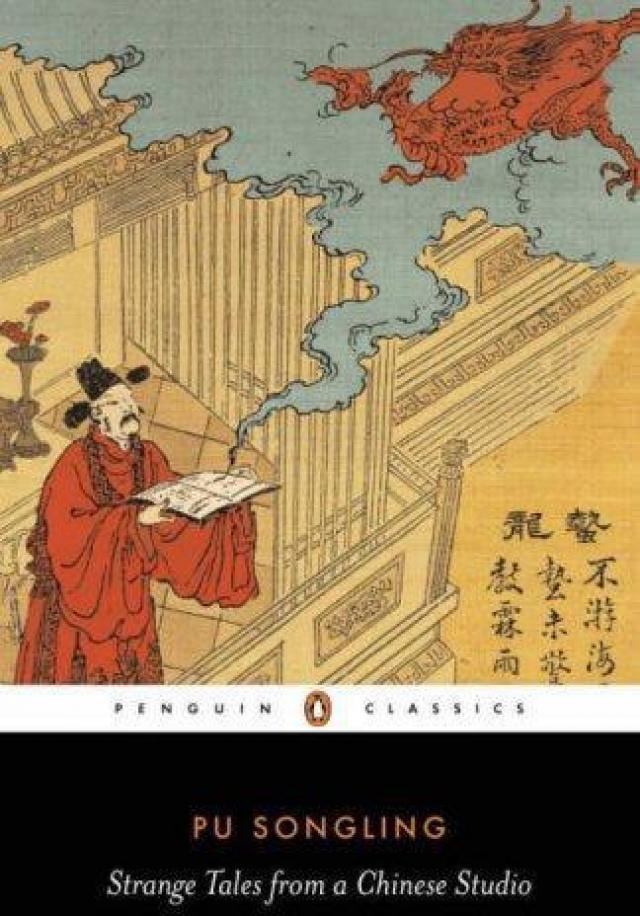
STRANGE TALES FROM A
CHINESE STUDIO
PU SONGLING (1640–1715) wrote his Strange Tales from a Chinese Studio (Liaozhai zhiyi) over several decades, during a life spent in obscurity in his home province of Shandong, in northern China. The book amounted to nearly five hundred items of greatly varying lengths, from short anecdotes and jottings to fully fledged stories, on a wide variety of ‘strange’ themes. It was never published in his lifetime, and at first circulated in hand-copied versions. It was finally printed in 1766, in the southern city of Hangzhou, and was reprinted countless times, attracting many commentaries and imitations. It rapidly came to be considered the supreme work of fiction in the classical Chinese language, just as The Story of the Stone (also published in Penguin Classics, in five volumes (1973–86)) came to be considered the pinnacle of fiction in the vernacular. This new translation introduces a selection of 104 tales from the original work.
JOHN MINFORD studied Chinese at Oxford and at the Australian National University and has taught in China, Hong Kong and New Zealand. He edited (with Geremie Barmé) Seeds of Fire: Chinese Voices of Conscience (1988) and (with Joseph S. M. Lau) Classical Chinese Literature: An Anthology of Translations (2000). He has translated numerous works from the Chinese, including the last two volumes of Cao Xueqin's eighteenth-century novel The Story of the Stone and Sunzi's The Art of War, both in Penguin Classics. He has also translated The Deer and the Cauldron (2000–2003), a three-volume Martial Arts novel by the contemporary Hong Kong writer Louis Cha. He is currently Professor of Chinese at the Australian National University.
PU SONGLING
Strange Tales from a Chinese Studio
Translated and edited by JOHN MINFORD
PENGUIN BOOKS
PENGUIN CLASSICS
Published by the Penguin Group
Penguin Books Ltd, 80 Strand, London WC2R 0RL, England
Penguin Group (USA) Inc., 375 Hudson Street, New York, New York 10014, USA
Penguin Group (Canada), 90 Eglinton Avenue East, Suite 700, Toronto, Ontario, Canada M4P 2Y3 (a division of Pearson Penguin Canada Inc.)
Penguin Ireland, 25 St Stephen's Green, Dublin 2, Ireland (a division of Penguin Books Ltd)
Penguin Group (Australia), 250 Camberwell Road, Camberwell, Victoria 3124, Australia (a division of Pearson Australia Group Pty Ltd)
Penguin Books India Pvt Ltd, 11 Community Centre, Panchsheel Park, New Delhi – 110 017, India
Penguin Group (NZ), cnr Airborne and Rosedale Roads, Albany, Auckland 1310, New Zealand (a division of Pearson New Zealand Ltd)
Penguin Books (South Africa) (Pty) Ltd, 24 Sturdee Avenue, Rosebank, Johannesburg 2196, South Africa
Penguin Books Ltd, Registered Offices: 80 Strand, London WC2R 0RL, England
www.penguin.com
This translation first published in Penguin Classics 2006
4
Copyright © John Minford, 2006
All rights reserved
The moral right of the translator has been asserted
Except in the United States of America, this book is sold subject to the condition that it shall not, by way of trade or otherwise, be lent, re-sold, hired out, or otherwise circulated without the publisher's prior consent in any form of binding or cover other than that in which it is published and without a similar condition including this condition being imposed on the subsequent purchaser
ISBN: 978-0-14-192852-4
Contents
Acknowledgements
Introduction
Note on the Text, Translation and Illustrations
Note on Names and Pronunciation
STRANGE TALES FROM A CHINESE STUDIO
1 Homunculus
2 An Otherworldly Examination
3 Living Dead
4 Spitting Water
5 Talking Pupils
6 The Painted Wall
7 The Troll
8 Biting a Ghost
9 Catching a Fox
10 The Monster in the Buckwheat
11 The Haunted House
12 Stealing a Peach
13 Growing Pears
14 The Taoist Priest of Mount Lao
15 The Monk of Changqing
16 The Snake-Charmer
17 The Wounded Python
18 The Fornicating Dog
19 The God of Hail
20 The Golden Goblet
21 Grace and Pine
22 A Most Exemplary Monk
23 Magical Arts
24 Wild Dog
25 Past Lives
26 Fox in the Bottle
27 Wailing Ghosts
28 Thumb and Thimble
29 Scorched Moth the Taoist
30 Friendship Beyond the Grave
31 Karmic Debts
32 Ritual Cleansing
33 The Door God and the Thief
34 The Painted Skin
35 The Merchant's Son
36 A Passion for Snakes
37 A Latter-Day Buddha
38 Fox Enchantment
39 Eating Stones
40 The Laughing Girl
41 The Magic Sword and the Magic Bag
42 The Devoted Mouse
43 An Earthquake
44 Snake Island
45 Generosity
46 The Giant Fish
47 The Giant Turtle
48 Making Animals
49 The Little Mandarin
50 Dying Together
51 The Alligator's Revenge
52 Sheep Skin
53 Sharp Sword
54 Lotus Fragrance
55 King of the Nine Mountains
56 The Fox of Fenzhou
57 Silkworm
58 Vocal Virtuosity
59 Fox as Prophet
60 This Transformation
61 Fox Control
62 Dragon Dormant
63 Cut Sleeve
64 The Girl from Nanking
65 Twenty Years a Dream
66 Mynah Bird
67 Lamp Dog
68 Doctor Five Hides
69 Butterfly
70 The Black Beast
71 The Stone Bowl
72 A Fatal Joke
73 Raining Money
74 Twin Lanterns
75 Ghost Foiled, Fox Put to Rout
76 Frog Chorus
77 Performing Mice
78 The Clay Scholar
79 Flowers of Illusion
80 Dwarf
81 Bird
82 Princess Lotus
83 The Girl in Green
84 Duck Justice
85 Big Sneeze
86 Steel Shirt
87 Fox Trouble
88 Lust Punished by Foxes
89 Mountain City
90 A Cure for Marital Strife
91 A Prank 381
92 Adultery and Enlightenment
93 Up His Sleeve
94 Silver Above Beauty
95 The Antique Lute
96 Waiting Room for Death
97 Rouge
98 The Southern Wutong-Spirit
99 Sunset
100 The Male Concubine
101 Coral
102 Mutton Fat and Pig Blood
103 Dung-Beetle Dumplings
104 Stir-Fry
Author's Preface
Glossary
Maps
Finding List
Further Reading
Notes
Acknowledgements
I was fortunate to receive a generous grant from the Taiwan Council for Cultural Construction and Development when I began this project, back in 1991. Without that three-year period of freedom I would never have been able to begin my journey into this strange and wonderful world, and write the first drafts from which these versions are descended. I wish to express my gratitude to the head of the Council, Kuo Wei-fan, and to my friends Joseph Lau, William Tay, Wang Ch'iu-kuei and Anthony Yu, for their loyal support over the years. Mark Elvin kindly invited me to spend the third year of this project (1993) as a Visiting Fellow at the Australian National University, and in Canberra Liu Ts’un-yan patiently answered several questions of mine. I am endebted once again to Richard Rigby, who sent me a copy from Japan of the invaluable Liaozhai Dictionary, compiled by Zhu Yixuan and his colleagues in 1991. Don Cohn gave me a beautiful old edition of the book, which he found in a bookshop in Tokyo. André Lévy, whose complete French translation is soon to be published by Picquier, has shared his knowledge and enthusiasm with me over the years. In Hong Kong, in the 1990s, Tong Man patiently went along with many a meandering train of thought as we read these stories together. More recently I have benefited, as always, from the acute comments of Rachel May, and from the shrewd emendations of David Hawkes, both of whom read the final drafts of this book in their entirety.
At Penguin, I am grateful to Paul Keegan for having so enthusiastically welcomed this book into the Classics series many years ago, and to Laura Barber for having waited so stoically during the intervening years for it to come to fruition. Caroline Pretty has been a wonderfully perceptive and discreet copy-editor, rescuing me from many careless errors and lazy omissions. She has been at all times a sympathetic collaborator, never an intruder.
These translations are dedicated to Günter and Barbara Wohlfart, dear friends, who shared good times ‘in the green grove’, and came when needed to ‘the dark frontier’.
Introduction
Pu Songling, the author of these extraordinary tales, was b orn in the summer of 1640, four years before the final collapse of the Ming dynasty (1368–1644) and the arrival in Peking of the Manchu conquerors from the north. He died in February 1715, towards the end of the long reign of the second Manchu Emperor, Kangxi, having spent almost his entire life in the mountainous north-eastern province of Shandong.1 His father was a well-to-do merchant from a village near the small town of Zichuan,2 and Pu Songling grew up here during the unsettled times of the dynastic transition, as the old order was falling apart and the conquerors were taking charge of their new domain – the period referred to several times in these tales as the Troubles. Peasant rebellions and anti-Manchu uprisings erupted periodically in Shandong during his childhood, all of them brutally suppressed by the new rulers.
In the spring of 1658, by which time the dynasty was beginning to acquire a certain stability, Pu Songling sat for his first public examination and was placed first in all three stages of the highly competitive process. He was singled out for high praise by the eminent mandarin acting as Examiner, and looked set for a distinguished career as an official. But it was not to be. From 1660 onwards, every one of his many attempts at acquiring the vital second degree proved unsuccessful.3 As a result, from the age of nineteen to the age of seventy-two he was to be a perpetual student, locked into the ‘examination hell’ of the Chinese civil service recruitment system,4 supporting his family as a lowly private secretary and tutor in the households of one or another of the local wealthy families.
His failure as a mandarin was a source of deep personal disappointment, but it did at least leave him with ample leisure for reading and writing. Throughout his long life he wrote prolifically in a wide variety of literary genres: verse of all sorts, prose essays, practical reference works and handbooks, fiction, drama and ballads. It is, however, for his superb Strange Tales, on which he worked during most of his adult life, that he achieved immortality. While Cao Xueqin's Story of the Stone, that rambling and addictive novel of manners and sentiment, is regarded as the supreme novel written in the Chinese vernacular, the superb gallery of bizarre miniatures that constitute Strange Tales is seen as the pinnacle of fiction in the classical language.5
TRADITIONS
Pu Songling was enormously well read (all those years of studying paid off), and deeply conscious of writing in two long literary traditions of storytelling, two distinct genres, that of the zhiguai, which we may call the Weird Account, and that of the chuanqi, the Strange Story. Both used the highly elliptical classical language, as opposed to the vernacular favoured by many writers of fiction and drama ever since the Southern Song dynasty (1127–1278), and both were part of the broader realm of ‘casual’ belles-lettres (what the Chinese call biji, ‘jottings’).6 A Weird Account might best be described as a pithy narrative of some strange event, a laconic record of some grotesque creature, of a haunting, a bizarre person, a peculiar phenomenon or coincidence. Here is a precursor of the genre, a strange little rudimentary myth, a fragment from The Book of Hills and Seas, one of the most ancient repositories of such things:
Big Daddy chased the sun. As the sun went down he was thirsty and wanted a drink, so he drank from the Yellow and Wei rivers. They were not enough, so he started north to drink the Great Marsh, but on the way he died of thirst. He threw away his staff, and it became the Forest of Deng.7
Here is a later and more polished example, this time a thumbnail sketch of a much-loved drunkard and eccentric, from the wonderful fifth-century collection of cameos A New Account of Tales of the World:
On many occasions, under the influence of wine, Liu Ling would be completely free and unrestrained, sometimes even removing his clothes and sitting stark naked in the middle of his room. Some people once saw him in this state and chided him for it. Ling retorted, ‘Heaven and earth are my pillars and roof, the rooms of my house are my jacket and trousers. What are you gentlemen doing in my trousers?’8
This sort of thing has fascinated Chinese readers since the dawn of literature, and still does. The Chinese press, both in the Mainland and in Hong Kong, regularly carries accounts of odd phenomena, sometimes human, sometimes not. In August 2004, for example, the Hong Kong press provided a piquant description of a man discovered in a remote part of the Chinese countryside, whose entire body was densely covered in hair.9
The Strange Stories are more artistically polished than the Weird Accounts. They are short works of fiction with fully developed plots and characterization. Some are romantic, some fantastical, some semi-historical, others are concerned with the exploits of magicians or Martial Arts adepts. These stories were first written during the Tang dynasty (618–907), more famous as a golden age for poetry, but the genre continued to be popular during the subsequent Song, Yuan (1279–13 68) and Ming dynasties.10
Pu Songling brought these two traditions together in his Strange Tales, an achievement for which he has sometimes been criticized by purist literary critics. On the one hand we find in his collection longer stories with complex plots, often involving relationships between men, fox-spirits and ghosts, sometimes interweaving the events of several incarnations.11 Then there are a large number of medium-length tales dealing with a variety of themes: the foibles of spiritual or alchemical pretension, both Buddhist and Taoist; the workings of illusion and enlightenment; and the ways of human vanity and corruption in general.12 These are interspersed with brief accounts of strange phenomena (earthquakes, hail-storms, mirages), of unusual abilities, pranks and preoccupations (rare sorts of kungfu, mediumistic skills – genuine or otherwise – strange performances with animals, obsessions with snakes); descriptions of unusual varieties of bird, fish, turtle and alligator, of magical stones, bags and swords; and tantalizing evocations of the transience of life, of strange tenants and abandoned halls. Pu Songling's collection ranges in style and form, as Anthony Yu writes, ‘from gossipy anecdotes and ethnography-like fragments to polished compositions of exquisite language and superb control.’13 I firmly believe that the richly heterogeneous nature of this book (to which I have tried to be faithful in this selection) was deliberate on the author's part. As we read we are offered the varied courses of a Chinese banquet. We are constantly being surprised and delighted, and yet nothing is there in excess. Pu Songling enjoyed breaking the rules, and he exploited to excellent effect the juxtaposition of contrasting elements, presenting his readers with, in the words of André Lévy, a ‘full range of inconsistencies while at the same time providing a subtle, inimitable and elusive unity’.14


