

Past Times, page 1


08-08-2023
Reworking of an earlier version
“We’ll try ten-year stops, looking for the automatics,” said Saunders.
2063—it was raining into the pit.
2053—sunlight and emptiness.
2043—the pit was fresher now, and a few rotting timbers lay half buried in the ground.
Saunders scowled at the meters. “She’s drawing more power than she should,” he said.
2023—the house had obviously burned. The projector roared; energy drained from the batteries like water from a squeezed sponge; a resistor was beginning to glow.
“Let’s go.” Hull’s face was white.
It was a battle to leap the next ten years.
2013—on the floor lay two small cylinders, tarnished by some years of weathering.
It took two hours to fight back five years. Then Saunders stopped the projector. His voice shook.
“No go, Sam. The farther back we go, the more energy we use per year. At this rate, our batteries will be dead before we get back…”
Poul Anderson
This is a work of fiction. All the characters and events portrayed in this book are fictional, and any resemblance to real people or incidents is purely coincidental.
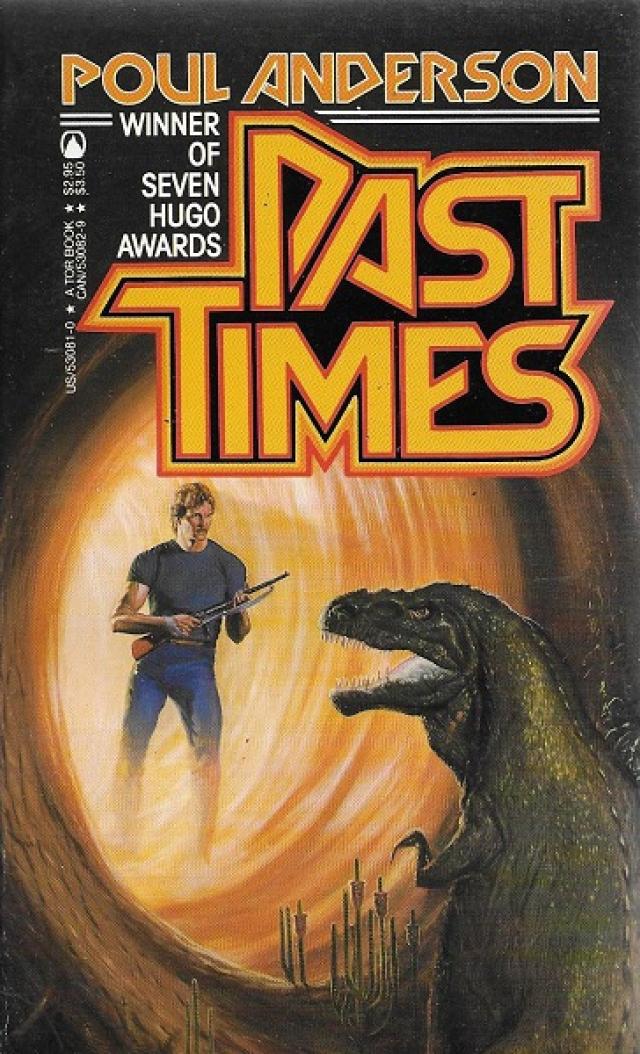
PAST TIMES
Copyright © 1984 by Poul Anderson
All rights reserved, including the right to reproduce this book or portions thereof in any form.
A TOR Book
Published by Tom Doherty Associates
8-10 West 36 Street New York, N.Y. 10018
Cover art by Kevin Eugene Johnson
First TOR printing: November 1984
ISBN: 0-812-53081-0
CAN. ED.: 0-812-53082-9
Acknowledgments: The stories contained herein were previously published and are copyrighted as follows:
“Wildcat,” Magazine offantasy and Science Fiction, © 1958 by Mercury Press Inc.
“Welcome,” Magazine of Fantasy and Science Fiction, ©
1960 by Mercury Press Inc.
“The Nest,” Science Fiction Adventures, © 1953 Future Publications.
“Eutopia,” Dangerous Visions, edited by Harlan Ellison, ©
1967 by Harlan Ellison.
“The Little Monster,” Way Out, edited by Roger Elwood, ©
1974 by Roger Elwood.
“The Light,” Galaxy, © 1957 by Galaxy Publishing Corporation.
“The Discovery of the Past,” © 1984 by Poul Anderson. A small part of this essay was published in Profanity magazine, © 1977 by Bruce Pelz.
“Flight to Forever,” Super Science Stories, © 1950 Popular Publications.
Printed in the United States of America
Contents:-
Wildcat
Welcome
The Nest
Eutopia
The Little Monster
The Light
The Discovery of the Past
Flight to Forever
CHAPTER ONE No Return
CHAPTER TWO Belgotai of Syrtis
CHAPTER THREE Trapped in the Time-Stream
CHAPTER FOUR End of Empire
CHAPTER FIVE Attack of the Anvardi
CHAPTER SIX Flight Without End
Wildcat
It was raining again, hot and heavy out of a hidden sky, and the air stank with swamp. Herries could just see the tall derricks a mile away, under a floodlight glare, and hear their engines mutter. Further away, a bull brontosaur cried and thunder went through the night.
Herries’ boots resounded hollowly on the dock. Beneath the slicker, his clothes lay sweat-soggy, the rain spilled off his hat and down his collar. He swore in a tired voice and stepped onto his gangplank.
Light from the shack on the barge glimmered off drenched wood. He saw the snaky neck just in time, as it reared over the gangplank rail and struck at him. He sprang back, grabbing for the Magnum carbine slung over one shoulder. The plesiosaur hissed monstrously and flipper-slapped the water. It was like a cannon going off.
Herries threw the gun to his shoulder and fired. The long sleek form took the bullet—somewhere—and screamed. The raw noise hurt the man’s eardrums.
Feet thudded over the wharf. Two guards reached Herries and began to shoot into the dark water. The door of the shack opened and a figure stood back against its yellow oblong, a tommy gun stammering idiotically in his hands.
“Cut it out!” bawled Herries. “That’s enough! Hold your fire!”
Silence fell. For a moment, only the ponderous rainfall had voice. Then the brontosaur bellowed again, remotely, and there were seethings and croakings in the water.
“He got away,” said Herries. “Or more likely his pals are now scraping him clean. Blood smell.” A dull anger lifted in him, he turned and grabbed the lapel of the nearest guard. “How often do I have to tell you characters, every gangway has to have a man near it with grenades?”
“Yes, sir. Sorry, sir.” Herries was a large man, and the other face looked up at him, white and scared in the wan electric radiance. “I just went off to the head—”
“You’ll stay there,” said Herries. “I don’t care if you explode. Our presence draws these critters, and you ought to know that by now. They’ve already snatched two men off this dock. They nearly got a third tonight—me. At the first suspicion of anything out there, you’re to pull the pin on a grenade and drop it in the water, understand? One more dereliction like this, and you’re fired—No.” He stopped, grinning humorlessly. “That’s not much of a punishment is it? A week in hack on bread.”
The other guard bristled. “Look here, Mr. Herries, we got our rights. The union—”
“Your precious union is a hundred million years in the future,” snapped the engineer. “It was understood that this is a dangerous job, that we’re subject to martial law, and that I can discipline anyone who steps out of line. Okay—remember it.”
He turned his back and tramped across the gangplank to the barge deck. It boomed underfoot. The shack had been closed again, with the excitement over. He opened the door and stepped through, peeling off his slicker.
Four men were playing poker beneath an unshaded bulb. The room was small and cluttered, hazy with tobacco smoke and the Jurassic mist. A fifth man lay on one of the bunks, reading. The walls were gaudy with pinups.
Olson riffled the cards and looked up. “Close call, boss,” he remarked, almost casually. “Want to sit in?”
“Not now,” said Herries. He felt his big square face sagging with weariness. “I’m bushed.” He nodded at Carver, who had just returned from a prospecting trip further north. “We lost one more derrick today.”
“Huh?” said Carver. “What happened this time?”
“It turns out this is the mating season.” Herries found a chair, sat down, and began to pull off his boots. “How they tell one season from another, I don’t know—length of day, maybe—but anyhow the brontosaurs aren’t shy of us any more—they’re going nuts. Now they go gallyhooting around and trample down charged fences or anything else that happens to be in the way. They’ve smashed three rigs to date, and one man.”
Carver raised an eyebrow in his chocolate-colored face. It was a rather sour standing joke here, how much better the Negroes looked than anyone else. A white man could be outdoors all his life in this clouded age and remain pasty. “Haven’t you tried shooting them?” he asked.
“Ever tried to kill a brontosaur with a rifle?” snorted Herries. “We can mess ’em up a little with .50-caliber machine guns or a bazooka—just enough so they decide to get out of the neighborhood—but being less intelligent than a chicken, they take off in any old direction. Makes as much havoc as the original rampage.” His left boot hit the floor with a sullen thud. “I’ve been begging for a couple of atomic howitzers, but it has to go through channels… Channels!” Fury spurted in him. “Five hundred human beings stuck in this nightmare world, and our requisitions have to go through channels!”
Olson began to deal the cards. Polansky gave the man in the bunk a chill glance. “You’re the wheel, Symonds,” he said. “Why the devil don’t you goose the great Transtemporal Oil Company?”
“Nuts,” said Carver. “The great benevolent all-wise United States Government is what counts. How about it, Symonds?”
You never got a rise out of Symonds, the human tape recorder: just a playback of the latest official line. Now he laid his book aside and sat up in his bunk. Herries noticed that the volume was Marcus Aurelius, in Latin yet.
Symonds looked at Carver through steel-rimmed glasses and said in a dusty tone: “I am only the comptroller and supply supervisor. In effect, a chief clerk. Mr. Herries is in charge of operations.”
He was a small shriveled man, with thin gray hair above a thin gray face. Even here, he wore a stiff-collared shirt and sober tie. One of the hardest things to take about him was the way his long nose waggled when he talked.
“In charge!” Herries spat expertly into a gobboon. “Sure, I direct the prospectors and the drillers and everybody else on down through the bull cook. But who handles the paperwork—all our reports and receipts and requests? You.” He tossed his right boot on the floor. “I don’t want the name of boss if I can’t get the staff to defend my own men.”
Something bumped against the supervisors’ barge; it quivered and the chips on the table rattled. Since there was no outcry from the dock guards, Herries ignored the matter. Some swimming giant. And except for the plesiosaurs and the non-malicious bumbling bronties, all the big dinosaurs encountered so far were fairly safe. They might step on you in an absent-minded way, but most of them were peaceful and you could outrun those which weren’t. It was the smaller carnivores, about the size of a man, leaping out of brush or muck with a skullful of teeth, which had taken most of the personnel lost. Their reptile life was too diffuse: even mortally wounded by elephant gun or grenade launcher, they could rave about for hours. They were the reason for sleeping on barges tied up by this sodden coast, along the gulf which would some day be Oklahoma.
Symonds spoke in his tight little voice: “I’d send your recommendations in, of course. The project office passes on them.”
“I’ll say it does,” muttered young Green-stein irreverently.
“Please do not blame me,” insisted Symonds.
I wonder. Herries glowered at him. Symonds had an in of some kind. That was obvious. A man who was simply a glorified clerk would not be called to Washington, for unspecified conferences with unspecified people, as often as this one was. But what was he, then?
A favorite relative? No… in spite of high pay, this operation was no political plum. FBI? Scarcely… the security checks were all run in the future. A hack in the bureaucracy? That was more probable. Symonds was here to see that oil was pumped and dinosaurs chased away and the hideously fecund jungle kept beyond the fence according to the least comma in the latest directive from headquarters.
The small man continued: “It has been explained to you officially that the heavier weapons are all needed at home. The international situation is critical. You ought to be thankful you are safely back in the past.”
“Heat, large economy-size alligators, and not a woman for a hundred million years,” grunted Olson. “I’d rather be blown up. Who dealt this mess?”
“You did,” said Polansky. “Gimme two, and make ’em good.”
Herries stripped the clothes off his thick hairy body, went to the rear of the cabin, and entered the shower cubby. He left the door open, to listen in. A boss was always lonely. Maybe he should have married when he had the chance. But then he wouldn’t be here. Except for Symonds, who was a widower and in any case more a government than company man, Transoco had been hiring only young bachelors for operations in the field.
“It seems kinda funny to talk about the international situation,” remarked Carver. “Hell, there won’t be any international situation for several geological periods.”
“The inertial effect makes simultaneity a valid approximational concept,” declared Symonds pedantically. His habit of lecturing scientists and engineers on their professions had not endeared him to them. “If we spend a year in the past, we must necessarily return to our own era to find a year gone, since the main projector operates only at the point of its own existence which—”
“Oh, stow it,” said Greenstein. “I read the orientation manual too.” He waited until everyone had cards, then shoved a few chips forward and added: “Druther spend my time a little nearer home. Say with Cleopatra.”
“Impossible,” Symonds told him. “Inertial effect again. In order to send a body into the past at all, the projector must energize it so much that the minimal time-distance we can cover becomes precisely the one we have covered to arrive here, one hundred and one million, three hundred twenty-seven thousand, et cetera, years.”
“But why not time-hop into the future? You don’t buck entropy in that direction. I mean, I suppose there is an inertial effect there, too, but it would be much smaller, so you could go into the future—”
“—about a hundred years at a hop, according to the handbook,” supplied Polansky.
“So why don’t they look at the twenty-first century?” asked Greenstein.
“I understand that that is classified information,” Symonds said. His tone implied that Greenstein had skirted some unimaginably gross obscenity.
Herries put his head out of the shower. “Sure it’s classified,” he said. “They’d classify the wheel if they could. But use your reason and you’ll see why travel into the future isn’t practical. Suppose you jump a hundred years ahead. How do you get home to report what you’ve seen? The projector will yank you a hundred million years back, less the distance you went forward.”
Symonds dove back into his book. Somehow, he gave an impression of lying there rigid with shock that men dared think after he had spoken the phrase of taboo.
“Uh… yes, I get it.” Greenstein nodded. He had only been recruited a month ago, to replace a man drowned in a grass-veiled bog. Before then, like nearly all the world, he had had no idea time travel existed. So far he had been too busy to examine its implications.
To Herries it was an old, worn-thin story.
“I daresay they did send an expedition a hundred million years up, so it could come back to the same week as it left,” he said. “Don’t ask me what was found. Classified: Tiptop Secret, Burn Before Reading.”
“You know, though,” said Polansky in a thoughtful tone, “I been thinking some myself. Why are we here at all? I mean, oil is necessary to defense and all that, but it seems to me it’d make more sense for the U.S. Army to come through, cross the ocean, and establish itself where all the enemy nations are going to be. Then we’d have a gun pointed at their heads!”
“Nice theory,” said Herries. “I’ve daydreamed myself. But there’s only one main projector, to energize all the subsidiary ones. Building it took almost the whole world supply of certain rare earths. Its capacity is limited. If we started sending military units into the past, it’d be a slow and cumbersome operation—and not being a Security officer, I’m not required to kid myself that Moscow doesn’t know we’ve got time travel. They’ve probably even given Washington a secret ultimatum: “Start sending back war material in any quantity, and we’ll hit you with everything we’ve got.’ But evidently they don’t feel strongly enough about our pumping oil on our own territory—or what will one day be our own territory—to make it a, uh, casus belli.”
“Just as we don’t feel their satellite base in the twentieth century is dangerous enough for us to fight about,” said Greenstein, “but I suspect we’re the reason they agreed to make the Moon a neutral zone. Same old standoff.”
“I wonder how long it can last?” murmured Polansky.
“Not much longer,” said Olson. “Read your history. I’ll see you, Greenstein, boy, and raise you two.”
Herries let the shower run about him. At least there was no shortage of hot water. Transoco had sent back a complete atomic pile. But civilization and war still ran on oil, he thought, and oil was desperately short up there.
Time, he reflected, was a paradoxical thing. The scientists had told him it was utterly rigid. Perhaps, though of course it would be a graveyard secret, the cloak-and-dagger boys had tested that theory the hard way, going back into the historical past (it could be done after all, Herries suspected, though by a roundabout route which consumed fabulous amounts of energy) in an attempt to head off the Bolshevik Revolution. It would have failed. Neither past nor future could be changed—they could only be discovered. Some of Transoco’s men had discovered death, an eon before they were born… But there would not be such a shortage of oil up in the future if Transoco had not gone back and drained it in the past. A self-causing future—
Primordial stuff, petroleum. Hoyle’s idea seemed to be right, it had not been formed by rotting dinosaurs but was present from the beginning. It was the stuff which had stuck the planets together.
And, Herries thought, was sticking to him now. He reached for the soap.
Earth spun gloomily through hours, and morning crept over wide brown waters. There was no real day as men understood day—the heavens were a leaden sheet with dirty black rainclouds scudding below the permanent fog layers.
Herries was up early, for there was a shipment scheduled. He came out of the bosses’ messhall and stood for a moment looking over the mud beach and the few square miles of cleared land, sleazy buildings and gaunt derricks inside an electric mesh fence. Automation replaced thousands of workers, so that five hundred men were enough to handle everything, but still the compound was the merest scratch, and the jungle remained a terrifying black wall. Not that the trees were so utterly alien—besides the archaic grotesqueries, like ferns and mosses of gruesome size, there were cycad, redwood, and gingko, scattered prototypes of oak and willow and birch. But Herries missed wild flowers.


