Pawn's Play, page 1
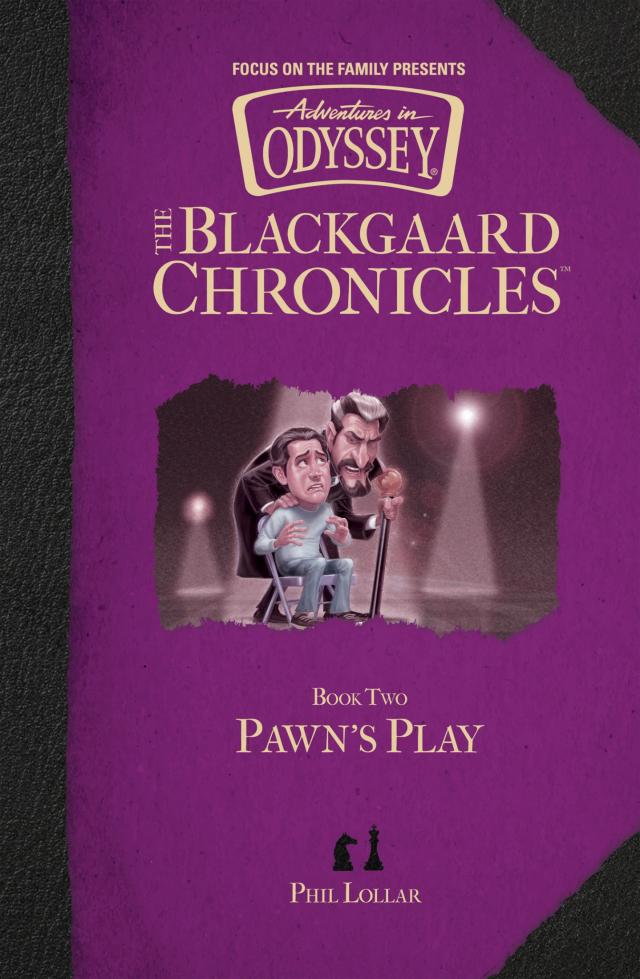


The Blackgaard Chronicles: Pawn’s Play
© 2017 Focus on the Family. All rights reserved.
Focus on the Family and Adventures in Odyssey, and the accompanying logos and designs, are federally registered trademarks of Focus on the Family, 8605 Explorer Drive, Colorado Springs, CO 80920.
No part of this publication may be reproduced, stored in a retrieval system, or transmitted in any form or by any means—electronic, mechanical, photocopy, recording, or otherwise—without prior written permission of Focus on the Family.
Scripture quotations from the Holy Bible, New International Version®, NIV®. Copyright © 1973, 1978, 1984, 2011 by Biblica, Inc.™ Used by permission of Zondervan. All rights reserved worldwide. (www.zondervan.com) The “NIV” and “New International Version” are trademarks registered in the United States Patent and Trademark Office by Biblica, Inc.™
This book is based on Adventures in Odyssey audio drama episodes “Connie Goes to Camp, Part 1”; “Connie Goes to Camp, Part 2”; and “Eugene’s Dilemma”—original scripts by Paul McCusker.
Novelization by Phil Lollar
Cover design by Jacob Isom
Cover illustration by Gary Locke
For Library of Congress Cataloging-in-Publication Data for this title, visit http://www.loc.gov/help/contact-general.html.
ISBN: 978-1-58997-927-7
ISBN 978-1-68428-197-8 (ePub); ISBN 978-1-68428-198-5 (Kindle); ISBN 978-1-68428-196-1 (Apple)
Build: 2019-05-16 18:17:53 EPUB 3.0
For
Nathan Carlson
and
Will Ryan
Contents
Chapter One
Chapter Two
Chapter Three
Chapter Four
Chapter Five
Chapter Six
Chapter Seven
Chapter Eight
Chapter Nine
Chapter Ten
Chapter Eleven
Chapter Twelve
Chapter Thirteen
Chapter Fourteen
Preview of Book Three
Don’t miss Opening Moves, Book 1 in The Blackgaard Chronicles book series. Available from better bookstores everywhere and at www.WhitsEnd.org/Store.
The Blackgaard Chronicles are based on popular Adventures in Odyssey (AIO) audio drama series. Learn more at www.aioclub.org, including how to get access to the complete library of AIO episodes, exclusive AIO radio dramas, daily devotions, and much more.
Chapter One
Summer 1989 . . .
Richard Maxwell was sweating.
A lot.
Despite the cool air in his present location—wherever it was—sweat beaded on his forehead and upper lip and trickled down his back, soaking his shirt. He had obviously messed up somewhere. But how? He was certain he had accounted for all the variables. No one could have known. He didn’t make any mistakes.
Or so he thought until a few hours ago. That’s when he realized how wrong he was.
Was it a few hours ago? It could have been longer. It was hard to tell time in the back of a sealed-up van with no windows or lights.
It was like something out of a bad movie: he was walking home from his job at the retirement home, having just stolen what promised to be his best haul yet, when the van pulled up alongside him, and two beefy guys manhandled him into the back. They slid the door shut, and the van took off so fast, he tumbled to the rear and banged his head against the back door.
They drove for what seemed like a long time, and when they finally stopped and opened the door, he was surprised to see they were in what he assumed was a nearly empty warehouse. The only things in it were the van and a small table with two chairs framed in a pool of light from the ceiling. The beefy guys pulled him out of the van and sat him down in one of the chairs. One of them placed the backpack of pilfered items on the table, and then they both turned and left, their footsteps echoing in the darkness.
A man with pasty skin, thinning salt-and-pepper hair, a potbelly, and milky gray eyes sat in the chair opposite Maxwell, looking at the contents of a file folder. The angle of the light caused his hooked nose to cast a strange shadow across his mouth and chin.
Without looking up, the man said, “Richard Maxwell: janitor, con artist, swindler, manipulator, and now—” He set down the folder and upended the backpack. The contents of the day’s haul spilled out onto the table. The man smirked at him. “—petty thief. My, my, you’ve led quite a life for someone so young, haven’t you?”
Maxwell thought there was something familiar about this jerk; he’d seen him somewhere. Then it hit him. “I know you. You’re like a city-government guy from Odyssey, right?”
The man smiled a greasy sort of smile. “Not like. Am. Councilman Philip Glossman. I wish I could say I was pleased to make your acquaintance. But I’m not.”
Maxwell licked his lips nervously. “Look, I . . . I was just holding that stuff for a friend.”
Glossman held up a finger and wagged it, pursing his lips and shaking his head slightly. “Please. Don’t even try.”
This was weird, Maxwell thought. Since when could city councilmen arrest people? And why all the subterfuge? He fought to stay cool. “So . . . where am I? What is this place?”
“All in good time, Maxwell. All in good time.” Glossman examined the contents of the backpack. He picked up a gold brooch shaped like a butterfly. Tiny, sparkling diamonds lined its wings. “Pretty.” He smirked. “Though it doesn’t really go with your outfit.”
That was it. Maxwell slammed his hands on the table and jumped up. “What is this? What’s going on here?”
Glossman continued smirking. “Sit down, Maxwell,” he said evenly.
Maxwell leaned across the table. “I’ve got rights! You can’t arrest me without telling me why.”
Glossman laughed. “Who said you’ve been arrested?”
Maxwell leaned back slowly and swallowed hard. “If you’re not arresting me, then—” He sank down in the chair, heart pounding. “Y-you . . . you’re . . . kidnapping me?”
A bigger laugh. “Hardly! Why kidnap someone nobody would pay a ransom for?”
“Then what’s going on?” Maxwell’s voice was almost pleading. “Why did you bring me here?”
Glossman scooted back his chair, stood, and stepped behind it. “I’ve brought you here to meet someone—someone who very much wants to meet you.” He turned his head and called into the darkness behind him. “Sir!”
After a few moments, Maxwell heard a door open, though he saw no light. The door closed, and one set of footsteps, accompanied by the occasional tap-tap of a walking stick, echoed in the empty building. The footsteps and the walking stick were headed right toward him and grew louder with each step and tap.
Suddenly another man appeared in the pool of light. He was tall and lean, with angular features. He wore a black, three-piece suit, tailored to fit him perfectly. The coat fell almost to his knees, the trousers were sharply creased, and his black shoes were polished to a high gloss. He carried a black walking stick with a polished gold knob for a handle. His hair was jet black, save for white streaks that ran from both temples to the back of his head on both sides, and his mustache and Vandyke beard were also jet black.
Glossman held out the chair for the man, and he glided into it with an easy grace, placing his walking stick on the table atop the pilfered loot. He looked across the table and smiled, teeth gleaming, and his gaze sent chills down Maxwell’s spine.
“Hello, Richard.” The man’s voice was deep, dark, rich, and cold as ice. “I’m Dr. Regis Blackgaard. You and I need to talk.”
Maxwell took steady, even breaths, though his heart was pounding. As casually as he could, he reached up and wiped the sweat from his brow and upper lip. “Okaaaay,” he said. He was surprised how calm his voice sounded. “So . . . let’s talk.”
Blackgaard smiled pleasantly but said nothing, so Maxwell continued. “Uh . . . nice weather we’re having? Great place you got here? How about them Cubs? Whadaya wanna talk about?”
“Why, about you, of course, Richard.” Blackgaard’s smile widened. “More specifically, about your future.”
Maxwell took a deep breath. “O-okay, look, I-I admit to taking a few trinkets from the geezers, okay? But I got your message. I won’t do it again. You don’t have to threaten me!”
Blackgaard’s brow furrowed. “Threaten? Are you under the impression that I’ve brought you here to harm you?”
Maxwell blinked, then swallowed. “Well . . . uh . . . yeah . . . sort of. I mean, when you have two thugs grab me off the street and throw me in the back of a van—”
Blackgaard shook his head. “That was for your safety! Those men were there to protect you.”
“Protect me from who?”
“Now, Richard,” said Blackgaard reprovingly. “Don’t be so naive. Surely you realize that your past actions have made you more than a few enemies. My men had your best interests at heart, I assure you.”
“Then why are you keeping me here against my will?”
“Am I?” Blackgaard shook his head again. “I think you’ve completely misconstrued the situation. You’re free to leave whenever you like.”
Now Maxwell’s brow furrowed. Who was this guy? “W-well if you’re not gonna hurt me, and you’re not holding me, then why am I here?”
“I’d have thought that would be obvious by now,” Blackgaard said, smiling again. “I want to hire you.”
Maxwell’s jaw dropped. “Hire me? B-b-but I . . . you . . . he . . . what?”
Maxwell wasn’t laughing. These guys were nuts! “If all you wanted to do was offer me a job, then why the big production—the blacked-out van, the long ride, the dark warehouse, the spotlight?”
Blackgaard rose from his chair. “I’m so very sorry, Richard,” he said in a sincere tone. “I understand now how all this must appear to you. My associate here”—he nodded at Glossman—“has a tendency to be, shall we say, overly dramatic in his actions on occasion.”
Maxwell looked at Glossman, who smirked and shrugged. Blackgaard slowly moved around the table to Maxwell’s side. “Thus, the blacked-out van. This warehouse is near the airport I happen to own. I have a very busy travel schedule. In fact, I’ll be catching a flight out shortly, so it was the most convenient place and time for us to meet—which is why you had such a long ride here. Again, I’m sorry for that. As for the lights, I just feel it’s a terrible waste of energy to turn them all on when it’s just the three of us in here. I can do so if you like, though—if it will make you more comfortable.” Blackgaard was standing next to him now, practically over him.
“No . . . that’s okay.” It all sounds so reasonable, Maxwell thought. So why does this still give me the creeps? He took another breath, then said aloud, “Look, Mr. Blackgaard—”
“Doctor.”
“Huh?”
“Dr. Regis Blackgaard.” He smiled again, but his eyes were cold. “PhD in psychology.”
“Oh, uh, sorry, uh . . . Dr. Blackgaard, I’m still pretty confused here. You said you know about my past—about the things I’ve, uh, supposedly done.”
Blackgaard chuckled. “Well put.”
“But you still want to hire me?”
“Indeed.” Blackgaard nodded. “In fact, your past is why I want to hire you.”
Maxwell blinked again. “Okay, I just went from pretty confused to totally confused.”
Blackgaard sat on the edge of the table. “Richard, most people who looked at your . . . résumé would no doubt see precisely what Mr. Glossman saw: con artist, swindler, manipulator, petty thief. But do you know what I see?”
“What?”
Blackgaard leaned in slightly. “An entrepreneur—resourceful, clever, intelligent. An energetic young man who is willing to do whatever it takes to get ahead. I want a young man like that on my team.”
“You do.”
“Oh yes. I want to help you, Richard.”
Maxwell’s eyes narrowed. “Why?”
Blackgaard sat back. “An excellent question. The answer is, because I believe that you can also help me.”
Maxwell smirked. “And there it is. The other shoe.”
“Other shoe? I’m afraid I don’t—”
“Stop with the innocent routine already!” Maxwell leaned back, put his foot on the table, tilted his chair on its two back legs, and intertwined his fingers behind his head. “You want something from me. Something you can’t do . . . something you want bad enough to bring me all the way here, flatter me, and bribe me with a job to get it. So why don’t you just tell me what it is?”
Glossman’s eyes were wide. Blackgaard stood and walked back around the table. Glossman held out the chair for him, but Blackgaard didn’t sit. Instead, he stopped, faced Maxwell, focused his coal-black eyes directly on him . . . and laughed. “You have a lot more spunk than I gave you credit for, Richard. Very well. You’re enrolled at Campbell College, correct?”
“Yeah.”
“Majoring in computer science?”
“Two for two.”
“I need a computer expert.”
Maxwell grinned. “I figured. To do what?”
Blackgaard sat. “I believe it’s called hacking—using a computer at one location to break into another computer at a different location.”
“Yeah.” Maxwell nodded. “I’m familiar with the term.”
“Can you do it?”
Maxwell took his hands from behind his head. “Maybe. If I have a powerful enough computer hooked up to a modem.” He quickly decided not to mention that the other computer had to be hooked up to a modem as well. He learned long ago to always leave himself a plausible excuse for failure. Besides, he now had an idea of where this was going, and he had his own scheme in mind.
Blackgaard leaned forward. “Like the computers at Campbell College?”
Maxwell took his foot off the table. The chair jolted forward onto all four legs. “Not the lab computers.” He thought for a moment. “I’d need to use the one in the computer security room.”
Blackgaard licked his lips. “Can you get to it?”
“Did you miss the part where I said it was a security room? The place is locked up tighter than a drum.”
Blackgaard exhaled and sat back in his chair.
Glossman tugged at his collar and eyed Blackgaard with a wary look.
Apparently the good doctor here doesn’t like disappointment, Maxwell thought. He smirked and said aloud, “But as it turns out, the college just happens to be looking for an entrepreneurial, resourceful, clever, intelligent, energetic computer-science major to head up its high-security programming section—in the computer security room.”
Glossman stopped tugging at his collar and scowled at Maxwell.
Blackgaard leaned forward again. “Excellent!” He fixed his coal-black eyes on Maxwell. “I meant what I said, Richard. I want you on my team. Can I count on you?”
Maxwell shrugged. “I dunno. What’s in it for me—besides a lousy job, I mean?”
“What every entrepreneurial, resourceful, clever, intelligent, energetic young person wants.” Blackgaard’s voice lowered to a near whisper. “Power.” His eyes bored into Maxwell’s. “What do you say?”
Maxwell leaned back in his chair again. “Whose computer do you want me to hack into?”
Blackgaard exchanged a look with Glossman and then smiled at Maxwell. “Have you ever heard of a place called . . . Whit’s End?”
Chapter Two
Dear Mom,
I’m sorry it’s taken me so long to write you a letter, but you know how crazy it is here at Camp What-A-Nut. Especially since they made me a girls’ cabin counselor.
How’s everything in Odyssey? Have you seen Whit? Or Eugene? It feels so strange not working at Whit’s End, and the past few days up here haven’t made those feelings go away. If anything, it’s made them worse, because a lot of the kids who went to Whit’s End are up here and know I was fired. So now every time I look at them, I feel embarrassed and hurt—and angry. It just doesn’t seem right that Whit would fire me over a silly computer program.
But being busy is better than sitting at home all day. It was “hit the ground running” right from the start. As soon as everybody checked in, we all gathered together in the great hall—which is also the cafeteria and the chapel—for the camp director’s welcome speech. He told us all about the camp’s history and how it got its weird name. Its real name is Camp Wey-Aka-Tal-Ah-Nee-Tee, a Native American phrase that supposedly means “land that stinks like swamp.” But that took too long to say, and no one could pronounce it right when they did say it. So they took the first letters—W-A-T-A-N-T—and, well, someone said it looked like “what-a-nut,” and—voilà!—Camp What-A-Nut was born.
After his speech, I gathered the girls in my cabin together in a corner of the meeting hall to go over the rules. I think you know most of them from church (the girls, I mean, not the rules): Lucy Cunningham-Schultz, Donna Barclay, Robyn Jacobs—and one you don’t know, Alison Leskowsky. She used to come to Whit’s End. You wouldn’t have any trouble picking out my girls among all the kids here, even if you didn’t know them: Lucy has brown hair (and glasses), Donna has dark hair and blue eyes, Robyn has red hair and freckles, and Alison is a blonde with a slight overbite. They all pretty much always hang out together, so all I have to do is look for a group of girls that consists of one brown, one black, one red, and one blonde head, and I’ve found them.
The rules were pretty standard safety stuff: no sports activities in the cabins; the beds are not trampolines, and the pillows are not clubs; and no food allowed outside the cafeteria, especially not in the cabins, because it attracts raccoons, opossums, skunks, and bears. And most important: campers are not allowed outside after lights out. I told them that one is the biggie. Break it, and you could get sent home. Even though this camp isn’t exactly roughing it, it’s still out in the wilderness, which means you can still run into danger. I remember hearing about Donny McCoy last year, when a bear chased him and . . . well . . . someone up a tree.