The Night Sheriff, page 15


There are not a lot of places like that in modern America. Things come and go so quickly here that in the space of a week, even the holiest of places could be razed for a fried chicken restaurant.
But the L’Enfant reversed the process, as it were. When she bound me to this spot, she had to give the spot she was binding me to a shape, a purpose. Now, everyone knew that Zenonland was going to be this magnificent place, and so that was the expectation that she gave to the land. The result was that she created an … idea that might have taken generations in both time and people to generate naturally, and because there was this idea and an expectation waiting to be filled—the land filled it. Usually, places that have spirits acquire them through use, as it were. But L’Enfant gave shape and self-awareness to the place that would become Zenonland before it even was Zenonland.
As a result, when our very first guests came through the gates on opening day—no, even as the workers and construction crews were putting the finishing touches on the park—they knew, everyone knew, that this was a special, a magical place, one that warmed people’s hearts and satisfied a spiritual need that most of them didn’t even know they were lacking. The park was a success from day one.
And when a magical place is established, and used for generations, an “animus spirit,” one that incorporates all of that emotion, can form. In my time I have encountered innumerable nature spirits occupying glens and pools and caves. Shy, gentle creatures that formed spontaneously over time.
Again, Celeste took that process and turned it on its head. She artificially created a niche where an animus spirit for the land would have naturally formed over time, and the land responded as if the emotions of the people were already there and manifested. When she attempted to pull forth a genius loci in order to ask about the fate of Mr. Mortimer, she actually created one on the spot from the dissipated wisps of Xochemilchic.
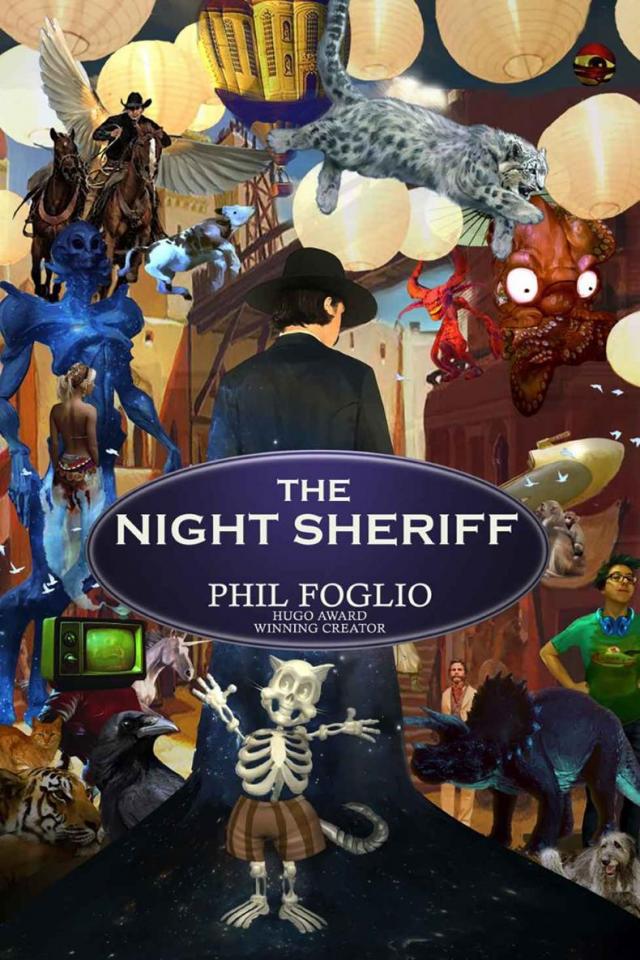
Unsurprisingly (in retrospect), the Spirit of Zenonland manifested itself as one of Mr. Bartholomew’s cartoon animals. I don’t know how it chose the shape it did, but it appeared as Bone Cat, the very first character that Mr. Bartholomew animated back in the early 1930s.
These days everyone knows Preston Platypus. He was Mr. Bartholomew’s breakthrough character, and there is no denying that it was his famous animated short, Ain’t We Got Guns, that began Zenon Studio’s climb to success.
But before that, he started with Bone Cat, a scrappy, mischievous, reanimated cat skeleton that bedeviled antagonists and delighted audiences through six shorts that are themselves a treatise on the early days of animation. Each one is significantly better and more sophisticated than the one that came before, as Mr. Bartholomew and his ragtag crew of filmmakers learned, and in many cases invented, the art of animation as they went.
But when Mr. Bartholomew was trying to lock down his now famous distribution deal with the owner of the Apogee Theatre chain that got Zenon cartoons in front of audiences from New York to Los Angeles, the owner, Mr. Jupiter Applegee, made but a single demand: He wanted to see something new.
And so Bone Cat was retired, and Preston Platypus bounced into the hearts of America and the world. But Mr. Bartholomew always held a particularly warm spot for Bone Cat, so it made perfect sense that he became the form that the spirit of the park assumed.
Because he is tied to me, he only appears when I am in contact with the land. Whenever I fly, he fades away. To where? Even he does not know, and thus he berates me whenever I contemplate flying instead of walking. Interestingly, he remains even if I am only technically on the ground. Standing atop a building, or even sitting in a chair, and he is still there.
Which meant that I had acquired a new friend, and a garrulous prankster of a friend at that. It took some getting used to. Before my association with Mr. Mortimer, I had been a bit of a loner. Then for fifteen years I had been part of a team. Oh, there was no denying that Mr. Mortimer had his puckish side, but on the whole he was a sober and steady fellow.
Bone Cat is his antithesis. It took some getting used to, and no mistake. To be honest, in the beginning, there were entire evenings I spent flying about over the park because the idea of the little fool capering gormlessly around me made me want to break things. Our first decade or so together was a strained one. This only began to change when I thought that he was dying.
I first noticed it on the night that Mr. Bartholomew himself passed away, in 1967. His death was no surprise—the man had lung cancer, after all. But there was a great deal of worry amongst the employees, and, from what I gathered, the general population as well. The Zenon Corporation was so closely associated with the man who’d created it, that the idea of it continuing on after he died was seen as unlikely, at best.
When I awoke that evening, Bone Cat did not move from his usual resting place, which was, at that time, curled atop my sarcophagus. I fluttered the lid, in order to get him to move. When he did not, I slowly opened it all the way, which resulted in him sliding to the ground and exploding into a pile of loose bones.
I was terrified, and spent several minutes scrabbling across the floor, scooping all the bones into my hat, which was the only thing I could find. My fears eased slightly when I noticed that the bones were slowly rearranging themselves into his normal shape, but he still refused to rouse.
Mr. Bartholomew died at 2:12 am. At two thirty, Bone Cat startled me again, by abruptly sitting up on my desk, where I had deposited him. For almost a minute, he did nothing, merely sitting and staring into space, until I poked him with an extended claw. He batted it away. “Barty-boy’s dead,” he informed me matter-of-factly.
I nodded. “Is that why you were … comatose?”
He nodded. “Yeah. Me and a few of the others thought we should be there. You know, to see him off.”
“Others? What others?”
“The other characters. You know, Preston, and Wenceslaus Weasel, and Count Honkula, and Missy Mammoth, and—”
“The other characters that Mr. Bartholomew created? They’re alive?” I waved my hands. “Or whatever it is you are? Am I going to have to deal with a whole pack of you?”
He grinned. “You should be so lucky. Nah, most of them went with him. Me? I’m still tied to the land.”
“So … You’re saying that a creator’s characters … when they die, they meet them …” I thought of some of the embarrassing deaths that Zenon villains had succumbed to over the years. The evil unicorn Dyspepsya, who met her doom strapped onto her own automatic pencil sharpener at the end of Zenon’s acclaimed retelling of The Lady of Shalott stood out in my mind. I had thought it moronic, at the time. But to be held accountable for it …
“Oh, not everyone you’re thinking of showed up,” Bone Cat assured me. “A lotta Zenon movies, he just signed the checks, y’know? But the early stuff? The characters he created himself, the ones he put something of himself into? We were there.”
As I have said elsewhere, I do not know what happens after people die. That said, the few hints that occasionally come my way continue to surprise me.
Bone Cat claimed that he was now fine, but I paid a bit more attention, and I noted that for the next few years, he seemed to go into a bit of a slow decline, which mirrored that of the park, and indeed the company itself.
As far as Zenonland goes, I personally believe that if the park had been an autonomous place, unconnected with the corporation, it could have survived perfectly well, possibly even better than it did, serviced by a volunteer “priesthood” that would have maintained it and preserved it for future guests. It has that kind of a hold on people. But, of course, that was not what happened at all. And so, as I promised, Mr. Raphael Zenon now enters our story.
If you look in a dictionary for the term “middle manager,” it should be illustrated with a tiny little picture of Mr. Raphael, trying not to be noticed. However fate did not allow him the genteel obscurity he craved. By the dictates of Mr. Bartholomew’s will, he was made the new CEO of the Zenon Corporation.
Mr. Raphael does not really receive enough credit in the Zenonland histories. There were many people who figured that he would be quickly swept aside, but whatever his personal inclination, when faced with adversity, he displayed the legendary Zenon family tenacity. While he lacked Mr. Bartholomew’s idealism, he remained loyal to his brother’s vision.
There is no denying that the company declined under his rule, but there were extraordinary circumstances that would have tested the mettle of anyone stepping into the position, and all things considered, the amazing thing is that the company survived at all.
Mr. Raphael’s is not a name familiar to the general public, which is how he would have wanted it, but his tenure is still studied at the better schools of business, albeit for all the wrong reasons.
It was undeniably true that under his watch, the Zenon Corporation reached its nadir. The malaise spread to Zenonland, which began to suffer as the company’s stock price fell. Maintenance was deferred. Corners were cut. The shine began to rub off. The magic began to dim. This naturally impacted how our guests felt about the place, which, in turn, was reflected in Bone Cat’s behavior. He became listless and out of sorts. Towards the end, there were entire weeks when he could hardly be bothered to rouse himself.
Now it would be very easy to blame all of this on Mr. Raphael’s mismanagement, and many histories of the company do. But what few people know was that he was restricted in every important way by his departed brother’s dictates from beyond the grave. Oh, there was no denying that Mr. Bartholomew had been the man with the vision of what the park could and should be. Call it genius or deluded, idealistic or fascistic, precognizant or overly nostalgic, but Mr. Bartholomew had thoroughly articulated that plan, demanded that everyone adhere to it, and had fully expected them to do so even after he was gone. And adhere they did, for a while.
But as I have mentioned, because of the whole cryonics cock-up, Mr. Bartholomew had taken to haunting the corporate offices. While he was primarily obsessed with the location of his body, this occupied only part of his time. The remainder he spent trying to run his company.
Unfortunately, those dead who barely comprehend that they are no longer alive, certainly do not have the mental flexibility to understand how things that happen in the outside world can make their core dictates irrelevant, impractical, or even illegal.
The upshot of this was that Mr. Bartholomew was often in a bad mood. It was very disturbing, because when you were talking about something innocuous, he would be quite businesslike, and several of his former associates had trouble remembering that he was actually dead. However, if you innocently suggested a change in the way things were being done that crossed any of the thousand and one invisible lines that existed in his head, he would roar and shriek and fling about every detached item in the room, smashing furniture and windows and, in several cases, almost injuring people.
Everyone at this level of the company was heavily invested in Zenon stock, and so they had great incentive to see that news of this haunting did not get out to the public. It was barely whispered about within the company, and, in fact, I did not find out about it until one evening when I opened my office door and was astonished to see Mr. Raphael himself, huddled upon my guest chair.
We had met, of course. Mr. Bartholomew himself had brought him to the park to meet me, shortly after the incident with the Wendigo. We did not hit it off.
Mr. Raphael was one of those persons who embraced the scientific worldview that was currently on the ascendance. It was neat and tidy and did not require the presence of invisible creatures that one was expected to petition for protection or favors. It was a universe as dull as he was, and that was exactly how he liked it. Naturally I, and the reality that I represented, flew in the face of everything that he wanted to believe, and rather than having to change his worldview, he found it much easier to pretend that I did not exist. Thus my surprise at finding him here.
It took almost an hour, a cup of coffee heavily laced with some of the brandy that the current Head of Park Security kept hidden in his desk, and a great deal of uncomfortable small talk before the reason for his visit was dragged out into the open. It was then that I learned of Mr. Bartholomew’s disruptive, post-vital shenanigans. Suddenly the reason for the retention of the many policies that encumbered the park, as well as the corporation itself, was explained—
“No, wait a minute,” I said. “Your brother died almost a decade ago …” I stared at Mr. Raphael aghast. “You’ve been putting up with this for ten years?” It was then that Mr. Raphael truly broke down. He had adored his brother, and had, with some justification, seen him as the source of everything positive that had happened in his life. However, things had gotten to the point where indulging his brother’s spirit was no longer realistically possible. The changes that Mr. Bartholomew’s shade was railing about were no longer simple things like tweaks to artistic style, or whether women employees should be allowed to wear trousers. He was now protesting changes that were needed to keep the Zenon Corporation in compliance with the law. Sociologically, it had been a tumultuous decade, and the company’s rules and regulations regarding things like the hiring of women for executive positions, the hiring of minorities, handicapped access, the permitting of unionization, adherence to safety standards, waste disposal procedures, and a hundred more, were grievously out of date.
None of this non-corporeal drama was known to anyone except for the inner corporate circle. To the outside world, it simply looked like another case of a company that had been ruled by a single man foundering without his strong hand on the tiller. A rather ironic interpretation, actually. But the result was the same—the company continued its downward spiral, and, by the late seventies, I had great hopes for its dissolution.
But Mr. Raphael realized that the choice he faced came down to continuing to obey his beloved brother and watching the thing that Mr. Bartholomew had created be destroyed, or destroying his brother, and letting the company that carried his name, live on. The answer had been obvious, but it had taken him another year to build the resolve needed to come to me.
“Why me?” I asked.
He looked at me as a man trapped in a bog, about to be sucked under, would stare at an overhanging tree branch that might—or might not—sway to where he could grab it in time to pull himself free. “He’s a ghost,” he said slowly, like he was explaining something to a child. “I don’t know how to deal with ghosts. None of us do.” He sighed. “But you do, don’t you?”
And indeed I did. Naturally, I couldn’t do any of the actual leg work, as it was all off-site. But through agents, people were paid to look the other way, and Mr. Bartholomew’s head was covertly removed from its grave. A suitable container was fashioned, and with great ceremony, before the gaze of Mr. Bartholomew’s shade, placed into a small freezer. Thereafter it was conveyed, within a refrigerated truck, to Zenonland in the dark of the night. As the truck pulled away, the shade left the Zenon offices, and although everyone who saw it swore that it appeared to be walking normally, it effortlessly kept up with the truck through the city and up to the gates of the park.
Bone Cat and I were waiting at the entrance when they all arrived. The truck pulled up to the curb, and a second later Mr. Bartholomew stepped out from behind it. I could tell that he was a ghost, of course, but it was still a shock, seeing him after all these years. He saw us, as they were unloading the truck, and strolled on over. “I’m told you’re responsible for finally straightening this out,” he said, as he gave Bone Cat a pat.
“Your brother did all the work,” I said. “I just told him what needed to be done.”
His eyes never left the freezer that was now being wheeled towards the gates, but he nodded. “Yeah, that’s Raff in a nutshell.” He sighed. “I probably leaned on him harder than I should’ve.”
“You think?”
“Tell him I’m sorry, and thanks for everything.” I was about to tell him to convey this himself, but as soon as the freezer cleared the turnstiles, Mr. Bartholomew gave a great sigh that never ended, and he dissipated from the inside out, vanishing into thin air. And that was that.
Now, I myself thought that things between Mr. Raphael and myself would revert to normal. But to my surprise, the very next evening, he was again waiting in my office. He already looked better. He was sitting up straight, and he had the look of a man who has finally gotten a decent night’s sleep. “He’s gone,” he said simply.
His gratitude for my assistance in freeing him from the shadow of his brother, who had always been a commanding personality, made the next decade or so much easier on me. This was also when I received my second raise in pay.
I also saw improvements being made in the park, which were reflected in Bone Cat’s rapid improvement. It was during this period that the Night Crew began to grow into the army of people, thousands strong, that it is today. All very good, and no doubt some would regard the resolution of my relationship with Mr. Raphael to be so saccharine that it was worthy of being made into a Zenon picture in its own right.
But there was one very important consequence of all this; the park did not close after twenty years. It did not close after thirty. It was no longer a mere company; it was well on its way to becoming an institution.
Eventually Mr. Raphael bowed out, and, for the first time, the Chairman of the Zenon Corporation was not a Zenon family member. History says many things about Mr. Michael’s tenure as CEO, but as one looks about today and sees a globe-straddling megacorporation that has absorbed half of the world’s entertainment properties while single-handedly bribing enough of the United States government that they cheerfully gutted their own trademark laws for our benefit … well! You have to admit that he did all right by our shareholders.
Which is a problem for me, as I am still trapped. Now don’t get me wrong, I certainly earn my keep, and it’s not like I object to my job, but I want my freedom. My only hope is Celeste. Oh yes, we have stayed in touch. She is in her seventies now and has been the official L’Enfant for over fifty-five years.