

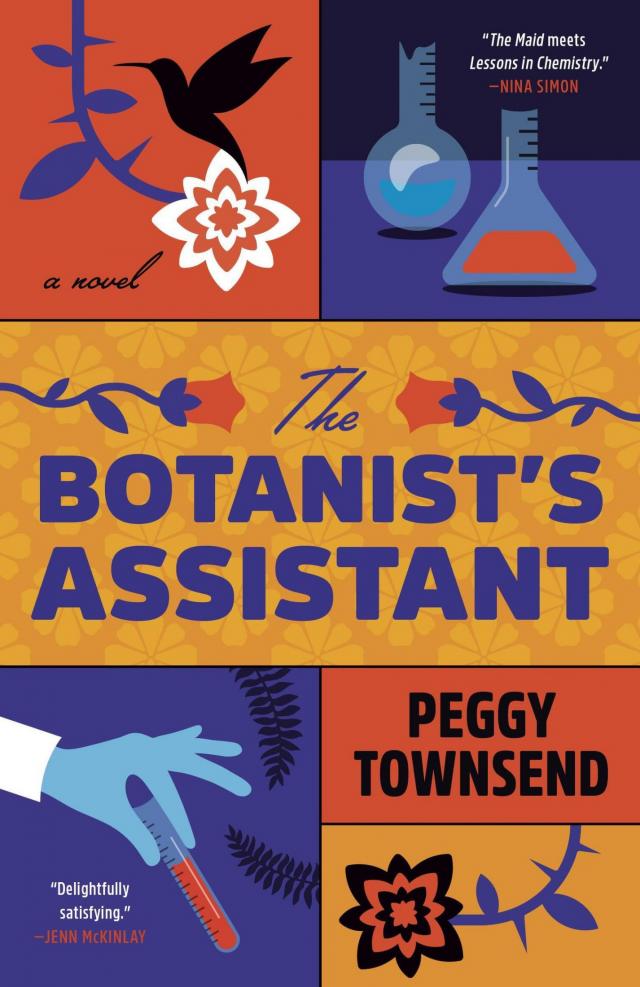
The Botanist's Assistant, page 1


Praise for
The Beautiful and the Wild
“The Beautiful and the Wild by Peggy Townsend is a gripping, edge-of-your-seat Alaskan wilderness survival story and so much more; a brilliantly insightful and compelling dysfunctional family drama that kept me turning the pages at warp speed.”
—Karen Dionne, #1 internationally bestselling author of The Marsh King’s Daughter and The Wicked Sister
“Page-turning. Exhilarating. Unforgettable.”
—Meg Waite Clayton, internationally bestselling author of The Postmistress of Paris
“The Beautiful and the Wild probes the darkest corners of the human heart…. Townsend’s masterfully written novel takes us to a harrowing past informing an even more treacherous present, chilling and unforgettable.”
—Elizabeth McKenzie, award-winning author of The Dog of the North
“Townsend has written a breath-stopping, heart-thumping, page-turning, keep-you-up-at-night story. ‘Wild’ is the word.”
—Karen Joy Fowler, New York Times bestselling author of Booth and We Are All Completely Beside Ourselves
“Wow, wow, wow. Townsend explores the lengths we go to to keep loved ones safe as well as how memory and perception change over time. Filled with secrets, dark terrain, and hope, The Beautiful and the Wild kept me guessing until the end.”
—Janet Skeslien Charles, New York Times bestselling author of The Paris Library
“Townsend elevates the proceedings above standard-issue genre fare by zeroing in on Liv and Xander’s relationship, which she renders with aching sensitivity. The mother-son bond at the heart of this tense melding of domestic suspense and survival thriller makes it tough to shake.”
—Publishers Weekly
“The shifting perspectives and fast-paced plot will keep even the most avid suspense readers on the edge of their seats.”
—Booklist
“A twisty, suspenseful story that straddles the line between survival novel and domestic thriller…. Townsend keeps readers guessing, evoking modern hits like The Girl on the Train and Gone Girl as she casts doubt on Liv’s character and recollection of events.”
—Shelf Awareness
More Praise for Peggy Townsend’s novels
“Journalist Peggy Townsend delivers an outstanding second novel about investigative reporter Aloa Snow that may overshadow her superb debut. Townsend’s expert plotting and attention to character elevate The Thin Edge.”
—Associated Press
“Entertaining sequel…. May she soon return for more adventures.”
—Publishers Weekly
“Townsend’s debut is driven by brisk plotting with bursts of stylish prose. Her eye for sharp character details makes her one to watch.”
—Kirkus Reviews
“An award-winning journalist herself, Townsend has created a nuanced young protagonist…. This could be the beginning of an intriguing series.”
—Booklist
Other Berkley Titles by Peggy Townsend
The Beautiful and the Wild
BERKLEY
An imprint of Penguin Random House LLC
1745 Broadway, New York, NY 10019
penguinrandomhouse.com
Copyright © 2025 by Peggy Townsend
Penguin Random House values and supports copyright. Copyright fuels creativity, encourages diverse voices, promotes free speech, and creates a vibrant culture. Thank you for buying an authorized edition of this book and for complying with copyright laws by not reproducing, scanning, or distributing any part of it in any form without permission. You are supporting writers and allowing Penguin Random House to continue to publish books for every reader. Please note that no part of this book may be used or reproduced in any manner for the purpose of training artificial intelligence technologies or systems.
BERKLEY and the BERKLEY & B colophon are registered trademarks of Penguin Random House LLC.
Cover design and illustrations by Jordan Jacob
Book design by Ashley Tucker, adapted for ebook
Interior art by Anton Dzyna/Shutterstock
Library of Congress Cataloging-in-Publication Data
Names: Townsend, Peggy, author.
Title: The botanist’s assistant / Peggy Townsend.
Description: First edition. | New York: Berkley, 2025.
Identifiers: LCCN 2025412019 (print) | LCCN 2025002222 (ebook) | ISBN 9780593638118 (trade paperback) | ISBN 9780593638125 (ebook)
Subjects: LCGFT: Cozy mysteries. | Novels.
Classification: LCC PS3620.O97 B68 2025 (print) | LCC PS3620.O97 (ebook) | DDC 813/.6—dc23/eng/20250326
LC record available at https://lccn.loc.gov/2025412019
LC ebook record available at https://lccn.loc.gov/2025002222
Ebook ISBN 9780593638125
The authorized representative in the EU for product safety and compliance is Penguin Random House Ireland, Morrison Chambers, 32 Nassau Street, Dublin D02 YH68, Ireland, https://eu-contact.penguin.ie.
ep_prh_7.1a_153859763_c0_r0
Contents
Dedication
Chapter 1: Three Hundred Seconds
Chapter 2: A Word to the Unwise
Chapter 3: No Cake
Chapter 4: Tea and Cookies for One
Chapter 5: A Sudden Realization
Chapter 6: Taking Note
Chapter 7: The Laugh
Chapter 8: Among the Flowers
Chapter 9: To Clean or Not to Clean
Chapter 10: A Parker’s Dilemma
Chapter 11: Hold On
Chapter 12: Breaking and Entering
Chapter 13: Window Staring
Chapter 14: Trial by Fire
Chapter 15: When You Hear Hoofbeats
Chapter 16: Sweet Somethings
Chapter 17: An Apology
Chapter 18: Coffee Trouble
Chapter 19: The Good Servant
Chapter 20: The Walkabout
Chapter 21: And Then a Howl
Chapter 22: The Young and the Small
Chapter 23: When the Deluge Comes
Chapter 24: Felis Silvestris Catus
Chapter 25: A Hunter at Work
Chapter 26: Mad Honey
Chapter 27: Eye in the Sky
Chapter 28: A Leaf Turned
Chapter 29: Fifty Ways to Feed Your Kitty
Chapter 30: Fail Me Once
Chapter 31: Not What They Seem
Chapter 32: For Want of a Leaf
Chapter 33: A Guy Who Knows a Guy
Chapter 34: An Important Cleanup
Chapter 35: The Early Girls Are Late
Acknowledgments
About the Author
_153859763_
For Jamie, my one and only
1
Three Hundred Seconds
Margaret Finch inserts her key into the lock, opens the lab door and inhales the faint scent of science at work: the sharp tang of acetone, the fermented-fruit smell of ethanol, the gas-station odor of petroleum ether. A new vent hood would take care of much of the smell, but until the new grant comes in, there’s no money for it.
She flips on the bright overhead lights and smiles at the sight of the shiny linoleum floors, the neat benches, the rows of sparkling glass beakers and flasks, the orderly shelves of nitrile gloves and safety goggles. She raises her gaze, and that’s the moment Margaret’s smile shifts into a frown.
According to the clock on the back wall, it’s seven fifty a.m. If Margaret didn’t hold such tight control of herself, she would have gasped. She is never late and yet, today, she is a full three hundred seconds behind schedule.
For a moment, Margaret doesn’t move as she reverse engineers the morning: the forty-five-minute drive to the lab from her little cottage on the hill (smooth sailing), ninety seconds of gathering her purse and starting her truck (yes), four minutes of teeth brushing and hair combing (certainly no lost seconds there), five minutes to pack her usual lunch—two hard-boiled eggs, a small square of cheddar cheese and a sliced apple—(check), half an hour of preparing and eating her morning oatmeal plus five minutes to wash the dishes she generated (OK), seven minutes to brew and fill her thermos with coffee (no variable in the machine) and ten minutes to get out of bed, wash her face and get dressed (wait!).
Hadn’t she had to hunt this morning for her rosebud-and-wren-print shirt, which wasn’t in its usual place on the ladder-back chair by her bed? Hadn’t she had to check the closet where it was also missing and then rerun her actions from the previous evening before she located the cotton blouse still draped over the ironing board in her cramped laundry room?
Margaret had dressed hurriedly, buttoning the rosebud blouse, zipping up her calf-length brown skirt, yanking on her socks and her sturdy leather boots, but there had been no making up for those lost minutes.
What had caused her to be so careless, so forgetful?
A slight breeze shakes the knobcone pine branches outside the lab windows, prompting Margaret to realize that she, too, needs to move and that trying to figure out the cause of her breakdown is simply wasting mor e time. She hustles into the lab, shrugs into her lab coat and settles herself at the computer.
There is work to be done.
Like almost everything else in the lab, the computer system is old and requires several tries to connect to the right Wi-Fi network. First it tries to send her to the library, then to some network named IPfreely. Margaret sighs. Business major, male, she guesses. She’s supposed to report things like this, although the way the wheels of the college grind, the offender will have graduated and gotten work at some high-paying corporate job before anything is done. She waits again as the ancient machine decides she wants the cafeteria across campus.
“Biological Sciences,” she commands before the computer finally allows her to link to the right spot.
She looks at her watch. Another two wasted minutes. At this rate she’ll be eating her lunch at twelve fifteen instead of noon.
If there’s one thing Margaret doesn’t like, it’s waste. There’s just so much of it in the world: mounds of food tossed in landfills, rivers of water hissing from sprinklers across golf courses and rich people’s lawns, clothes tossed out after one season of wearing. Squandering finite resources like water, land—and time—is what people who don’t pay attention do. Margaret always pays attention. It’s who she is. She has managed, for instance, to wear her brown leather boots for the past eleven years, thanks to meticulous maintenance and regular resoling.
Margaret gives a tiny shake of her head to settle her brain back to her task and calls up her data file, noticing that today is March 12 and, with the slightest prick of shock, that tomorrow is her birthday and she will turn fifty-four. Not an age that needs to be celebrated. Not that anyone will.
Usually Beth Purdy, assistant to the dean of biological sciences, will mark the birthdays of faculty and staff with a delivery to the breakroom of a supermarket cake emblazoned with a generic Happy Birthday! Margaret, however, is not expecting a cake, not after she suggested to Purdy two weeks ago that some might see her messy desk as evidence of a cluttered mind and emailed her the link to an article titled “Five Signs You Might Be Sabotaging Your Own Success.”
Margaret was only trying to help; however, as often happens, her good intention somehow landed with a thud.
Yet, unbeknownst to Margaret as she sits at her computer, her fifty-fourth birthday will be marked. Not by a cake or even the salmon-and-roasted-potato dinner she decided to cook for herself but by an unexpected and very upsetting death.
2
A Word to the Unwise
Margaret has already put in a good half hour of work on the computer when the lab door opens and a hacking cough announces the arrival of Calvin Hollowell, the lab’s postdoc.
Why the man insists on smoking is a puzzle to Margaret. As a scientist, he should know the dangers of sucking clouds of benzene, arsenic and formaldehyde into his lungs. And yet, he persists.
Hollowell is freckled and round-bodied with a shock of rusty red hair that pokes in every direction like a startled porcupine. What people notice most about him, however, is not his freckles nor the wildness of his hair but the anxiousness that radiates out from him. He practically vibrates with it. Tell Calvin he’d won a million dollars, and he would spend the next 365 days worrying either that someone was going to con him out of his winnings or that he’d buy something he’d later regret, and the money would languish in some savings account, never to be spent.
Margaret believes DNA may have dealt Calvin that rough hand. (Didn’t he always say what a fussy and colicky baby he was?) She suspects, however, the trait has been made worse by the fact that Calvin is on his third postdoc position and, as even he can see by now, the world of academia is slowly but irrevocably closing its doors on him.
“Morning, Margaret,” Calvin says with a sigh so loud and high-pitched that whales in the nearby bay might hear it.
“Is everything all right?” Margaret asks, knowing it is not. The world is hardly ever all right with him.
Calvin shakes his head. “Apparently my neighbor complained that his parrot has developed asthma because of the secondhand smoke from my apartment, so now my landlord says the only place I can smoke is across the street near the dog park, and you know how I distrust dogs.”
Margaret does. Earlier this year, Calvin read an article about a millionaire who’d left her entire fortune to her cat instead of her children and is now convinced that his parents’ new toy poodle, Anthony, is attempting to cut him from his parents’ will. The dog, he claims, growls and nips at his ankles whenever they are out of the room, then acts the perfect saint the minute they return so that when he complains to his mother that the dog is an “evil pest,” she sniffs, “At least Anthony shows us affection, unlike some people I know.”
“He’ll probably inherit everything,” is what Calvin says.
Margaret has tried to ease his anxiety by sending him research articles on meditation and jogging, but it’s like trying to calm a jumbled sea with a tablespoon of oil. Calvin says the only thing that relaxes him is smoking and, with today’s world the way it is, he might as well be a vampire for how much acceptance smokers get.
“You could try to quit again,” Margaret says. “I understand six times is the charm.”
She’d seen a university study citing that particular number, which made her wonder why people kept insisting it was three.
Calvin shudders. “Even if I could quit, can you imagine what would happen? I’d weigh three hundred pounds. I’d rather take my chances with pneumonia. At least I’d die thin.”
Margaret doesn’t tell him that he should wish for tuberculosis instead of pneumonia if he wants to die a waif. Instead, she watches him peel off his sweatshirt to see that today, besides his usual outfit of stained red sneakers and faded gym shorts, he’s wearing a T-shirt that proclaims Science Is Like Magic but Real, which no serious scientist would say, let alone shout from his or her clothes.
Where does he get such things?
Margaret herself wears sensible skirts and cotton blouses printed with nature themes. She has five such shirts, one for each day of work: dragonflies and ferns for Mondays, a spray of monarch butterflies on Tuesdays, roses and wrens for Wednesdays, twists of clematis vines with tiny hummingbirds concealed in the plant’s lush purple flowers for Thursdays and cheery golden California poppies on Fridays. The blouses remind her of the power of plants and the beauty of her garden, which is where she finds the most peace. The schedule of shirts also saves time that otherwise might be wasted by staring into a closet and wondering what to wear.
Margaret is just returning to her data when Calvin mutters, “Where the heck is Zhang?”
“Not here yet,” Margaret answers, which, to her mind, is not something you should necessarily regret. She’s seen years of grad students—smart ones, shy ones, loud ones, plodding ones—but never anyone as prone to accidents, mistakes and spills as the graduate student Travis Zhang.
Zhang came to the lab seven months ago and, during that time, has managed to jam the sixty-three-thousand-dollar mass spectrometer, causing a five-hundred-dollar repair bill, set off a small lab fire when he put a flask of petroleum ether too close to a lit Bunsen burner, and regularly contaminates samples by sneaking bites of sandwich while attempting extractions (high metabolism, he claims). Three weeks ago, he added water to acid instead of the other way around, causing a glass beaker to explode with a sound like a hand grenade going off.
Anybody else would have pointed him toward the door, but her boss, the understanding and brilliant Dr. Jonathan M. Deaver, has allowed Zhang to stay, requiring only that he be continuously monitored while performing tasks in the lab.


