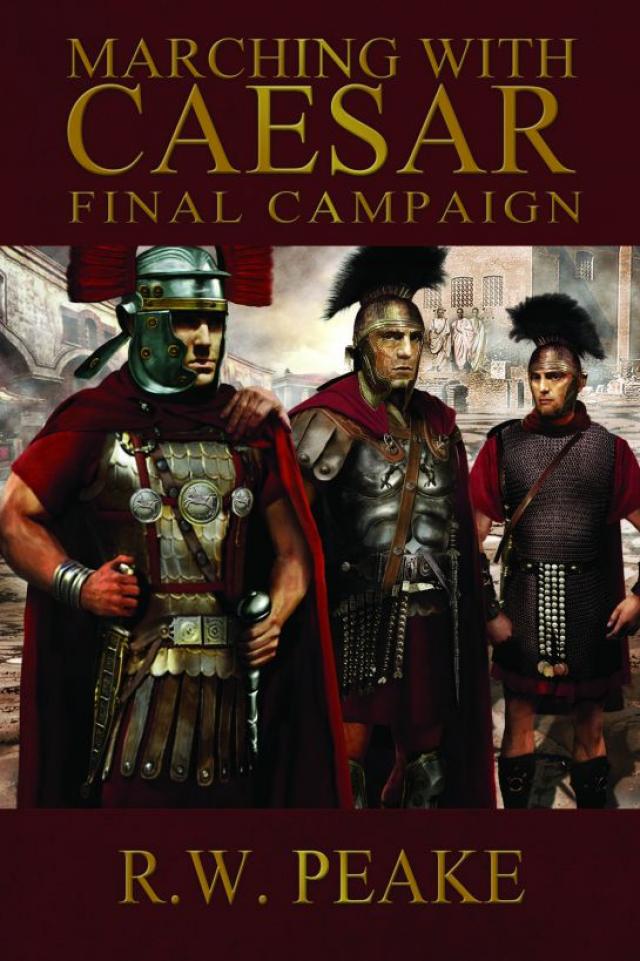
Marching With Caesar-Final Campaign, page 9


What was written on the vellum was the command to Marcus Primus to conduct a punitive expedition against the Thracians. It did say that it was preferred that it be the Triballi, but any tribe of Thrace would suffice; at least that was the essence of the order. I examined the document carefully, yet I could see no signs that it had been altered, but my examination was not thorough. Affixed to the bottom of the document was the seal of a sphinx, the unmistakable emblem of Octavian that he had been using for many years by this point. From what I could tell, the document appeared to be genuine, and while not a clear-cut exoneration of Marcus Primus, it was ambiguous enough in its wording that I knew I had no chance of impeaching Primus for overstepping his authority. For a fleeting moment, I regretted not bringing Scribonius, because I was sure that if there was a flaw in this document, he would have spotted it. But it was too late, and I struggled to keep my face composed when I handed the scroll back to Primus, who made no attempt to hide his smirk.
“Are you satisfied now, Prefect?”
I swallowed hard, but kept my voice even and under control. “Yes, Praetor. And I apologize for questioning you.”
Primus actually looked surprised at the apology when he took the scroll back.
“Well, thank you for that, Prefect.” He tried to sound magnanimous, I will give him that, but he failed miserably.
He looked around at the others, and I was somewhat reassured that only Masala looked like he was enjoying the spectacle.
“And now that’s settled, perhaps we can continue on the march tomorrow? To Serdica?” Primus was smiling when he spoke, but it was not a pleasant smile and, with a sinking feeling, I knew that this fat little man would not be satisfied with this victory.
“Of course, sir. Again, I apologize, but I had to be sure.”
Primus addressed the others, waving the scroll. “Does anyone else wish to question my authority and orders?”
Understandably, nobody stepped forward. Turning back to me, Primus said the only sensible thing that night. “It’s been a long and trying day. I suggest that we all turn in and get a good start in the morning.”
Along with the others, I rendered Primus a stiff salute before turning about and filing out with the others. Once we were out of the tent, both Macrinus and Flaminius called to me.
“What was that all about?” Macrinus asked, but before I answered, I looked about carefully.
The Tribunes were heading off to their tent a short distance away and were just out of earshot. However, to be safe, I motioned to the two Primi Pili to follow me farther away from the Praetorium. Since it was shortly past midnight, the camp was essentially deserted except for the men walking their posts. However, we were in uniform and had nothing to fear about being challenged. Once we were where I deemed it safe to talk, I explained to them the cause of their summons to the Praetorium. When I was finished, neither man spoke for a few moments, trying to digest all that I had told them.
Finally, Macrinus said, “So in the end, you risked your ass for nothing.”
I did not like the way Macrinus put it, yet there was really no arguing the point.
“I didn’t think he had received a written order from Augustus,” was my only defense.
“Do you think it’s genuine?” Flaminius asked, and that was the nub of it.
“Honestly, I don’t know. It looked genuine enough, and it had the seal affixed to it, but I didn’t have time to sit down and go over it closely. What I find suspicious is why he needed the extra time before he showed me the order. If he had it all along, why wait?”
Macrinus and Flaminius considered this for a moment. Then Flaminius cleared his throat in a way that suggested he wanted to say something. When I glanced in his direction, even in the darkness, illuminated only by a nearby torch, I could see he was looking distinctly uncomfortable.
“What is it, Flaminius?”
The Primus Pilus did not answer immediately, his eyes shifting from me to Macrinus, and I quickly lost patience.
“If you have something to say, spit it out.”
“Er, it’s just that I wanted to ask you a question, but I don’t want you to think badly of me when I do.”
Mystified, I promised him that I would not hold anything he said against him.
“Before I joined the Legions,” he said, looking everywhere but at me or Macrinus, “I was learning my father’s trade. Then I decided it wasn’t the life I wanted, so I joined the Legions.”
“That’s a very touching story.” I did not hide my sarcasm. “But I’m not sure exactly what that could possibly have to do with what we’re talking about.”
“He was a forger,” Flaminius said quietly.
For a moment, I thought my eyebrows would make it all the way up to my hairline and I could see Macrinus was no less surprised.
“Go ahead,” I urged him, now that I understood the significance of his words.
“You said that the letter appeared genuine? That it hadn’t been written over?”
I nodded.
“And that it had the seal on it?”
“Yes, yes.” I was getting impatient. “That’s what I said.”
“Well, my old tata showed me how to lift a seal off an original document and transfer it to another,” he explained. “He always said that it was the hardest kind of fake for a man to spot, even when he was looking for it. Do you remember what the seal looked like?”
“It was Augustus’ seal,” I replied. “That much I’m sure of.”
Now it was his turn to become impatient.
“That’s not what I’m talking about. I’m talking about the seal itself. Did you notice any flaking around the edges of where it was affixed to the vellum?”
I thought hard, but could only shake my head in answer. “Not that I noticed.”
“What about different colors? Sometimes when the seal is lifted from the original document, the forger has to use a little extra wax to affix it to the new document. They use as little as they can get away with, but if they did that, it would look like it had a very narrow ring around the outer edge.”
Something in his description jarred my memory, but it was not definitive enough for me to say anything other than, “I think I saw that.”
“You think?” Flaminius sounded very disappointed, though not any more than I was.
“I can’t be sure,” I snapped, instantly regretting taking out my ire on Flaminius, who was only trying to help. “I'm sorry, Flaminius. This isn't your fault in any way. I wish I could definitely say that I saw the different color ring that you refer to. I think I did, but I can’t be sure.”
“That’s probably what they did then,” Flaminius explained. “That’s why Primus needed the extra time, to transfer the seal from one document to the other. Copying out a set of orders that says what he wants it to say is easy. And as you said yourself, it doesn’t matter that it’s not in Augustus’ hand.”
“With all respect, Prefect, I think Primus outfoxed you,” Macrinus put in.
I glared at him, not appreciating his statement of what I knew to be obvious.
“Thank you for that, Macrinus,” I said acidly. “Do you have any ideas about how I can prove that the orders are forged?”
“No.” He sounded defeated. “I think we're going to march to Serdica, and we’re going to kill whoever we find there. The only good part is that if it does turn out that those orders were forged, I wouldn’t give a brass obol for Marcus Primus’ future.”
“But how many men have to die before that happens?” I asked grimly.
I saw Macrinus shrug in the darkness.
“There’s only one way to find out.”
Scribonius listened to me describe the meeting and the conversation afterward with Flaminius and Macrinus. When I was finished, Scribonius wasted no time.
“I think Flaminius was right. It’s the only thing that makes sense when you take into account the delay. And I also think Macrinus is right in that Primus has gotten the upper hand and your best course right now is to keep your mouth shut and lay low.”
I sat listening, saying nothing.
When he was finished, all I could say was, “You’re right. They’re right. And I'm going to do what you suggest. I just have to face the fact that Marcus Primus beat me.”
Scribonius gave me the kind of indulgent smile that a parent gives to a wayward son who has done wrong but is still loved.
“Oh, Titus,” he sighed. “Not everything is a fight that you win or lose. And I'd say it’s much too early for you to concede defeat. This is a setback, nothing more. You just need to be patient.”
“When has that ever happened?” I could not help but laugh at myself, or more accurately at the thought of me showing anything resembling patience.
Of all my flaws, this one has cost me the most dearly over the years and, still in my fifties, I could not honestly say I was much more patient than when I was twenty.
“There’s always hope,” I heard Diocles mutter as he tried to ignore our conversation and get some sleep.
“Shut up, you little pederast, or I’ll make you wish you had never opened your mouth,” I growled at him.
He made a huffing sound and flounced about on his cot, but said nothing further. With nothing left to discuss, Scribonius excused himself and I retired for the night, my mind full of thoughts that kept me up for quite a while.
Much to my surprise, Marcus Primus did not choose to rub his victory in my face; in fact, it was never mentioned for the rest of the campaign, at least by the Praetor. Later, I would learn that this was due to Masala’s influence, it being much stronger than I had ever suspected. We continued the march, reaching the imaginary line that marked the border between Macedonia and Thrace, with the Strymon (Struma) River to our left, and the base of the Rhodope Mountains, the range that ran on a north-south axis and guarded the Thracian border to our right. In between these two obstacles is a narrow gap, perhaps five miles across, with a thick stand of trees along the riverbank on one side, and more trees covering the lower slopes of the mountains on the other. In other words, it is a perfect spot for an ambush. Even with our scouts having seen no signs of any large-scale movement by Thracians of any tribe, either by tracks or dust clouds, I still wanted to be cautious when we essentially crossed into enemy territory. Making a halt a couple of miles short of where we estimated the border to be, I ordered the men to don their armor, including helmets, and to uncover their shields, but keeping them slung. One could hear the groans all up and down the column, yet I was adamant. Marcus Primus made a fuss just like the men; I found it ironic that for once he and the men were in accord about something.
“Is this really necessary, Prefect?” Primus whined.
I knew that he dreaded the thought of donning the armor he had once been so proud of, since it was a hot day.
“It’s only necessary if something happens,” I responded. “And given what happened to start this campaign in the first place a few years ago, I'd rather the men be a little uncomfortable.”
Primus stuck his lower lip out, but did not argue further. The men put their armor on and we resumed the march, but we passed through the gap without incident. Despite this, I did not allow the men to doff their armor, informing the Primi Pili and Tribunes in charge of the other forces that we would be marching in this manner for the duration. Again, the others did not particularly like hearing this. Nonetheless, I was firm in my order. We ended the day’s march a few miles inside the border of Thrace, meaning that the men constructed a full marching camp in enemy territory, with the ditches of Caesarian dimensions and a full watch. The scouts returning to camp reported their first signs of Thracian activity in the form of a relatively large group of horsemen, heading in our general direction.
“It’s undoubtedly a scouting party,” Macrinus opined.
I agreed, but until I laid eyes on them myself, I was not willing to take any action. The scouts’ estimate was that the party was about fifty men strong, all warriors, with spare mounts, strengthening the suspicion that the Thracians had been alerted to our presence and were looking for us. We had no way of knowing to what tribe these Thracians belonged, and I dreaded the thought that they would belong to someone other than the Triballi, or even the Serdi. The last thing we could afford was an all-out war with every Thracian tribe and, in my mind, this was the largest risk we ran. With only two Legions, a relatively small auxiliary and cavalry force, we could not hope to contend with a combined force of Thracians on their own ground. This was essentially a large-scale raid, where we had to rely on hitting hard and fast, then getting out before there was a mustering of a sufficient force of Thracians to wipe us out. At that particular time, it was estimated that all of Thrace could field almost 100,000 warriors; it would take a fraction of that force to wipe us off the face of the Earth. Every mile deeper into Thrace we went, the greater my foreboding grew that this was not going to end well, for any of us.
On the third day after we crossed the border, we left the banks of the Strymon (Struma), turning more to the northeast in the direction of Serdica. Shortly after we began the march that day, the Thracian scouting party showed itself, skylining themselves on a low ridge directly in the path of our line of march. There was the usual flurry of excitement whenever a potential enemy is first sighted, with men stepping out of the column to try and catch a glimpse, yet not staying long enough to attract the attention of their Centurion or Optio and a swat of the vitus. I had ordered Libo to keep two hundred troopers with the main body at all times, so now I called for him.
“Sweep those bastards off that hill,” I ordered. “We can’t stop them from watching us, but we don’t have to make it easy for them.”
Libo and the troopers immediately set off. I watched them pound past the vanguard and up the hill. The Thracians took one look at the oncoming troopers then immediately turned tail to vacate the ridge. When Libo and his men crested the ridge, I was struck by a pang of anxiety, realizing I had not specifically told the Tribune I just wanted him to disperse the Thracians and not pursue them. More times than I could count through the years, the cavalry had gotten themselves in trouble by being too aggressive, and it was a common tactic for an enemy of Rome to use that to their advantage. Of course, the Parthians are rightfully the most famous for this, seeming to retreat in disarray in order to lure a pursuing force away from the support of the main body before turning on them. I did not know that the Thracians used this tactic, yet it was an oversight on my part that I hoped Libo and his men would not pay for. Watching the skyline anxiously, I could only see the dust cloud churned up by the hooves of Libo and his men hovering just above the hilltop. Just when I was on the verge of rounding up Scribonius and the rest of the Evocati with us, despite the fact they were only about fifty in number, to go after Libo, I saw him cresting the hill with all of his troopers. I breathed a sigh of relief, but it was short-lived, as Libo came cantering up to report.
“There’s a large group of Thracians formed up on a hill about two miles away,” he said breathlessly. “And it looks like they plan on trying to stop us.”
Marcus Primus had come bouncing up in time to hear Libo’s report, and he let out a squawk of what sounded like surprise and fear.
“Already?” he gasped. “I wasn’t expecting them to muster a force for several more days.”
“Yes, it’s funny how the enemy refuses to cooperate sometimes,” I replied dryly, prompting a scowl from the Praetor.
Ignoring me, he turned to Libo and said, “You didn’t think to attack them and take them by surprise?”
Libo looked astonished, his face undoubtedly matching my own expression.
“Praetor, I’m not sure, but it looks like there are perhaps five thousand men gathered on that hill.”
“Five thousand Thracians,” Primus said scornfully, looking over to Masala for support.
Somewhat surprisingly, his aide looked similarly doubtful at the wisdom of the Praetor’s words.
“Surely they would have been surprised,” Primus protested. “You could have inflicted a great deal of damage, then gotten away. You are mounted, after all.”
“Oh, they would have been surprised,” I agreed. “They would have been shocked that we would throw men away so callously, without any hope of success. So yes, it would have achieved surprise.”
Primus’ face turned a deep red, but he did not reply. Without saying another word, he turned his mount and trotted away. After he had gone, I turned to Libo.
“Let’s go take a look.”
Indeed, as Libo had reported, the Thracians were arrayed on a hill across a small valley from the ridge that the vanguard was just at that moment ascending where we had first seen the Thracian scouts. Too far away to make out individuals, I still believed that Libo’s estimate of five thousand was close to the mark. Sitting astride our direction of march, we were now faced with a choice.
“Do we go around, or do we go through?” I wondered aloud, looking carefully at the surrounding countryside.