Marching With Caesar-Antony and Cleopatra: Part I-Antony, page 19


“In fact,” he continued, “if we can get them to do what we want, this may turn out to be one of the easiest victories you'll ever be part of.”
I shot a sidelong glance at Scribonius, taking comfort that he looked as doubtful as I felt about this claim, but we continued to listen.
“First, we need to entice them into trying to attack us up here, charging up this hill. There are a couple of major weaknesses with the cataphract, and that's their stamina and their lateral mobility. Those poor beasts are so burdened down with armor that if they have to charge more than a furlong at a gallop, they’re next to useless when they get there. Make them charge uphill, and it’s even worse for them.”
When explained that way, it did not seem nearly as outlandish that we could win a victory, but there was still a problem, and it did not take long for one of the other Primi Pili to raise his hand.
“General, how are we supposed to get them to charge like we need them to?” asked Caecina, Primus Pilus of the 7th.
“The men who are atop those huge lumbering beasts are all Parthian noblemen,” Ventidius replied. “Jumped-up bastards who think their cac doesn’t stink. You know, just like we Roman nobles.”
There was hearty laughter at that, helped by the fact that it was true.
“All you and your men need to do is prick that pride of theirs a few times. Talk about their mothers, talk about their wives and what you’re going to do to them after we whip these cocksuckers. Use your imagination,” he said with a smile, then turned serious. “But it’s absolutely crucial that you succeed in making them lose their heads as a group. Actually, you only need to get to a few of them; once a few of them start up the hill baying for our blood, the rest will follow.”
One of the marks of a good general is making his men believe, and by the time Ventidius had outlined the complete plan, we all walked out of the forum as believers in what we needed to do to achieve victory.
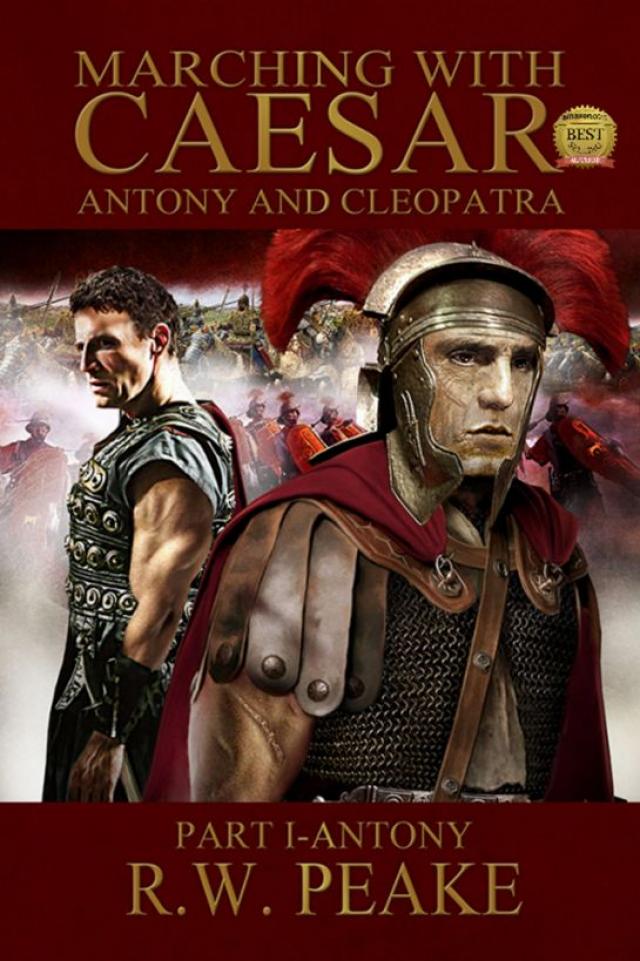
The next morning saw our men arrayed in front of our camp, facing down the hill towards where the Parthians had begun forming up. They had arrived at dusk the day before, not even bothering to make a proper camp, counting on Labienus to protect them from a sortie from our side. It took the Parthians the better part of the morning to prepare themselves as we watched what had to have been quite an ordeal getting the armor on the horses, each horse requiring at least two men to lift the blanket of armor plates onto the beast. The cataphract horse wears what is essentially a coat that covers his head all the way down to just below the knees, with little iron plates sewn into the blanket, each plate about two inches square, with less than a finger width of space between each one. The only spot uncovered by armor is where the saddle and rider sit; even the horses’ heads are covered with a hood. The riders are armored in a similar manner, while each man carries a ten-foot lance with a barbed iron tip, and wear helmets with cheekguards so broad that they almost completely obscure the face. They certainly did not seem to be in a hurry, but I suppose that moving with undue haste only serves to tire the horses out. Still, it was almost midday before the enemy horsemen were formed up, moving slowly past the camp of Labienus, his men doing much the same thing we were, lining the walls of their camp to watch their allies slaughter us, or so they hoped. Just on our side of Labienus’ camp, the Parthians drew to a halt to dress their lines, and I have to say that they were formidable looking, sitting so closely together that one could not see any space between horses and riders. I could just imagine how devastating it would be for such a densely packed formation weighing that much to come slamming into our lines, so I offered up a prayer that Ventidius’ plan worked. Once the Parthians settled down, it became clear that they had no intention of making the first move, sitting there and daring us to come charging down the hill at them.
“You know what to do,” I heard Ventidius bellow as immediately some of the men with the loudest voices began yelling at the Parthians.
“I still owe your mother a sesterce for the fuck last night!”
“Your father’s a pig!”
“After we kill you, I’m going to fuck your wife and your daughter!”
That was just starting out; as the men got into the spirit of things, the inventiveness of the taunts grew in leaps and bounds. At first, it seemed as if we were having no effect, but then someone found one of the prisoners from Labienus’ force who spoke Parthian. After some persuasion, he translated the insults we had been using into Parthian. The effect was immediate and dramatic; even with the atrocious mispronunciation we were obviously understandable to the Parthians, as suddenly there was a ripple of movement along the lines, with men turning to each other while gesturing to us. The tension of the men was communicated to their horses, many of them beginning to dance nervously about, the movement of the metal plates creating a shimmering effect from the sun. The beasts started tossing their heads, as if they too could understand what was being said about their riders, their families, and loved ones, and they were taking offense as much as the men sitting astride them. Then, one man suddenly spurred his horse forward, brandishing his lance at us while shouting something back.
“Your mothers are whores,” he shouted at us in heavily accented Latin, but instead of making anyone angry, it just caused hoots of derisive laughter.
“Tell me something I don’t know,” someone called out. “But at least she’s worth it, unlike yours.”
“My mother is dead, you Roman bastard,” the man roared.
“Well, at least that explains why she smelled so bad and just lay there,” our man shot back, eliciting an enraged howl from the Parthian.
The men behind him called out to him, whereupon he turned back to say something to his friends, who let out a roar. Suddenly, without the sound of horns or any other obvious command, that first small group of Parthians charged, quickly followed by the rest of them.
“Here they come, boys,” Ventidius called out. “You know what to do.”
Despite appearances, only a small fraction of the army was in the formation facing the Parthians. The rest of us were gathered in the camp on either side, where a number of men were standing with ropes whose other end was tied to a section of rampart stakes, each stake loosened from the dirt. On a blast from the bucina, the men yanked the ropes, pulling the stakes out of the way, then we went boiling out over the rampart and into the ditch where bundles of sticks and other debris had been thrown to fill it up to a level that was not visible to the Parthians, yet allowed us to cross the ditch quickly without having to pull ourselves up and out of it. The Parthians did not see us immediately; between the angle of our approach and the fact that their helmets seriously hindered their peripheral vision, we were able to close to less than a hundred paces on each side before we were noticed, first by just the Parthians on the fringes of their formation. Even after they spotted us, the momentum created by the mass of horseflesh each man was astride was such that they could do little more than watch helplessly as we darted in among them, ducking underneath their mounts while stabbing upward into the horses’ bellies with our short, killing swords. For this was the second part of Ventidius’ plan, to ignore the men and kill their horses, knowing that there was one chink in their armor, one place where there were no plates to block the thrusts of our swords. After all, who would be brave enough or stupid enough to essentially throw themselves under the pounding hooves of these massive killing machines? But that is exactly what we did, descending on both flanks of the Parthians who had already begun to slow as their mounts started laboring from being whipped into a full gallop up a hill that was dotted with stumps of trees, making it even more dangerous for them. The air was rent with the screams of horses in agony, still one of my least favorite sounds, and I was thankful that because of my size, I was not expected to participate in what was rapidly turning into a one-sided slaughter. Instead, I concentrated on finishing the men thrown from their mounts as my men disemboweled the poor beasts; at least those Parthians who managed to jump free and were not crushed under their collapsing horses. The surprise was total, and the ground was soon heaped with the bodies of men and horses as the air filled with the stench of offal from our men savaging the Parthian mounts. There was the familiar buzzing sound of our slingers, who were concentrated on the wall with the orders to aim their missiles into the center of the mass of Parthians, the idea being that even if the lead shot was not potent enough to puncture their heavy armor, at the very least it would give them something to worry about as we pressed in from either side. However, it became clear very quickly that the missiles were much more effective than we imagined, punching through the armor plating, then becoming deformed from the impact, turning into jagged pieces of death that tore into flesh, causing horrible wounds. The screams of the men and horses targeted by the slingers added to the din, becoming so loud that none of the Centurions could be heard when they shouted orders. Fortunately, the men, once they knew what needed to be done, required little direction as they weaved in and out between the thrashing hooves and the ineffectual downward stabs of the Parthian lances, our men thrusting upwards over and over. It was incredibly messy; few of the men were quick enough to leap out of the way of the falling guts of the horses, so before much time at all had gone by, every one of them was covered black with blood and other matter. I tried to be careful where I stepped, as I moved among the still-steaming carcasses of horse and man, looking for survivors to finish but quickly giving up. Before long, I was as filthy as the men from mid-thigh down. This was not a battle, it was a slaughter, one that took less than a sixth part of a watch to complete. The Parthians in the rear ranks, once they saw what was happening, tried to wheel about to gallop down the hill, but the combination of tree stumps and the bodies of their comrades made them easy targets for our more nimble men to run down. These Parthians were pulled from their saddles from behind, our men leaping astride the back of the horse, then grabbing the rider around the neck, stabbing with their swords. I noticed that men were no longer trying to kill the horses, and I have to believe that they were as tired of killing defenseless animals as I was seeing it. A few Parthians managed to escape, streaming down the hill, the tails of their horses flying as their riders whipped and spurred them mercilessly, intent on nothing more than staying alive a few moments longer. Labienus, seeing what was happening from his camp, seemed to be the only man to keep his head, sending perhaps two Cohorts’ worth of men out to form a line in front of their camp, the men opening their ranks to let the fleeing Parthians through, then closing back up to wait for us.
Those two Cohorts enabled Quintus Labienus to escape with the rest of his force, except for the two Cohorts left behind, who paid for their effort with the lives of every last one of them as, with the advantage of our uphill momentum, we slammed into them at full speed. These men had been trained to fight in the Roman manner, but they were not Roman, so it did not take long for the first of them in the rear ranks to take that step backwards, sealing the fate of the entire force. However, they did manage to buy Labienus enough time to lead his army into the heavily forested flanks of the mountain slope that led down southwards to Tarsus, forcing our Galatian cavalry to abandon trying to run them down, since sending horsemen into the woods after infantry is essentially the same as ordering the entire force to fall on their own swords.
I stood watching as the rearguard of Labienus’ force made the cover of the trees, the Galatians pulling up short, waving their weapons while shouting curses at the backs of the retreating enemy. I was panting for breath, my legs shaking from the all-out exertion of the last third of a watch, and this was another moment that I still acutely remember to this day as one where I realized that I was getting old. I had just turned 38 years old a few weeks before, and there was a healthy amount of gray in my beard, though it had yet to show up in my hair. As I tried to catch my breath, I turned to look up the hill, the sight so striking that I let out an exclamation that caused the men around me to turn and look at me with some concern. Balbus came trotting up, asking me what was wrong. Not wanting to speak and betray that I was still out of breath, I merely nodded my head up the slope. He turned, then let out a low whistle.
“I don’t think I have ever seen anything like that before,” he said.
I did not reply, but neither had I. The slope all the way up almost to the edge of the ditch of our camp was completely covered with bodies of men and horses. They were in heaps, packed so tightly that only if I looked very carefully could I see a few patches of open ground. Sticking up at odd intervals were stumps of some of the trees we had cut down to construct the camp, except every one of them was covered in blood, or worse. There were ripples of movement as men walked among the bodies, alternately looking for signs of life, which they would end with a quick thrust of the sword, then bending over to search the bodies of the dead Parthians for loot. As I watched, I noticed that men were going to the horses that still lived first, reinforcing my suspicion that they were as sickened by the slaughter of the animals as I was. My wind finally returned, so I began directing the men in cleaning up our part of the field, ordering them to drag the bodies of Labienus’ dead into the ditch of his camp, then walked up the hill to find Ventidius to receive further orders. I had to wade through the gore to get there, while I stopped a few times to put a horse out of its misery, but I did not bother with any Parthians, partially because I knew that the rankers would take care of them, and also because I wanted them to suffer.
The decision was made to abandon our camp to set off in pursuit of Labienus, leaving the bodies to the elements and the animals. Our losses were incredibly light; a few men had been slow moving among the horses and suffered a crushed skull, but other than those deaths, there were mainly bumps and bruises. The 10th lost four men in the fight with Labienus, with another half-dozen wounded, only one serious, and he died within a day. The next morning, we set out in pursuit, moving quickly down the slope of the mountains north of Tarsus. When we arrived there, the place was in a shambles from the previous two years’ of occupation by the Parthians, so Ventidius was forced to call a halt and take command.
In Tarsus, we learned that Pacorus had not been with his Parthians when we slaughtered them, and according to some reports, still commanded a considerable force. Ventidius ordered Silo to press on with cavalry, instructing him to block Labienus’ retreat to hold him in place while we marched to meet him. We were in Tarsus for more than a week before Ventidius considered the situation stable enough for him to leave. A day into our march, the traveling much easier because we were moving along the coast on a good Roman road, Silo sent word that he had pinned Labienus down by taking the pass known as the Syrian Gates, the only way into Syria from that direction.
We came upon Labienus, along with about a thousand cataphracts left over from the slaughter at the Cilician Gates, trapped between Silo’s cavalry up in the pass and our own force. We did not even bother making camp, grounding our gear while leaving a Legion to guard our baggage train, moving into battle array with only a short break to catch our breath. For reasons I did not understand, Labienus chose to come out from behind the rampart of the camp he had built, facing us, while the cataphracts faced their rear, looking up the slope of the pass at Silo and the Galatians. Perhaps he was just tired of being chased and decided to risk all on one throw of the dice, but if so it was a terrible choice to make because he was heavily outnumbered. His men did put up a ferocious struggle, fighting with the courage of warriors who knew that their fate was sealed and were determined to take as many of us with them as they could. However, being trained by a Roman and being a Roman are not the same thing; it takes a lifetime to be a Legionary worthy of the name. While we were engaged, the Parthian cavalry made a last desperate attempt to break through Silo’s blockade, but the heavily armored horses of the Parthians had the same problem as at the Cilician Gates in making the charge uphill. Normally, one of those cataphracts was more than a match for two, or even three of the Galatians, but not ten of them, as Silo and his men swarmed around each Parthian like so many dogs around a bear, waiting to dart in at the right moment. At least I assume that was what was happening, since we were busy in our own right. We pressed in and around Labienus’ men as their numbers dwindled, cutting them down without letup, with the battle over in less than a full watch.
Sometime in the confusion, Labienus escaped with a few of his bodyguard. Men began trying to surrender, and while we had been ordered to take prisoners that would march in Ventidius’ triumph, it took some time to get the men to obey. Although our losses were heavier than at the Cilician Gates, they were still laughingly light, although my Princeps Posterior Celadus had a serious wound to his thigh that consigned him to the wagons for a bit, while the Hastatus Prior in Trebellius’ Fifth Cohort was killed by a sword thrust through the mouth. We spent the next two days in place resting and taking care of the dead and wounded before pressing on through the Syrian Gates and on to Damascus. At Damascus, we learned Pacorus had retreated up into Mesopotamia and indeed had not been present at the last battle. That meant Labienus and Pacorus were still on the loose and posed a threat, but since it was late in the season Ventidius made the decision to settle the army into winter camp a month earlier than normal, splitting us between Antioch and Damascus, with Silo in command in Damascus. We were assigned to camp outside Damascus, and when the announcement was made that we would be staying put, I was certain that the cheers could be heard all the way back to Rome. Damascus is a legend throughout the army for being the fleshpot of the East, where any vice can be indulged as long as a man has enough coin to pay for it. Despite the men’s eagerness to test this belief to the fullest, I was equally determined to avoid a repeat of the episode with Tetarfenus, so I held a meeting with the Centurions, informing them that the men were to be held under a tight rein during our time in Damascus. I was pleasantly surprised that there was no argument, even from those men who I could normally expect some sort of bickering about my decision. I suppose that Tetarfenus was on their minds as well.