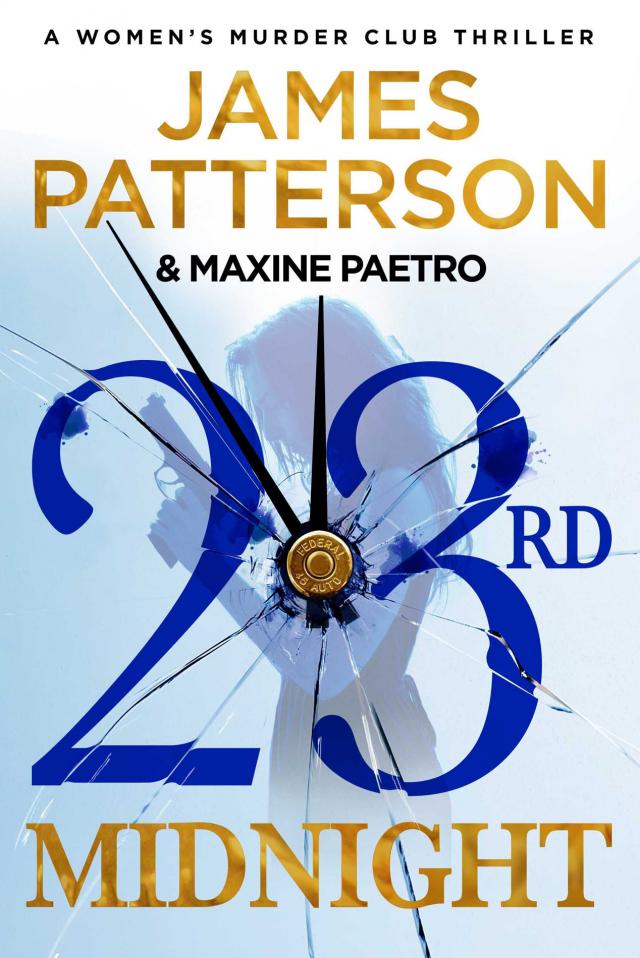
23rd Midnight, page 1
part #23 of Women's Murder Club Series


About the Authors
JAMES PATTERSON is one of the best-known and biggest-selling writers of all time. His books have sold in excess of 400 million copies worldwide. He is the author of some of the most popular series of the past two decades – the Alex Cross, Women’s Murder Club, Detective Michael Bennett and Private novels – and he has written many other number one bestsellers including standalone thrillers and non-fiction.
James is passionate about encouraging children to read. Inspired by his own son who was a reluctant reader, he also writes a range of books for young readers including the Middle School, Dog Diaries, Treasure Hunters and Max Einstein series. James has donated millions in grants to independent bookshops and has been the most borrowed author in UK libraries for the past thirteen years in a row. He lives in Florida with his family.
MAXINE PAETRO is a novelist who has collaborated with James Patterson on the bestselling Women’s Murder Club, Private and Confessions series, Woman of God, and other stand-alone novels. She lives with her husband, John, in New York.
A list of titles by James Patterson appears at the back of this book
James Patterson
& Maxine Paetro
* * *
23RD MIDNIGHT
Contents
PROLOGUE: MONDAY ONE
TWO
THREE
TWO DAYS EARLIER CHAPTER 1
CHAPTER 2
CHAPTER 3
CHAPTER 4
CHAPTER 5
CHAPTER 6
CHAPTER 7
CHAPTER 8
CHAPTER 9
CHAPTER 10
CHAPTER 11
CHAPTER 12
CHAPTER 13
CHAPTER 14
CHAPTER 15
CHAPTER 16
CHAPTER 17
CHAPTER 18
CHAPTER 19
CHAPTER 20
CHAPTER 21
CHAPTER 22
CHAPTER 23
CHAPTER 24
CHAPTER 25
CHAPTER 26
CHAPTER 27
CHAPTER 28
CHAPTER 29
CHAPTER 30
CHAPTER 31
CHAPTER 32
CHAPTER 33
CHAPTER 34
CHAPTER 35
CHAPTER 36
CHAPTER 37
CHAPTER 38
CHAPTER 39
CHAPTER 40
CHAPTER 41
CHAPTER 42
CHAPTER 43
CHAPTER 44
CHAPTER 45
CHAPTER 46
CHAPTER 47
CHAPTER 48
CHAPTER 49
CHAPTER 50
CHAPTER 51
CHAPTER 52
CHAPTER 53
CHAPTER 54
CHAPTER 55
CHAPTER 56
CHAPTER 57
CHAPTER 58
CHAPTER 59
CHAPTER 60
CHAPTER 61
CHAPTER 62
CHAPTER 63
CHAPTER 64
CHAPTER 65
CHAPTER 66
CHAPTER 67
CHAPTER 68
CHAPTER 69
CHAPTER 70
CHAPTER 71
CHAPTER 72
CHAPTER 73
CHAPTER 74
CHAPTER 75
CHAPTER 76
CHAPTER 77
CHAPTER 78
CHAPTER 79
CHAPTER 80
CHAPTER 81
CHAPTER 82
CHAPTER 83
CHAPTER 84
CHAPTER 85
CHAPTER 86
CHAPTER 87
CHAPTER 88
CHAPTER 89
CHAPTER 90
CHAPTER 91
CHAPTER 92
CHAPTER 93
CHAPTER 94
CHAPTER 95
CHAPTER 96
CHAPTER 97
CHAPTER 98
CHAPTER 99
CHAPTER 100
CHAPTER 101
CHAPTER 102
CHAPTER 103
CHAPTER 104
CHAPTER 105
ACKNOWLEDGMENTS
Dedicated to our friends and fans of the Women’s Murder Club. This book’s for you.
Prologue
* * *
MONDAY
ONE
AT DAWN THAT morning, a man dressed entirely in black nosed his gray Ford sedan up to the curb on Taylor Street. To the east, the morning sun struggled to rise through the clouds over San Francisco Bay. It was still dark but the man, who was now in “Blackout” mode, knew this street as well as he knew his own mind.
He cut his headlights, released the trunk latch, lowered the seat back a few inches and adjusted his video glasses in the rearview mirror. With his unobstructed view of Victorian row houses and the wooden staircase across the street, Blackout waited for Catherine. She was always on time, one of the many things he liked about her.
At twenty-five, Catherine Fleet was a beautiful mother of a baby girl named Josephina, and an integral part of the masterwork he was creating. He wished he could talk with her about it, but there wouldn’t be time. She was leaving her house on Leavenworth now. She would turn down Macondray Lane, the quarter mile of footpath that ran downhill and at a right angle to Taylor.
The lane parted a smattering of trees and hugged the walls of the large homes until it merged with the wooden staircase that ended only yards from the rear of Blackout’s stripped-down cop car.
Catherine would pause there, Josie strapped into her front-facing carrier, and together they would take in the magnificent view of dawn breaking over San Francisco Bay. Moments later, she would head south to Ina Coolbrith Park for their morning walk.
As he rounded off that thought, Blackout saw a flicker of movement in his rearview mirror. Catherine was halfway down the staircase, as regular as a metronome. Her unbuttoned dark coat revealed a garnet-red, snowflake-patterned sweater over dark pants. Her long, dark hair spilled over her shoulders and floated around the redheaded baby’s ears.
Perfect. She was perfect.
Blackout secured his video glasses, worked his gloves over his large hands, and got out of his car. In only a dozen strides he’d reached the foot of the staircase. Catherine looked down briefly, gripping the banister, giving the good-looking young man a brief smile.
Blackout smiled back, took the first two steps upward, snagging the toe of his shoe on the third. As he’d calculated, he tripped and fell facedown spectacularly, sprawling with his arms spread like a large broken bird.
She called out, “Oh, my gosh. Are you all right?”
“I, uh, don’t know,” he said. “I think I slammed my knee on the edge of the riser …”
Blackout was awkwardly working himself up into a crouch when Catherine reached him.
“Can you stand up?”
The concern in her voice sent a wave of pleasure through him as he looked up into her blue eyes, the irises rimmed with gold halos. The baby was awake, beating her fists against the air.
“I’m good,” said Blackout. “Embarrassed, is all. I try to impress with finesse.”
Catherine laughed, saying, “Forget it ever happened,” never seeing the small vial Blackout had secreted in his clenched hand. Called “Down Dog,” it was an inelegant name, but it got the job done. He aimed the sprayer at Catherine Fleet’s golden blue eyes and thumbed the lever.
Her reaction was instant, sharp, pained. She cried, “What did you do?” She sat down hard, tearing up from the pepper spray and palming her eyes. The baby girl was gulping air, exhaling wails that could be heard through brick walls.
Blackout had to move fast, before someone else came down the stairs on their way to the park. He scrambled up and got behind Catherine, cradled her lovely neck between his forearm and biceps. She could barely draw breath, gasping, “Don’t. Hurt. My baby.”
“Don’t worry. She’s in good hands.”
Catherine tried to push off the step, to get away from him, but Blackout held her in place and spoke gently to her as he squeezed.
“Don’t fight me, Catherine. It’ll be all over soon. Shhh, shhhh. I’ve got you.”
In fifteen seconds, Catherine was unconscious. In forty seconds, a woman who’d been at the peak of life was dead. But the baby was wailing.
Blackout assessed their combined weight at a hundred and twenty pounds. He checked in all directions. They were alone. He gathered up mother and child and carried them twenty yards to his car’s unlatched trunk.
He stowed them without trouble and was reaching inside to kill the baby, when a man’s voice called out.
“Pardon me. Do you need some help there?”
TWO
BLACKOUT TURNED TO see a jogger in shorts and a tennis shirt materialize in the gloom, coming slowly toward him. He had seen him before, a man in his seventies, stiff, arthritic, now winded from climbing the hill out of the park.
“We’re fine,” Blackout shouted back. “We’re all fine.”
The jogger’s expression showed confusion, then, as the baby’s cries filled the air, the old man put it all together. And he held up his phone.
He shot pictures, then turned and ran surprisingly fast back down the hill, with his phone clapped to his ear. He was calling 911. Had to be. He had pictures on his phone. Of him. Of his car. Maybe he’d gotten an angle on his plates and the contents of the trunk.
The baby was shrieking.
There was no time for rage. Blackout covered the baby’s mouth and nose with his large gloved hand until moments later the baby had stopped breathing. Then he dragged blankets over the two dead bodies. Slamming the trunk lid closed, he surveyed the field with a chopper gunner’s eyes, tipping the street toward him and dividing it into a grid.
The jogger was sixty feet away and gaining downhill speed. Farther down the block, near the Victorian row houses, an impatient woman yanked on the leash of a small, prancy dog before disappearing through a doorway.
And now, the sun was burning off the cloud cover and pinking up the sky. Blackout slid into the driver’s seat and backed his old Ford into a K-turn. Straightening out, he touched his foot to the gas. He trailed behind the old man for a moment before darting around him, braking suddenly, blocking him in. The old man faltered, dodged, then made for the space between two parked cars.
Blackout reached for the weapon lying on the passenger seat. A stun cane. He grasped it, exited his vehicle, and using the stick as a bat, he swung and connected with the back of the old man’s head. The jogger fell against a parked van then slumped to the street. He cried out weakly, but the sound didn’t carry.
The phone had jumped from the jogger’s hand, skidded a few yards downhill. Blackout walked over and crushed it with his heel, then uncapped the stun cane.
The jogger was weeping, helpless. He couldn’t stand.
Blackout looked down at him and carefully placed the business end of the stun cane against the jogger’s throat.
He spoke in a soothing voice, “What’s your name?”
The old man pushed futilely at the stick. His face was red. Tears spilled down his cheeks.
“Don’t,” he said. “I didn’t see anything.”
“I said, ‘What is your name’?”
He wheezed, “Jay. Cob.”
“Jacob. Got it. You took pictures, buddy. Big mistake. Hang on for the thrill of your life.”
Blackout pulled the stun cane’s trigger, sending a million volts into the old man’s body, enough to light up the entire block. He knew that the human body could only absorb one percent of a charge that strong, but that plus the current knocked the old man out and with luck, stopped his heart.
But no. The old man blinked his eyes. His mouth moved.
The sky was brightening and Blackout had no more time for this. Back in his car, he pulled the classic Ruger Mark IV, complete with suppressor, from his glove box. He walked back to the old man and aimed the gun point-blank at his forehead and fired it. Then put two more in his chest.
With his back to the many-windowed houses on Taylor’s west side, Blackout picked the SIM card out of the litter of Jacob’s broken phone. He tossed the stun cane back into his car and took the driver’s seat, returning the gun to the glove box. The engine was still running and now Blackout allowed elation, that precious, elusive feeling, to fill him up. He heard in his deep and heaving breaths, the soundtrack of his life.
He made a mental note to freeze frame on the bullet hole in Jacob’s forehead. Fade to black.
And then he headed the car downhill.
Blackout still had a lot of work to do, of the most important kind.
THREE
AS HE DROVE at the residential speed limit of twenty miles an hour, Blackout’s immediate plan had been to get off Taylor as fast as he reasonably could. He had taken the first right at Green, then turned up onto Leavenworth, passing the house where Catherine and Josie Fleet had lived.
A man he recognized as Catherine’s husband, Brad Fleet, had been coming down the front steps. He’d looked both ways and, not seeing his wife and daughter, had no doubt assumed that Catherine and Josie were still in the park. Poor bastard.
As police cars, sirens screaming, could be heard on the street below, Blackout proceeded to the location for his most important scene.
Now, hours later, safe at home, he thought how long that drive had seemed with the woman and baby tucked away inside the trunk. And he’d had a few thoughts about the senior citizen who’d seen too much, lying dead on Taylor between two parked vehicles.
He’d charged up his video glasses in the car as he drove and later, filmed the perfect ceremony for his victims—without interference. He’d felt peaceful. Reverent.
That part, the end of their story, was one long four-minute shot that might be even more bittersweet with music. Something classical, he thought. Albinoni’s “Adagio in G Minor.” Better yet, Ravel’s Pavane for a Dead Princess. Yes, that was more appropriate, a fitting homage to a killer he’d often thought of as a teacher, almost a friend. He was sure his mentor would like the results of the day’s work and pictured him now: a superior executioner confined to a cell at San Quentin. A man named Evan Burke.
TWO DAYS EARLIER
CHAPTER 1
CINDY THOMAS SAT in the back seat of a Lincoln Town Car heading toward Book Passage in Corte Madera. It was Saturday afternoon, the first stop on her book tour, and she had every reason to be excited.
It had been a whirlwind since she’d sold the project. Given the hot subject matter, her publisher had accelerated the production schedule to push out finished copies in record time.
Prepublication reviews had been outstanding. Industry buzz had it that her book could hit number one on the New York Times Best Seller list. If that came to pass, it would be an honor and a miracle, but she wasn’t feeling the buzz, not even close.
In the course of writing Evan Burke’s authorized biography, she’d been repeatedly shocked by Burke’s ruthlessness, the pleasure he took in killing. Unable to wall herself off from the sickening details of his crimes, Cindy had come to know Evan Burke too well. And that knowledge had changed her.
Cindy held the book in her lap tightly with both hands. She flipped it over to look again at Burke’s photo on the back cover. He looked ordinary: A white man with an unlined face and a full head of hair who could be anywhere from his fifties to his seventies. He’d had work done, too, getting his face sculpted and chemically abraded. That rolled back his age by ten to twenty years. His brown eyes looked kind. But Evan Burke had never felt kindness. He was a psychopath, a serial killer who’d racked up over a hundred murders before he was finally caught in the act.
Injured in a shoot-out with police, he’d been arrested, hospitalized, and charged with murder in the first degree.
That should have been a full stop, the end of the story, but Evan Burke’s narcissism couldn’t be stopped. While still being treated for his injuries, cuffed and shackled to a hospital bed, he’d asked to see Cindy Thomas, star crime reporter with the San Francisco Chronicle.
Cindy hadn’t known that Burke was a fan of her work, but he’d told her that he read her column daily and that she would be famous one day. She had gone to the hospital hoping for a quote, and he’d pitched his big idea.
“I want to cement my place in history. What do you say, Cindy? Let’s write a book together.”
An investigative reporter with an earlier true-crime book to her credit, Cindy remembered being a little dazed in Burke’s presence.
It was only later, after she’d seen his vision of a compelling read that would showcase her talent and boost her career, that she’d said, “Okay,” to his proposal and even “thank you.” Evan Burke would savor his standing in the serial killer Hall of Fame from his cell in solitary confinement.
Early into this agreement with Burke, she’d changed the original title from Evan Burke’s Last Stand to a new one: You Never Knew Me: The True Story of Evan Burke, “The Ghost of Catalina.” Bob Barnett, Cindy’s agent and lawyer, had said, “Great title. Very selling. Your name goes first.” That’s how Cindy Thomas became Evan Burke’s confidante, coauthor, and conduit to the world beyond San Quentin State Prison.
Now, holding the finished product, the book looked small when compared with Burke’s hellacious crime spree. He confessed to a half dozen murders and helped law enforcement crack multiple unsolved serial killings in exchange for his demands, namely TV, a no-Wi-Fi laptop, a radio, and private time in the shower. And he wanted an attorney-client room where he could meet with her.
And that’s how Evan Burke got monthly access to Cindy’s previously wide-open and very fertile mind.