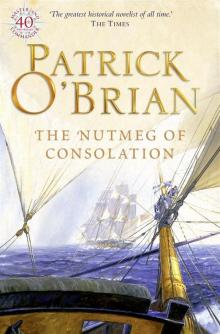
The Nutmeg of Consolation, page 7



'Is his name Maturin?'
'I am ashamed to say I did not catch it, sir: he was in quite a passion by the time I reached the hall. A small slight pale ill-looking man.'
'Desire him to walk in, and cancel my engagements with the Dato Selim and Mr Pierson.' He put his drawing-board, watercolours and orchid carefully to one side and pressed the well-worn knob on his clock; as the door opened he hurried forward crying 'My dear Maturin, how very happy I am to see you! We had given you up for lost. I trust you are well?'
'Perfectly well, I thank you, Governor; only a little ruffled,' said Stephen, whose face was indeed somewhat less sallow than usual. 'The sergeant offered me fourpence to go away.'
'I am so sorry: almost all the people have been changed. But do please sit down. Drink some orangeado - here is an ice-cold jug - and tell me what has happened all this time.'
'Fox successfully negotiated his treaty. The Diane then sailed to keep a rendezvous off the False Natunas. The other ship did not appear and at the end of the stipulated time Aubrey steered for Batavia. In the night the frigate struck on an uncharted reef at the height of a spring tide. The sea was reasonably placid, the stranding far from disastrous - in no way a wreck - but it proved impossible to get her off, in spite of the most extreme exertions, and we had to resign ourselves to waiting for the next very high water at the change of the moon. Mr Fox thought it his duty to lose no time and he sailed for Batavia together with his suite in the stoutest of the ship's boats, carrying the treaty. He was overtaken by the typhoon that destroyed the Diane on her reef, and I fear he must necessarily have been lost. You have had no word?'
'No word at all; nor could there be any word, I am afraid. That typhoon was horribly destructive: two Indiamen were dismasted and many, many country ships foundered. There was no conceivable hope for an open boat.'
After a pause Maturin said 'He left an authenticated duplicate with his secretary, Mr Edwards, as a formal precaution. I have it here' - holding up a folder. 'It was of course Edwards's office and privilege to bring it to you, but the poor young man is prostrated with dysentery and he begged me to take it, with his duty and respectful compliments, in order that no time should be lost.'
'Very proper in him.' Raffles took the envelope from the folder. 'You will forgive me?'
'Of course.'
'No envoy ever obtained better terms,' said Raffles at last. 'They might have been dictated by the Ministry.' His satisfaction was not quite whole-hearted however and having looked questioningly at Stephen he went on, 'But there is an accompanying letter.'
'There is, I am afraid,' said Stephen. 'I read it to see whether my part in the transaction was given away - revealed - I will not say betrayed. A certain strangeness had led me to suppose that this might possibly be the case.'
'That at least he did not do,' said Raffles. 'But it is a shockingly discreditable piece of invective. Poor Fox. I have seen this coming for some years: but to such a degree... You may not think so, Maturin, but as a young man he was excellent company. Terribly discreditable,' he said again, looking at the neat, deliberate writing with distress.
'So discreditable that I was tempted to suppress it.'
'Does Mr Edwards know the contents of the letter?'
'He does not, poor young man. Indeed, he builds all his hopes on delivering the treaty and whatever goes with it in Whitehall.'
'I see. I see. You can absolutely assert that, Maturin?'
'I can, too.'
'It would blast Fox's reputation if it were made public. All his friends would regret it extremely... Olivia, my dear,' he cried as his wife passed the french window, wearing gardening-gloves, 'here is Dr Maturin back from his travels, and most of his companions with him.'
'I beg your pardon most humbly, ma'am, for appearing in this state, in pantaloons, unpowdered hair and what might almost be taken for a beard,' said Stephen. 'Captain Aubrey declared that I should not go, that I should bring disgrace on the service; but I evaded him. He himself will not set foot on shore nor will any of his men until they are fit for an admiral's inspection. For you are to understand, ma'am, that we travelled in an unwashed junk ordinarily employed in carrying ore, a potent source of filth, and our garments were stowed in a bewildering multiplicity of compartments; so it will be an hour or so before he can do himself the honour of waiting on you. In the meantime, however, he desires his best compliments.'
Mrs Raffles smiled, said that she was very happy to see Dr Maturin again, that she would at once send to ask Captain Aubrey and his officers to dine that afternoon, and that she would now leave them.
'Now,' said Raffles, as the men sat down again, 'do you choose to tell me how the treaty was obtained?'
'There were of course many factors - the subsidy, Fox's arguments and so on- - but one was the fact that your banker and that dear man van Buren brought me acquainted with the proper intermediaries, and I was able to conciliate the good-will of a majority in the council.'
'I hope you do not suppose that Government will ever refund more than a tenth part of your expenditure, and that only after seven years of impertinent repetitious questioning?'
I do not It was an indulgence I allowed myself mostly for the good cause but also I must admit from a restless desire to undermine Ledward and his friend.
Oh what happened to them?'
'It appears that having lost all credit at court they were killed in an affray.'
'I beg pardon.'
'And since the French had virtually no money at all, Ledward having gambled it away, there was no competition, so the indulgence was not a costly one. I mean to offer myself another: the purchase of a tolerable merchantman, approved for swift sailing.'
'So you do not intend to go home in an Indiaman?'
'Never in life. Did I not tell you of our rendezvous with -with another vessel in these waters or farther afield, and our return by way of New South Wales?'
'Yes, you did, but I had imagined the time was past.'
'Not at all; several possibilities were foreseen. Besides, in your private ear, it is not inconceivable that we may meet the Corn�e.'
'Would not that call for a very considerable ship - a very considerable outlay?'
'Very considerable indeed, no doubt. But then I have a not inconsiderable surplus in Shao Yen's hands; my gifts were pitifully small. And if that is not enough I can always draw on London.' A pause, an unhatural pause. 'You look down, sir: you have, if I may so express myself, an uneasy, embarrassed air.'
'Why, to tell you the truth, Maturin, I must confess that I feel both uneasy and embarrassed. There is no personal mail for you or Aubrey - I presume it is gone to New South Wales - but I have what may be very wretched news for you. Did you not tell me that you had changed your unsatisfactory bank?'
'So I did too. As sullen, unobliging a set of illiterate dogs as ever you could wish to see.'
'And that in their place you had chosen Smith and Clowes?'
'Just so.'
'Then with very much regret I am obliged to tell you that Smith and Clowes have suspended payment. They are broke. There may eventually be some small dividend for the creditors, but at present there is not the least possibility of your drawing on them.'
Stephen had an instant, brilliantly clear vision of the attorney's office in Portsmouth in which the document requiring his bank to transfer all he possessed to Smith and Clowes was written, together with a power of attorney addressed to Sir Joseph Blaine, who was also the executor of his will - a document framed by an able lawyer, a man of business thoroughly accustomed to dealing with shifts, evasions and bad faith, an aged dusty man who took real pleasure in his task, his toothless jaws munching as his pen scratched on and on. The dusty room was lined with books, for reference rather than delight, and the dusty window looked out on to a blank wall: a reflector hanging at an angle sent a certain hint of day to the dim ceiling, and the reflection of a passing gull moved across as a darker shadow among the cobwebs.
'There, sir,' said the lawyer, 'if you will copy that, for in such matters holograph is always best, I defy the most contentious cavilling prig in the kingdom to get round it. You will not forget to sign both documents and send them off to Sir Joseph by the evening post. The bag is not sealed until half past five o'clock, which gives you plenty of time to copy two sheets wrote small and to go aboard before the turn of the tide.'
The recollection and even the attorney's creaking little speech could scarcely have taken a heartbeat of time, for here was Raffles' voice going on almost without the loss of a word, 'But on the other hand, I do have some less dismal tidings, I am happy to say, some trifling set-off. We have recently weighed a Dutch twenty-gun ship - she had been sunk on purpose several months ago because of infection - and now she is as trim and tight as the day she was launched. If we were on the terrace you could see her with a glass; she lies just inside the island by the Dutch Company's yard. As I say, she is only a twenty-gun ship, so she can hardly set about the Corn�e, but at least she may enable you to keep your appointment.'
'You astonish me, Governor. I am amazed, happily amazed,' said Stephen.
'I am glad of that,' said Raffles, looking at him doubtfully.
'May I go and tell Aubrey of our good fortune? I left him in a sombre mood, conning over the innumerable ship's books and papers belonging to the late Diane that he must present to the senior naval officer here: he is sadly puzzled, because when the Dyaks attacked our island he lost both his purser and his clerk.'
'Lord, Maturin,' cried Raffles, 'you never told me about that.'
'I am a very poor reporter of battles. I do hot see them nor in general do I take part. In this one I was in the hospital-tent almost all the time; I did not even join in the final charge. It was a severe engagement. They killed and wounded many of our people: we destroyed them entirely. But Captain Aubrey will give you an exactaccount. He leapt about the field of blood as though it were his native heath. You know a tiger's coughing roar, of course?'
'Of course.'
'That is the noise he makes when in battle. Will I go and fetch him now, and shift my clothes into something more worthy of dear Mrs Raffles' table?'
'Certainly: my barge will carry you over at once, and bring our guests back. Pray, how many officers survived?'
'All but the purser, the clerk and one midshipman, though Fielding will limp the days of his life, and Bennett, a master's mate, is still in a very precarious state, while little Reade lost an arm.'
'That little curly headed boy?'
'No. The little curly headed boy was killed.'
Raffles shook his head; but there was no decent comment, and he only said 'I will send for the barge.' Having done so he said 'As for Aubrey, ship's books and senior naval officer, there is none here, none nearer than Colombo: that is why I have such a free hand with this Dutch ship. I may observe that I have known cases where all a ship's books and papers were lost in a wreck or by enemy action, and the authorities remained
totally unmoved, giving a quietus out of hand; whereas a missing docket or receipt or signature in one of the many, mans' volumes has meant interminable wrangling correspondence and accounts unsettled for seven years, or even ten. I throw this out quite unofficially, of course.'
On his way down to the water's edge Stephen asked the Governor's coxswain to lead him to a toy-shop. 'I wish to buy dolls suitable for three little Chinese girls,' he said; for it had been arranged that he and Jack should stay at the Residence, and as Li Po was urgent to sail for his cargo of ore on the next tide, this was probably the last time he would see them.
'Dolls, sir?' said the coxswain in a wondering voice; and he considered for some time before going on, 'I don't know any but a Dutch shop, and what a Chinese girl would make of a Dutch doll I cannot tell. You will know best, sir, in view of the parties concerned. In view of the parties concerned,' he repeated, with some satisfaction.
He led Stephen to a shop by a canal, a shop with two bow windows on either side of an open door in which there sat a fat Batavian sloven.
'The gentleman wants to buy a doll,' said the coxswain. 'Doll,' he said much louder, jerking his arm and head in a wooden manner.
The sloven looked at them with pale narrowed suspicious eyes, but at length recognizing the Governor's livery she heaved herself up and let them into the shop. The choice was limited to half a dozen figures showing the clothes fashionable in Paris several years ago. She turned up their skirts and petticoats to show their frilly and above all removable drawers: 'Real lace, yis, yis,' she said. Having gazed at them for some minutes Stephen, in despair, picked the three less offensive images.
The sloven wrote the price on a card, large and plain, and gave it to the coxswain, repeating 'Real lace, yis, yis.'
She says half a joe apiece, sir, said the coxswain, deeply shocked, for half a joe was close on two pounds.
Stephen laid down the money and with a leering smile the sloven added three complimentary chamber-pots to the parcel.
'Well, I don't know, I'm sure,' said the coxswain. 'I never seen a Chinese girl with anything like this. Nor yet a little Moor.'
As the Governor's barge pulled out to the junk Stephen reflected on his new poverty, but superficially; he did not enquire into the nature of his feelings or rather of the feeling that was taking shape at some depth. For the present he was scarcely aware of anything but a general sense of loss and a certain dismay. Often in battle he had had men brought to him, shockingly hurt but hardly conscious of it, particularly if the wound could not be seen.
'I shall dismiss it for a week or so,' he said. He had done this with various misfortunes, losses and infidelities in the past, and although dreams sometimes undid him by night and although there were other disadvantages it still seemed to him the best way of dealing with a situation where distress and emotion were likely to get out of hand. Relative importance often proved less than he had supposed in the first confusion of mind.
Aboard the junk he called Mai-mai, Lou-meng and Pen T'sao and gave them his presents. They thanked him politely, bowed again and again, and cherished the carefully folded wrapping paper; but it was clear from their wondering look at the figures and their shocked, even indignant recognition of the garnished chamber-pots that Stephen had not given the pleasure he had hoped for: though with a certain lack of confidence, it is true.
He had better luck in the den he shared with Jack Aubrey. Making his way through the labyrinthine bowels of the big junk and along its broad short decks he saw that Mrs Raffles' invitation had been received. Elegant broadcloth coats, calculated to resist an arctic gale, were hanging, brushed and trim, in shady places, and their owners, wearing white breeches, stood close to them, keeping as cool and dust-free as possible.
'There you are, Stephen,' cried Jack, an involuntary smile ruining the severity of his tone, 'and much credit have you spread on the service, no doubt: I wonder the dogs did not set upon you. Ahmed and Killick took your clothes in hand the moment the invitation came, and there they are laid out on the chest. I will pass the word for the ship's barber.'
'Before he comes,' said Stephen, 'let me tell you two things or three. The first is that Raffles has a ship for you, a Dutch twenty-gun ship that was wholly immersed for some months on purpose and that has now been raised.'
'Oh, oh!' cried Jack, his face lighting with joy - that is to say glowed bright red, his teeth gleaming in the redness and his eyes a brighter blue - and he shook Stephen's hand with paralysing force.
'The second is that when we met Wan Da he told me, as you know, that the Corn�e would be sailing soon. What I did not tell you was that she would be following much the same course that we should have taken in the Diane and must take in this dredged-up Dutchman, by the more or less obligatory Salibabu Passage, that she was extremely short of powder, and that as it is a state monopoly, I asked him to persuade the Vizier to allow her none.' The plum-coloured happiness disappeared from Jack's face: he looked down. 'At that time,' went on Stephen, 'I had our possible merchantman in mind, and I did not choose to have her captured or blown out of the water if I could avoid it. In any case, the Corn�e probably has some powder, salved or purchased from the Chinese merchants; and of course I cannot tell how successful Wan Da may have been.' He thought it better not to say anything about the ship's books at present; there was something of a pause, and in that pause began the drumming of the monsoon rain, louder and louder.
'Well,' said Jack, something of the first glow returning. 'I cannot tell you how delighted I am about the Governor's ship' - raising his voice - 'Killick. Killick, there. Pass the word for the barber.'
'Gentlemen,' said the Governor, 'I cannot tell you how delighted we are, Mrs Raffles and I, to see you at this table. We would indeed wish there were more of you, and that you were all whole; though to be sure' - bowing to his bandaged guests and smiling particularly at Reade, who blushed and looked at his plate - 'there are many glorious precedents...' It was a well-turned, sincere speech of welcome, delivered with that felicity which had often carried the day in committees; but it did not quite hit the naval tone, and Raffles' hearers, ordinarily fed much earlier in the day, were hungry, clammily hot and thirsty in spite of the rain that had pierced their boat-cloaks, and any speech would have been too long for them; they displayed no sullenness but no very eager attention either, and when Reade turned pale the Governor came to an abrupt close, skipping five paragraphs and drinking to their happy return in ice-cold claret-cup, considered more healthy in this climate for invalids and the young.
Dish after dish, and cheerfulness returned, helped by Mrs Raffles' natural kindness, natural gifts as a hostess, and by the cool breeze that followed the rain; it was wonderful to see how much the invalids and the young contrived to eat and how pleasantly they were persuaded to take an informal leave as soon as any lassitude appeared.
It was a diminished company that reached the port; a still smaller one that joined Mrs Raffles and the two other ladies for coffee and tea; and only Jack, Stephen and Fielding survived to walk into the library with the Governor. Jack had already made his acknowledgments, his most heartfelt acknowledgments, for Raffles' kindness in offering him the Dutch ship, the Gelijkheid, and now the Governor gave him a portfolio of her plans, sheer draught, deck draught, profile and everything else capable of exact measurement and representation, and over these the sailors pored with close professional attention while Ahmed brought the surviving botanical specimens from the voyage. Before opening the packet Stephen gave Raffles a succinct account of Kumai, that other Eden, its orang-utangs, its tarsiers, its tree-shrews. 'If I could foresee a fortnight's peace, I should go there tomorrow,' said Raffles. 'A visit of courtesy to the Sultan, confirming the alliance, would be a perfect excuse; and the sloop Plover, due from Colombo at the end of the month, would give me pomp enough. But you can have no idea of how uneasy rests a head with even a hemi-demi-semi crown upon it. Java and its dependencies have a vast population of rajas and sultans and great feudatories, and they are all given to parricide, fratricide and coups d'etat; and then there is the enmity between the Javanese, Madurese, ordinary Malays of course, Kalangs, Baduwis, Amboynese,
'I am ashamed to say I did not catch it, sir: he was in quite a passion by the time I reached the hall. A small slight pale ill-looking man.'
'Desire him to walk in, and cancel my engagements with the Dato Selim and Mr Pierson.' He put his drawing-board, watercolours and orchid carefully to one side and pressed the well-worn knob on his clock; as the door opened he hurried forward crying 'My dear Maturin, how very happy I am to see you! We had given you up for lost. I trust you are well?'
'Perfectly well, I thank you, Governor; only a little ruffled,' said Stephen, whose face was indeed somewhat less sallow than usual. 'The sergeant offered me fourpence to go away.'
'I am so sorry: almost all the people have been changed. But do please sit down. Drink some orangeado - here is an ice-cold jug - and tell me what has happened all this time.'
'Fox successfully negotiated his treaty. The Diane then sailed to keep a rendezvous off the False Natunas. The other ship did not appear and at the end of the stipulated time Aubrey steered for Batavia. In the night the frigate struck on an uncharted reef at the height of a spring tide. The sea was reasonably placid, the stranding far from disastrous - in no way a wreck - but it proved impossible to get her off, in spite of the most extreme exertions, and we had to resign ourselves to waiting for the next very high water at the change of the moon. Mr Fox thought it his duty to lose no time and he sailed for Batavia together with his suite in the stoutest of the ship's boats, carrying the treaty. He was overtaken by the typhoon that destroyed the Diane on her reef, and I fear he must necessarily have been lost. You have had no word?'
'No word at all; nor could there be any word, I am afraid. That typhoon was horribly destructive: two Indiamen were dismasted and many, many country ships foundered. There was no conceivable hope for an open boat.'
After a pause Maturin said 'He left an authenticated duplicate with his secretary, Mr Edwards, as a formal precaution. I have it here' - holding up a folder. 'It was of course Edwards's office and privilege to bring it to you, but the poor young man is prostrated with dysentery and he begged me to take it, with his duty and respectful compliments, in order that no time should be lost.'
'Very proper in him.' Raffles took the envelope from the folder. 'You will forgive me?'
'Of course.'
'No envoy ever obtained better terms,' said Raffles at last. 'They might have been dictated by the Ministry.' His satisfaction was not quite whole-hearted however and having looked questioningly at Stephen he went on, 'But there is an accompanying letter.'
'There is, I am afraid,' said Stephen. 'I read it to see whether my part in the transaction was given away - revealed - I will not say betrayed. A certain strangeness had led me to suppose that this might possibly be the case.'
'That at least he did not do,' said Raffles. 'But it is a shockingly discreditable piece of invective. Poor Fox. I have seen this coming for some years: but to such a degree... You may not think so, Maturin, but as a young man he was excellent company. Terribly discreditable,' he said again, looking at the neat, deliberate writing with distress.
'So discreditable that I was tempted to suppress it.'
'Does Mr Edwards know the contents of the letter?'
'He does not, poor young man. Indeed, he builds all his hopes on delivering the treaty and whatever goes with it in Whitehall.'
'I see. I see. You can absolutely assert that, Maturin?'
'I can, too.'
'It would blast Fox's reputation if it were made public. All his friends would regret it extremely... Olivia, my dear,' he cried as his wife passed the french window, wearing gardening-gloves, 'here is Dr Maturin back from his travels, and most of his companions with him.'
'I beg your pardon most humbly, ma'am, for appearing in this state, in pantaloons, unpowdered hair and what might almost be taken for a beard,' said Stephen. 'Captain Aubrey declared that I should not go, that I should bring disgrace on the service; but I evaded him. He himself will not set foot on shore nor will any of his men until they are fit for an admiral's inspection. For you are to understand, ma'am, that we travelled in an unwashed junk ordinarily employed in carrying ore, a potent source of filth, and our garments were stowed in a bewildering multiplicity of compartments; so it will be an hour or so before he can do himself the honour of waiting on you. In the meantime, however, he desires his best compliments.'
Mrs Raffles smiled, said that she was very happy to see Dr Maturin again, that she would at once send to ask Captain Aubrey and his officers to dine that afternoon, and that she would now leave them.
'Now,' said Raffles, as the men sat down again, 'do you choose to tell me how the treaty was obtained?'
'There were of course many factors - the subsidy, Fox's arguments and so on- - but one was the fact that your banker and that dear man van Buren brought me acquainted with the proper intermediaries, and I was able to conciliate the good-will of a majority in the council.'
'I hope you do not suppose that Government will ever refund more than a tenth part of your expenditure, and that only after seven years of impertinent repetitious questioning?'
I do not It was an indulgence I allowed myself mostly for the good cause but also I must admit from a restless desire to undermine Ledward and his friend.
Oh what happened to them?'
'It appears that having lost all credit at court they were killed in an affray.'
'I beg pardon.'
'And since the French had virtually no money at all, Ledward having gambled it away, there was no competition, so the indulgence was not a costly one. I mean to offer myself another: the purchase of a tolerable merchantman, approved for swift sailing.'
'So you do not intend to go home in an Indiaman?'
'Never in life. Did I not tell you of our rendezvous with -with another vessel in these waters or farther afield, and our return by way of New South Wales?'
'Yes, you did, but I had imagined the time was past.'
'Not at all; several possibilities were foreseen. Besides, in your private ear, it is not inconceivable that we may meet the Corn�e.'
'Would not that call for a very considerable ship - a very considerable outlay?'
'Very considerable indeed, no doubt. But then I have a not inconsiderable surplus in Shao Yen's hands; my gifts were pitifully small. And if that is not enough I can always draw on London.' A pause, an unhatural pause. 'You look down, sir: you have, if I may so express myself, an uneasy, embarrassed air.'
'Why, to tell you the truth, Maturin, I must confess that I feel both uneasy and embarrassed. There is no personal mail for you or Aubrey - I presume it is gone to New South Wales - but I have what may be very wretched news for you. Did you not tell me that you had changed your unsatisfactory bank?'
'So I did too. As sullen, unobliging a set of illiterate dogs as ever you could wish to see.'
'And that in their place you had chosen Smith and Clowes?'
'Just so.'
'Then with very much regret I am obliged to tell you that Smith and Clowes have suspended payment. They are broke. There may eventually be some small dividend for the creditors, but at present there is not the least possibility of your drawing on them.'
Stephen had an instant, brilliantly clear vision of the attorney's office in Portsmouth in which the document requiring his bank to transfer all he possessed to Smith and Clowes was written, together with a power of attorney addressed to Sir Joseph Blaine, who was also the executor of his will - a document framed by an able lawyer, a man of business thoroughly accustomed to dealing with shifts, evasions and bad faith, an aged dusty man who took real pleasure in his task, his toothless jaws munching as his pen scratched on and on. The dusty room was lined with books, for reference rather than delight, and the dusty window looked out on to a blank wall: a reflector hanging at an angle sent a certain hint of day to the dim ceiling, and the reflection of a passing gull moved across as a darker shadow among the cobwebs.
'There, sir,' said the lawyer, 'if you will copy that, for in such matters holograph is always best, I defy the most contentious cavilling prig in the kingdom to get round it. You will not forget to sign both documents and send them off to Sir Joseph by the evening post. The bag is not sealed until half past five o'clock, which gives you plenty of time to copy two sheets wrote small and to go aboard before the turn of the tide.'
The recollection and even the attorney's creaking little speech could scarcely have taken a heartbeat of time, for here was Raffles' voice going on almost without the loss of a word, 'But on the other hand, I do have some less dismal tidings, I am happy to say, some trifling set-off. We have recently weighed a Dutch twenty-gun ship - she had been sunk on purpose several months ago because of infection - and now she is as trim and tight as the day she was launched. If we were on the terrace you could see her with a glass; she lies just inside the island by the Dutch Company's yard. As I say, she is only a twenty-gun ship, so she can hardly set about the Corn�e, but at least she may enable you to keep your appointment.'
'You astonish me, Governor. I am amazed, happily amazed,' said Stephen.
'I am glad of that,' said Raffles, looking at him doubtfully.
'May I go and tell Aubrey of our good fortune? I left him in a sombre mood, conning over the innumerable ship's books and papers belonging to the late Diane that he must present to the senior naval officer here: he is sadly puzzled, because when the Dyaks attacked our island he lost both his purser and his clerk.'
'Lord, Maturin,' cried Raffles, 'you never told me about that.'
'I am a very poor reporter of battles. I do hot see them nor in general do I take part. In this one I was in the hospital-tent almost all the time; I did not even join in the final charge. It was a severe engagement. They killed and wounded many of our people: we destroyed them entirely. But Captain Aubrey will give you an exactaccount. He leapt about the field of blood as though it were his native heath. You know a tiger's coughing roar, of course?'
'Of course.'
'That is the noise he makes when in battle. Will I go and fetch him now, and shift my clothes into something more worthy of dear Mrs Raffles' table?'
'Certainly: my barge will carry you over at once, and bring our guests back. Pray, how many officers survived?'
'All but the purser, the clerk and one midshipman, though Fielding will limp the days of his life, and Bennett, a master's mate, is still in a very precarious state, while little Reade lost an arm.'
'That little curly headed boy?'
'No. The little curly headed boy was killed.'
Raffles shook his head; but there was no decent comment, and he only said 'I will send for the barge.' Having done so he said 'As for Aubrey, ship's books and senior naval officer, there is none here, none nearer than Colombo: that is why I have such a free hand with this Dutch ship. I may observe that I have known cases where all a ship's books and papers were lost in a wreck or by enemy action, and the authorities remained
totally unmoved, giving a quietus out of hand; whereas a missing docket or receipt or signature in one of the many, mans' volumes has meant interminable wrangling correspondence and accounts unsettled for seven years, or even ten. I throw this out quite unofficially, of course.'
On his way down to the water's edge Stephen asked the Governor's coxswain to lead him to a toy-shop. 'I wish to buy dolls suitable for three little Chinese girls,' he said; for it had been arranged that he and Jack should stay at the Residence, and as Li Po was urgent to sail for his cargo of ore on the next tide, this was probably the last time he would see them.
'Dolls, sir?' said the coxswain in a wondering voice; and he considered for some time before going on, 'I don't know any but a Dutch shop, and what a Chinese girl would make of a Dutch doll I cannot tell. You will know best, sir, in view of the parties concerned. In view of the parties concerned,' he repeated, with some satisfaction.
He led Stephen to a shop by a canal, a shop with two bow windows on either side of an open door in which there sat a fat Batavian sloven.
'The gentleman wants to buy a doll,' said the coxswain. 'Doll,' he said much louder, jerking his arm and head in a wooden manner.
The sloven looked at them with pale narrowed suspicious eyes, but at length recognizing the Governor's livery she heaved herself up and let them into the shop. The choice was limited to half a dozen figures showing the clothes fashionable in Paris several years ago. She turned up their skirts and petticoats to show their frilly and above all removable drawers: 'Real lace, yis, yis,' she said. Having gazed at them for some minutes Stephen, in despair, picked the three less offensive images.
The sloven wrote the price on a card, large and plain, and gave it to the coxswain, repeating 'Real lace, yis, yis.'
She says half a joe apiece, sir, said the coxswain, deeply shocked, for half a joe was close on two pounds.
Stephen laid down the money and with a leering smile the sloven added three complimentary chamber-pots to the parcel.
'Well, I don't know, I'm sure,' said the coxswain. 'I never seen a Chinese girl with anything like this. Nor yet a little Moor.'
As the Governor's barge pulled out to the junk Stephen reflected on his new poverty, but superficially; he did not enquire into the nature of his feelings or rather of the feeling that was taking shape at some depth. For the present he was scarcely aware of anything but a general sense of loss and a certain dismay. Often in battle he had had men brought to him, shockingly hurt but hardly conscious of it, particularly if the wound could not be seen.
'I shall dismiss it for a week or so,' he said. He had done this with various misfortunes, losses and infidelities in the past, and although dreams sometimes undid him by night and although there were other disadvantages it still seemed to him the best way of dealing with a situation where distress and emotion were likely to get out of hand. Relative importance often proved less than he had supposed in the first confusion of mind.
Aboard the junk he called Mai-mai, Lou-meng and Pen T'sao and gave them his presents. They thanked him politely, bowed again and again, and cherished the carefully folded wrapping paper; but it was clear from their wondering look at the figures and their shocked, even indignant recognition of the garnished chamber-pots that Stephen had not given the pleasure he had hoped for: though with a certain lack of confidence, it is true.
He had better luck in the den he shared with Jack Aubrey. Making his way through the labyrinthine bowels of the big junk and along its broad short decks he saw that Mrs Raffles' invitation had been received. Elegant broadcloth coats, calculated to resist an arctic gale, were hanging, brushed and trim, in shady places, and their owners, wearing white breeches, stood close to them, keeping as cool and dust-free as possible.
'There you are, Stephen,' cried Jack, an involuntary smile ruining the severity of his tone, 'and much credit have you spread on the service, no doubt: I wonder the dogs did not set upon you. Ahmed and Killick took your clothes in hand the moment the invitation came, and there they are laid out on the chest. I will pass the word for the ship's barber.'
'Before he comes,' said Stephen, 'let me tell you two things or three. The first is that Raffles has a ship for you, a Dutch twenty-gun ship that was wholly immersed for some months on purpose and that has now been raised.'
'Oh, oh!' cried Jack, his face lighting with joy - that is to say glowed bright red, his teeth gleaming in the redness and his eyes a brighter blue - and he shook Stephen's hand with paralysing force.
'The second is that when we met Wan Da he told me, as you know, that the Corn�e would be sailing soon. What I did not tell you was that she would be following much the same course that we should have taken in the Diane and must take in this dredged-up Dutchman, by the more or less obligatory Salibabu Passage, that she was extremely short of powder, and that as it is a state monopoly, I asked him to persuade the Vizier to allow her none.' The plum-coloured happiness disappeared from Jack's face: he looked down. 'At that time,' went on Stephen, 'I had our possible merchantman in mind, and I did not choose to have her captured or blown out of the water if I could avoid it. In any case, the Corn�e probably has some powder, salved or purchased from the Chinese merchants; and of course I cannot tell how successful Wan Da may have been.' He thought it better not to say anything about the ship's books at present; there was something of a pause, and in that pause began the drumming of the monsoon rain, louder and louder.
'Well,' said Jack, something of the first glow returning. 'I cannot tell you how delighted I am about the Governor's ship' - raising his voice - 'Killick. Killick, there. Pass the word for the barber.'
'Gentlemen,' said the Governor, 'I cannot tell you how delighted we are, Mrs Raffles and I, to see you at this table. We would indeed wish there were more of you, and that you were all whole; though to be sure' - bowing to his bandaged guests and smiling particularly at Reade, who blushed and looked at his plate - 'there are many glorious precedents...' It was a well-turned, sincere speech of welcome, delivered with that felicity which had often carried the day in committees; but it did not quite hit the naval tone, and Raffles' hearers, ordinarily fed much earlier in the day, were hungry, clammily hot and thirsty in spite of the rain that had pierced their boat-cloaks, and any speech would have been too long for them; they displayed no sullenness but no very eager attention either, and when Reade turned pale the Governor came to an abrupt close, skipping five paragraphs and drinking to their happy return in ice-cold claret-cup, considered more healthy in this climate for invalids and the young.
Dish after dish, and cheerfulness returned, helped by Mrs Raffles' natural kindness, natural gifts as a hostess, and by the cool breeze that followed the rain; it was wonderful to see how much the invalids and the young contrived to eat and how pleasantly they were persuaded to take an informal leave as soon as any lassitude appeared.
It was a diminished company that reached the port; a still smaller one that joined Mrs Raffles and the two other ladies for coffee and tea; and only Jack, Stephen and Fielding survived to walk into the library with the Governor. Jack had already made his acknowledgments, his most heartfelt acknowledgments, for Raffles' kindness in offering him the Dutch ship, the Gelijkheid, and now the Governor gave him a portfolio of her plans, sheer draught, deck draught, profile and everything else capable of exact measurement and representation, and over these the sailors pored with close professional attention while Ahmed brought the surviving botanical specimens from the voyage. Before opening the packet Stephen gave Raffles a succinct account of Kumai, that other Eden, its orang-utangs, its tarsiers, its tree-shrews. 'If I could foresee a fortnight's peace, I should go there tomorrow,' said Raffles. 'A visit of courtesy to the Sultan, confirming the alliance, would be a perfect excuse; and the sloop Plover, due from Colombo at the end of the month, would give me pomp enough. But you can have no idea of how uneasy rests a head with even a hemi-demi-semi crown upon it. Java and its dependencies have a vast population of rajas and sultans and great feudatories, and they are all given to parricide, fratricide and coups d'etat; and then there is the enmity between the Javanese, Madurese, ordinary Malays of course, Kalangs, Baduwis, Amboynese,