The Second Sun, page 27


“They’ll invite probably half of the serving O-6 grade naval officers to consider retirement from active duty. That’s before the board convenes. They’ll waive the twenty years of service requirement to qualify for retired pay. There are quite a few captains who made grade early just by surviving. Guys with eighteen, nineteen years of service. So that’s only fair.”
“How many years do you have in?” she asked.
“Coming on twenty-two. The basic rule is you get two and a half percent of your current base pay as retired pay, which is pretty generous.”
“But still,” she pointed out. “All these guys who get ‘plucked’ are gonna have their income cut. And everyone’s predicting a recession. Jobs are gonna be tough to find.”
“Yes, jobs will be few and far between. Truman alluded to that, didn’t he? That’s why you have to marry me, Commander with active duty pay.”
She laughed. “I’ll think about it, soon-to-be ex-Captain. But you’re gonna have to be really nice to me, right? And I’m going to be the senior one, right? Lots of respect. Maybe even some groveling.”
“Absolutely,” I said. “Want a demonstration?”
“Right now?”
“Well,” I said.
Then the phone rang.
I started to get up but then subsided. Respect, she’d said. Her house, her phone. Her problem, whatever it was. With respect came responsibility. I grinned at her and nodded at the phone. She laughed and went to get it.
Admiral Leahy’s office calling, she reported. We’re sending a car. Need the both of you to come in, please. Now would be nice.
I asked for the phone. “If this concerns a trip to Japan the answer is no,” I growled.
“Hello, Captain,” the nice young lady said. “I have no idea of why he wants to see you. He usually doesn’t share. Get me Captain Bowen and that ONI commander. It’s Fleet Admiral Leahy—that usually does it.”
“Don’t care—no more goddamn excursions to Japan,” I said.
“Oh, Captain,” the aide said. “Don’t be that way. He’s an old man. He wouldn’t know what to do if you refused to come when called. He might even send the Marines.”
Janet frowned and relieved me of the phone. “We’ll be ready when the car shows up,” she said, sweetly, and hung up.
We waited for ten minutes outside Leahy’s office. A pretty young civilian secretary finally beckoned us in. I tried to glare at her, but it was hard when she blew us a kiss as we went through the office door. We assumed the customary standing position in front of the Great Man’s desk.
“The president has a job for you both,” he began. “He’s standing up something called an Atomic Energy Commission. The underlying idea is to deflect all the current hostile press and general disapproval for using the Bomb on helpless Japanese civilians by changing the focus of our atomic program onto the peaceful uses of atomic energy. Unlimited electrical power. Clean, nonpolluting power stations. Not to mention the medical uses of atomic isotopes to detect and cure cancer. The possibility of developing atomic power plants for ships and large airplanes, which would never have to be refueled. He wants to call it Atoms for Peace. Make everyone look forward to the possibilities of nuclear fission for the benefit of all mankind, instead of backward to the destruction of two Japanese cities.”
I couldn’t think of anything to say, and neither could Janet.
“He wants you two to be accredited to this commission as White House technical representatives. With duties to be specified by the president. That way everyone knows you’re Truman’s people, just like everyone knew who Roosevelt’s people were, and why they were there. You both have seen firsthand what the Bomb could do. No one in this commission can claim that experience. Commander, your knowledge of Japanese will be invaluable to the members of the commission when they start asking questions about the dangers of using atomic power without careful supervision.”
“And what’s my role, if I may ask?” I said.
He looked up at me, and for the first and only time in my life, I saw him smile. “Your role is to protect her, Captain,” he said. “An election is coming. There will necessarily be people on this commission who are not friends of the president. You have credentials. You were the man who confirmed the Japanese program. You were also there to debrief the Japanese victims in Hiroshima and Nagasaki. And, last but not least, you’re the biggest Navy captain I’ve ever seen. Somebody starts browbeating Commander Waring here, I would expect you to loom to good effect. The commission will be made up of senior academics, bureaucrats, and political operatives from both parties, who will have no experience with, what did the president call it, hired muscle. That’s how they’ll perceive you after the first incident, whatever it is, which means they’ll never see you coming when it’s time to report to the president.”
“Kabuki,” I muttered.
“Just so, Captain. Enjoy. And thank you again for all you two have done.”
He turned back to his paperwork and we obligingly left.
“You think this is a paying job?” I asked Janet after we were safely in the car.
“Oh, yes,” she said. “Why?”
“Well, then, maybe you don’t have to marry me after all.”
She grinned. “Sayeth the fly, to the spider, perhaps?”
I tried to keep a straight face, but, boy, it was hard.
AUTHOR’S THOUGHTS
Well, the obvious question: did the Japanese government try for an atomic weapon during World War II? I am convinced they did. But not the way the American government did. The Japanese government was an aggregation of factions. The army. The navy. The barons. The imperial court. The emperor himself. It is clear from the records that the Japanese army and navy both had nuclear programs. It is equally clear that neither one knew anything about the other’s program. The army and the navy were competing factions in Japan. Competing for budget money, bureaucratic power, approval at court, and influence within the bureaucracy. They did not speak to each other. To speak to each other as equals would have meant a distinct loss of face for both of them. Simply not done.
In the earliest years of the twentieth century the fundamental science of atomic energy was an international endeavor. Individual scientists would make discoveries and then share them with all the other physicists working in that area—worldwide. So it’s not like the Japanese would have been starting from scratch in the field. Their top mathematicians and physicists were part of the international network and well known to their European counterparts.
Adding to my conviction is the effort made by the US government to suppress any evidence that Japan had a bomb project in motion. The sources I used to dig out this story all complain about how other sources and information they needed and knew existed were firmly withdrawn from access. There could only be one reason for that: Japan was a vitally needed ally in the postwar decade of rising communism in China and the growing realization that the Soviet empire was bent on the destruction of American ideals for world peace. The Japanese were happy to oblige by assuming the cloak of nuclear victims, a pose they could not sustain if the facts of their own nuclear program ever spilled out.
On balance, I think the American government was right. Smother the actual history. And today’s strong strategic alignment with the United States proves that: Japan is now the primary bulwark against the imperial ambitions of China in Asia. No other country in Asia is capable of doing this. The atomic bombings of two Japanese cities were tragic, as was the entire war. Equally tragic, in my opinion, is the enslavement of China and Russia under the rubric of communism, which has resulted in far more deaths than were experienced in those two cities.
I can’t imagine the angst produced by the decisions to reconstitute Japan as the industrial giant of Asia and an ally of the United States, given the savagery of the war in terms of how many Americans died or never came home. My father, who went out to the western Pacific in 1942 and came back in 1946, would not speak to a Japanese person for the rest of his life, even when he became a vice admiral. Senior American politicians would explain the move to bring Japan into the American orbit in terms of the Japanese people, who never really got a vote in the original decision for Japan to start a war with the United States. It was bad guys in the Japanese government who started the war, not the Japanese people. I can just hear a grieving mother whose son never came back saying: that’s a distinction without a difference.
Truman’s decision was, however, the essence of statecraft. Having watched FDR rule, he knew that the big picture, in every sense of that expression, comes first. The Atoms for Peace program didn’t happen under Truman. Eisenhower made the original speech in 1953, but for the reasons I cited.
ACKNOWLEDGMENTS
The bibliography of the atomic bomb project during WWII is beyond huge. The book that got me interested in the story of Japan’s atomic project was a book about Germany’s involvement in Japan’s project, called Germany’s Last Mission to Japan: The Failed Voyage of U-234, by Joseph Mark Scalia. That led to the book Japan’s Secret War: How Japan’s Race to Build Its Own Atomic Bomb Provided the Groundwork for North Korea’s Nuclear Program, by Robert K. Wilcox, which describes how North Korea jump-started its current nuclear weapons program by building on the remains of the Japanese works on its east coast. The Apocalypse Factory: Plutonium and the Making of the Atomic Age, by Steve Olson, describes the development of plutonium, and Dark Sun: The Making of the Hydrogen Bomb, by Richard Rhodes, details the making of the hydrogen bomb. The bibliography section of Dark Sun consists of twelve pages of small, single-spaced listings. As always, I consulted many other sources, assisted by daily searches on Google.
The question remains: did the Japanese put together an A-bomb and test it? Just for the hell of it, I consulted some obscure charts of the sea area off Hungnam, near the group of islands one researcher said was the location of their test. Contemporary charts don’t show this, but one from 1952 showed a deformity in the sea bottom just off those islands some three hundred feet deep and a quarter mile in diameter. There are no other such deformations within one hundred miles of Hungnam, up or down the Korean coast.
I lived through the decade when Japanese superiority in manufacturing, education, quality assurance, precise attention to technical detail, and technical innovation burst upon the American industrial scene. It took more than a decade for American manufacturing to catch on and then catch up. In 1964, my destroyer, USS Morton (DD-948), went into the Japanese naval shipyard in Yokosuka. Morton was a main-engineering basket case. Nothing worked as it should. One morning, I was surprised to see down on the pier a line of over a hundred Japanese women, all dressed in white uniforms, and each carrying a basket. They came aboard, went down into the firerooms and engine rooms, and proceeded to dismantle every one of our main machinery pumps and motors. Each woman carried away parts of things like main feed pumps, generators, vent fans, and really big steam valves in their straw baskets.
Four days later, they were all back and reinstalling the parts and pieces they had taken. When we lit the plant off, everything worked. Everything was running so smoothly and quietly that you couldn’t be sure that the plant was even lit off. No steam leaks. No roaring noises from the main feed pumps. No vibrating pipes. The valve handles could be turned with one hand. This was mechanical engineering at its finest. The women thought nothing of it. Business as usual. The machine, whatever it was, large or small, had a plan of specifications. Do what you have to do to return the machine to its own specifications. Of course it will work. Is this news, gentlemen? Um … could those guys have fashioned an atomic bomb? Yes, I think they could. And probably have, by now.
ALSO BY P. T. DEUTERMANN
THE CAM RICHTER NOVELS
The Cat Dancers
Spider Mountain
The Moonpool
Nightwalkers
THRILLERS
Red Swan
Cold Frame
The Last Man
The Firefly
Darkside
Hunting Season
Train Man
Zero Option
Sweepers
Official Privilege
SEA STORIES
Iwo, 26 Charlie
The Last Paladin
Trial By Fire
The Hooligans
The Nugget
The Iceman
The Commodore
Sentinels of Fire
Ghosts of Bungo Suido
Pacific Glory
The Edge of Honor
Scorpion in the Sea
ABOUT THE AUTHOR
P. T. Deutermann is the noted author of many previous novels based both on his experiences as a senior staff officer in Washington, DC, and at sea as a navy captain and, later, as a commodore of destroyers. His World War II works include Iwo, 26 Charlie; The Last Paladin; and Pacific Glory, all of which won the W. Y. Boyd Literary Award for Excellence in Military Fiction, as well as The Hooligans, The Nugget, Sentinels of Fire, The Commodore, Trial by Fire, Ghosts of Bungo Suido, and The Iceman. He lives in North Carolina with his wife of fifty-five years. You can sign up for email updates here.
Thank you for buying this
St. Martin’s Publishing Group ebook.
To receive special offers, bonus content,
and info on new releases and other great reads,
sign up for our newsletters.
Or visit us online at
us.macmillan.com/newslettersignup
For email updates on the author, click here.
Contents
Title Page
Copyright Notice
Dedication
One. Strahlung
Two. Portsmouth Navy Yard
Three. A Really Big Submarine
Four. Van Rensselaer
Five. Revelation
Six. Touch the Tar Baby
Seven. The Night Train
Eight. Truman
Nine. ONI
Ten. The Navy
Eleven. Cominch
Twelve. The Lady From ONI
Thirteen. The Game Begins
Fourteen. Los Alamos
Fifteen. Hot Brass Tacks
Sixteen. Trinity
Seventeen. The Mission
Eighteen. Hungnam
Nineteen. Wait and Watch
Twenty. The Really Long Haul
Twenty-One. The Hungnam Approaches
Twenty-Two. Waiting
Twenty-Three. Standing Tall
Twenty-Four. Aftermath
Twenty-Five. The Sun Bomb
Twenty-Six. Back
Twenty-Seven. New Ways
Twenty-Eight. El Supremo
Twenty-Nine. Gone
Thirty. The Ground Truth
Thirty-One. Staying the Course
Thirty-Two. Nagasaki
Thirty-Three. What To Say
Thirty-Four. Planning the Brief
Thirty-Five. El Supremo
Thirty-Six. Heading Home
Thirty-Seven. Briefing the President
Thirty-Eight. Van Rensselaer’s Farewell
Thirty-Nine. Brand-New World
Author’s Thoughts
Acknowledgments
Also by P. T. Deutermann
About the Author
Copyright
This is a work of fiction. All of the characters, organizations, and events portrayed in this novel are either products of the author’s imagination or are used fictitiously.
First published in the United States by St. Martin’s Press, an imprint of St. Martin’s Publishing Group
THE SECOND SUN. Copyright © 2025 by P. T. Deutermann. All rights reserved. For information, address St. Martin’s Publishing Group, 120 Broadway, New York, NY 10271.
www.stmartins.com
Cover design by Nikolaas Eickelbeck
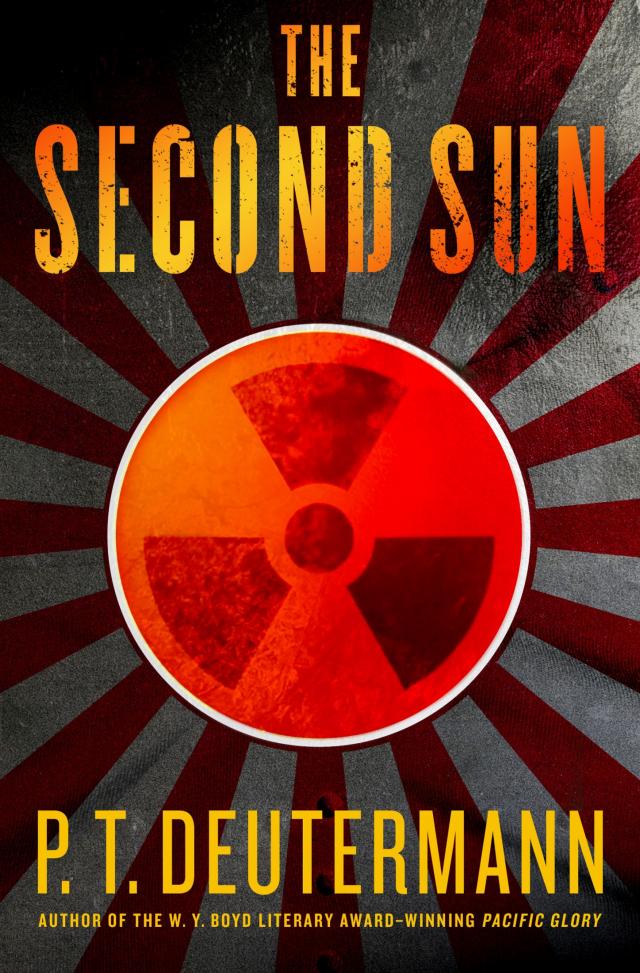
Cover art: Metal background © GuerraGPhoto/Shutterstock; rays © Sakchai.K/Shutterstock; radioactive sign © Duda Vasilii/Shutterstock; circle texture © Kaentian Street/Shutterstock; grunge texture © Naletova Elena/Shutterstock
eISBN 9781250360984
The publisher of this book does not authorize the use or reproduction of any part of this book in any manner for the purpose of training artificial intelligence technologies or systems. The publisher of this book expressly reserves this book from the Text and Data Mining exception in accordance with Article 4(3) of the European Union Digital Single Market Directive 2019/790.
Our ebooks may be purchased in bulk for promotional, educational, or business use. Please contact the Macmillan Corporate and Premium Sales Department at 1-800-221-7945, extension 5442, or by email at MacmillanSpecialMarkets@macmillan.com.
First Edition: 2025
P. T. Deutermann, The Second Sun