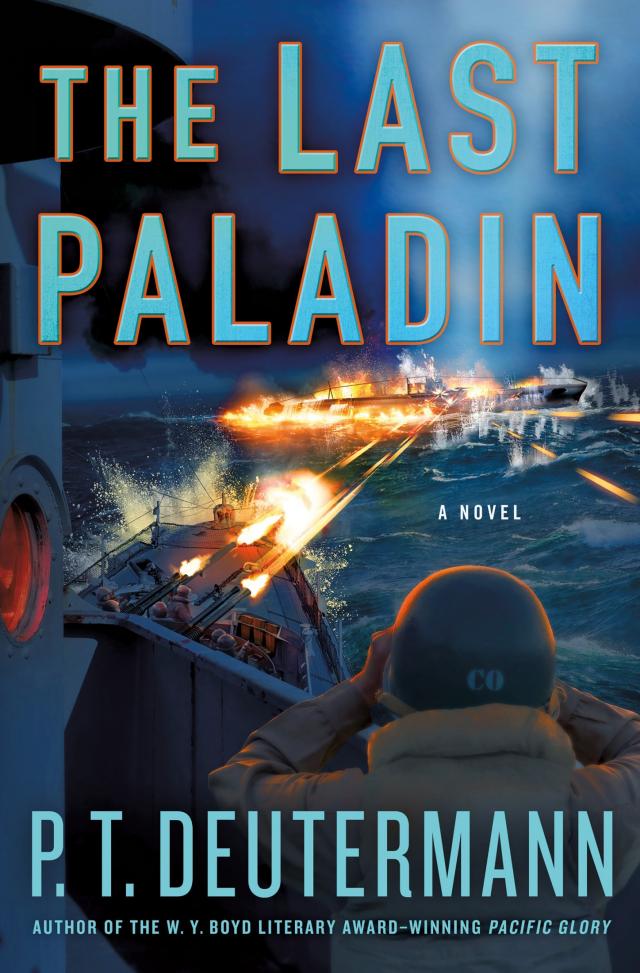
The Last Paladin, page 1


Begin Reading
Table of Contents
About the Author
Copyright Page
Thank you for buying this
St. Martin’s Publishing Group ebook.
To receive special offers, bonus content,
and info on new releases and other great reads,
sign up for our newsletters.
Or visit us online at
us.macmillan.com/newslettersignup
For email updates on the author, click here.
The author and publisher have provided this e-book to you for your personal use only. You may not make this e-book publicly available in any way. Copyright infringement is against the law. If you believe the copy of this e-book you are reading infringes on the author’s copyright, please notify the publisher at: us.macmillanusa.com/piracy.
This book is dedicated to the thousands of Allied officers and enlisted men who spent months at sea fighting an invisible yet lethal enemy: German and Japanese submarines. From the monthlong and frigid darks of the far northern oceans, to the Mediterranean Sea, to the central and South Atlantic Ocean, and all the way out to the endless tracts of miles-deep water in the Far East, these men waged a war of wits, sound, physical stamina, and the constant terror of never knowing when a one-ton, guided underwater missile might slam into the side of their ship at fifty miles an hour, day or night, and send them and all around them to meet their Maker.
I wish to express my personal thanks to the technical staff and professional researchers of the Naval History and Heritage Command, which is located primarily in the Washington Navy Yard, in Washington, DC. They toil endlessly behind the scenes to gather up and preserve the Navy’s memories, both good and bad. They facilitate George Santayana’s dictum: “Those who cannot remember the past are condemned to repeat it.” That means that what they do and the lessons they provide are an extraordinarily useful service, especially for those of us in or about to take up the profession of arms.
1
CO
My name is Mariano deTomasi. I’m a lieutenant commander in the US Navy and commanding officer of the destroyer escort USS Holland (DE-202), which is presently moored alongside a destroyer tender in Tulagi Harbor in the Solomon Islands. I’m sitting in a dilapidated wicker rocking chair on the veranda of what had to have been a plantation house a long time ago. A fan with at least one bad bearing is grinding away manfully on the ceiling, trying in vain to stir the steamy tropical air. The view from the veranda is not particularly impressive. There’s a clutch of weather-beaten jeeps parked haphazardly around the building, several ratty-looking palm trees, and, in the distance, two badly rust-streaked Navy cargo ships anchored down in the harbor itself. Beyond them is my ship, tied up alongside the destroyer tender USS Wilson (AD-14) and looking somewhat insignificant in comparison to the 26,000-ton repair ship. There’s a row of Quonset huts fronting the harbor piers, their decaying steel sides shimmering in the heat, but there’s a surprising lack of activity along the piers. I can hear the clickety-clack of typewriters going hell for leather in the office behind me. The never-ending paperwork, I thought. I’m definitely in the rear with the gear, as the Army guys termed it.
Tulagi seems to be a real backwater these days, a far cry from those perilous times in the fall of 1942 when the First Marines had gone ashore on Guadalcanal, whose brooding green bulk across the strait now gave little evidence of the savage fighting that had taken place on that blood-soaked island. At the time, Tulagi had been the Navy’s frontline refuge, a small harbor to which battered American warships could limp back from their latest night engagement with the Imperial Japanese Navy. I’d seen some pictures of heavy cruisers with their bows blown clean off parked along this shore and camouflaged with palm tree fronds, while repair personnel worked around the clock to get them seaworthy enough to make it to Nouméa, and from there, to a stateside shipyard. All those herculean efforts had been undertaken between air raids by Japanese bombers looking to finish the job until they were driven off by Marine fighters from Henderson Field, across the channel. Cactus. That had been the code name for Guadalcanal. The air defenses there were called the Cactus Air Force, made up of a mixed bag of Navy carrier fighters, Marine fighter squadrons, and whatever itinerant aircraft that had been available to join the fight.
It was hard to imagine now, looking at the harbor, that back in ’42 twin-engine Japanese bombers nicknamed “Judys” came skimming across these waters to drop their fearsome torpedoes, many of which ended up skating across the harbor and nosing up through coral sands at fifty miles an hour before grinding their propellers off on the rocky shore. The shooting war had long since gone north as the swelling might of Fortress America converged in the central Pacific in this summer of 1944. Rumor had it that the next target for Chester Nimitz’s central Pacific push would be the Marianas—the islands of Guam, Tinian, Saipan. MacArthur was reportedly closing in on the Philippines, with an invasion probably planned for the fall, and after that, everyone expected a direct assault on Japan itself.
I glanced at my watch and sighed. I’d been kept waiting for just over a half hour since coming ashore in response to a summons from the commodore. We’d arrived a day ago and tied up alongside the destroyer tender, USS Wilson (AD-12). I knew I shouldn’t be surprised to be cooling my heels. Holland was supposed to have been here a month ago, and the commodore’s welcome-to-WestPac message had made it clear that Himself was not pleased with our late arrival. The sympathetic expression on the yeoman’s face when I’d first stepped into the office and given my name confirmed I was in for it.
I sighed again as I remembered my ship’s first swashbuckling days with the Royal Navy, with whom Holland had been serving since being commissioned. Heat had not been the problem on the convoy escort runs to Russia, and, as I sat here sweating, I almost missed the icy domains of the far North Atlantic Ocean, with its seven hours of metallic gray daylight, lurking icebergs, monstrous seas, and, of course, Hitler’s malevolent U-boats. Almost.
I think the big difference was that the Brits had been fighting Hitler ever since September 1939, and, with their backs to the wall, admin and stuffy protocol had long since gone by the boards by the time Holland reported for convoy duty. We’d arrived at Scapa Flow in March 1943, fresh from builder’s trials and shakedown at the New York naval shipyard. Holland was a destroyer escort of the Buckley class, purpose-built to hunt down and kill submarines. My arrival call on British Commodore Halen had been short and refreshingly sweet. A bulky, red-bearded captain, who resembled portraits of Henry VIII, had met me on his weather-beaten flagship’s quarterdeck, taken me to his cabin, offered me a large scotch, and then welcomed me and my ship most sincerely to the Tenth Destroyer Flotilla. He’d then informed me that they were sailing the next day to join up with a convoy to Murmansk, and could we be ready for sea by 0930 tomorrow morning? We’re ready now, sir, as soon as we refuel. Marvelous, he’d proclaimed. Any questions, Captain? None, Commodore.
Good man, the commodore said approvingly. Drink up, then. There’s lots for you Yanks to learn, isn’t there, but there’s nothing like a run to Murmansk to get you up to speed, eh, what? That said, we are very glad to have you with us. A brand-new ship. God’s wounds, Captain, all our kit is bloody well worn out. Our people are exhausted; there’s not enough food, and we’ve come to dread the letters from home. We will lean on you heavily just because you’re fresh and so is your equipment.
We’ll do our best, Commodore, I’d told him. Could we perhaps have a liaison officer assigned for this first convoy run?
Capital idea, Captain. Save us all a lot of time. Especially when we get out to The Gap—that’s the bit of the North Atlantic where we’ll have no air cover. The only planes that can reach us out there are the Luftwaffe. I know you’re an anti-submarine ship, but refresh your people in antiaircraft warfare. The threat has been much reduced, but German bombers are not to be trifled with, especially if you don’t have some fighters to send against them.
Got it, Commodore.
Very well, sir. Carry on, then. My signals officer will be aboard shortly to give you all the operations bump. Your liaison officer will come aboard no later than 1800.
And then we’d trotted off to Russia the very next day. Just like that.
I heard the screen door open behind me. A chief yeoman stepped out and informed me that the commodore would see me now. Lucky me, I thought, but tried to keep my expression neutral. I followed the chief through the typing pool and down a long hallway to a set of wooden batwing doors. The chief, whose steely face, slight limp, and bright red facial and neck scars spoke volumes about where he’d been for the past few years, stood aside and gestured for me to go on in. I pushed through the doors and then stopped in shock at the sight of the commodore, who looked like a cadaver who’d been propped up at his wooden desk. His yellowish skin stretched over the bones of his face like old parchment. His uniform shirt hung like khaki-colored cotton drapes over his emaciated frame.
“What’s the matter, Captain?” the commodore snapped. “Never seen malaria before?”
“Sorry, sir,” I said, trying not to stare. “No, I haven’t seen malaria before.”
“There’s lots you haven’t seen, Captain; this isn’t going to be like Atlantic convoy duty out here, especially since you’ve missed the convoy. Why is Holland so damned late?”
“The far North Atlantic is not kind to small ships, sir,” I replied, wondering if I was going to be invited to sit down. “We needed voyage repairs, and they als o needed time to install a hedgehog launcher, a new radar, three new long-haul radios, and make mods to the sonar.”
“And the other five ships? Did they get upgrades, too? Because they all arrived on time, unlike you, sir.”
“They came from other yards, Commodore,” I said patiently. “So, I don’t know if they did or didn’t. We were in the Norfolk Navy Yard, and, apparently, cramming all the new stuff just took more time than their planners expected. Once we came out of the Yards, we came straight here to Tulagi, via some pit stops for fuel.”
The commodore began to tap a fountain pen on his desk as he gave me a stern look. His eyes were sunken, and he looked to be over fifty years old, even though he was probably forty at best. If the commodore felt like he looked, I could partially understand the unpleasant tenor of what should have been a welcome-aboard call.
“Well, you’re in the Pacific Fleet now, Captain,” the commodore said at last. “AKA, the First Team. The Big Blue Fleet. The one that’s going to take this abomination of a war back to that megalomaniac emperor who set it in motion. Destroyers out here don’t ‘escort’; they fight. They take on heavy cruisers. The battleships don’t just sail around pretty seas like the Brits do in the Mediterranean, showing the flag and maintaining ‘His Majesty’s presence.’ Out here they fight Japanese battleships, great big bastards, crowded with twice as many heavy guns as our ships carry. Our combatants don’t cruise offshore to enforce a theoretical blockade around a German-occupied continent—our combatants fight fleet actions. Carrier versus carrier at two hundred miles. Cruiser formations duking it out at one thousand yards, at night. We don’t make leisurely transits from point A to point B, like from Halifax to Murmansk, U-boats be damned, like you’ve been doing. We invade occupied and heavily fortified islands, and we deliver thousands of Marines ashore right into the teeth of fanatic Japanese infantry, who believe dying in battle is a higher calling than even victory, and who fight to the death rather than ever surrender.
“You’re anchored in Tulagi, which is a peaceful backwater now. A distant logistics base. The big show has gone north, on its way to Tokyo via any number of benighted island atolls, which will require more bloody smashing, all of which means I’m damned if I know what to do with a lone LantFleet DE who’s unfamiliar with how we operate, where we operate, how we communicate, and against whom we operate, and late.”
I took a controlled breath before answering, seeing that the commodore was puffing from delivering his diatribe. “We were told,” I said quietly, “that we’d been sent out here to provide escort services to whatever big deal was shaping up next.”
I paused, determined to maintain control of my temper, then continued. “I assumed they were talking about protecting invasion forces—transports, landing ships, ammo ships, cargo ships, tankers—and not going up against Japanese carriers. Holland is a DE, Commodore. Destroyer escort. Anti-submarine ship. Three-inch guns, not five-inch. We specialize in hunting down submarines and killing them. I don’t think all these PacFleet carriers or battleships or even your cruisers can do that. And, while I think that Japanese submarines are nowhere near as good as Hitler’s U-boats, I seem to recall that one lone I-boat sank a carrier, blew a destroyer in half, and punched a great big, go-back-to-the-States-for-repairs hole in a battleship, and all of that with a single spread of torpedoes.”
The commodore glared at me. “You’ve got a smart mouth on you,” he said finally, “for the captain of such a little bitty ship. I can have you removed with the stroke of this pen for insubordination.”
I decided to go on the attack. “Where’s my intel briefing, Commodore?” I demanded. “Updated charts? Communications plans? Standard operating procedures for PacFleet destroyer forces? Supply system requisitioning procedures? Current code books? Am I in the wrong office? Do I need to go to somebody else, Commodore, to get these things?”
“How dare you!” the commodore hissed. “You work for me, not the other way around, mister!”
“Mister?” I said. “The title is ‘captain,’ not ‘mister.’ Sir. You know what? I think maybe I should go back to my ship and try out some of those brand-new, long-haul HF radios. Tell the First Team, as you call them, about my reception here, or lack of one. Tell them that I think perhaps your medical condition has affected your mind. They do know the full extent of your physical condition, right, Commodore? Yes?”
The commodore’s jaundiced eyes widened. He looked like he would explode, if he could have managed the energy. When I saw he couldn’t, I seized the opening.
“Let’s do this, Commodore,” I said, still in as calm a voice as I could muster. “You assign Holland to a patrol station, some place between the Solomons and wherever the next island invasion is going to take place, with general orders: you know, look for submarines. Or act as a distant picket. Maybe even become a mid-ocean weather reporting station. A lone outpost, way out there to cover the First Team’s flanks. Give me fuel and supplies for a sixty-day patrol. We’ll get out of your hair and take that time to soak up all those PacFleet procedures, while you, or somebody, figures out how you eventually want to employ us. How’s that sound, sir?”
The commodore gave me what he must have thought was a withering glare. The effort made his eyes tear up. He was a wreck.
“Go back to your ship, Captain,” he growled. “I’ll give you sailing orders when I’m damned good and ready to. Nothing too taxing, I promise you; don’t want to overstress a LantFleet unit on her first time in the real Navy war. In the meantime, get the hell out of my office.”
“Aye, aye, sir,” I said. “Pleasure meeting you, I’m sure.”
I left the office and retraced my steps down the hallway. The same chief met me halfway and escorted me to the door, his scarred face a study in absolute neutrality. As I stepped through the door, I asked if this was the standard welcome-aboard call for LantFleet ships being transferred to WestPac. The chief stopped in the doorway and studied his shoes for a moment before replying. The clacking typewriters behind him never stopped.
“There’s more to it than malaria,” he said quietly. “Our squadron doc says Commodore Halen’ll be dead in a few weeks. He used to be my favorite boss. It’s painful to watch. His replacement is inbound, coming up from Brisbane, I think. Until then, we’re all going through the motions, pretending there’s nothing wrong. The chief staff officer, Lieutenant Commander Carson, is over on Cactus today. He’ll set you up on a mission and with whatever logistics you need as soon as he gets back.”
“Okay,” I said. “Sorry to hear that. I guess I’m surprised they didn’t relieve him right away.”
“He asked nicely,” the chief said. “To be allowed to keep serving, that is. His wife died of cancer just before Pearl happened. He was here for the initial Guadalcanal invasion, including all the battles that gave that patch of water out there the name Ironbottom Sound. Navy Cross. Purple Heart. Had to swim for his life from two broken-backed destroyers during those bad old days, late ’42, before any of us truly understood Japanese torpedoes. I, myself, got off the Atlanta just before she went down. Today’s replacement ships and crews can’t imagine the ferocity we encountered when we first went up against the Japanese. Those of us who had to be left behind here at Tulagi are still licking our wounds. The tone of your office call this morning was more about us than you, if that’s any comfort, Captain. Every time I look out at Ironbottom Sound I start to weep, so he’s not the only broken one here. If that makes any sense, Captain.”
“All the sense in the world, Chief,” I said, recognizing that I’d just been tactfully admonished. No surprise there—in a way, calibrating senior officers was part of a chief’s job. “But for what it’s worth, the U-boat war up there in the land of the midnight sun wasn’t exactly a cakewalk. I will never get the smell of burning men out of my memory.”
“Well, that makes two of us, Captain,” the chief said with a sigh. “Pray to God once a day, without fail, that you never encounter a Japanese type 93 torpedo. We’ll be in touch, sir, and, again, I apologize on behalf of the entire staff for—that business in his office.”