

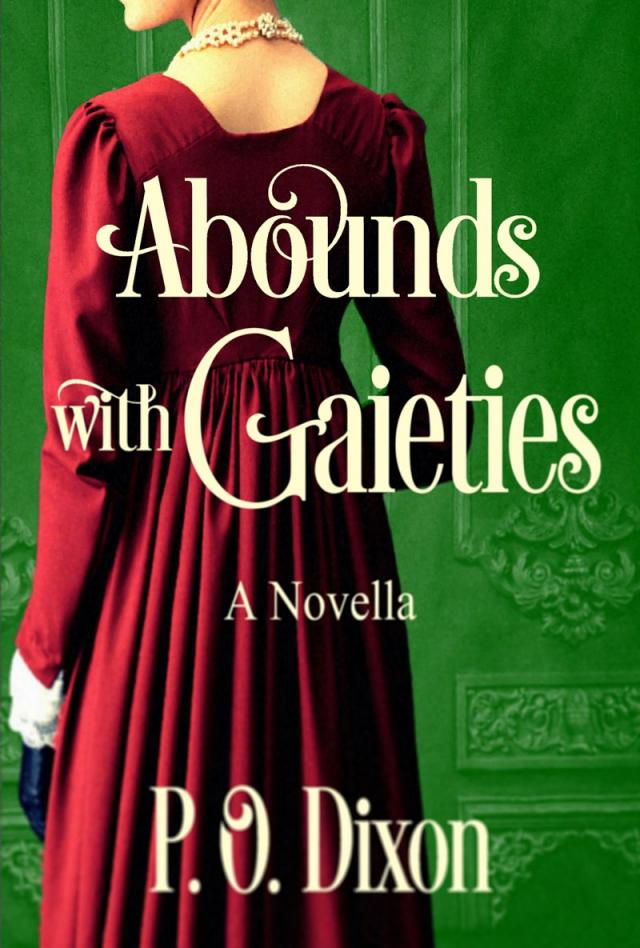
Abounds with Gaieties, page 1


Contents
Introduction
Chapter 1
Chapter 2
Chapter 3
Chapter 4
Chapter 5
Chapter 6
Chapter 7
Chapter 8
Chapter 9
Chapter 10
Chapter 11
Chapter 12
Featured Book!
P. O. Dixon Books
About the Author
Acknowledgments
Introduction
Darcy returns to Hertfordshire to face his feelings for Elizabeth, stirring in Elizabeth confounding feelings of her own.
Fitzwilliam Darcy faces a dilemma when his friend, Charles Bingley, accuses him of acting on his own behalf in leaving Hertfordshire. Bingley suggests Darcy is far more attracted to Miss Elizabeth Bennet than he cares to admit.
Darcy grows concerned that if Bingley noticed his fascination with Elizabeth, others might have too. Even Elizabeth herself.
He returns to Hertfordshire and faces his feelings for Elizabeth rather than stay away and continue to avoid them. Will the spark he feels for her ignite something far beyond the bounds of prudent behavior?
As Darcy and Elizabeth spend more and more time together, she struggles to keep her feelings for him at bay. Can they resist the powerful attraction between them, or will they soon find what they've always longed for in each other?
Abounds with Gaieties is a delightful holiday-themed novella which reimagines Jane Austen’s timeless classic, combining just enough of the old to satisfy your want of nostalgia and enough of the new to quench your desire for another romantic escape with Darcy and Elizabeth.
“This is quite the season indeed for friendly meetings.”
-Jane Austen
One
LONGBOURN VILLAGE - HERTFORDSHIRE, ENGLAND - DECEMBER 1811
Miss Elizabeth Bennet hated seeing her elder sister in such low spirits. Jane’s cheeks looked somewhat sunken, she lacked a healthy glow, and her bright, angelic eyes seemed to have dimmed. All for the cause of her lover, Mr. Charles Bingley. The gentleman had promised to return in just a few days, but it was now a week later.
Jane, who never complained about anything, said, “Were it simply a matter of his being late by a day or two, I would have no cause for concern. I should imagine the business which dictated his return to town has yet to be resolved. However, Miss Bingley’s letter plainly stated her brother is to remain in town indefinitely, and I am beginning to believe her.”
Elizabeth sighed and put aside her book. “Dearest Jane, may I remind you again not to take Miss Bingley’s letter to heart,” she said, although she too was beginning to have doubts. Not that she doubted for a second that Mr. Bingley was in love with her sister. However, Elizabeth would not dismiss the power of the gentleman’s sisters and his closest friend, Mr. Darcy, over him. She could think of no other explanation for the remaining inhabitants of Netherfield to take their leave on Mr. Bingley’s heels other than to persuade him to remain in town.
Miss Bingley’s letter to Jane had arrived within a day of Mr. Bingley’s departure, thus casting an air of despair over Longbourn. Making matters worse, the news came shortly after Elizabeth had been the means of ruining her eager mother’s scheme to secure the Bennet family’s place at Longbourn in the event of her husband’s demise.
The morning after the Netherfield ball, Mrs. Bennet was confident she would rid herself of one of her five unmarried daughters. Determined that her eldest was soon to be married to their new neighbor, Mr. Bingley, the matchmaking mama had pointed Mr. William Collins, the heir apparent to the Longbourn estate owing to an entailment, toward her second eldest daughter, Elizabeth.
But, to the lady’s surprise and utter vexation, Elizabeth had declared she would not have him, and owing to the manner of her refusal, which Mrs. Bennet had the misfortune of hearing through a closed door as she happened to place her ear against it, Mr. Collins abdicated his plan to choose a bride from among the Bennet daughters.
Elizabeth recalled the part of her speech to Mr. Collins that had spared her from his design for future marital felicity involving her.
“I should have paid more attention to the wisdom of Miss Lucas. She was quite right about your unwavering determination to marry for only the deepest and truest kind of love,” Mr. Collins conceded. “There is a sensible young lady if I ever met one. She would never be foolish enough to jeopardize the security of her family and herself for such a fanciful notion,” he added, sounding rather wise himself to Elizabeth’s ears.
With one arm folded over the other, Elizabeth had said, “If you truly believe what you are espousing, sir, then perhaps you ought to be standing before her rather than wasting your time here with me.”
The shock on her mother’s face when she nearly fell inside the room was such that Elizabeth would not soon forget. Nor was her mother’s ensuing disapprobation something Elizabeth would quickly overcome. That her mother would think Elizabeth would commit to an alliance that would bring her nothing but misery was one thing, but that was nowhere near the worst part of Mrs. Bennet’s lamentations. In front of Mr. Collins, Elizabeth’s mother accused her of thinking too highly of herself simply because the proud Mr. Darcy had singled her out for a dance at the Netherfield ball.
She still felt the sting of her mother’s words clawing at her sensibilities. Anyone who knew Elizabeth well knew how much she disliked the proud Mr. Darcy. It was not as though she had a choice in the matter. To have declined Mr. Darcy’s request for a dance would have meant sitting out the rest of the ball. Elizabeth was not inclined to forgo her share of the evening’s gaieties. For her mother to suggest that Elizabeth forgot what she was about because of her dance with Mr. Darcy was vexing, for it meant her mother did not really know her at all.
Considering the way Mrs. Bennet lamented Mr. Bingley’s continued absence, she did not know her eldest daughter either. Surely if her mother exercised more temperance, Jane would not be so ill at ease.
Jane sighed. “I fear following your advice not to take Miss Bingley’s letter to heart is easier said than done. I know how much you dislike her, but I have never seen her in an unfavorable light.”
Elizabeth could not argue with her sister on the latter score, for Jane was too good not to see the best in everyone. Elizabeth knew better. Jane always gives everyone the benefit of the doubt.
Elizabeth did not fault her. She only hoped Jane would never have to come to understand the less-than-agreeable side of humanity, for if she did, she would lose some of the light that made her so special.
“Far be it from me to be the one who poisons your mind against Miss Bingley, but I do not believe she acted in her brother’s best interest when she wrote the letter. On the contrary, I believe she was thinking only of herself. Consider her assertion that her brother is amorous of Miss Georgiana Darcy, for instance,” Elizabeth said, referring to the part of Miss Bingley’s letter that Jane had said hurt her the most.
Jane had purposely pointed out the part that read:
I really do not think Georgiana Darcy has her equal for beauty, elegance, and accomplishments; and the affection she inspires in Louisa and myself is heightened into something still more interesting, from the hope we dare entertain of her being hereafter our sister. I do not know whether I ever before mentioned to you my feelings on this subject, but I will not leave the country without confiding them, and I trust you will not esteem them unreasonable.
My brother admires her greatly already; he will have frequent opportunities now of seeing her on the most intimate footing; her relations all wish the connection as much as his own, and a sister’s partiality is not misleading me, I think, when I call Charles most capable of engaging any woman’s heart. With all these circumstances to favor an attachment, and nothing to prevent it, am I wrong, my dearest Jane, in indulging the hope of an event that will secure the happiness of so many?
And to think Jane had thought Miss Bingley had meant well. She could not have conceived that the woman’s words were an open rebuke intended to make her feel small. Instead, Jane had interpreted Miss Bingley’s words as well-intended and meant to spare her feelings.
Elizabeth continued, “Did Mr. Bingley ever once show any sign of suffering a tender regard for the young lady? I daresay he never once mentioned her name. And what of the young lady’s own brother? It is hard to suppose he would sit idly by and do nothing while the man destined for his sister was courting someone else. A man like Mr. Darcy would not have disregarded such conduct.”
Elizabeth reached out to touch her sister’s hand. It disappointed her when Jane pulled away.
“In hindsight,” Jane began, her voice pained, “can one really say that Mr. Bingley was courting me?”
“I never saw a man more violently in love,” said Elizabeth. “Indeed, no one who has ever seen you together can doubt his affection. Miss Bingley, I am sure, cannot. She is not such a simpleton. She would have ordered her wedding clothes if she had seen half as much love in Mr. Darcy for herself.”
“One might suppose Mr. Bingley made a beginning, but who is to say his return to town did not remind him of what he is really about? Even you would argue I might have done more to encourage him. If not Miss Darcy, surely there are many other young ladies with whom he might spend his time. Young ladies who are far more receptive and encouraging than I was whenever we were together.”
“I am sure your chance will come soon enough. Let us wait and see what happens before you give up all hope of Mr. Bingley’s return.”
Jane sighed in resignation. “Very well. I will try, for now.”
Two
DARCY HOUSE - LONDON, ENGLAND
Having been forewarned by way of a message from Mr. Hurst, who undoubtedly acted under the influence of Miss Caroline Bingley, it did not surprise Fitzwilliam Darcy when a servant showed his friend Charles Bingley into his study.
The room was austere and crisp in its cleanliness. It spoke to the owner’s stature, from the rich, smooth finish of the mahogany desk rubbed with lemon oil earlier that morning to its luxurious velvet curtains and richly paneled walls.
Bingley, whose countenance was twisted into an expression of complete vexation, was on a mission. Having dispensed with all the usual civilities, the younger man came straight to the point of his visit.
“Darcy, old fellow,” he said, “I need to talk with you. I have heard all I wish to hear from my sisters regarding this matter. I want to hear from you why you returned to London on the heels of my leave-taking when you and the others were meant to remain in Hertfordshire. I promised Miss Bennet that I would return in three or four days. I fully expected you would still be there, and now I am trying to piece together what went wrong. Did I misunderstand your intentions?”
“No, you did not misunderstand my intentions,” Darcy replied. “But I could not, in good conscience, let you continue your course without intervention. Hence my return to town with the hope you would remain here.”
“My course? What do you mean?” Bingley asked, a furrow forming between his brows.
“You were behaving much too recklessly,” Darcy said. “I studied you and the young lady during the ball at Netherfield. I was persuaded her feelings are not as engaged as yours. You would be wise to cool your ardor and allow for some time and distance between the two of you to gain a better perspective.”
Bingley appeared crestfallen as Darcy made his claim. The younger man looked aghast—his eyes wide open, his mouth ajar. At length, he said, “No, I am certain Miss Bennet feels the same way about me that I feel about her. Therefore, there is no need to slow down my courtship. I love her and intend to make an offer of marriage in due course of time.”
Darcy frowned from his brow to his mouth, his lips set in a disapproving line. “That would be a mistake, Bingley. You should not rush into such a momentous decision without giving it proper thought and consideration first.”
“I cannot think of anything more important than marrying the woman I love,” said Bingley firmly. “And if you truly care for me, you will support my decision.”
“Bingley, think of what you are doing,” Darcy said. “You would risk throwing away all of your advantages in life by aligning yourself with someone like Miss Jane Bennet. She is from a family of no consequence. She has no fortune, despite her angelic charms. You can do so much better.”
“I love her,” Bingley said stubbornly. “And I do not care about any of those other things.”
Darcy shook his head. “You are young and impulsive and do not know what you are about. I care about you too much to stand by and watch you make a mistake you will regret for the rest of your life.”
“There is nothing you can say that will change my mind,” Bingley said. “If Miss Bennet will have me, I very well plan on marrying her, and I would appreciate your support, not your judgment.”
Darcy sighed. “What you are asking goes against everything I firmly believe. As your friend, I would not see you make such a grave mistake.”
“I appreciate your concern,” Bingley said. “But I am a grown man and can make my own decisions.”
Darcy was about to say something else when Bingley held up his hand.
“I will not mince words, Darcy,” Bingley said. “I fear you are the one who is most interested in protecting yourself—from your attraction to Miss Elizabeth Bennet.”
Darcy could not deny his fascination with Elizabeth grew by the day while he remained in Hertfordshire. There was an air about her that drove him to distraction. The sparkle of her eyes, the twinkle, and the joy he saw there spoke more clearly to him than any woman he had ever known. Her eyes spoke of happiness and playfulness, of fierceness and passion. They drew him in, but he also knew enough to keep whatever feelings she had incited in him at bay. His own feelings aside, there were other matters to consider.
“Indeed, you are mistaken, my friend,” Darcy said after a moment. “I am thinking of you and your future.”
“For me not to return as promised must certainly subject Miss Bennet to everyone’s derision for disappointed hopes. It would expose me to her family’s and our neighbors’ censure for caprice and instability. I simply must return to finish what I started. Should my efforts prove fruitless, then at least I will know I tried.”
“I am not saying your efforts would prove fruitless. No doubt the young woman would marry you in a heartbeat if for nothing else than for the sake of her family.”
Bingley, whose voice was thick with emotion, said, “You speak as though you believe Miss Bennet is mercenary when you must know it could not be further from the truth. Regardless of what you may think of her mother, Miss Bennet should be neither faulted nor characterized in such a manner. Is her own sister’s behavior not a testament to that? My sisters told me all about the uproar caused when Miss Elizabeth refused Mr. Collins’s hand in marriage.”
This was news to Darcy. The Bingley sisters had not breathed a word of it to him. This picture in his mind of Elizabeth in the arms of another man robbed him of his composure. The one woman in the world he dreamed of holding in his arms night after night, only in vain. Darcy felt a flash of rage, but he tamped it down.
His hand gripped the arm of his chair. “When did Collins do that?” he asked, hoping his tone did not reflect the disturbance in his mind.
“According to my sisters, it happened the day after the ball. Do not tell me you did not know.”
Darcy always knew how much the youngest Bingley sister loved to tease him about his fascination with Elizabeth’s fine eyes when they were all together in Hertfordshire. Had his singling her out for a dance at the Netherfield ball further fueled Miss Bingley’s jealousy?
What did she mean by keeping this intelligence from me when making sport of the Bennet family’s lot in life is one of her favorite pastimes?
“It is true. I do not have the highest opinion of her mother, her three younger sisters, and even her father, owing to his questionable behavior on more than one occasion. Still, I always excused Miss Bennet and Miss Elizabeth from such censure as they always seemed far more sensible than the rest of their family.”
“Dare I say, you seemed more than a little bothered when I told you about Mr. Collins’s proposal to Miss Elizabeth.”
“Why would I be concerned one way or the other? If she indeed refused the man’s offer, it would have been imprudent on her part. I understand he is the heir apparent to her family’s estate.”
“So, one sister is to be faulted for marrying for the sake of her family and the other is to be derided for not marrying for the motive of duty. Is that what you are saying?”
Darcy’s finding himself on the unenviable side of a logical discussion with his friend was indeed unfamiliar territory.
“I am not saying I find fault in either of them. In advising you not to rush into anything, I am thinking only of you and what is in your best interest.”
“If you want what is best for me, then you will cease your objections to my scheme and return with me to Hertfordshire. Granted, I have stayed away longer than I had intended. However, I am sure Miss Bennet will understand once I explain my reason. Besides, remaining at Netherfield until the start of the London season is no less than what we had planned from the start, is it not?”


