William Tell Told Again, page 1


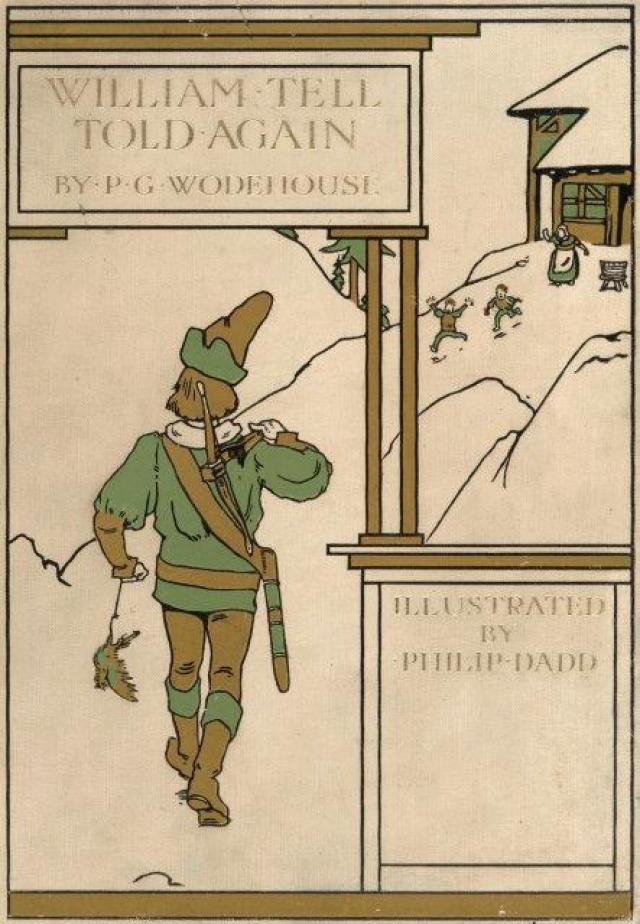
William Tell Told Again
P. G. Wodehouse
With illustrations in colour by Philip Dadd
Described in verse by John W. Houghton
1904
To
Biddy O’Sullivan
for a
Christmas Present
Contents
Prologue
Chapter I
Chapter II
Chapter III
Chapter IV
Chapter V
Chapter VI
Chapter VII
Chapter VIII
Chapter IX
Chapter X
Chapter XI
Chapter XII
Chapter XIII
Chapter XIV
Chapter XV
Epilogue
List of Illustrations
Gessler’s methods of persuasionSometimes it was only a birdThey would march about, beating tin cans and shoutingAn egg flew across the meadow, and burst over Leuthold’s shoulder“Here! Hi!” shouted the soldiers, “Stop!”They saw Friesshardt raise his pike, and bring it down with all his force on Tell’s head“Look here!” he began. “Look there!” said FriesshardtFriesshardt rushed to stop himThe crowd danced and shouted“Come, come, come!” said Gessler, “tell me all about it”“I have here an apple”There was a stir of excitement in the crowdA moment’s suspense, and then a terrific cheer arose from the spectators“Seize that man!” he shoutedHe was led away to the shore of the lakeTell’s second arrow had found its mark
Transcriber’s note: William Tell Told Again is two children’s books in one. One is a picture book – 16 full-colour illustrations by Philip Dadd described in verse by John W. Houghton. The other is a humorous novel by P. G. Wodehouse, based on the picture book. The novel has a lengthier storyline, a more intricate plot, and more characterization. The bound volume intermingled the picture book with the novel, illustrations and poems appearing at regular intervals. Most pictures and verses were distant from the page of the novel that they reflected.
For this version, the illustrations and verses have been inserted following the paragraph in the novel that describes the events being illustrated. To read the novel, skip the verses appearing after each illustration (but one). To read the picture book, follow the “Next plate” link after each verse.
The Swiss, against their Austrian foes,
Had ne’er a soul to lead ’em,
Till Tell, as you’ve heard tell, arose
And guided them to freedom.
Tell’s tale we tell again – an act
For which pray no one scold us –
This tale of Tell we tell, in fact,
As this Tell tale was told us.
(Next plate)
Chapter I
Once upon a time, more years ago than anybody can remember, before the first hotel had been built or the first Englishman had taken a photograph of Mont Blanc and brought it home to be pasted in an album and shown after tea to his envious friends, Switzerland belonged to the Emperor of Austria, to do what he liked with.
One of the first things the Emperor did was to send his friend Hermann Gessler to govern the country. Gessler was not a nice man, and it soon became plain that he would never make himself really popular with the Swiss. The point on which they disagreed in particular was the question of taxes. The Swiss, who were a simple and thrifty people, objected to paying taxes of any sort. They said they wanted to spend their money on all kinds of other things. Gessler, on the other hand, wished to put a tax on everything, and, being Governor, he did it. He made everyone who owned a flock of sheep pay a certain sum of money to him; and if the farmer sold his sheep and bought cows, he had to pay rather more money to Gessler for the cows than he had paid for the sheep. Gessler also taxed bread, and biscuits, and jam, and buns, and lemonade, and, in fact, everything he could think of, till the people of Switzerland determined to complain. They appointed Walter Fürst, who had red hair and looked fierce; Werner Stauffacher, who had gray hair and was always wondering how he ought to pronounce his name; and Arnold of Melchthal, who had light-yellow hair and was supposed to know a great deal about the law, to make the complaint. They called on the Governor one lovely morning in April, and were shown into the Hall of Audience.
“Well,” said Gessler, “and what’s the matter now?”
The other two pushed Walter Fürst forward because he looked fierce, and they thought he might frighten the Governor.
Walter Fürst coughed.
“Well?” asked Gessler.
“Er – ahem!” said Walter Fürst.
“That’s the way,” whispered Werner; “give it him!”
“Er – ahem!” said Walter Fürst again; “the fact is, your Governorship—”
“It’s a small point,” interrupted Gessler, “but I’m generally called ‘your Excellency.’ Yes?”
“The fact is, your Excellency, it seems to the people of Switzerland—”
“—Whom I represent,” whispered Arnold of Melchthal.
“—Whom I represent, that things want changing.”
“What things?” inquired Gessler.
“The taxes, your excellent Governorship.”
“Change the taxes? Why, don’t the people of Switzerland think there are enough taxes?”
Arnold of Melchthal broke in hastily.
“They think there are many too many,” he said. “What with the tax on sheep, and the tax on cows, and the tax on bread, and the tax on tea, and the tax—”
“I know, I know,” Gessler interrupted; “I know all the taxes. Come to the point. What about ’em?”
“Well, your Excellency, there are too many of them.”
“Too many!”
“Yes. And we are not going to put up with it any longer!” shouted Arnold of Melchthal.
Gessler leaned forward in his throne.
“Might I ask you to repeat that remark?” he said.
“We are not going to put up with it any longer!”
Gessler sat back again with an ugly smile.
“Oh,” he said – “oh, indeed! You aren’t, aren’t you! Desire the Lord High Executioner to step this way,” he added to a soldier who stood beside him.
The Lord High Executioner entered the presence. He was a kind-looking old gentleman with white hair, and he wore a beautiful black robe, tastefully decorated with death’s-heads.
“Your Excellency sent for me?” he said.
“Just so,” replied Gessler. “This gentleman here” – he pointed to Arnold of Melchthal – “says he does not like taxes, and that he isn’t going to put up with them any longer.”
“Tut-tut!” murmured the executioner.
“See what you can do for him.”
“Certainly, your Excellency. Robert,” he cried, “is the oil on the boil?”
“Just this minute boiled over,” replied a voice from the other side of the door.
“Then bring it in, and mind you don’t spill any.”
Enter Robert, in a suit of armour and a black mask, carrying a large caldron, from which the steam rose in great clouds.
“Now, sir, if you please,” said the executioner politely to Arnold of Melchthal.
Arnold looked at the caldron.
“Why, it’s hot,” he said.
“Warmish,” admitted the executioner.
“It’s against the law to threaten a man with hot oil.”
* * *
Beneath a tyrant foreign yoke,
How love of freedom waxes!
(Especially when foreign folk
Come round collecting taxes.)
The Swiss, held down by Gessler’s fist,
Would fain have used evasion;
Yet none there seemed who could resist
His methods of persuasion.
(Next plate)
* * *
“You may bring an action against me,” said the executioner. “Now, sir, if you please. We are wasting time. The forefinger of your left hand, if I may trouble you. Thank you. I am obliged.”
He took Arnold’s left hand, and dipped the tip of the first finger into the oil.
“Ow!” cried Arnold, jumping.
“Don’t let him see he’s hurting you,” whispered Werner Stauffacher. “Pretend you don’t notice it.”
Gessler leaned forward again.
“Have your views on taxes changed at all?” he asked. “Do you see my point of view more clearly now?”
Arnold admitted that he thought that, after all, there might be something to be said for it.
“That’s right,” said the Governor. “And the tax on sheep? You don’t object to that?”
“No.”
“And the tax on cows?”
“I like it.”
“And those on bread, and buns, and lemonade?”
“I enjoy them.”
“Excellent. In fact, you’re quite contented?”
“Quite.”
“And you think the rest of the people are?”
“Oh, quite, quite!”
“And do you think the same?” he asked of Walter and Werner.
“Oh yes, your Excellency!” they cried.
“Then that’s all right,” said Gessler. “I was sure you would be sensible about it. Now, if you will kindly place in the tambourine which the gentleman on my left is presenting to you a mere trifle to compensate us for our trouble in giving you an audience, and if you” (to Arnold of Melchthal) “will contribute an additional trifle for use of the Imperial boiling oil , I think we shall all be satisfied. You’ve done it? That’s right. Good-bye, and mind the step as you go out.”
And, as he finished this speech, the three spokesmen of the people of Switzerland were shown out of the Hall of Audience.
Chapter II
They were met in the street outside by a large body of their fellow-citizens, who had accompanied them to the Palace, and who had been spending the time since their departure in listening by turns at the keyhole of the front-door. But as the Hall of Audience was at the other side of the Palace, and cut off from the front-door by two other doors, a flight of stairs, and a long passage, they had not heard very much of what had gone on inside, and they surrounded the three spokesmen as they came out, and questioned them eagerly.
“Has he taken off the tax on jam?” asked Ulric the smith.
“What is he going to do about the tax on mixed biscuits?” shouted Klaus von der Flue, who was a chimney-sweep of the town and loved mixed biscuits.
“Never mind about tea and mixed biscuits!” cried his neighbour, Meier of Sarnen. “What I want to know is whether we shall have to pay for keeping sheep any more.”
“What did the Governor say?” asked Jost Weiler, a practical man, who liked to go straight to the point.
The three spokesmen looked at one another a little doubtfully.
“We-e-ll,” said Werner Stauffacher at last, “as a matter of fact, he didn’t actually say very much. It was more what he did, if you understand me, than what he said.”
“I should describe His Excellency the Governor,” said Walter Fürst, “as a man who has got a way with him – a man who has got all sorts of arguments at his finger-tips.”
At the mention of finger-tips, Arnold of Melchthal uttered a sharp howl.
“In short,” continued Walter, “after a few minutes’ very interesting conversation he made us see that it really wouldn’t do, and that we must go on paying the taxes as before.”
There was a dead silence for several minutes, while everybody looked at everybody else in dismay.
The silence was broken by Arnold of Sewa. Arnold of Sewa had been disappointed at not being chosen as one of the three spokesmen, and he thought that if he had been so chosen all this trouble would not have occurred.
“The fact is,” he said bitterly, “that you three have failed to do what you were sent to do. I mention no names – far from it – but I don’t mind saying that there are some people in this town who would have given a better account of themselves. What you want in little matters of this sort is, if I may say so, tact. Tact; that’s what you want. Of course, if you will go rushing into the Governor’s presence—”
“But we didn’t rush,” said Walter Fürst.
“—Shouting out that you want the taxes abolished—”
“But we didn’t shout,” said Walter Fürst.
“I really cannot speak if I am to be constantly interrupted,” said Arnold of Sewa severely. “What I say is, that you ought to employ tact. Tact; that’s what you want. If I had been chosen to represent the Swiss people in this affair – I am not saying I ought to have been, mind you; I merely say if I had been – I should have acted rather after the following fashion: Walking firmly, but not defiantly, into the tyrant’s presence, I should have broken the ice with some pleasant remark about the weather. The conversation once started, the rest would have been easy. I should have said that I hoped His Excellency had enjoyed a good dinner. Once on the subject of food, and it would have been the simplest of tasks to show him how unnecessary taxes on food were, and the whole affair would have been pleasantly settled while you waited. I do not imply that the Swiss people would have done better to have chosen me as their representative. I merely say that that is how I should have acted had they done so.”
And Arnold of Sewa twirled his moustache and looked offended. His friends instantly suggested that he should be allowed to try where the other three had failed, and the rest of the crowd, beginning to hope once more, took up the cry. The result was that the visitors’ bell of the Palace was rung for the second time. Arnold of Sewa went in, and the door was banged behind him.
Five minutes later he came out, sucking the first finger of his left hand.
“No,” he said; “it can’t be done. The tyrant has convinced me.”
“I knew he would,” said Arnold of Melchthal.
“Then I think you might have warned me,” snapped Arnold of Sewa, dancing with the pain of his burnt finger.
“Was it hot?”
“Boiling.”
“Ah!”
“Then he really won’t let us off the taxes?” asked the crowd in disappointed voices.
“No.”
“Then the long and short of it is,” said Walter Fürst, drawing a deep breath, “that we must rebel!”
“Rebel?” cried everybody.
“Rebel!” repeated Walter firmly.
“We will!” cried everybody.
“Down with the tyrant!” shouted Walter Fürst.
“Down with the taxes!” shrieked the crowd.
A scene of great enthusiasm followed. The last words were spoken by Werner Stauffacher.
“We want a leader,” he said.
“I don’t wish to thrust myself forward,” began Arnold of Sewa, “but I must say, if it comes to leading—”
“And I know the very man for the job,” said Werner Stauffacher. “William Tell!”
“Hurrah for William Tell!” roared the crowd, and, taking the time from Werner Stauffacher, they burst into the grand old Swiss chant which runs as follows:
“For he’s a jolly good fellow!
For he’s a jolly good fellow!!
For he’s a jolly good fe-e-ll-ow!!!!
And so say all of us!”
And having sung this till they were all quite hoarse, they went off to their beds to get a few hours’ sleep before beginning the labours of the day.
Chapter III
In a picturesque little châlet high up in the mountains, covered with snow and edelweiss (which is a flower that grows in the Alps, and you are not allowed to pick it), dwelt William Tell, his wife Hedwig, and his two sons, Walter and William. Such a remarkable man was Tell that I think I must devote a whole chapter to him and his exploits. There was really nothing he could not do. He was the best shot with the cross-bow in the whole of Switzerland. He had the courage of a lion, the sure-footedness of a wild goat, the agility of a squirrel, and a beautiful beard. If you wanted someone to hurry across desolate ice-fields, and leap from crag to crag after a chamois, Tell was the man for your money. If you wanted a man to say rude things to the Governor, it was to Tell that you applied first. Once when he was hunting in the wild ravine of Schächenthal, where men were hardly ever to be seen, he met the Governor face to face. There was no way of getting past. On one side the rocky wall rose sheer up, while below the river roared. Directly Gessler caught sight of Tell striding along with his cross-bow, his cheeks grew pale and his knees tottered, and he sat down on a rock feeling very unwell indeed.
“Aha!” said Tell. “Oho! so it’s you, is it? I know you. And a nice sort of person you are, with your taxes on bread and sheep, aren’t you! You’ll come to a bad end one of these days, that’s what will happen to you. Oh, you old reprobate! Pooh!” And he had passed on with a look of scorn, leaving Gessler to think over what he had said. And Gessler ever since had had a grudge against him, and was only waiting for a chance of paying him out.
“Mark my words,” said Tell’s wife, Hedwig, when her husband told her about it after supper that night – “mark my words, he will never forgive you.”
“I will avoid him,” said Tell. “He will not seek me.”
“Well, mind you do,” was Hedwig’s reply.
On another occasion, when the Governor’s soldiers were chasing a friend of his, called Baumgarten, and when Baumgarten’s only chance of escape was to cross the lake during a fierce storm, and when the ferryman, sensibly remarking, “What! must I rush into the jaws of death? No man that hath his senses would do that!” refused to take out his boat even for twice his proper fare, and when the soldiers rode down to seize their prey with dreadful shouts, Tell jumped into the boat, and, rowing with all his might, brought his friend safe across after a choppy passage. Which made Gessler the Governor still more angry with him.