

The Dark Issue 30, page 1


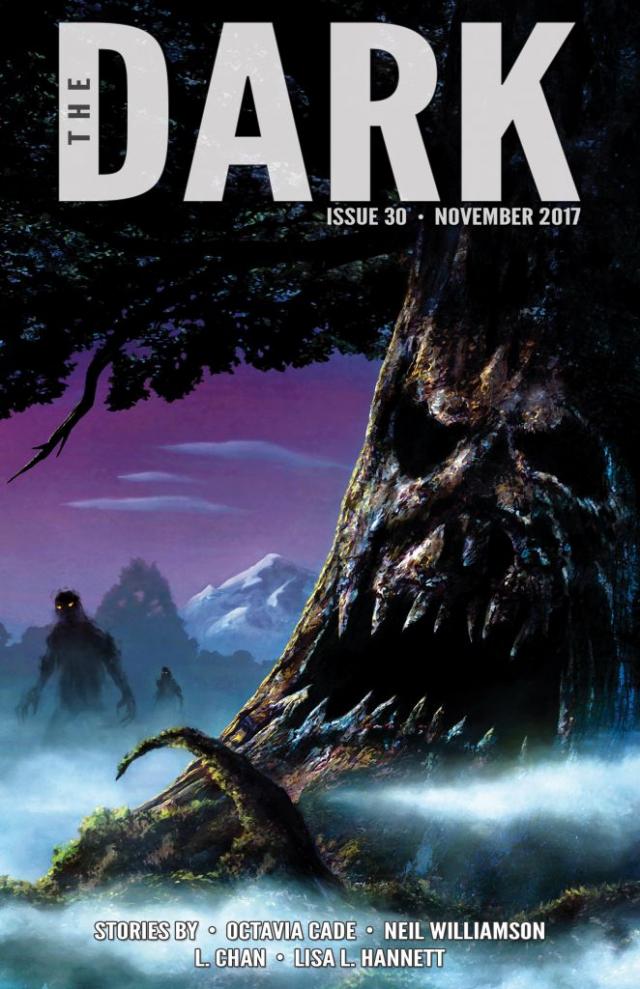
THE DARK
Issue 30 • November 2017
“The Better Part of Drowning” by Octavia Cade
“Silk Bones” by Neil Williamson
“The Sound of His Voice Like the Colour of Salt” by L Chan
“Sugared Heat” by Lisa L. Hannett
Cover Art: “Running with the Demon” by Tomislav Tikulin
ISSN 2332-4392.
Edited by Silvia Moreno-Garcia and Sean Wallace.
Cover design by Garry Nurrish.
Copyright © 2017 by Prime Books.
www.thedarkmagazine.com
The Better Part of Drowning
by Octavia Cade
Alix was never sure what kept the groaning rickety-spider of a dock up, unless it was the mussels that swarmed over the piles, turning them to hazards that could slice a swimmer open. The divers were all over scars from waves and mussels, always being pushed into shell sharp as knives and leaving their blood to scent the water.
“You kids be careful you don’t draw the crabs!” If she heard that once a day she heard it fifty times, and each time she had to smile over the slicing pain and wave up, because coins weren’t thrown to kids who wailed. Wailing made her choke if she tried to dive anyway, and there were always kids enough to squabble over coins so tears did nothing but anchor her to surface and starvation and blind her to the sudden scuttle of predation.
Don’t draw the crabs, they always said, and smiled as they said it, because it was entertaining to see kids dive in crab beds, and entertaining to see the bloodshed when they were slow enough for catching. Alix didn’t blame them for that. She’d never been able to look away either, no matter how much bile rose in her throat, the metal taste of panic.
Crabmeat, crabmeat. It was their own little circle of carnivorism, the smallest crabs providing one and the smaller kids the other. Not that the biggest of the scuttlers couldn’t take a man full-grown, but usually the bigger you got the more sense you had, and the more the habit of watching claws kept them away from bone.
Alix had long since learned not to feel resentment for the crab-call—“Don’t draw the crabs” was always sung out in the whistle-tones of scuttlers—but it was the call for sharks that made her shudder most, because she didn’t understand it and the fin-man knew it and sang anyway. “Don’t draw the sharks,” he sang in crab-tones, but his business was sharks and if Alix didn’t draw them then he’d starve.
“I’ve never seen no sharks,” she called up, sulky in the water because his call never came with coins, or small pieces for trading. “Crabs must have ate ‘em all, mister.”
“Course there’s sharks here,” he said, hanging over and his mouth empty of teeth, the words rounded off like shoreline glass. “Don’t you see them hanging?”
There were dried fins hung from the last dock shop but one, the Street of Endings stretched out over ocean, but they could have come from anything. “Where do you think I get them from, if not from you kids?” said the fin-man. It struck her that if sharks swam after all, then she was basically being used as bait, and for more than crabs.
“Course we’re not,” said Toby, at fourteen the oldest of the divers and impatient with ignorance. “There’s no such thing as sharks. Not anymore. You want to know what those fins really are?” he said, leaning close. “They’re us. If he catches you he skins you and folds you into fins.”
“You’re making that up,” said Alix. “He’s got teeth hanging there too, strings of them. Kids’ teeth don’t look like that.” She’d spat her milk teeth into the sea as they came out, until another of the divers told her she could sell them for grinding and teas, traded the knowledge for a day chiselling mussels from the nearest dock support. After that she’d examined each tooth carefully before trading it to the apothecary for salve to harden her fingers against shellfish and a charm to keep the crabs away. It wasn’t as good a protection as the small tattoo that Toby had between his shoulder blades, the crab-sign that blurred their sight enough for slowness, but it was all her milk teeth could support.
Toby scoffed at her. “Teeth last forever,” he said. “They’re a thousand years old, those old teeth, like as not. I bet he got them handed down to him, from his da.”
Alix chewed her lip, considering. “He is pretty old,” she admitted, in doubtful tones. It was difficult to think of the fin-man having a parent. Parents died when you were a babe, mostly, or just beginning to toddle. The fin-man would have come diving with the rest of them then. “Maybe there were sharks when he was a kid.”
If he ever was a kid. It seemed unfathomable that a person who spent so little time in salt could be so wrinkled.
“If you’re not careful he’ll come and eat you up,” said Toby, trying to sneak an arm around. He was always trying to do that now, was a lot more patient with her than he’d been only a year since, and it wasn’t as if any part of her was rounding out for pinching yet.
“Bugger off,” she said, slipping out from under and swift-kicking. “Go try your scary lies on some other girl.” But she said it smiling, because he kissed her sometimes and sometimes she kissed him, when the weather made poor sport of diving and she wanted to taste something other than starvation.
She didn’t believe him. Not in broad daylight with the sun on the water making it look less murky from surface-side at least. Then Toby washed up with his back flayed off, his eyes and lips eaten away by little fish, and all Alix could do was drag him up out of the water-scum of surf and leave him.
“That’s not all you can do,” said Perette, grim. “The ‘pothecary takes more than teeth.” They didn’t have a knife between them so she traded a kidney and half of a spleen for the use of one and got to butchering.
Under the knife he looked very young. Then he stopped looking like much of anything, and when Perette was done she loaded up Alix with the organs they had left to them, the usable ones, and left the rest for crabs.
“I’ll never eat crabs again,” said Alix, but when the offal was traded away Perette bought them steaming bowls of chowder and there were little red legs in it from baby crabs too young for sugar and singing.
“Get that down you,” she said, and it was kinder than it could have been. “Look, those ones died last week, like as not. The meat’s on the edge of turning. They didn’t have time to munch on him.”
“S’pose.” She still felt weird about eating it. But that was more from politeness than scruples. Not that the hungry little eyes watching from beneath the edge of dock bothered her. If you shared what you got you starved. They’d be better working than eating and there was always opportunity for coins once word got round that a diver had died. People liked to play at ghouls then, it gave them a thrill to come throw coins into the murk and watch kids bleed and drown for them, get snipped apart by claws thick as thighs.
It still seemed a bit off to gorge the death of someone who’d been friendly. But the crab meat was rich and it was sweet, even on the verge as it was, and most of all it was warm. She licked the bowl out when she was done, didn’t leave even a scrap.
“I’m so full I’ll sink like sugar,” she said, and Perette smiled fondly from deep in her own bowl and warned of cramps.
“I’m not some nitwit baby four year,” Alix scoffed. “I know my business.” It was a simple business, easily remembered: dive and eat again, or stay in hammocks tied up close under the dock planks and think of death and crabs, just out of reach of either.
There was competition in the water, but she was older than most of the others now, and cannier with it. She did her best to look shocked and helpless over the mate she’d eaten at one remove, but the smaller kids cornered the market there and she had to push them away as coins were thrown to them, as crab-shells were thrown, old meat and fruit and melting biscuits, little pieces of scrap, empty bottles, cloth weighed down with stones. The sea didn’t ruin much if you got to it quick enough, even the biscuits were still edible though they made the mouth pucker and felt like wet sand in the mouth.
“You kids be careful you don’t draw the crabs!”
There was nothing to do but smile and wave, and to dive in the places away from fish hooks because they were let down sometimes by the fin-man, embedded in the piles between mussels and she lost blood enough to shellfish without sacrificing to iron and teeth as well.
Besides, there were better places to dive under than the fin-shop. Nothing came down from there but cartilage. She’d snaffled one once, a thin leathery piece that she had to boil for hours with bladderwrack to be able to stomach. Better than nothing, but there were other things to dive for and other things to sell, and the fin-man was so parsimonious in his hanging that anyone waiting for a windfall would be waiting a long time.
Loot was different beneath each shop. The bakery was the best, and not only because the baker gave them bread each night, the last of the loaves that didn’t sell, and sometimes little sugar cakes that Alix thought she kept aside especially on feast days. There were times, floating beneath, when the smells made her nauseous—the richness of the sugar, the sickly scent of caramel—but the caramel overflowed sometimes, bubbled through floorboards and into the ocean. It was no good hooking it as it came down, soft still and plastic in fingers, the salt water improving the flavour a little even as it made the caramel gritty on the tongue. It had to settle, to sit on the bottom and be covered in sand until the crabs came for it, until the sugar turned their shells to thin and sweetened wafer crisps.
“It’s magic,” Alix told the younger kids, same as she was told when she was four and learning to dive. “Magic sugar. If you eat it it’ll turn to iron in your belly and drown you.” The words had a bitter taste she was long used to, and the small starving faces turned up to hers had lost any appeal they might once have had in the shadow of her own hunger. Those sugary lumps might make a meal, if a scanty one, but a sugared crab small enough to be caught and sold would feed the seller for a day and there was no time nor pity for little ones who couldn’t learn and gobbled the sugar instead.
They tended to learn quicker when it was drowning on the menu, drowning come with sugar and consequence. She’d learned to make the descriptions vivid as she could, gurgling and choking, turning her own face blue with held breath. It was a stupid lie, but if they didn’t grasp it they would drown, pulled under not by weight of caramel but by the bigger kids, the ones with a vested interest in keeping the story going.
Alix had only done it once, held a kid under but she’d cried all through it and made it longer than it needed to be. One of the other divers had taken over, called her soft and scorned her twelve year old muscles, more suited for sunbathing than sugar work he said. A year ago it was, and she still felt shame in remembering, still felt the weakness in her arms and the disgrace of needing help to finish it.
It had been Toby done it for her. His skinny-strong arms had held the little one under, and one hand about her wrist had made her help with the holding too, so she wouldn’t look even weaker.
He’d sat with her afterwards, under the darkest corner of under-dock and thrown stones at the big crabs to keep them away while she bawled into wood. She could still feel the piles under her arms, the big logs that kept the dock from drowning—the whistle-chant of the crabs as they circled round, the clacking of claws a punctuation to notes.
“It’s shit, I know,” he said.
“It’ll be better next time,” he said, and Alix wanted to scream at him, to pummel him with her shell-scarred hands and make him promise there wouldn’t be a next time, but he’d done her the courtesy of truth-telling and to throw that back might have seen him leave her to crabs and she wasn’t that far gone yet.
“Big bastards under here,” he said, over the scuttling and the clack-clacking, the crustacean hunger choir, but Alix could hear the tension in his voice, the way that he turned as the crabs circled round and she didn’t put them in danger of staying longer than the stones held out. The largest of them was bigger than she was, almost, with a curved shell the size of her chest and it didn’t circle, that one, just stayed still as stones and watched, the stalk-eyes glaring, the claws coming together too softly to hear and that made it worse, as if it were waiting, conserving itself for the final rush and feeling the hunger rise within it. It looked at Alix as she looked at chowder—intelligently, as if she were something to be devoured, and the soft crab-crooning that came from it raised hairs all down the length of her.
“It was stupid to come down here anyway,” she said, scrubbing at eyes turned small and red.
“Don’t ever do it by yourself,” said Toby, and she’d rolled those small red eyes at him.
“I know. I’m not a baby.” But the truth was she’d forgotten, had run at once for the darkest place when drowning was over and hadn’t one thought for the crabs with claws thick as her arm and how they’d slice her up easy enough, the carnivorous crawlers, if they ever cornered her alone.
Now those crabs were going to eat Toby up, if they hadn’t already. The useless bits of him, the kissing bits and the stoning bits, the ones that couldn’t be dried and powdered up for drugs and trade.
“Perette,” she said, turning over in the hammock they shared in the early morning—sunrise and sunset the only time they were able to share body heat, being on different schedules as they were, diving and fucking requiring different levels of light. “D’you think the crabs took his back?”
The other girl was silent for long moments, her body shaking with the effort not to cough. She’d had the cough for a long time and Alix worried for her, pretended not to see the effort it took to settle, the choking ropes of bloody phlegm. “Crabs don’t skin that ways,” she said. “It were knife work, and good work too. All the cuts were clean.”
They knew what they were doing, was what she didn’t say.
Perette was aging out of diving and into fishing of another sort. “It’s still going down,” she said, pretty-mouthed, and Alix brought her salt water to rinse with. She was lucky in that she was straight up and down still; less fat made the sinking easier and no-one was going to mistake her for a mermaid, anyway.
“What about sharks?”
“Mermaids are more likely than sharks,” mumbled Perette.
“What are the fins then?”
“Dunno. But I’m not going to find out and neither are you.” That, of course, was enough for Alix to risk another theft—sheer perversity, and they boiled it up together on a night so cold that there was no-one willing enough to spend coin in watching them freeze.
“Wonder if we’ll grow fins now too,” said Alix. It wouldn’t be the first time, on the Street of Endings, with another of the shops above full of goldfish that were human, once. They fell through the cracks sometimes when the dock shifted and she’d even eaten one, when she was small, before she knew what they’d been.
Now that she knew she still ate them, given half the chance. The fish were sweet and plump and they wiggled going down, and she could say they escaped for true, take the fallen fishbowl back up to the woman who owned the place and say, honest enough, that she couldn’t find the fish in the ocean no more.
“It doesn’t bother me if you eat them,” said the Lady of Scales one day, as Alix was slipping out the door with a fistful of small coin in her hand for the return of glass. “It’s the risk they take,” she said, and Alix had promised herself then not to eat any more that came down in the winds. Fearful enough to let yourself be turned into goldfish—and she understood escape, she did, but some bargains were bad no matter what you were running from—and worse to be dumped from bowl into ocean and unable to get back. Worse still to be eaten up by some starving brat—but to have the woman who’d transformed you praise the eating made the scales sour in her stomach.
“They say it was eating the goldfish turned the crabs to singing,” she said. “All the souls crying they couldn’t come back.”
“I should think they’d know better than to go after kids then,” Perette scowled. “Could be their own or near to it.”
“I think someone should be sorry for them,” said Alix, but Perette was less certain.
“I’m more sorry for me,” she said. “If you don’t want to I will.” She liked to roast them on a stick over burning driftwood, char the little gold bodies until the flesh was burnt and sweet. “It’s them or me,” said Perette, “and if them were me they’d understand. Fish-folk know about bargains better than anyone”, for if there was one thing Perette understood it was trade. “You put your body on the line, you’d best be willing to accept what that means,” she said, coming back of a morning with a black eye, sometimes, or just walking funny. “It’ll break your heart else,” she said, and Alix would come up out of the water, wrap her in the driest blanket they had and sit with her ‘til she fell asleep, even though it took hours sometimes and that was time she wasn’t diving for coin or sugar or any of the other falling treasures.
“I bet they thought they’d get to be human again one day,” she said. “But maybe it’s better to be a crab than a goldfish?” Crabs at least were hunters, and they sang so pretty sometimes, especially when sugared up.
“D’you think they get souls from more than goldfish?” she said, not wanting the answer, not really, because they’d only left the useless pieces of Toby for the crabs and any soul they got from those was bound to be a bitty shredded thing.
“You don’t know they got souls at all,” said Perette. “How many goldies have we guzzled?”
Between them it wasn’t many. The Lady of Scales kept a close enough eye above for all it wasn’t gimlet, but even a few should have seen a change and Alix felt no different after swallowing. If there were more souls than one sloshing about in her tummy with chowder and little bones then they’d never said nothing to her.
“Maybe they only stick if there’s nowt there to begin with,” she began, but Perette started coughing then and it took her too long to stop, her chest all over spasms.


