Saguaro Riptide, page 3
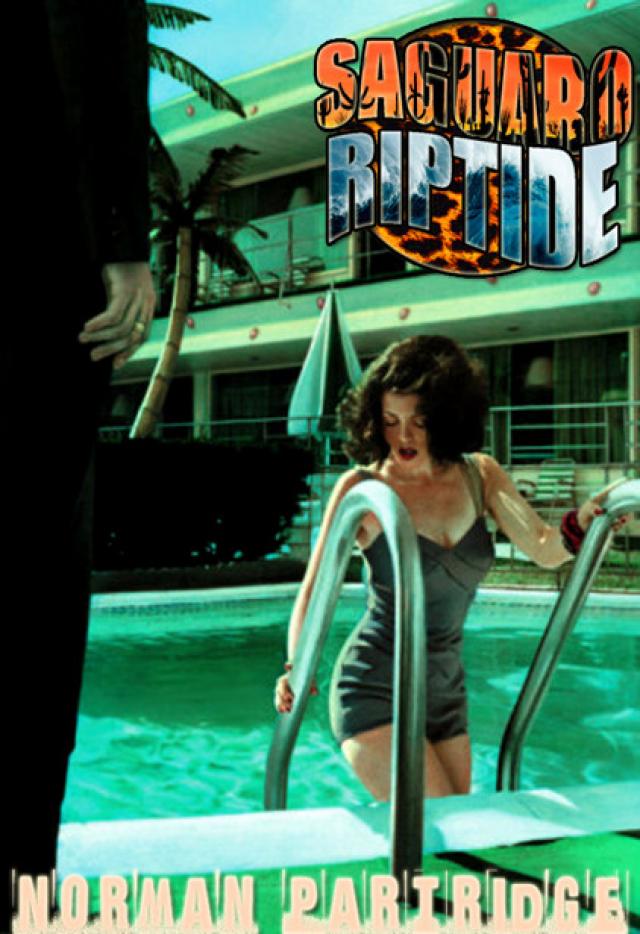


Pablo nodded. “I see your point. These days marketing is everything.”
“You got that right.”
“Well, she’ll be ready to roll manana, buddy. Me and my boys, we work all night.”
Jack thanked him, and they shook hands. “Maybe you can help me with one other thing—I’m crashing out at a friend’s tonight. He lives in this neighborhood. You know where Rancho Rojo Lane is?”
“Sure thing. Three blocks up, turn toward the Pacific ocean, one block over. Can’t miss it.”
‘Thanks.”
“De nada.” Pablo smiled. “Fact is, I should be thanking you.”
“Why’s that?”
“A couple weeks ago I had five hundred bucks in my pocket and didn’t know what to do with it. So I put it on Sattler’s black ass . . . even got odds.”
“Smart man.”
Pablo shrugged. “You want to know the funny part?”
“Sure.”
“If you would have come in here a couple of weeks ago, I would have bet a thousand.”
“Why’s that?”
Pablo grinned. “Amigo, you look a lot bigger on television.”
***
A huge saguaro cactus stood guard in the front yard at 1333 Rancho Rojo Lane, surrounded by a dozen senors intent on serious siestas.
The gentlemen were uniformly hunkered down—legs covered by colorful serapes, arms folded over their knees. Their chins rested on their arms, and on their heads they wore sombreros of the mucho grande variety.
Plaster sombreros on plaster cabezas.
Jack shook his head. Sure, he’d come across the Southwest’s peculiar version of the lawn jockey before, but never had he confronted such an impressive assemblage as the one that occupied Vince Komoko’s front yard.
Jack moved forward. His boots crunched over the speckled gravel that stood in for a lawn, but not a single plaster sombrero bobbed in acknowledgment of his presence.
Jack glanced at the giant saguaro as he passed by, noting with some measure of irony that it was concrete, as phony as the sleeping senors. He couldn’t imagine why anyone would buy a concrete cactus. It wasn’t like the real thing would inflate the ol’ water bill or anything.
He rang the doorbell. The merry strains of “La Cucharacha” echoed through Casa Komoko, but no one answered the door.
Baddalach used Freddy G’s key.
He opened the door.
He entered Vince Komoko’s house.
JACK OPENED VINCE KOMOKO’S REFRIGERATOR.
First impression? Vince Komoko had to be a midget. What else could explain the expansive assortment of airline-size liquor bottles, Lilliputian condiment bottles, and tiny Cheese ’n’ Crackers packets stored in the big Westinghouse?
Jack took a miniature bottle of vodka from the fridge. He rolled it between his hands, which had started to ache again. The vodka didn’t do the trick the way a beer would, but he had to think this through.
He clutched the bottle in his right hand and opened a few of the kitchen cupboards with his left. More food for midgets. Little bags of peanuts and potato chips, and a coffeemaker that looked like it could brew maybe half a cup, tops. The latter item was particularly surprising, given the fact that Komoko was also the owner of an impressive collection of coffee cups which bore the insignias of restaurants, gas stations, and motels throughout the Southwest.
Jack helped himself to some peanuts. One package wasn’t enough. Neither was two. He cut himself off at four—anymore and he’d feel like he should be earning some frequent flier mileage or something.
What had Freddy G said about Vince Komoko’s house? That it was a pirate’s treasure trove?
Jack exited the kitchen and searched the rest of the house.
Conclusion? If Vince Komoko was a pirate, he was definitely out of the Captain Crunch school.
Hanging in the bathroom were towels from motels in New Mexico, Texas, and Arizona. The shower curtain was from a joint in Tucson. The bath mat was from Dallas. The stampsized slivers of soap had been lifted from Motel 6. Tiny containers of designer shampoo and conditioner circled the tub. Without a doubt, that stuff came from joints that rated four stars in the Triple-A tour books.
Jack opened the cupboard under the sink. The space was stacked solid—miniature Kleenex boxes, rolls of one-ply toilet paper guaranteed to snag on a hairy man’s ass, even a couple of bottles of industrial strength Pine-Sol with PROPERTY OF ROADRUNNER MOTEL/GALLUP, NM scrawled on the side in magic marker.
Jack checked out the bedroom. The bed looked like it had been made by a guy who had spent some serious time in the military—spread folded just so, sheets and blankets tucked in tight. But, then, Freddy had said that Komoko was some kind of war hero, so that fit.
The only thing about the bed that didn’t scream GI was the little mint on the pillow. Red letters on the silver wrapper told Jack that the mint had been stolen from Freddy G’s own Casbah.
The bedspread was from a Best Western in Albuquerque, as were the pillowcases. The TV above the dresser had once been bolted to the wall of The Big Texan Motel in Amarillo. The lamps—a pair of avocado beauties that practically screamed 1973—were refugees from a Sheraton in Wichita Falls.
Jack sat on the bed. It was hard as a rock; had to have been from a motel, too. He glanced at the nightstand and was not a bit surprised to see a little metal box that made him suddenly nostalgic.
MAGIC FINGERS!
ENJOY AN “ELECTRO-MASSAGE”
ON OUR VIBRATING MATTRESS!
LET THE GENIE’S FINGERS TAKE OUT THE KINKS!
.25 FOR ½ HOUR
Jack had a quarter in his pocket.
He dropped it in the slot. Pulled off his boots. Settled back.
When the machine kicked off a half hour later, he had everything figured out.
He put on his boots and walked back to Pablo’s garage.
***
“I need maps for Nevada, Arizona, New Mexico, and Texas,” Jack said.
Pablo shook his head. “No, you don’t.”
“Huh?”
Pablo laughed, shooting his thumb over his shoulder at Jack’s Celica. The hood was up and two guys were under it. “You ain’t gonna make Texas in that thing. Not unless you leave it with me for a week.”
“You’re probably right. But it doesn’t hurt to plan ahead.”
Pablo handed over the maps. Jack started for the door.
“Hey, amigo,” Pablo said.
“Yeah?”
“You sure you want to pour all that money into your car? I could probably fix you up with something used that’s pretty nice, give you more bang for your buck.”
“No way. That Celica, it’s going to be a classic. The Ford Mustang, that’s the classic from the sixties. A couple more years, the Toyota Celica’s gonna be the Mustang of the seventies.”
Pablo thought that one over. Finally, he said, “You know what?”
“What?”
“You gotta stop taking punches to the head, amigo.”
***
Maps in hand. Jack returned to Komoko’s house. He found a stash of emergency sewing kits from the Dallas Westin in a drawer in the bedroom, and he used the needles to pin the road maps to the living room wall.
Then he sorted through all Komoko’s junk—the ashtrays and coffee cups and bath towels and miniature bars of soap and anything else he could find—spearing the cities on the map that the stuff had come from.
When Jack was finished, a couple dozen needles marked Komoko’s trail. It looked as if Vince had traveled the expected route—93 out of Vegas to Interstate 40, then 40 straight across Arizona and New Mexico and a good piece of Texas, finally cutting south toward Dallas on smaller highways. With one exception, Vince Komoko’s pirate booty had been appropriated from unsuspecting businesses along this route.
And that one exception didn’t make any sense, because it was a flyspeck town way to hell and gone in southern Arizona, a place with the unlikely name of Pipeline Beach.
Jack picked up an ashtray that he’d found in the bedroom, thinking maybe he’d read it wrong the first time. But there was no mistaking the words stenciled on the smoky green glass—
Surf’s up at
THE SAGUARO RIPTIDE MOTEL
Pipeline Beach, Arizona
Jack thought it over. Maybe Vince had taken a pleasure trip down south. Maybe. But for some reason, he didn’t think so.
So he thought about Vince Komoko, motel pirate, motor lodge Blackbeard. A guy like that . . . Christ, talk about your small potatoes. What was Komoko doing heisting Freddy G? Ripping off two mil from the mob was a hell of a long way from stealing a TV set or a midget-sized coffeemaker or a handful of pillow mints.
You didn’t make that kind of jump unless someone pushed you.
Jack stared at the ashtray.
He wondered if Vince Komoko had any friends in Pipeline Beach.
He wondered if Vince saved his phone bills.
***
The woman picked up on the third ring. “You got me,” she said.
“Hey, that’s great,” Jack said. “But it’s Vince I need to talk to.”
The woman was a couple hundred miles away, but Jack could feel her jump. “Uh . . .” she said. “You . . . you must have the wrong number.”
“No I don’t. You know Vince. Vince Komoko? Calls you all the time? You guys get together at the Saguaro Riptide, have some real laughs. Vince told me all about it.”
“Uh . . . well . . .”
“Sure, you know Vince. I’m his buddy. I’m supposed to meet him down there. Why don’t you give me your address and I’ll drive on down from Vegas. I’ve got something for Vince. Something he forgot—”
“No,” she said. “You’re wrong. I don’t know any Vince. And don’t come near me.”
She hung up.
***
Jack dialed Freddy G’s private number. Freddy’s niece picked up—at least she said she was Freddy’s niece. Her tone of voice said something else entirely.
A second later, Freddy came on the line. “Jack, how you makin’ out?”
“Good. Look, I’m gonna need to make a drive down to Arizona. Little town called Pipeline Beach.”
“Never heard of it.”
“That makes two of us. But I think our friend Vince has.”
“That’s good enough for me.”
“The thing is, my car’s in the shop. I probably can’t get started until tomorrow.”
“Forget that.” Freddy chuckled. “You get a cab and get your ass out to McCarran. Catch a plane. You need Tucson or Phoenix?”
"Tucson.”
“Okay then. The tickets will be waiting for you. We’ll make reservations for tonight at a motel in Tucson, and tomorrow you can drive down to Pipeline Beach.”
“Sounds good. But I’m kind of tapped out right now, what with the boxing commission holding up my purse and all—”
“Forget about that,” Freddy interrupted. “Soon as I get off the phone with you. I’ll call the Casbah manager and have him fix you up with some corporate plastic.”
“Hey, that’s great news.”
“Glad to oblige. ’Cause right now, you could use some great news.”
“What do you mean?”
“Well, the word on the street is that your pal the promoter dropped the assault charges.”
“Hey, that is great news!”
“Wrong-o, Jack.” Freddy sighed. “I’m afraid your tongue-tied pal has called in the Muslims.”
“Christ on a cross,” Jack said.
THE MAN IN THE AFRICAN HAT STOOD IN THE DESERT, waiting, surrounded by towering sandstone monuments the color of blood. The sky, too, was bloody, but the blood in the sky was drying, cottonlike clouds daubing the wound, the hot wind smearing clotting rivulets across a canvas the color of gutted salmon. But the man who waited in the desert realized that these colors—and, in fact, his impression of same—were impermanence personified. Soon other colors would come, triggering other impressions. Perhaps the wound would begin to heal. Perhaps a rusty brown horizon would scab the injured flesh of the heavens. Or perhaps the sunset would fade gently, less violently, to the color of an insignificant bruise—a magnificent, plum-ripened purple.
And then would come the night. The night was black, the same color as the man in the African hat. And, like the man, the night was a single color through and through, never giving way to another.
The coming of night was what the man in the African hat was waiting for. In truth, he did not mind waiting. Patience was one of many virtues he had forced upon himself long ago.
So he stood in the desert, and he waited among the sandstone towers. His Saturn automobile was parked twenty feet away, but he did not move toward it or seek an alternate shelter. Not even when the wind kicked up, powdering his black suit with fine red dust. Instead he stood near a lone pay phone which hung on a pole that a man with a whimsical turn of mind might have viewed as some form of mechanical cactus.
But the man who waited in the desert did not possess a whimsical turn of mind. It was his belief that laughter was an incalculable weakness. Even the slightest hint of a smile was unmasculine, in his opinion. When he looked at the phone, he saw it first as an instrument which facilitated communication.
Secondly, he saw it as a weapon. Telephone cords made dependable garrotes. With one, an adversary could be strangled in well under a minute.
The man’s left hand moved from his side, reflexively reaching to loosen his black bow tie, but this movement was terminated as soon as the man’s brain recognized it for what it was.
There was no place in his body for even a millimeter of unease. Of this the man was certain.
The offending hand became a fist. The man flexed it. Knuckles popped like dull firecrackers. His grip tightened, neatly trimmed fingernails digging trenches in callused palms. The muscles in his forearm danced, as did his well-developed triceps, and he waited for the telephone to ring, and he continued to flex his fist and the muscles which connected it to his torso.
The phone would most probably not ring for another hour. The man in the African hat had arrived at this place early because he would no more be late for an appointment than he would be anxious about arriving early for same. He always allowed adequate time for the incalculable interruptions of everyday life—flat tires, traffic cops, automotive collisions— though he was a careful man, and, as such, he was seldom troubled by incidents of this nature.
But the man in the African hat did not mind waiting in a place like this. This particular section of desert was the only area close to Las Vegas where the man felt comfortable. He truly enjoyed standing among the bloody sandstone monuments beneath a wounded sky. In this place a peaceful ease charged his soul, the same way pumping blood charges a flexing muscle.
The name of this place was the Valley of Fire. The man in the African hat liked that, as well. Names were very important to him. He felt that they should be chosen with great care.
Strange, in fact, to consider that most names were selected without an ounce of that particular commodity. The man in the African hat had been born with one name—Woody Jefferson—a name chosen by a father who was enamored of heroin, a name the man had been forced to wear for twenty long years. But it had been the wrong name—a name born of junkie imagination—and so the man had discarded it many years ago in a New Jersey prison.
Only when he found his true name did he truly find himself.
That name was Woodrow Saad Muhammad.
The man wore it proudly. His name was a gift from Allah, and it was sacred. He treated it with reverence. He expected others to do the same.
For example, he never allowed anyone to call him Woody.
In his mind, that familiarity was a particularly vile abomination.
Woodrow was a man.
Woody was an erect penis.
The last two men who had dared to call him Woody were dead.
***
Rahway was the name of the New Jersey prison where Woodrow lost five years of his life. He recognized now that he had deserved to spend time in such a place. He certainly was not proud of the crimes he had committed as a callow youth.
Those crimes belonged to Woody Jefferson, the terror of Camden, New Jersey, a boy who had not minded in the least if his name was twin to an unfortunate bit of slang. Moreover, that boy had actually preferred to be called Woody.
But Woody Jefferson was an ignorant youth, with ignorant ways. A second conviction for armed robbery earned him a stretch in Rahway, but robbery was actually the least of his crimes. Before the age of eighteen. Woody had murdered two men, one woman, three dogs, and an evangelist.
Woodrow thought that Woody had been a fool. The murders were a good example—each one had been committed in the heat of passion. Woody hadn’t earned a single cent from any of them.
Things changed for him in prison. He discovered the Muslim faith and the teachings of the Honorable Elijah Muhammad. Soon after, he became a member of the greatest nation on the face of the earth—the Nation of Islam. He became a man, truly, taking the teachings of Islam to heart.
Earth is spacious and a man can accomplish what he will.
Woodrow drew great strength from these few words. And through the Messenger, he discovered the words of others which helped him on his way.
One of these was Elijah Muhammad’s own instructor. Master Wallace Fard. It was Master Fard who first related the tale of Mr. Yacub, the black mad scientist who had created the white devil race. Woodrow realized that Master Fard was a bit of a mystic, but he did not doubt the Master’s word. An unceasing wellspring of inner faith allowed him to believe.
His belief was especially strong when he stood in the desert and black blankets of night pulled tight around the chins of the bloody sandstone monuments that surrounded him.
As now.
Woodrow looked to the sky. The stars seemed especially bright this evening. His eyes scanned the heavens, and he remembered a line from an old science fiction film he had seen as a boy.