The Caricaturist, page 1


SELECT PRAISE FOR
Norman Lock’s American Novels Series
______________________________________
“Shimmers with glorious language, fluid rhythms, and complex insights.”
—NPR
“Our national history and literature are Norman Lock’s playground in his dazzling series, The American Novels.… [His] supple, elegantly plain-spoken prose captures the generosity of the American spirit in addition to its moral failures, and his passionate engagement with our literary heritage evinces pride in its unique character.”
—Washington Post
“This is fiction of a high caliber … on the cutting edge of history, providing us with a way to grapple with our evolving sense of the past, as we wonder what is next.”
—New York Sun
“Lock writes some of the most deceptively beautiful sentences in contemporary fiction. Beneath their clarity are layers of cultural and literary references, profound questions about loyalty, race, the possibility of social progress, and the nature of truth … to create something entirely new—an American fable of ideas.”
—Shelf Awareness
“[A] consistently excellent series.… Lock has an impressive ear for the musicality of language, and his characteristic lush prose brings vitality and poetic authenticity to the dialogue.”
—Booklist
On The Boy in His Winter
“[Lock] is one of the most interesting writers out there. This time, he re-imagines Huck Finn’s journeys, transporting the iconic character deep into America’s past—and future.”
—Reader’s Digest
On American Meteor
“[Walt Whitman] hovers over [American Meteor], just as Mark Twain’s spirit pervaded The Boy in His Winter.… Like all Mr. Lock’s books, this is an ambitious work, where ideas crowd together on the page like desperate men on a battlefield.”
—Wall Street Journal
On The Port-Wine Stain
“Lock’s novel engages not merely with [Edgar Allan Poe and Thomas Dent Mütter] but with decadent fin de siècle art and modernist literature that raised philosophical and moral questions about the metaphysical relations among art, science and human consciousness. The reader is just as spellbound by Lock’s story as [his novel’s narrator] is by Poe’s.… Echoes of Wilde’s The Picture of Dorian Gray and Freud’s theory of the uncanny abound in this mesmerizingly twisted, richly layered homage to a pioneer of American Gothic fiction.”
—New York Times Book Review
On A Fugitive in Walden Woods
“A Fugitive in Walden Woods manages that special magic of making Thoreau’s time in Walden Woods seem fresh and surprising and necessary right now.… This is a patient and perceptive novel, a pleasure to read even as it grapples with issues that affect the United States to this day.”
—Victor LaValle
On The Wreckage of Eden
“The lively passages of Emily [Dickinson’s]’s letters are so evocative of her poetry that it becomes easy to see why Robert finds her so captivating. The book also expands and deepens themes of moral hypocrisy around racism and slavery.… Lyrically written but unafraid of the ugliness of the time, Lock’s thought-provoking series continues to impress.”
—Publishers Weekly
On Feast Day of the Cannibals
“Lock does not merely imitate 19th-century prose; he makes it his own, with verbal flourishes worthy of Melville.”
—Gay & Lesbian Review
On American Follies
“Ragtime in a fever dream.… When you mix 19thcentury racists, feminists, misogynists, freaks, and a flim-flam man, the spectacle that results might bear resemblance to the contemporary United States.”
—Library Journal (starred review)
On Tooth of the Covenant
“Splendid.… Lock masters the interplay between nineteenth-century Hawthorne and his fictional surrogate, Isaac, as he travels through Puritan New England. The historical details are immersive and meticulous.”
—Foreword Reviews (starred review)
On Voices in the Dead House
“Gripping.… The legacy of John Brown looms over both Alcott and Whitman [in] a haunting novel that offers candid portraits of literary legends.”
—Kirkus Reviews (starred review)
On The Ice Harp
“Lock deftly takes us into the polyphonic swirl of Emerson’s mind at the end of his life, inviting us to meet the man anew even as the philosopher fights to stop forgetting himself.… [A] remarkably empathetic and deeply moral novel.”
—Matt Bell
Other Books in the American Novels Series
The Ice Harp
Voices in the Dead House
Tooth of the Covenant
American Follies
Feast Day of the Cannibals
The Wreckage of Eden
A Fugitive in Walden Woods
The Port-Wine Stain
American Meteor
The Boy in His Winter
Also by Norman Lock
Love Among the Particles (stories)
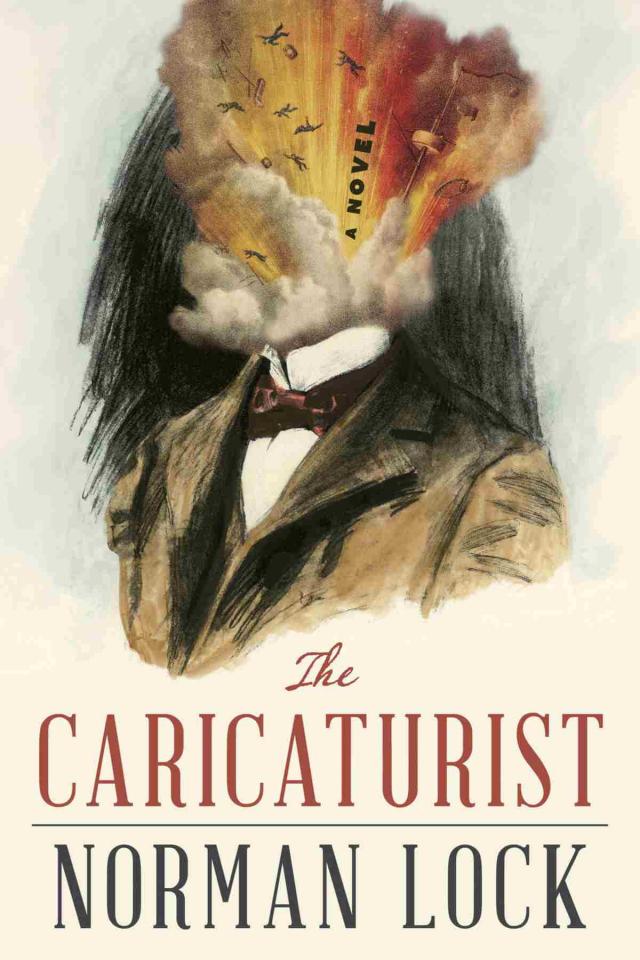
The
Caricaturist
Norman Lock
First published in the United States in 2024
by Bellevue Literary Press, New York
For information, contact:
Bellevue Literary Press
90 Broad Street
Suite 2100
New York, NY 10004
www.blpress.org
© 2024 by Norman Lock
Cover Photo © North Wind Pictures / Bridgeman Images
This is a work of fiction. Characters, organizations, events, and places (even those that are actual) are either products of the author’s imagination or are used fictitiously.
Library of Congress Cataloging-in-Publication Data
Names: Lock, Norman, author.
Title: The caricaturist / Norman Lock.
Description: First edition. | New York : Bellevue Literary Press, 2024. | Series: American novels series
Identifiers: LCCN 2023036369 | ISBN 9781954276277 (paperback ; acid-free paper) | ISBN 9781954276284 (epub)
Subjects: LCSH: Cartoonists--United States--Fiction. | Crane, Stephen, 1871-1900--Fiction. | United States--History--19th century--Fiction. | LCGFT: Biographical fiction. | Historical fiction. | Novels.
Classification: LCC PS3562.O218 C37 2024 | DDC 813/.54--dc23/eng/20230828
LC record available at https://lccn.loc.gov/2023036369All rights reserved. No part of this publication may be reproduced or transmitted in any form or by any means, electronic or mechanical, including photocopy, recording, or any information storage and retrieval system now known or to be invented, without permission in writing from the publisher, except by a reviewer who wishes to quote brief passages in connection with a print, online, or broadcast review.
Bellevue Literary Press would like to thank all its generous donors—individuals and foundations—for their support.
This project is supported in part by an award from the National Endowment for the Arts.
This publication is made possible by the New York State Council on the Arts with the support of the Office of the Governor and the New York State Legislature.
Book design and composition by Mulberry Tree Press, Inc.
Bellevue Literary Press is committed to ecological stewardship in our book production practices, working to reduce our impact on the natural environment.
This book is printed on acid-free paper.
Manufactured in the United States of America.
First Edition
10987654321
paperback ISBN: 978-1-954276-27-7
ebook ISBN: 978-1-954276-28-4
For my cousin and friend David Moore, Our grandmother Helen Ida (Barrett) Hub, And our great-grandfather Franklin Barrett
A man walked into the Night.
“What must I do?” he asked of it.
“There is nothing you can do,” Night replied.
The man would have seen its teeth
Had there been light to see by.
“What must I say?”
“There is nothing to say.”
He would have heard Night snigger
Had it not been for distant thunder.
“Will I be allowed to remain here?”
While he waited for Night to reply,
Darkness roared down the vast jetties of Space,
Engulfing him.
—Written by Stephen Crane on board
the Three Friends and pocketed
by Oliver Fischer, June 10, 1898
Fiasco
If there is a witness to my little life,
To my tiny throes and struggles,
He sees a fool …
—STEPHEN CRANE
AUGUST 9, 1897–AUGUST 17, 1897
Philadelphia and Croydon, Pennsylvania
The tassel on my Turkish fez fell across my nose each time I nodded over the bubbling hookah. The attic room, packed like a portmanteau with the necessities of the undiscovered artist, was heavy with the languid smoke of hashish, which loosened, if not my tongue, which felt like a lump of India rubber in my mouth, then the muscles that combined to keep my head erect. In plain words, I would fall into a drowse until a sneeze returned me to a kind of consciousness, causing the tassel to swing madly like the tail of a horse harassed by an imperialist fly, its tiny bulb of electric jade beyond the skill even of Lalique to imitate.
“It smells like burning mummies in here!”
Robert Pearson th rew open the windows. He had arrived unceremoniously while I was in a Pre-Raphaelite garden, admiring Swinburne’s golden bird.
“What do you call that thing on your head?”
“A fez.”
“Makes you look an ass!”
I bowed my head over my Persian slippers, which had been crushed under Pearson’s big boots. The tassel swung across my face, and I swatted it furiously.
“You’re a first-class clown, Ollie!” The result of a derisive snort, snot bubbled up in his nostrils, which he wiped on his sleeve. The sleeve, I noted, was frayed.
“Pearson, that’s a filthy habit,” I said as I lighted the gasolier, which cast a sickly gloom.
Settling noisily on my couch, he set to picking at the ravelings.
I drew on the hookah with a force sufficient to make the water boil madly in the blue glass bottle. “No doubt you’ve read Baudelaire’s Les Paradis artificiels concerning his use of hashish.… No? Well, I’ll lend you my copy if you promise not to wipe your boots with it.”
“I don’t sling the lingo,” said Pearson, who looked as if he’d sucked a sour pickle.
“By jingo, you should! Or maybe you think a Baldwin locomotive is more beautiful than Manet’s Le Déjeuner sur l’herbe?”
Pearson looked for a place to spit his contempt for the Old World and settled on an empty tomato tin in which I let my brushes steep.
“I have in mind a boating trip to Croydon,” I said like a nabob proposing an expedition down the Ganges.
“Are you inviting me?”
“We’re friends, aren’t we?” Despite our sniping, we were friends, and would be still, had he not been perforated by Spanish shrapnel. “Every Algernon needs his Jack. We’ll enlist Teplov in the business.”
Michael Teplov painted icons in the Russian style of such exquisite tininess as to elude criticism by the faculty of myopic old men at the Pennsylvania Academy of the Fine Arts, where we sniffed turps and linseed oil and dreamed of fame. His father, Mikhail, after beginning life in America as a sidewalk “puller-in” for the downtown department stores, had attained the enviable position—in our eyes—of wine merchant, supplying Philadelphia’s restaurants with French and German tipple. We could usually put the touch on the old man for several bottles of vin ordinaire to fuel our revels, so long as his bashful son was invited to sit among the sots.
Pearson stroked his beard. “What’s so special about Croydon?”
I was about to lay out my scheme when “Salome” let herself in. I had given her a key to my room in recognition of our alliance, spoken as the French pronounce it. I’d given her the handle “Salome” in praise of her sensuality. We had met the previous summer at Asbury Park, a resort town on the New Jersey seacoast, where I had set myself up as a boardwalk caricaturist. I have hers to this day, done in crayon, although the woman herself got away. Her name, front to back, was Anne Neel.
“Hello, you two scrags!” She unpinned her hat, and with a carelessness that always drove me mad, she tossed it on the bed.
Coloring to the roots of his reddish beard, Pearson said, apropos of nothing, “Gee rod!”
“We’re not the least scragged,” I said, waving my hand as if to dismiss the universe.
“You, my love, have been at the pipe.”
“Which is not to be scragged, tanked, or otherwise soused.” I leaned toward her and said, “I am drunk in the manner of a man whose senses are deranged by beauty.”
“What an idiot!” grumbled Pearson, who could be counted on to become a fool in Anne’s presence. (Yes, old friend, I was every bit of one in those days. Nearly ten years later, as I look back on them, I see little in my favor, except your affection for me.)
She drew on the hookah to no effect, since the hashish was dead and past reviving in the bowl.
Pointing to the rubber gas hose drooping from the wall, I invited her to take a draft.
“Maybe later,” she said as she unbuttoned her shirtwaist with a slowness that would have aroused a sloth.
“Not tonight, Salome.”
“I thought you wanted to draw me in the raw,” she said, her pretty lips gathered in a pout.
Pearson held his breath as I let the seconds pile up in a silence broken only by the popping of the gas fixture.
“Can’t you see I have a guest?”
A strangulated noise could be heard coming from Pearson’s throat.
“Oh well.” She buttoned up her blouse and fetched her hat. “Another time.”
“Stay awhile. I’m organizing a trip up the Delaware on my grandfather’s boat.”
“I’m fond of the old boy; he’s right off the square.”
“There’s something you can do for me.”
“In Croydon!” said Pearson, scowling, since he could think of nothing intelligent to mark his presence in the room. Sensing his inadequacy, he began to smoke a cigarette at a furious rate.
“Croydon is a charming place,” she said, recalling, I hoped, the afternoon when we had chased her windblown hat into the japonica bushes.
“I’ll have one, Robert.”
Pearson took a cigarette from the pack. She parted her lips. His hand shook; she steadied it with her own. His face turned incarnadine, but he managed to light it with a Diamond match.
“Thanks.” Her eyes narrowed in an uprising of blue smoke. “You were saying, Ollie?”
My eyes glazed with smoke and memory, I saw once more the japonica blossoms caught in her long hair.
“Oliver!”
A hand organ playing in the street abruptly cut memory’s ever-lengthening cord.
I laid a hand on Anne’s arm and my eyes on her breast. Had she read my thoughts?
Irritated, Pearson took a loose piece of wallpaper and yanked it. A little cumulus of dust arose and mingled with the smoke of tobacco and stale Turkish hashish.
“Damn it, Robert, I was fond of those fronds!”
Shamefaced, he tried to rehang the torn paper with a paste of spit and powdered plaster.
“Oh, shut up, Oliver!” said Anne sharply.
I muzzled the droll, incorrigible Algernon Moncrieff, whom I had idolized ever since I saw a Mask and Wig production of The Importance of Being Earnest.
The floor being hard and pillows scarce, we sat our derrières on books—Pearson on The Idiot and Anne on Anna Karenina. I plumped for Crime and Punishment. Russian novels tend to be more commodious than the slender volumes of the Symbolists. Reverently, I opened a secondhand edition on French art to a reproduction of Le Déjeuner sur l’herbe. “I want to paint this!”
“Manet’s Luncheon on the Grass,” I said.
“In Croydon?” asked Pearson skeptically.
“Yes.”
“Whatever for?” asked Anne.
“Does an artist need a reason?”
“It’s a damned queer picture,” said Robert, fingering his Adam’s apple.
“Paris went berserk in ’63 when it was shown at the Salon des Refusés. The critics called it ‘scabrous’—all but Zola, who mocked them.”
There are some leaves, some tree trunks, and, in the background, a river in which a chemise-wearing woman bathes; in the foreground, two young men are seated across from a second woman, who has just exited the water and who dries her naked skin in the open air. This nude woman has scandalized the public, who see only her in the canvas. My God! What indecency: a woman without the slightest covering between two clothed men!
Referring to the reproduction of the Luncheon, I assigned our parts in the tableau vivant.
“You, Robert, by virtue of your reddish beard, will take the role of the gentleman at the center of the painting—this handsome fellow dressed in a chestnut-colored coat, white flannels, and a dark tie knotted at a soft collar. You’re completely at ease, sitting slightly behind Anne, who sits with one leg drawn up, her chin resting in her hand as she gazes unabashedly at the viewer.”
“Why am I smiling?” she asked.
“We don’t know. It’s one of the aspects of the painting that makes it enigmatic. Another is why neither gentleman takes the slightest notice of a naked young woman in their midst.”
“And what is she doing?” asked Anne, pointing to a dark-haired woman dressed in a chemise, whose gaze is lowered and hand partially submerged in the river in which she stands.