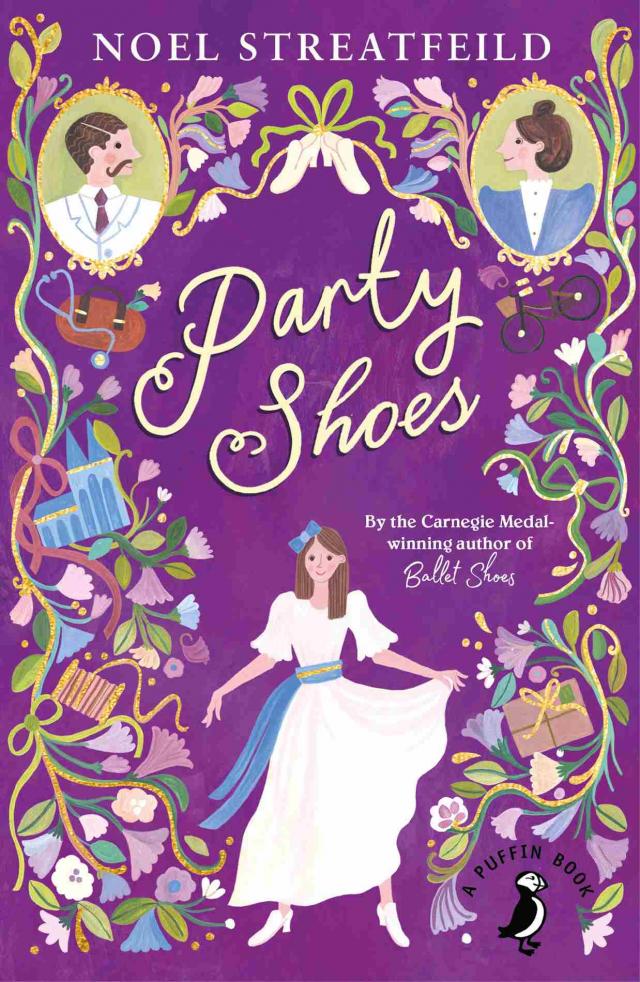
Party Shoes, page 1


About the Author
NOEL STREATFEILD was born in Sussex in 1895 and was one of three sisters. After working in munitions factories and canteens for the armed forces when the First World War broke out, Noel followed her dream of being on stage and went to RADA where she became a professional actress.
She began writing children’s books in 1931 and after Ballet Shoes was published in 1936 she quickly became one of the most popular authors of her day. When she visited Puffin exhibitions, there were queues right out of the building and all the way down the street. She was one of the first winners of the Carnegie Medal and was awarded an OBE in 1983.
Noel Streatfeild died in 1986.
Books by Noel Streatfeild
BALLET SHOES
CIRCUS SHOES
TENNIS SHOES
THEATRE SHOES
PARTY SHOES
Contents
1. The Parcel
2. The Committee
3. Asking at Home
4. Asking at the Abbey
5. Writing
6. The Holidays Begin
7. Getting a Cast
8. The Ballet
9. The Mummers
10. Philip
11. Christopher’s Rehearsal
12. Madame Ramosova
13. John Comes Home
14. Clothes
15. Phoebe
16. Wardrobe Mistresses
17. Sally at Linkwell
18. The Pageant Takes Shape
19. Dress Parade
20. Fire
21. The Twentieth
22. Dress Rehearsal
23. The Pageant
A Letter to the Reader of this Book
During the war my niece, Nicolette, was given a party frock and shoes from America. A lovely frock of the sort that nobody had because of clothes rationing. Blue organdie over a silk slip. It was Nicolette’s first long frock and she could hardly wait for the right occasion to put it on. But no occasion turned up. There was at that time almost no transport. So little heating that if it was a winter party something warmer than organdie would have to be worn. Food was difficult, and every grown-up person too busy to arrange a party of the making-do sort it would have to have been. The frock hung in the cupboard, and hung in the cupboard. A most depressing place for a first long party frock. Worst of all, Nicolette grew. Even the most optimistic person had to wonder, if there ever was a party, would the frock be too short and too tight?
I am glad to say that Nicolette did wear the frock. If it was a bit tight it did not show. She looked exactly as somebody of thirteen ought to look at a party. But I remember the months of anxiety when the frock hung in the cupboard. How awful to have been Nicolette. How many more girls had party frocks and shoes sent them from abroad and no party? So, for Nicolette in England, and the givers of the party frock and shoes in America, I wrote this book.
1. The Parcel
THE PARCEL came while the family were having breakfast. It caused confusion because, although it was marked ‘unsolicited gift’, the postman had to have a lot of money before he would deliver it. Mrs Miggs, who came in to help with the housework, had not arrived, so Miss Lipscombe, who was boiling instruments in the surgery, answered the bell. Miss Lipscombe had, when she was younger, been Matron in charge of a workhouse. People say to Matrons, ‘Yes, Matron’, whenever they speak, which makes it difficult for Matrons when they retire. If for years and years people have said ‘Yes, Matron’ in respectful tones it is hard to get accustomed to people saying a plain ‘No’. To make up for all the respectful ‘Yes, Matrons’ that she did not get, Miss Lipscombe made a favour of everything that she did in the hope that people would remember how important she was. That was why it was awkward that it was she who answered the postman’s ring.
The family were sitting round the table eating breakfast, which that day was cereal and sausages. They heard Miss Lipscombe say, ‘Nonsense. No parcel is worth so much. No, I certainly can’t disturb the doctor at breakfast.’ Mr Bins, the postman, could not be heard at first, but presently he lost his temper and then his voice roared into the dining room. ‘I’ve no time for argufying with you. I’ve got work to do, if you haven’t.’ At the breakfast table the children looked at each other in a hopeful sort of way. Mr Bins was a very old friend, and he had said the one thing that was absolutely certain to make Miss Lipscombe angry. Doctor Andrews got up.
‘I had better save bloodshed.’ He opened the dining-room door and called out in a casual voice, as though he had not heard the argument going on, ‘Morning, Bins.’
The dining-room door being open the children could hear everything. Miss Lipscombe and Mr Bins talked at the same time. Mr Bins said he was not going to be put about by a cantankerous female that didn’t know her place. Miss Lipscombe said what the world was coming to she didn’t know when creatures like Bins could so far forget themselves. Then Doctor Andrews cut in:
‘Sorry you’ve been taken from your work, Miss Lipscombe, perhaps you would get my instruments packed. I shall be off in a minute.’ And to Mr Bins, ‘What’s the damage?’
There was a pause after that. Obviously money was being paid out. Then Mr Bins said, ‘Good morning, Doctor.’
As soon as the money was paid all the family, from Mrs Andrews down to Benjamin, thought about the parcel.
Mrs Andrews wondered whether it was for her. Could it possibly have some of that glorious flannel in it that made shirts for the boys?
John knew it was not for him but wondered about the stamps. He collected Dominions only. He hoped it was from Canada and had a very expensive stamp on it. He had only started his collection in the summer just before his first term at Marlborough, and it was not up to much yet.
Selina prayed hard that it was for her. It might be because she had a godmother in America. It was true that her godmother did not usually send presents for proper occasions. She never remembered Selina’s birthday was in October. If a present came now, even though it was late, it would look like a present for Christmas. All the same, just once she might have kept an occasion for a change. She sent lovely presents when she did send them. Selina hoped, if it was a present, it had in it something like sweets that could be shared round, because, on the whole, she got more parcels than anybody else in the family, and that made things a bit awkward when you were just a cousin and everybody else were brothers and sisters.
The twins, Christopher and Sally, had an especial interest in the parcel. They guessed it came from America and was for them. It might say ‘unsolicited gift’, but they knew that they had written a letter to Uncle Bill in Washington, which, if it had got past the censor, would mean that Uncle Bill had been shopping. Christopher wanted skates. He wanted skates so badly that he dreaded a cold winter because he had not any. When it comes to not wanting ice and snow things are pretty bad. The maddening thing was he had saved the money to buy skates, but there were no new ones being made, and none of his size were ever advertised for sale second-hand. He had not exactly asked for skates in his letter to Uncle Bill, but he had said, ‘It would be pretty decent if there was ice this Christmas, if I had any skates, but there are none made now.’ Sally felt she could no longer live without silk tights. She had written, ‘There is a chance that I may dance the lead in the ballet we do at school at Easter, if I had silk tights which I have not. There are no silk tights at all here now.’ Later on in the letter they had said, ‘We have saved enough money to pay for skates and tights when we can get anyone to get them for us.’ They were a little nervous about saying this as it was the sort of thing the censor might stop, but, on the other hand, they did not want Uncle Bill to think he was expected to fork out the money, because he had only his pay as a Colonel and their father said that did not go far in Washington.
Phoebe hoped there was material in the parcel that Mum would make into a party frock for her. She had no proper party frock. She had expected to come into Sally’s pink one by now, but Sally remained so terribly small for twelve and a half. It was particularly sickening this Christmas that she had not got a party frock because she had a party to wear one at. It was the only party this year and was for children of ten or under. It was all very well for Mum to say she looked a pet in that cream thing; she looked simply awful in that cream thing. It was much too short and much too tight, and other children who were nine and a half did not wear, for best, a dress which their sister had worn five years before.
Augustus had not paused in his eating while Miss Lipscombe and Mr Bins were arguing about the parcel, but, as he ate, little quick pictures of what might be in the parcel jumped in and out of his brain. Once a parcel had come from Australia with sort of crystallized fruits in it, at least that was what Mum had called them. There had been gorgeous parcels from America from Selina’s godmother, with enormous sweets on the end of little sticks. Once there had been a parcel from Canada with a great tin of nuts in it. He did not know what to hope was in this parcel. He just saw a nice mixture of what had come in other parcels.
Benjamin had taken advantage of the parcel distracting everybody’s attention to hum, which he was not allowed to do at table. He made little words to his humming. ‘It’s a ’normous parcel. It’s a present for Benjamin. It’s full to the very top of ice cream.’
Doctor Andrews came back into the dining room. He was carrying a large box done up in brown paper. He held it out to Selina.
‘It’s for you, niece. It says, “Miss Selina Cole, unsolicited gift.” I hope it’s something you want because there was three pounds, eighteen shillings, and fourpe nce to pay.’
Mrs Andrews nearly dropped the teapot.
‘Three pounds, eighteen shillings, and fourpence! Good gracious, Jim!’ She turned to Selina. ‘I hope it’s something useful, darling, after the Customs charging all that much.’
The doctor sat down and went on with his breakfast.
‘I hope it’s something she likes.’
Selina read the declaration form. She looked up, her eyes shining.
‘It’s a dress and shoes. Oh, Aunt Ann, I do hope it’s velvet. I think I want a red velvet dress almost more than anything else in the world.’
Mrs Andrews laughed.
‘Put the parcel in the armchair until after breakfast, darling. I know it seems awful to be expected to wait to open it, but you can’t risk getting sausage on to a new dress, and you easily might sitting next to Benjamin.’
Benjamin stopped humming. He had a hoarse, deep voice for somebody of four. He leant across to his mother.
‘My dear! I never upset my food.’
His mother pulled his plate closer to him.
‘Not more than once a day; eat up, old man.’
It was hard for Selina to swallow the rest of her breakfast. Nobody, however hungry they are, could be really interested in breakfast when a parcel marked ‘New dress’ is lying unopened in the armchair in the corner. Especially a person who has not had a new dress for a year because of needing an overcoat, shoes, a gym tunic, and underclothes. It was hard to sit still and not fidget while the others finished eating. Uncle Jim was very strict about sitting still. He was so often called away in the middle of a meal to attend to a patient that he was afraid his children would think that was the normal way to behave. He would never let anybody get up for any reason at all until the last person had finished eating, and he never allowed them to say, ‘For goodness’ sake hurry up.’ If anyone fidgeted he just took longer before he got up himself, or would let Aunt Ann get up, to show that the meal was over. Fortunately for Selina the surgery bell rang just as Augustus, who was always slow, finished drinking his milk. The doctor got up and breakfast was over.
Aunt Ann helped Selina untie the string. All the family wanted to help pull off the brown paper but Aunt Ann held them back.
‘Don’t be mean. It’s Selina’s parcel.’
Inside was a box. It was tied up in the lovely way Americans tie up parcels, with yards and yards of fine scarlet and green ribbon. When that ribbon was taken off the box and the lid lifted there was a card lying on top of tissue paper. The card said: ‘I have just remembered that you are now ’tweenage, and must be ready for this. I hope you’ll have a good time in it.’ Selina laid the card on one side and lifted the tissue paper. There lay the frock. She held it by its shoulders and gaped at it, and so did everybody else. It was long. Down to the ground. Cream organdie over a cream satin slip. It had ruched square shoulders and short puffed sleeves. After a moment Phoebe said in a whisper:
‘There’s still things left in the box.’
Selina undid three smaller parcels. In the two biggest were one each of a pair of satin shoes, and in the other was a blue sash for the frock and a blue bow to wear in her hair. Aunt Ann seemed to find all this glory too much for her legs. She sat down suddenly.
‘Selina, my pet, your godmother has the most inflated ideas about what is worn in English villages at the end of a long war.’
Sally took the sash from Selina and put it round herself. She turned to her mother.
‘She’ll have to wear it fairly soon or she’ll have outgrown it, and then it’ll come on to me.’
Mrs Andrews was looking sadly at the frock. If only it had been made of velvet or serge or something useful.
‘Even if it passed on to you, darling, what could you wear it for?’
Phoebe spoke very fast, her words falling over each other.
‘If nobody ever is going to wear it, couldn’t it, oh couldn’t it be cut short and me wear it for the party next week?’
John saw how aghast Selina looked at the suggestion. He gave Phoebe’s curls a tug.
‘The present was for Selina, not you. Of course she’ll wear it.’
Selina was grateful to John, but she did not think he quite appreciated the position.
‘When?’
John turned to his mother.
‘Isn’t somebody getting married or anything like that? It could be worn as a bridesmaid.’
Sally stroked the blue sash.
‘Everybody who was going to be married has been married, and anyway, you can’t just say “I’ve got a frock, can I be a bridesmaid?”’ She turned suddenly to her mother, her eyes shining. ‘I tell you what, couldn’t we give a party so’s she could wear it?’
Mrs Andrews looked miserable.
‘Oh, I do wish we could, but who would come to it? You see, the sort of party for that frock would be an evening one, a dance, and nobody could get here in the evening. There isn’t a bus after seven. That’s why the Smiths’ little party next week for people under ten is in the afternoon, and even then it’s been an awful job to get twelve children together.’
John did not care if he never went to a dance, but he did feel it was pretty sickening for Selina to get a present that she could never use. He knew just how he would feel if somebody gave him a motorbike and it had to stop in the garage.
‘Selina’s got to wear it. We’ll have to think of a way. Can I have the stamp, Selina?’
Selina was trying on the shoes. Even with wool stockings they looked gloriously partyish. She felt so low that she could only nod. Mrs Andrews got up.
‘If anything they’re too big, which is a comfort. Rack your brains, darlings. Perhaps together you can think of something.’
Christopher was so disappointed about the skates that he had not until that moment thought about Selina. Now, looking at her feet, he felt sorry for her. Suppose it had been skates, and then there was never any ice.
‘Let’s think until teatime and then after tea let’s have a family committee. Everybody must have an idea by five o’clock.’
Mrs Andrews went towards the door. A family committee did not include her or the doctor. It was a thing held by the children. Selina had been counted as family since she had come to live with her Andrews cousins.
‘It’s getting late, we may as well get the chores done. Twins, it’s your day for clearing the table; don’t forget, when you’ve swept up the crumbs, to give them to the birds. I found a whole lot on the floor yesterday. Selina, when you’ve finished helping with the bedrooms write a nice thank-you letter to your godmother.’ She glanced anxiously towards the window. ‘I do hope Mrs Miggs is coming.’
The frock and shoes were back in the box. Selina folded the brown paper. Sally picked up the string and wound it into a little skein.
‘Cheer up, Selina, we’ve never had a family committee yet when we didn’t think of something.’
Christopher was piling the breakfast plates together.
‘Five o’clock in the schoolroom, and everybody’s got to come with an idea.’
2. The Committee
THE SCHOOLROOM was only called the schoolroom when the family remembered. It had always been the nursery. When John was eleven he had asked some boys to tea one Saturday afternoon, and without thinking he had said, ‘Come up and play in the nursery.’ On Monday when he went to school he found lots of boys saying, and even singing, ‘Andrews Major plays in a nursery.’ This was such a humiliation that John had to speak to his father about it. Doctor Andrews spoke to Mrs Andrews and it was decided that in future the nursery was to be called the schoolroom.
The family met in the schoolroom at five o’clock as arranged. It was a bit difficult for them to be there at the right time because tea was at half past four and at five o’clock they were still sitting round the table. Augustus and Benjamin took a long time over their tea. It was the last meal they had before going to bed, and they seemed to remember this, filling up cracks in their insides with slice after slice of bread and jam. Phoebe also ate a good deal at teatime, but she did not need to eat as much as Augustus and Benjamin because she had a cup of cocoa and a slice of bread and margarine when she went to bed. John, Selina, Christopher, and Sally, who were going to have a proper supper at half past seven, got very bored watching Phoebe, Augustus, and Benjamin eat. Tea was the one meal that the doctor and Mrs Andrews did not eat with their family. Mrs Andrews said, ‘I was brought up to have tea in the drawing room, darlings, a very uncomfortable meal which none of you would like, but it’s the one bit of civilization, as I knew it, left to me so I’m clinging to it.’