Flight & Anchor, page 1


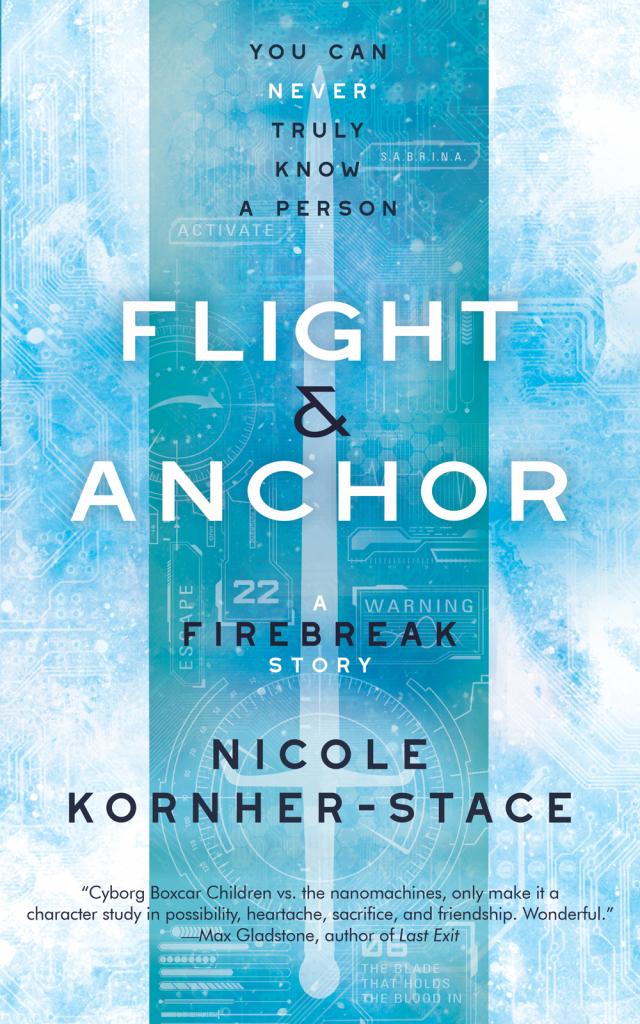
Praise for Flight & Anchor
“Kornher-Stace masterfully weaves a deviously creative romp that is somehow both nail-bitingly suspenseful and tenderly cozy, as if the authors of How to Win the Time War had decided to set The Boxcar Children in Snow Crash’s tongue-in-cheek hyper-capitalist dystopia. Flight & Anchor is a stunning achievement.”
—Maria Dong, author of Liar, Dreamer, Thief
“A character study in possibility, heartache, sacrifice, and friendship. Wonderful.”
—Max Gladstone, author of Last Exit
“Nicole Kornher-Stace’s Flight & Anchor pulls you along with the speed of a dystopian freight train. Taking the weaponized childhoods of kids like Ender and blending in a touch of Hanna-style rebellion against the mother organization, Kornher-Stace draws you into a story not only of survival but of calculated surrender to drive the best possible outcome.”
—Kimberly Unger, author of Nucleation
“Flight & Anchor: what a feat of adrenaline, friendship, loyalty, fraught circumstance, and fun! Nicole Kornher-Stace deftly—exquisitely—balances the lightness of classic runaway-child books (Boxcar Children! From the Mixed-Up Files of Mrs. Basil E. Frankweiler!) with the savagery of survival-in-the-wilderness books (Hatchet! Robinson Crusoe!) to entertaining and harrowing effect.”
—C. S. E. Cooney, author of Saint Death’s Daughter
“Kornher-Stace’s nail-biting novella, full of Easter eggs for fans of her expanding universe, keeps us grounded in stakes that are both world-shattering and movingly human.”
—Mike Allen, Shirley Jackson Award–nominated author of Aftermath of an Industrial Accident
“Kornher-Stace finds a perfect balance between human childhood and otherworldliness by making us fall for the myth and propaganda surrounding 06 and 22 while also making them deeply human, if only deep down. A burning ember of humanity in the midst of overwhelming propaganda.”
—Bookish Brew’s Reviews
Also by the Author
Desideria (2008)
Archivist Wasp (2015)
Latchkey (2018)
Firebreak (2021)
Jillian vs Parasite Planet (2021)
A Note from the Publisher About Piracy
Dear Reader,
Thank you so much for purchasing this reading copy. We hope you enjoy it.
This book is intended for personal use only. Please do not share, reproduce, post, or resell it. All editions of this book are protected by international copyright law; all rights are reserved without the express permission of the author and the publishers.
Piracy is illegal. It hinders publishers from putting out more great books like this. Most importantly, piracy keeps authors from getting paid.
If you have any questions about copyright, or if you think this copy was pirated, please immediately contact us at tachyon@tachyonpublications.com.
Thank you,
Tachyon Publications LLC
1459 18th Street #139
San Francisco, CA 94107
415.285.5615
tachyon@tachyonpublications.com
Flight & Anchor
© 2023 by Nicole Kornher-Stace
This is a work of fiction. All events portrayed in this book are fictitious and any resemblance to real people or events is purely coincidental. All rights reserved including the right to reproduce this book or portions thereof in any form without the express permission of the author and the publisher.
Interior and cover design by Elizabeth Story
Tachyon Publications LLC
1459 18th Street #139
San Francisco, CA 94107
415.285.5615
www.tachyonpublications.com
tachyon@tachyonpublications.com
Series editor: Jacob Weisman
Editor: Jaymee Goh
Print ISBN: 978-1-61696-392-7
Digital ISBN: 978-1-61696-393-4
Printed in the United States by Versa Press, Inc.
First Edition: 2023
9 8 7 6 5 4 3 2 1
For all the readers, who keep giving me a reason
1.
One cold night, two children stand in front of a coffee shop. Snow blows all around them, and they are badly dressed for it. A boy and a girl, the barista thinks, noticing them through the plate glass. Young enough or short enough that the window-paint lettering coffee, retouched just that morning by the barista themself in blue to match the blue chalk on the sidewalk chalkboard, arcs over both their cold-huddled heads like a monochrome rainbow.
Strange clothing, the barista notes. The one they think might be a girl is in an oversize lime-green blazer, the maybe-boy in a white lab coat, like a tiny pharmacist. Both blazer and lab coat are buttoned the whole way up, but the blazer only goes so far. Beneath it, the girl’s got on what looks like a simple dark shirt that buttons up the front. No winter gear to speak of. No real coats, even. Snow in their hair. Window light pools around them: soft, buttery, looking much warmer than it is.
The barista checks the time on their lenses. Four minutes ’til closing. Quiet this time of evening, usually. Storm like this, the place is dead.
A normal day, they’d be finishing up wiping down the counters now. Flipping the door sign—like the chalkboard, a symptom of how terminally old-school their boss is—to closed. Walking the six blocks to the checkpoint, then the two blocks home. Tilting their head back, from time to time, to let the app on their lenses show them where the stars would be, if the sky weren’t wall-to-wall snow and smog instead.
Frozen with rag in hand, though, they’re just standing there. Watching these two weird kids devour that yellow light with their eyes.
Nine years old or so, the barista reckons. Then reconsiders. It’s the look on the children’s faces that’s lifting years off them, peeling them back to something less worldly, less certain. It’s in the way the upper half of the girl’s body is oscillating toward and away from the door, one indecisive degree at a time, while her feet, in their no doubt seasonally inappropriate attire, do not move. In how the boy holds himself in perfect, ready stillness, in a way that reminds the barista of nothing so much as their cat, facing down a spider, unsure which of them is the hunter and which the prey.
Eleven, maybe. Twelve at most. In any case too young for this shit. Unsupervised. Underdressed. Three hours into an expected all-night nor’easter. They look like they’re wearing half a Halloween costume apiece. And not the good kind. The kind you slap together out of stuff from your parents’ closets and basements when you can’t afford the ones at the party store.
The snow is coming down in big clumpy flakes now. When it hits the kids’ faces, it takes an alarmingly long time to melt.
In hindsight, the barista will wonder why it took them so long to act. Unpack, in bullet points, as part of a whole minute-by-minute replay of everything they should have done instead. Rationalize, albeit feebly.
Because the children weren’t visibly injured.
Because the barista has their implant set to alert them if there’s a bioweapon in the air and it hadn’t gone off in days.
Because one of the best parts of this job is how it’s way out on the edge of the Stellaxis half of the city, just a couple of blocks from the Greenleaf one, near enough to the little strip of demilitarized zone that beyond a few small skirmishes, this street hasn’t seen real combat since October.
Because, due to the above, there was no quantifiable threat from which the kids need rescuing. Just two kids, ogling a warm haven from the cold.
Because the real answer makes less sense.
Because the real answer doesn’t land as a thought, not a fully formed one anyway. It’s more of a catch in the barista’s breath every time this girl so much as shifts from foot to foot, or brushes the snow from her face, or shoves her hands deeper in her pockets, and every time the boy pointedly does none of these things. It hits as a tiny chemical shock, like getting slapped on the back of the skull. Danger, it’s telling them. Run.
The barista gives this due consideration. Then, deliberately, over the mental alarms this raises, they push it carefully away. They’re children on their own in the snow. Maybe they’re looking at the barista alone in the shop and thinking they can clean out the register and get gone before the barista can blink up a security patrol on their lenses. At their age—hell, at older—the barista would’ve done the same. Endless war fucks with you like that. Pares down your options to what starts to look a lot like one single, inevitable, ill-advised point.
The barista puts down the rag. Whatever the fuck this is, it’s not happening on their watch. They march across the warmth of the room and haul open the door. Two faces snap to them, too quickly, raising little hairs on the back of their neck. The word vampires skips unbidden across the surface of the barista’s mind. Have to be invited in.
But no. These are just a couple of cold kids who’ve clearly had a hell of a day. Close up, the blazer and pharmacist coat are snow-damp but clean, a faint chemical smell wafting off them that the barista at first mistakes for the perfume of dryer sheets—then realizes they can’t quite identify. The kids themselves: also clean. Well-fed. At a glance, no signs of chronic dehydration. This isn’t life for them, then. At least not yet. Just a misadventure. The kind that gets the mis- tacked on in hindsight, best the barista can tell. Plenty of those in their past. They know the signs.
In the children’s proximity, the barista’s lenses remain silent. Nothing airborne and deadly has seeped into their weird Halloween-costume attire, waiting to be unleashed on the shop’s interior. The barista blinks up a quick weapons-check interface—not exactly retail worker standard-issue, but one can only hear so many on-the-job horror stories before going to a cousin of a friend of a friend with a month’s worth of tips for a small software upgrade—and, of course, the kids aren’t packing. Not so much as a rusty junk-shop pocketknife or a few inches of sharpened rebar, and that’s maybe most surprising of all. They’re out here wandering around in what could at any minute renew its status as a conflict hot zone, and they’re defenseless.
So the barista props the door open with one hip. Tilts their head in toward that delicious drench of coffee-scented warmth. Letting the heat out, Rach—the owner, Rachel, the barista’s boss—would say. But Rach doesn’t stay for closing, and nothing fills the day-old bakery basket like a big-ass storm, and these kids can wait for whoever they belong to just as well out of the snow as in it, and if the barista gets back to their apartment a little later than usual, honestly so what.
The kids pause to assess the barista, straddling the doorway in their jeans and undercut and apron like it’s a magic portal and they’ve got one sneaker in each world and finding both options underwhelming. The question of the kids’ footwear remains a mystery for now, as both have white plastic Comforts of Home shopping bags tied over what at least, thankfully, do look like decent boots. There is snow in their eyelashes. The barista’s pretty sure they’ve been standing outside the window for only five to six minutes, max. Could track their prints back behind them, before the snow dusts them over. See where they’ve been. Who’s looking to follow after.
But that could be anywhere. Anyone. And they’re here now, and who knows what’s behind them. Some paths are best left unwalked, or unrepeated. It’s a big city, and not all of it as nice as Rach’s place. Not nearly.
All at once, both kids straighten as something passes between them invisibly, and despite themself, the barista shudders. Something’s off about their movement, something dreamlike, something the barista has seen before, grasps after, glances off.
It won’t be until tomorrow that they’ll realize, hands shaking hard enough to drop the stack of to-go cups they’re carrying out from storage, what exactly it is they’re looking at. By which point it will be too late to either help or hinder them. Both hypotheticals will strike them, suddenly, as absolutely laughable.
They’ll tell the story of this night for years to come. They live and work in a city that’s been at civil war with itself for decades and this, right here, is probably the closest they have ever come to death.
For now, whatever this weird feeling is, it lasts only that one nanosecond. Then they’re kids again and cold and hungry, and they’re tracking grimy snow onto the just-cleaned tile, and the barista sighs and flips the sign to closed behind them, and then goes to fetch a mop.
2.
In the light, at a table, snow steadily melting off them and puddling around their chair legs, the barista’s earlier observations are proven correct: two healthy-looking, well-fed, clean children of twelve or so. Each sits before a giant paper cup of coffee with enough flavoring syrup to give their grandkids cavities, enough soywhip on top that they’ll have to tunnel into it with plastic spoons. The day-old bakery basket sits between them, full of cellophane-wrapped muffins and oversized cookies. Couple of brownies. The barista makes the executive decision that the brownies will be their dinner if the kids don’t inhale them first.
When the children are sufficiently hopped up on sugar to (hopefully) drop their weirdly considerable guard, the barista will ferret out their secret. For now, they rock their chair back on two legs in the exact way that used to drive their mother up the wall, as if to say to these kids: see, I’m not so old. You can trust me. I’m one of the good ones.
But the kids just sit there awkwardly, not appreciating the elegance and solidity of the barista’s plan. There’s another pause, like they’re conferring. It’s less weird under the lights, at least—looks less like telepathy and more like they’re chatting over their implants like anyone else.
“Nice jackets,” the barista ventures. Gestures toward the hooks by the door. Old-school’s not so bad, they figure. Company coffee shop wouldn’t have those. Or baked goods that weren’t primarily cellulose and flavoring. Or a living, breathing barista to offer a couple of runaways a basket of same, gratis, instead of having already called in some company cops on a loitering charge. Old-school’s pretty fucking great, actually, all things considered. “If you want to hang them up over there to dry . . .”
They trail off. The kids have gone guarded again. Their arms tighten against their sides, like those ridiculous jackets are about to be taken from them by force.
Not that, then.
A moment passes. Another. Then the kids reach into their pockets and come out with a handful of loose change apiece, actual, physical metal coins like maybe one customer a day pays with. It’s a good way to tell at a glance when a person’s implant’s been locked out or otherwise disabled, infrequent enough that Rach keeps saying she doesn’t need to waste the counter space on a register anymore, not when upward of ninety-five percent of customers blink over their coffee money to the smart surface of the counter directly.
None of which is easily reconciled with how the kids are pretty obviously conversing with each other over their implants now.
The barista waves this off before they can start counting their cash out on the tabletop.
“My treat. I’m Cass, by the way,” Cass says, tapping their nametag like it hasn’t already been evaluated, inventoried, classified, along with every thread of their clothing and every pore of their face. Can’t shake the feeling that they’ve passed some kind of test, just in having successfully coaxed two half-frozen kids in from the cold. That the fact of them, here, staring at their cooling coffees while the storm rains off them, is test number two.
Is it a hospital, what they smell like? No, that’s also wrong. This is going to bug Cass for a while. Like being unable to place where you’ve seen an actor in a movie. They hate that.
The kids look at them like Cass is a trap they’re working out how to disarm. Cass, who remembers being a shy child themself, smiles, reaches for a brownie, peels back the cellophane, and takes a big, slightly-too-crumbly bite. The kids watch Cass chew, swallow. Cass can’t tell if it’s that the kids are hungry or that they’re trying to figure out whether they’re about to be poisoned, waiting to see what happens when that sticky mouthful hits Cass’s guts.
Meanwhile, the boy is pushing his pile of coins across the table resolutely. “We can pay,” he says. It’s the first that either of them has spoken. Voice like a person passing a checkpoint ID scan, trying to duck their face into the collar of their shirt, never mind that it’s the implant, not the face, that’s being scanned. One hundred percent instinctual, and one hundred percent a gesture too old for a child of twelve. He wears it like the coat: outsize. Cass files this away. “Take it.”
Cass shakes their head. “Sorry, kid. Already closed the register. Besides, we’re running a special today. Free coffee and muffins to the last two customers of the evening.”
They track the boy’s left eyebrow as it quirks up by about a half millimeter. Shakes his head. It’s another tiny, tiny movement, planned and executed with what looks to be a surprising amount of concentration. For all that the girl’s weird grace of motion grates at Cass’s backbrain, the boy’s painstaking exertion of control over his is worse. This kid moves like he’s holding two leashes with sleeping tigers at the end of them, and both are this close to waking up.
“We can pay,” he says again. It isn’t that his teeth are gritted. It’s more that his whole person is. “How much?”