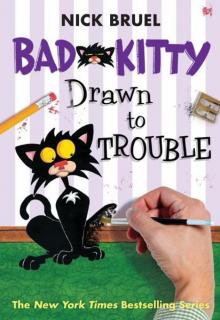
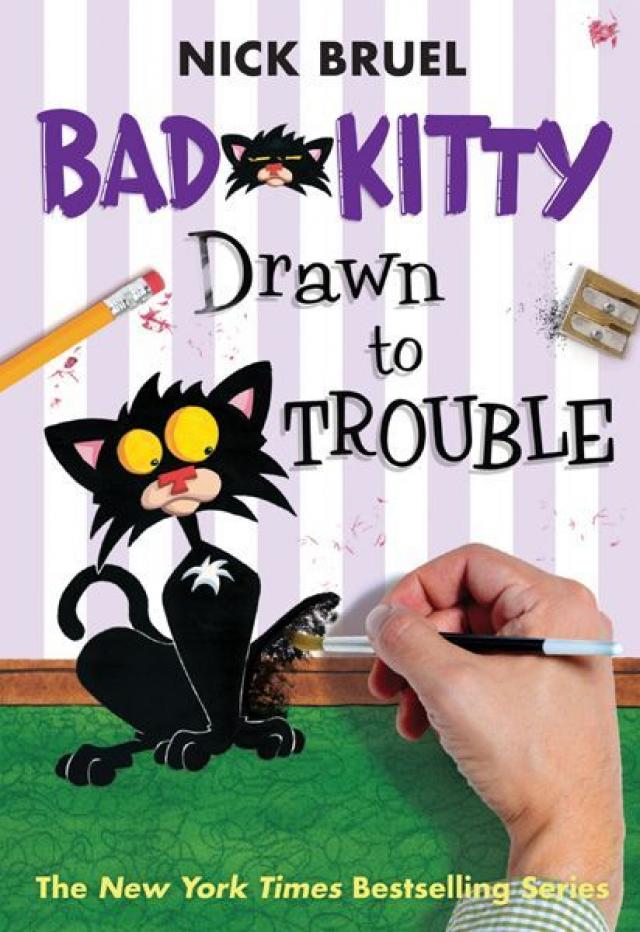
Bad Kitty Drawn to Trouble, page 1


For this, the tenth Bad Kitty book, I would like to acknowledge the invaluable sup- port I have always received from the good folk at Roaring Brook who have sup- ported me and my ornery pussycat from the very beginning. Special attention must be given to Simon Boughton, Lauren Wohl, the ever-patient Jennifer Browne, who has designed each of these books, and, of course, my often invoked editor, Neal Porter. Likewise, nothing would have been possible over the years without their assistants Ben Tomek, Kat Kopit, Colleen AF Venable, and Emily Feinberg to name just a few. Within the walls of Macmillan, Roaring Brook’s parent company, there are simply too many names for me to acknowledge, and to be perfectly honest I don’t know them all even though I should. But to the many people in marketing, publicity, sales, design, and so forth . . . thank you. Your participation in Bad Kitty’s growth and success has been critical. So, from the bottom of my heart, thank you.
Copyright © 2014 by Nick Bruel
A Neal Porter Book
Published by Roaring Brook Press
Roaring Brook Press is a division of Holtzbrinck Publishing Holdings Limited Partnership
175 Fifth Avenue, New York, New York 10010
mackids.com
All rights reserved
Library of Congress Cataloging-in-Publication Data
Bruel, Nick, author, illustrator
Bad Kitty drawn to trouble / Nick Bruel. — First edition.
p. cm
"A Neal Porter Book."
Summary: Author/illustrator Nick Bruel tries to explain to the reader how to
write a story, but Bad Kitty is not at all happy about the plot, which has her
going on a turnip diet to lose weight. Includes a recipe for roasted turnips.
eISBN 978-1-4668-6196-1
[1. Cats—Fiction. 2. Authorship—Fiction. 3. Illustration of books—Fiction. 4.
Humorours stories.]
I. Title.
PZ7.B82832Bal 2013
[E]—dc23
2013001633
Roaring Brook Press books may be purchased for business or promotional use. For
information on bulk purchases please contact Macmillan Corporate and Premium Sales
Department at (800) 221-7945 x5442 or by email at specialmarkets@macmillan.com
First edition 2014
Printed in the United States of America by RR Donnelley
& Sons Company, Harrisonburg, Virginia
1 3 5 7 9 10 8 6 4 2
• CONTENTS •
CHAPTER ONE
MEET THE AUTHOR . . . . . . . . . . . . . . . . . 5
CHAPTER TWO
MEET THE CHARACTER . . . . . . . . . . . . . . 21
CHAPTER THREE
THE CONFLICT . . . . . . . . . . . . . . . . . . . . 38
CHAPTER FOUR
MEET THE ANTAGONIST . . . . . . . . . . . . . 53
CHAPTER FIVE
PLOT POINTS . . . . . . . . . . . . . . . . . . . . .66
CHAPTER SIX
THE MOST IMPORTANT RULE ABOUT
WRITING STORIES . . . . . . . . . . . . . . . . . .93
EPILOGUE . . . . . . . . . . . . . . . . . . . . 117
APPENDIX . . . . . . . . . . . . . . . . . . . 126
•CHAPTER ONE•
MEET THE AUTHOR
Hi.
My name is Nick Bruel.
I am an AUTHOR,H which means that I write books.
In fact, I wrote THIS book.
This one. The book you’re reading right now.
Now, smell the book you’re holding. That’s right. Smell it.
Does it smell like paper? That’s how you know it’s a book.
If you are reading this book on an electronic device, please download an app that will make your book smell like paper. Then you’ll know what I’m talking about.
All words followed by a H will be defined in the Appendix at the end of this book.
Don’t you think it would be nicer if you could see me? After all, I can see YOU. So, I think it would be nicer if we could see each other.
Like all children’s book authors, I am extremely good-looking. But I’m not sure how you could see that for yourself.
I know! I’ll make a drawing of myself!
As you can see, I am also an ILLUSTRATOR,H
which means that I made all
the artwork, also known as
"illustrations," in this book.
Hmmmm . . . I’m not
sure if this is good
enough.
What to do? What to do?
Hey, I know! I’ll draw a mirror! Then I’ll look into the mirror and you can see me!
As both the author and illustrator of this book, I can do anything I want.
HI THERE!
Now
I can
see you,
and you can
see me!
I told you I was good-
looking. Now stop staring at
me! Didn’t your mother ever tell
you that staring at good-looking
people for too long can make
you go color blind? No? Really?
Well, that’s what my mother always told me.
She also told me that watching too many cartoons would make me wet the bed. And, boy, was she ever right about that! Although, I do think the quart of orange juice I drank every night might have had something to do with that.
ACTUAL PHOTO OF THE AUTHOR IN FIRST GRADE
Long, flowing
hair
Radiant
smile
Awesomely
cool glasses
Stylish
striped mock-
turtleneck
shirt bought
with matching
pants (not shown)
But enough about my personal life! We have important work to do!
This is a BAD KITTY book, and we haven’t even seen Kitty yet!
I’m going to start drawing Kitty now. You can draw Kitty with me if you want. I’ll draw on the left, but I’ll leave you enough room on the right so you can follow each step. If you are reading from a library book, you may want to ask your librarian first if you can draw on the pages.* If you are reading from a digital copy of this book, go ahead and draw on the screen; your parents won’t mind.**
1. Draw her nose.
2. Draw her mouth.
3. Draw her elbows. No, wait! I meant eyes.
Draw her eyes. Sorry.
4. Now draw the hair on her head.
*Your librarian is going to say going to say "No."
* * Yes, they will.
Are you exhausted yet? No? Really. Well, I am. I need some water. I’m going to go get a glass of water and come right back.
Ahhh . . . that’s better. You’re still here? But I was gone an hour! Don’t you have homework or some- thing? Fine. Where were we? Oh, right . . .
5. Now draw her ears.
6. And finally her whiskers.
HI, KITTY!
Shall we draw the rest of Kitty? Yes? Well, too bad. Because I don’t feel like it. HAH! Just kidding! I’m funny. Wasn’t I funny just now? I thought I was very funny. Everyone loves me because I’m funny. Didn’t you think I was . . . um . . . okay. Moving on.
7. Next we draw Kitty’s elbows. I mean NECK! Neck. Sorry.
8. Draw her shoulders and front paws.
Don’t forget
about that little
tuft of white fur
on her chest.
9. Now her back legs and paws.
10. And finally her tail.
That wasn’t so hard, was it? Now draw her about a billion more times and you’ll know what my job is like.
You’ll probably want to practice drawing Kitty so here’s what you can do . . . Just photocopy pages 10 through 13 and keep drawing her over and over just as I showed you. But don’t tell my editor. He won’t like this idea one bit.
Too late! He
found out!
Which one of
you told him?
Let’s see now. Something is still not quite right.
It’s as if something is still missing. But what can it be? We drew her eyes. We drew that little tuft of white fur on her chest. Maybe she needs more elbows. No, that’s not it.
Kitty, can you think of what’s missing?
Oh, right! We still have to give you color! Silly me. Just wait here a minute, Kitty, while I go get my paints.
Okey dokey, Kitty. Hold still while I apply some colors to you.
As you can see, I use a veritable rainbow of colors to paint Kitty.
Her fur is jet black. Her nose is cadmium red, shaded with red earth. Her eyes are cadmium yel- low, shaded with yellow ochre. Her mouth is flesh toned and shaded with brown pink. And the white tuft of fur on her chest is highlighted with a hint of cobalt blue.
What’s that? You can’t see all of these beautiful col- ors? What about the yellow ochre? The cadmium red? The cobalt blue? Can’t you see ANY of them?!
EGADS!
You’ve gone COLOR BLIND!
I told you not to stare at my picture too long!
•CHAPTER TWO•
MEET THE CHARACTERH
Okay. Let’s get started!
We’re lucky! We already have a character for our story. That’s YOU, Kitty!
Yes, YOU! You are someone who has a personal- ity, and as our story moves forward we’re going to get to know you better.
In fact, Kitty, you’re not just any character. You’re goi
It’s a bit like being the star in a movie.
I thought you might like that, Kitty.
No! Not now, Terry.
Go back! Go Back!
Terry? Don’t worry about him, Kitty. That was just a little FORESHADOWING,H which is when a writer drops little hints about what’s going to come later in the story.
But right now we need a SETTING,H someplace where your story can take place.
Deciding on a setting is one great way to start a story.
For instance, maybe our story will be a great pirate adventure! In that case, we might set our story in the middle of the ocean!
Oops. Sorry about that, Kitty. Here . . .
let me help you up.
So ocean adventure was a bad idea. But don’t worry, Kitty. We’ll think of something. Maybe we could set our story in the jungle.
Sure! We’ll make an exotic jungle tale set inside the wild, untamed forests of Africa with strange plants, mysterious noises, and huge, dangerous beasts of prey.
What’s wrong, Kitty? Don’t you like this setting?
Not now, Terry!
Fine. Maybe we could set our story in the frozen North. That would be different.
Or maybe a spooky graveyard! Readers never seem to get tired of a good zombie story.
You know what . . . We could use all three settings. In most stories, the settings change.
But, NAH! I think we should stick with the same old setting we usually use in your stories, Kitty: your home.
You’re a cat, after all, Kitty. And cats usually live inside a house. Sometimes, it’s important that the setting match the character to make the story believable.
Of course, a story doesn’t always have to be believable to be good.
•CHAPTER THREE•
THE CONFLICT
So now we have a protagonist and we have a set- ting for our story. But a story just isn’t a story until something happens. But how do we make some- thing happen?
Well, let’s think about our protagonist—Kitty. If we want to write a story about her, we need to get to know her better.
Let’s begin by asking ourselves some questions about Kitty . . .
What does Kitty like?
What does Kitty NOT like?
What makes her happy?
What makes her angry?
What is she afraid of?
Asking questions like these about your protagonist is one of the most important things you can do when you’re writing a story. Because when you find the answers, you just may find your story.
I know one thing that Kitty cares about. She likes food. So, let’s think about that.
Hey, I know what we can do! Let’s make a MACGUFFIN!H What’s that, you ask? A MacGuffin is a goal or desired object that a character in a story really wants. In this case, I think Kitty would really want a big bowl of her favorite FOOD. So let’s give her some.
But here’s the problem . . . If we just give Kitty the food, and then she eats her food, then there really won’t be much of a story.
What we need to do is create a little CONFLICT.H
Conflict is what happens when a character faces a problem or a challenge. Without conflict, a story would be very dull, indeed. So let’s not make it so easy for Kitty to get what she wants.
Sorry, Kitty, but you’re getting too fat. We’ve decid- ed that you need to eat less.
But here’s the good news! Our story is starting to take shape! In fact, I think we can now give it a title . . .
Wow. Doesn’t this look like it could become a great story, Kitty? Are you as excited as I am?
You see, Kitty, often the conflict that a character like yourself faces can become the PLOTH to the story. The plot is simply what happens in a story. And the plot to this story will be about what happens when you don’t get the breakfast you want.
Gosh, Kitty. You can be such a harsh critic some- times.
But going on a diet doesn’t mean that you have to go hungry, Kitty. Here ya go!
This is great! Our story has a plot. But I think it can use a THEME.H If you going on a diet is the plot, then maybe the turnip can be the theme. Hmmm . . . that doesn’t sound right. Maybe the cat food is the theme. No. The polar bear? No.
You know what, Kitty, I’m embarrassed to say this, but I don’t think I know what a "theme" is. Well, who better to turn to than our very own answer man: Uncle Murray.
OH, UNCLE MURRAY!
WHAT’S THE DIFFERENCE
BETWEEN PLOT AND THEME?
Hi, Uncle Murray. I need some help
with how to write a story.
I’ll do what I can, Boss.
So, to begin . . . What is a plot?
The plot is what the story is about.
Okay, then what is a theme?
The theme is what the story is
about.
Wait . . . WHAT? Are you trying to tell me that the plot and the theme to a story are the same thing?
No, they’re totally different. Well, kinda differ- ent. The plot describes what HAPPENS in a story. But the theme describes the ideas or the message in a story.
So what is the PLOT in our story?
Well, the plot here would be what happens when that goofy cat has to
YAY! I
love, love,
LOVE to
write
stories!!
go on a diet and doesn’t get the food she wants.
And the THEME?
Well, you’ve been talking a lot about things like “character” and “setting”
and “plot” and stuff like that. So, I
think the theme here is about writing
stories.
So the plot would be Kitty going on
a diet and all of the goofy things that
happen because of it. But the theme
would be the idea of my using this story
as a way of teaching kids how to write
their own stories.
Now you’re getting it!
So, do all stories need both a plot AND a theme?
Well, all stories need a plot. If nothing is happen- ing, then it’s not really a story. A story doesn’t really need a theme to be a story. But a theme will always make a story more interesting.