

Washington's Labyrinth (The Guardians of Legacy Book 8), page 123


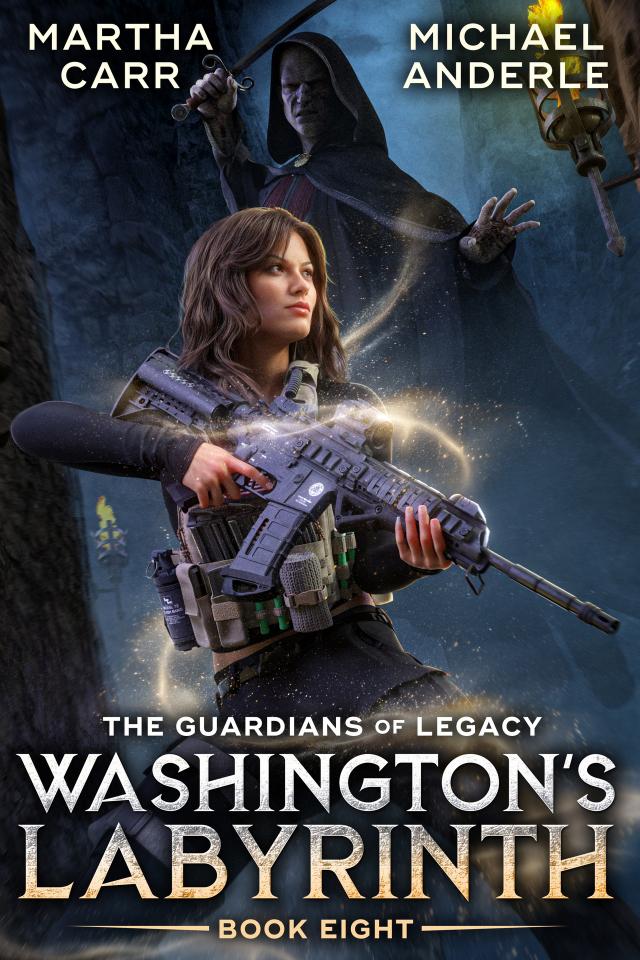
WASHINGTON’S LABYRINTH
THE GUARDIANS OF LEGACY™
BOOK EIGHT
MARTHA CARR
MICHAEL ANDERLE
This book is a work of fiction. All of the characters, organizations, and events portrayed in this novel are either products of the author’s imagination or are used fictitiously. Sometimes both.
Copyright © 2025 LMBPN Publishing
Cover Art by Jake @ J Caleb Design
http://jcalebdesign.com / jcalebdesign@gmail.com
Cover copyright © LMBPN Publishing
A Michael Anderle Production
LMBPN Publishing supports the right to free expression and the value of copyright. The purpose of copyright is to encourage writers and artists to produce the creative works that enrich our culture.
The distribution of this book without permission is a theft of the author’s intellectual property. If you would like permission to use material from the book (other than for review purposes), please contact support@lmbpn.com. Thank you for your support of the author’s rights.
LMBPN Publishing
2375 E. Tropicana Avenue, Suite 8-305
Las Vegas, Nevada 89119 USA
Version 1.00, October 2025
ebook ISBN: 979-8-89354-336-0
Print ISBN: 979-8-88878-292-7
THE WASHINGTON’S LABYRINTH TEAM
Thanks to our JIT Readers
Dave Hicks
Christopher Gilliard
Peter Manis
Sean Kesterson
Dorothy Lloyd
Diane L. Smith
Editor
SkyFyre Editing Team
CONTENTS
Chapter 1
Chapter 2
Chapter 3
Chapter 4
Chapter 5
Chapter 6
Chapter 7
Chapter 8
Chapter 9
Chapter 10
Chapter 11
Chapter 12
Chapter 13
Chapter 14
Chapter 15
Chapter 16
Chapter 17
Chapter 18
Chapter 19
Chapter 20
Chapter 21
Chapter 22
Chapter 23
Chapter 24
Chapter 25
Chapter 26
Chapter 27
Chapter 28
Chapter 29
Chapter 30
Chapter 31
Chapter 32
Chapter 33
Chapter 34
Free Books
Martha’s Notes
Michael’s Notes
Books by Martha Carr
Books by Michael Anderle
Connect with the Authors
CHAPTER ONE
The analog clock ticked insistently. Each second landed in the silence with a dry snap. Sergeant Bill Tolan finished scrawling his name on the duty log and let the pencil fall on the paper with a click, then swiped his badge over a scanner as digital confirmation.
The digital handoff cleared. He always used both, per procedure. Computers forgot in the worst way.
There was something amusing about using a pencil in a state-of-the-art facility. Given the age of many of the UPDOs in the Long-Term Storage Warehouse, maybe it wasn’t funny.
He’d heard that the staff at Camp Legacy used UPDOs in the field. Warehouse Command hated the idea. The LTSW was all about locking them up and throwing away the key.
The monitor tech, a private, was muttering to himself about the wall of camera feeds. Nobody spent more than a few weeks in the LTSW without developing the habit of muttering in the dark. Rows of glowing blue aisles filled the screens. In one frame, an amber diode on a locker blinked.
“Aisle Delta had a vent hiss an hour ago,” the tech advised him. “Facilities cleared it, no delta-P. Left a note in the system.” He stood and straightened his uniform. “Thank God you’re here. I have to go to the can.” The regs required every monitoring station to be manned 24/7. Two minutes in the bathroom wasn’t worth getting punished.
Bill nodded. After the tech departed, Bill grunted and turned the ledger toward him. He circled the entry in firm pencil and added a question mark. He didn’t like relying on someone else’s fix without asking what had triggered it.
Hisses were never just hisses in the warehouse, and accidents killed people…or worse. There was no greater concentration of dangerous supernatural knick-knacks in the entire country, if not the world.
Behind a blast-glass viewport, a corridor stretched off into the distance. Argon filled one of the containment rooms. In it was a long, thin case, coffin-shaped and lightly frosted, marked with a code he’d memorized.
He shivered and pushed the thoughts away. He’d been trained that belief gave UPDOs powers. He didn’t know how far that extended, and he wasn’t one of the few LTSW personnel with resistance. There was no reason to risk it with the more dangerous items.
The outer security door buzzed open. Footsteps echoed. Someone stopped in the doorway and casually leaned against the frame. “God, it’s cold in here,” Drew Mencken greeted. The corporal was grinning as usual, though he looked tired. He’d been on a different shift. Maybe he didn’t want to come back.
Bill shrugged. “It’s fine.”
“Did they turn the air down again, or is that just your disposition?”
“You want warm, transfer to Kilo and sit next to that Pele obsidian for a shift,” Bill replied, not looking up. “I haven’t sweated that much outside a sauna in a long time.”
Mencken stepped inside. He held a Styrofoam cup from the break room, steam curling out in lazy spirals. “You get those science fair pictures uploaded? Your kid’s volcano looked like a war crime.”
Bill frowned. “Garage still smells like sulfur and glue. Containment saves lives.”
Mencken tapped the slogan printed on the warning poster behind the desk like it was scripture. “Especially from the actions of middle schoolers.” He dropped onto the spare stool and set the cup down just off the coaster. Bill noted that the badge on Mencken’s uniform was clipped to the right side. Mencken always wore it on the left. A petty observation, but they didn’t assign people to the LTSW who weren’t detail-oriented.
He hoped Mencken wasn’t hung over, but that’d explain his expression and his badge. A brief loss of concentration was all it took for an accident.
“You get any interesting crate gossip while I was on day shift?” Mencken asked.
“A flicker earlier.” Bill was still concerned. “Might be the switch again.”
“You think anything’s ever really quiet down here?”
Bill shrugged. “If it is, it’s probably listening.”
Mencken nodded, gaze flicking toward the screen bank. “I’ve been thinking. Which one’s worse, you and me babysitting UPDOs in neat rows like we’re in a museum, or the battalion in Virginia? They don’t even know what they’re looking for half the time before they roll up on it. I mean, they had to raid an entire base filled with UPDOs. How about that mummy, and Philadelphia with a crazy lady who can body-hop?”
It wasn’t the first time Mencken had asked. “Field’s worse. Out there, you’ve got variables you can’t see, and you have to worry about civilians who don’t know about UPDOs, let alone protocol. In here? We write the rules and stick to ‘em.”
Bill shook his head. “We’ve had accidents, but this place is still standing. No breaches either. That means something.” He smiled and patted his chest. “The task force is gone, and they have the USLC now, but the warehouse is still here.”
“Rules never broke a sweat to save a life,” Mencken noted.
Bill let it pass. They watched the cameras cycle for a moment. The red line on the corridor floor didn’t blink or stutter. The freezer lockers were quiet, the containment labels clear.
Mencken glanced at the duty log and frowned. “What’s the one in Aisle Hotel? The bone hook?”
“Wrapped in twelve layers of ballistic gel. Still twitches if you breathe on it.”
Bill didn’t have to check. He’d walked the perimeter a hundred times, maybe more. He had entry clearance for the storage zone, unlike Mencken.
“You trust these crates and containment rooms?”
“I trust the steel and the signage, and I don’t touch anything I don’t want to bury.” He frowned. “I wish we had all those barrier candles they’ve been using at Legacy.”
Mencken shrugged. “From what I hear, they’d burn out if we used them for very long.” He nodded at the monitors. “Any of those get to you? Not what’s deadliest. What makes you think twice about who you are?”
Bill leaned back with a frown. Everybody asked that type of question after working at the warehouse for a while, but Mencken had never been so existential about it.
“Anything that talks.” Bill shrugged. “It makes me worry about getting stuck as a ghost in a little box.”
“That’s…” Mencken blinked and sighed. “That’d be bad.”
There was something off about the cadence of his voice. The rhythm and flow didn’t sound right. Bill turned his head. “You okay?”
Mencken smiled wide and easy. His right hand flexed around the cup.
He was left-handed. Bill narrowed his eyes.
The corporal’s gaze drifted back to the
“What if someone walked out with something small?” Mencken asked. “A rusty key nobody would miss. Would you stop them?”
“That’s literally our job. Why the hell wouldn’t I? I swore an oath and signed an eighty-page document that said I would.”
“Even if it’s not dangerous?”
“It’s not our place to decide what’s dangerous. That’s way above our pay grade.”
Mencken chuckled. “Petty men with petty concerns playing God. Those are the people we’re listening to?”
Bill dropped his gaze to the silent alarm switch beneath the desk and made sure he could find it without looking.
“Nothing is ‘nothing’ in here.” His voice was as flat as the desktop. “You know that. The simplest, smallest thing can be dangerous in ways we can’t imagine.”
Mencken’s eyes were still on the red. “From one point of view.”
Bill glanced at the door. “Geez. I wonder what’s taking the private so long.”
Two men were better for handling trouble.
“When you got to go, you got to go.” Mencken stared at him. “Do you ever think about what all this really is?”
Bill grunted and flexed his fingers at his sides. “Be more specific.”
“The warehouse. The crates. The shelves stretching past sanity. All of it.” Mencken gestured at the red-line corridor. “We call it containment, but it’s more like a quarantine for ideas.” He spread his arms. “This country was founded on freedom. Freedom of speech, freedom of ideas, freedom of religion. Now we lock it up and only let it out if it can help us lock other things up. If it can curtail freedom.”
Bill had had his fill of philosophy during the mandatory ethics training. Too many people with too little field time getting abstract about consequences they’d never had to dodge. The men and women from Camp Legacy had faced UPDOs and the terrorists using them. Not all of them had escaped unscathed.
There was something else chewing at the edge of Bill’s thoughts. “Aren’t you the same guy who said, ‘It’s all boxes in the end?’ Now you suddenly care about freedom for crazy, cursed magic?”
Mencken cocked his head. “‘Cursed?’ Hm. The British thought our founding ideas were cursed and delusional.” He gestured at the blast glass. “We trap history in there. Not the dates and medals kind, but the dangerous kind. The stuff that asks hard questions. That changes you. That could change the country.”
“We store objects.” Bill scoffed. “Dangerous ones, at that. We’re not here to be changed. We’re here to make sure nobody else has to. Don’t you understand how close it’s been, especially this last year or so? That mummy in Foxtrot could kill everyone in this building if it escaped. Half the shit the 1st Battalion has sent us could wipe out towns or help someone take over the country. Some of this stuff is dangerous in ways you can’t even tell.”
The corporal nodded. His expression was calm but too still, like he was watching himself from the outside. “You ever wonder if that makes us the real problem? We choose what the world is allowed to remember?”
Bill turned to him now, eyes narrowing. “Are you hungover, Mencken? Or have you been hanging out online and met a new girl?”
“Why do you ask?”
“Because you sound like you swallowed a manifesto, and I figured a nice ass convinced you to do that.”
Mencken smiled. This wasn’t the grin from earlier. This one was thinner, with fewer teeth and more threat. “Maybe I’m just tired of pretending we aren’t curators with guns.”
Bill exhaled and sat back. The stool creaked.
“All right.” His gaze dropped to the alarm button again. “Mnemonic protocol. Now.”
Mencken blinked. “Are you serious?”
“Dead.” Bill’s hand rested near the laminated card taped to the side of the terminal. “What was your first duty station before they onboarded you for the LTSW?”
Mencken didn’t hesitate. “Joint Base Lewis-McChord. I was there for a year and a year at Fort Huachuca before that. I was recruited for the warehouse staff at Huachuca.”
Bill didn’t relax. “What’s my kid’s name?”
“Layla.” Mencken laughed. “Come on, Bill. It’s me. How could I know about her volcano and not know her name?”
Bill’s hand drifted toward his holstered pistol. “You don’t sound like you. You don’t move like you.”
“What the hell’s that mean?”
“It means I know how you drink and which hand you write with. You’re wrong on both counts tonight.”
Mencken’s expression didn’t change. He slowly stood up, paper cup in hand—the wrong hand. Behind them, a camera feed jittered. Aisle Echo, upper-left quadrant.
He glanced at the door. “Private’s taking a damned long time in the bathroom.” He kept his hand on his holster. “He left right before you arrived. I wonder if you had anything to do with that.”
Mencken stepped closer. “Do you love liberty?”
“Don’t come any closer. Of course, I love liberty. Did someone pay you to betray your country, Mencken? Hot spy tell you to grab a couple of UPDOs to prove your love?”
“Do you love liberty?” Mencken repeated, voice calm.
Bill’s mouth opened. “What the hell is this? Please tell me you’re drunk. You keep acting weird, you’ll get shot.” His grip tightened on the gun. Pulling a firearm outside training meant, at minimum, stacks of reports and having to justify it personally to his commanding officer. He had to be sure before he did that.
Mencken nodded. “What price are you willing to pay?”
Bill’s mind clouded. He tried to draw his gun, but it fell out of his hand and clattered to the floor. He stumbled toward the alarm. “What have you done to me?”
Mencken smiled. “I’ve had to adjust my legacy use. It’s dangerous, but it was necessary. I’m not sure it’ll survive this, but I can’t play this game with phantoms, and I need what’s left of that legacy to hide myself. Some sacrifices are worth it for the greater good.”
Bill’s ears rang. There was pressure in his eyes, and his vision swam. He dropped to his knees, clawing at the alarm button. Mencken caught his arm and wagged a finger.
“Not yet, my dear.” Mencken smiled, his timbre now higher. “It’s not appropriate to delay the game after I’ve put so much trouble into this. Don’t worry. I’m sure the delightful Leah will figure it all out quickly.” He winked.
Bill groaned and tried to push his hand toward the button. Mencken let go of his arm and stepped back with a self-satisfied smile. Bill’s hand wouldn’t move.
Mencken leaned forward and lowered his voice. “What price are you willing to pay?”
Bill tried to demand a challenge response or scream, but the words drifted away in his mind. His fingers floated, unmoored from muscle. In the last clear frame his mind captured, Mencken waved and walked toward the door that led to UPDO storage. He placed his hand on the biometric pad by the inner door, and the light turned green.
That wasn’t right. Mencken wasn’t cleared for entry, only guarding the entrance. The lock disengaged with a heavy clunk.
Bill slumped to the floor, and the world went black.
Bill awoke with a groan. There was cold concrete under his cheek. A loud, piercing noise made his head pound. He opened his eyes. Red light pulsed across the walls, and a klaxon shrieked in a two-tone pattern. Not a drill. It was a containment breach.
He rolled onto his side, teeth clenched against dizziness, and forced himself to breathe by counts. The biometric pad at the inner corridor door was still green. The lock was disengaged, and the door was wide open. It was a breach.
Bill got to his knees. Nobody else was in the room, and the desk chair was on the floor. His clipboard was under the console. His radio mic had been unhooked, and the cord was slack. His pistol lay on the floor.
“Mencken?” His throat was raw. “Where are you, you traitorous son of a bitch? Damn you.” No response. He scanned the room again. No corporal, no tech.
The console beeped. When Bill checked, he realized that the camera feeds were on a ten-minute delay. A quick inspection confirmed the change was time-stamped at about the time he hit the floor. The echo feed had dropped out for five frames, then come back clean.
He pulled up the access logs. An authorization entry was time-stamped during his blackout. No badge ID, no name, and a blank clearance code.


