

No Justice for the Deceived, page 1


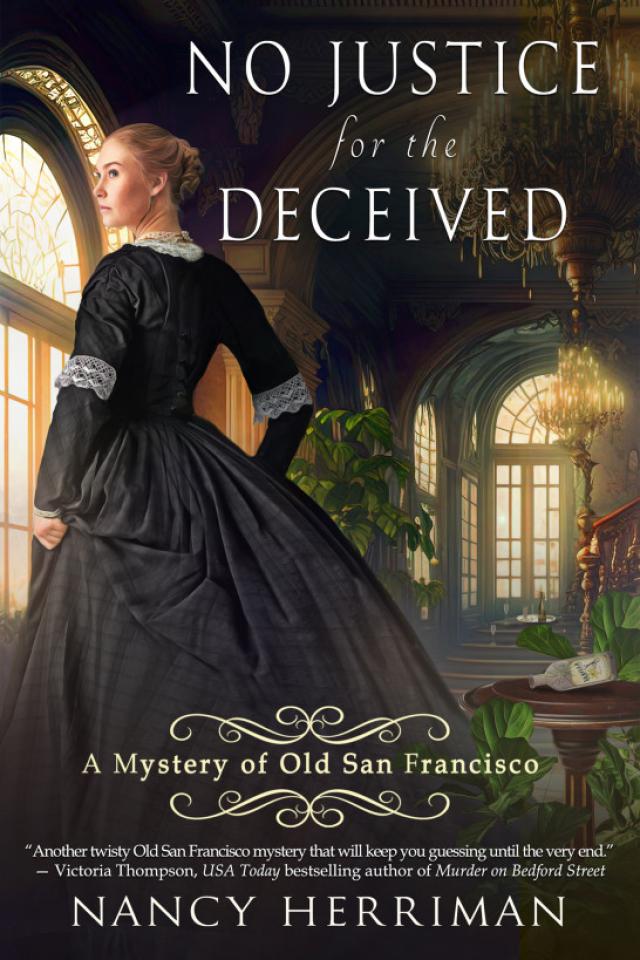
No Justice for the Deceived
Word of an upcoming engagement that will join two prominent families has tongues wagging among San Francisco society, but Celia worries the bride-to-be may be making a serious mistake. Her intended, a controlling man and a known womanizer, has recently been linked to a violent attack on a former mistress. When a hapless maid is poisoned at the party where the engagement was to be announced, Celia discovers that the fiancé was the intended victim.
Detective Nick Greaves is called to the scene to investigate the grim death and finds once again that Celia has already unearthed valuable clues. Teaming up to track down the would-be murderer, they soon determine that any number of people had reason to do away with the man. And when another young woman is found dead, Celia realizes that cornering the killer may expose a cruel truth at the heart of a wealthy family’s deceptions . . .
Title Page
Copyright
No Justice for the Deceived
Nancy Herriman
Copyright © 2023 by Nancy Herriman
Cover design and illustration by Dar Albert, Wicked Smart Designs
Published by Beyond the Page at Smashwords
Beyond the Page Books
are published by
Beyond the Page Publishing
www.beyondthepagepub.com
ISBN: 978-1-960511-10-2
All rights reserved under International and Pan-American Copyright Conventions. By payment of required fees, you have been granted the non-exclusive, non-transferable right to access and read the text of this book. No part of this text may be reproduced, transmitted, downloaded, decompiled, reverse engineered, or stored in or introduced into any information storage and retrieval system, in any form or by any means, whether electronic or mechanical, now known or hereinafter invented without the express written permission of both the copyright holder and the publisher.
This is a work of fiction. Names, characters, places, and incidents either are the product of the author’s imagination or are used fictitiously, and any resemblance to actual persons, living or dead, business establishments, events or locales is entirely coincidental. The publisher does not have any control over and does not assume any responsibility for author or third-party websites or their content.
The scanning, uploading, and distribution of this book via the Internet or via any other means without the permission of the publisher is illegal and punishable by law. Your support of the author’s rights is appreciated.
Dedication
To Teresa, a dear friend and amazing woman
Contents
Chapter 1
Chapter 2
Chapter 3
Chapter 4
Chapter 5
Chapter 6
Chapter 7
Chapter 8
Chapter 9
Chapter 10
Chapter 11
Chapter 12
Chapter 13
Chapter 14
Chapter 15
Chapter 16
Chapter 17
Chapter 18
Chapter 19
Chapter 20
Author’s Note
Books by Nancy Herriman
About the Author
Chapter 1
San Francisco
February 1868
“It’s rare to see a clubfoot in a female, Mrs. Davies,” Dr. Schneider said. The physician tilted his head and squinted through the spectacles balanced upon his nose, eyeing Celia’s cousin with unpleasant curiosity. “Did one of her parents happen to be afflicted?”
Barbara returned his scrutiny with a glare. She was used to being stared at, her half-Chinese heritage impossible to disguise. Her parentage showed in the beautiful sheen of her black hair, the shape of her dark eyes. How often, Celia wondered, had a young woman like Barbara ever entered the hallowed confines of this man’s surgery? Where the fire in the tiled hearth warmed the room to the perfect temperature, his walnut desk gleamed as if polished daily, the leaded glass in the medicine cabinets was unmarred by fingerprints, and his credentials were proudly displayed in gilt frames. Where tastefully pale February light filtered through the surgery window’s lace curtains, as white as the day they’d been hung and far whiter than the ones gracing the windows of Celia’s medical clinic.
It was safe to say that a young woman like Barbara had never stepped inside the papered walls of this hushed room, faintly smelling of pipe smoke and ammonia.
I should not have brought her here, no matter the recommendation I was given.
“My Uncle Walford, her father, was not afflicted, Dr. Schneider,” Celia replied, sensing more than observing the tension pinching her cousin’s shoulders. “Her mother died long before I moved to San Francisco from England, so I cannot—”
“My Chinese mother did not have a clubfoot, Cousin Celia, Dr. Schneider,” Barbara stated, her voice as taut as her shoulders. That she hadn’t already jumped down from the examining table and run from the fellow’s surgery showed an admirable amount of restraint.
The doctor frowned at her outburst.
“Is there anything you can do for her, Doctor?” Celia interrupted before he crafted a retort that might cause Celia to want to storm from the surgery herself.
Dr. Schneider exhaled and resumed turning Barbara’s foot over in his hand. Her toes curled at an odd angle, contorting the bones. “She had surgery as a child?”
The old scars were clearly visible. “Yes, but as you can see, the operation was not fully successful,” Celia replied. “On damp, cold days her foot causes her a great deal of pain.”
“I can speak for myself, Cousin,” Barbara said, her cheeks reddening. “I’m not a child any longer.”
“Your ward is outspoken, Mrs. Davies,” the doctor said. Why he’d not included a tut she could not fathom.
“I confess I admire that trait, Dr. Schneider.”
He tutted at that.
“I had surgery when I was around four,” Barbara said. “That’s what my father told me, because I don’t remember much about it.”
“I see.” He released her leg, and Barbara adjusted her skirt over her crinoline, the checked green wool falling to drape over her bare ankle and foot and conceal them.
“So?” Celia asked.
“There’s not much I can do for her at her present age, Mrs. Davies. If I had attended your cousin when she was young and her bones and tendons were more pliable, I’m certain we would have achieved a complete cure,” he said. “However, at this point, extensive surgery would be needed in order to repair what was previously done as well as attempt a further fix. Even if successful—which is doubtful—the treatment would also require a lengthy and uncomfortable recovery.” He slid an assessing look at Barbara, who had climbed down from the examining table and was occupied in pulling on her stocking. “I expect your cousin may not wish to endure that.”
“Barbara is both strong and courageous, Dr. Schneider, so do not doubt her ability to ‘endure.’ However, I accept your assessment that the situation is likely too far gone to correct.” As it was, the money for the procedure would have been difficult to come by. “Thank you, though, for your time. I will be certain to tell Miss Bremerton when I see her next that I appreciated her recommendation, but that you are unable to provide any help for my cousin.”
He stood up from the stool he’d been seated on. “The recommendation was from Miss Bremerton? How are you two acquainted?”
“She knows Cousin Celia through her charity work and wants to fund a women’s medical clinic like the one my cousin runs,” Barbara explained, tightening the laces on the inner sides of her low-heeled boots. “She recently visited us to ask for her advice.”
“Ah, so that is your connection, Mrs. Davies.”
“We are not acquainted because Miss Bremerton requested my services in an investigation, Dr. Schneider, if that is what you were wondering.”
Perhaps Celia’s notoriety was the only reason he’d agreed to examine Barbara in the first place. A relative of the notorious “female detective.” The first time a reporter had written about Celia had been bad enough. After she discovered a dead body in an acquaintance’s front yard last November, she’d become the subject of even more articles. A profusion of requests had followed the lines of print, entreaties to locate missing persons or confirm inheritances or prove the parlor maid was stealing from the lady of the house. Barbara had sulked with each new solicitation for help. Celia had turned them all down, because she was not a female detective, despite the number of criminal cases she’d managed to become embroiled in.
“I was simply curious, that’s all, Mrs. Davies.” Dr. Schneider turned to pluck a clean towel off a stack of them, using it to wipe his hands. “I know Miss Bremerton and she has never mentioned your name.”
“She has had no reason to mention me, I presume.”
“Will you be attending the masquerade ball her fiancé’s family is hosting tomorrow evening?”
“Her fiancé? I was unaware Miss Bremerton is engaged to be wed.” Proving the true and limited extent of her acquaintance with the young woman.
“I believe she and Mr. Sebastian Carr mean to formalize their engagement at the mask tomorrow.” He glanced at Celia’s black dress. Her widow’s weeds. “Forgive me, madam. Undoubtedly, you won’t be attending. My sympathies on your loss.”
Celia accepted his sentiments with a nod. She had scant need for sympathies over her husband’s death, however. She could not miss or mourn a man who ’d abandoned her and whom she’d rarely had contact with in the final years of his life.
“I do regret that I cannot attend the ball,” she said. “I’ve never been to a masquerade. I presume from your question, however, that you will be there and you may see Miss Bremerton before I do.”
“Mrs. Schneider and I have been invited, of course, but my wife wants to attend the grand masquerade ball hosted by the San Francisco Verein Society on Thursday next and has only one costume to wear.” He removed his spectacles and took to wiping the lenses with the towel he’d been using to clean his hands, peering nearsightedly at Celia while he rubbed the glass over and over. “She doesn’t want to spoil the surprise by wearing it to the Carrs’ fete tomorrow.”
The San Francisco Verein Society was the largest German-American organization in the city, and an invitation to the masked ball they annually hosted in the week prior to the beginning of Lent was highly coveted.
“How very fortunate for you to be able to attend the Verein Society’s event,” Celia replied, helping Barbara with her cloak.
“It promises to be a fantastic evening. I may drop in at the Carrs’ and give my regards, though,” he said. “I had hoped to meet Miss Bremerton’s parents at the mask, but they had to cancel their plans to make the trip to San Francisco. Mr. Bremerton recently suffered a severe attack of ague and his wife, of course, did not wish to leave his side.”
“Miss Bremerton is in San Francisco without them?”
“She arrived last fall to stay with a relative but was quickly embraced by the Carrs, Mrs. Davies. Her parents fully trust Mr. Carr to watch over her,” the doctor sniffed.
“Certainly.”
He stared at his spectacles, at last realizing he’d been repeatedly rubbing the lenses, and tucked them into a pocket of his striped waistcoat. “Sebastian Carr is a lucky man to have snagged Irene Bremerton as his fiancée.”
A comment that made Miss Bremerton sound rather like a prize trout hooked by an angler.
“Mr. Carr will indeed be fortunate to be married to such a generous and talented woman as Miss Bremerton. I was most impressed by her plans for the medical clinic her friend will oversee.” She’d been told that a bequest to Miss Bremerton from a recently deceased relative would be financing that clinic. “We spoke for several hours about what she and her friend hope to accomplish.”
“Ah, Mrs. Davies, Sebastian will see to it that Miss Bremerton is far too busy to be involved in founding medical clinics for destitute females, I assure you.”
Barbara grumbled a complaint under her breath.
“For my part, Dr. Schneider, I hope you are mistaken.” Celia took Barbara’s elbow and guided her to the door, which the doctor rushed to open. “Thank you again.”
They marched out of the examination room. In the hall waited the middle-aged woman who’d answered the front bell. She was as quick as the doctor had been to throw wide the door and usher them outside.
They reached the pavement and Celia gazed up the road, ascending toward Telegraph Hill and home. Alert to the stares of people passing on the crowded street. People likely wondering why a respectably dressed white woman was in the company of a teenaged Chinese girl in Western garb.
Barbara glanced back at the surgery. “I’m glad Dr. Schneider didn’t want to operate on my foot, Cousin Celia. I don’t like him.”
“I do not much either, Barbara,” she said, taking her cousin’s hand and tucking it in the crook of her elbow.
“He was awfully mean about Miss Bremerton,” her cousin said, walking alongside Celia with her head high, because she’d learned that displaying confidence was her best safeguard. “Talking as if he hopes both she and her friend’s clinic will fail.”
As if he hoped Sebastian Carr would crush her spirit. “I expect Dr. Schneider is like so many people who do not appreciate successful, independent women.”
Barbara looked over at her. “Or he’s simply mean.”
• • •
“Would you mind if I knock off early today, sir?”
Nick Greaves looked up from the paperwork strewn across his desk. His assistant, J. E. Taylor, stood in the doorway to the detectives’ office, his hat in his hand. Behind him in the main room of the station house, one of the other officers was hauling a resistant lawbreaker toward the jail. The sound of the man’s pitiful wailing competed with the thudding of his boots as he kicked at every piece of furniture the officer dragged him past. Only midafternoon and they already had their first thoroughly soaked drunk.
Taylor shut the door to block out the noise of the commotion. Nick could still hear the yowling.
“Sir?” his assistant asked when Nick didn’t reply. “I mean, Mr. Greaves. Sorry about calling you ‘sir’ all the time. I know you don’t like it, but I can’t seem to stop.”
Shoving aside the report on a robbery they’d recently resolved, Nick leaned back in his chair. It creaked, like usual. One day he’d figure out how to permanently fix it. Or how to keep from leaning back. “It’s okay, Taylor.”
“Would you mind, though? If I left early today?” he said. “I’ve finished interviewing folks about that counterfeiting case and there’s not much else going on. But I know what you always say about quiet days.”
“That they never last.” A fact as constant as the creaking of his blasted chair.
Taylor reached up to rub at his neck where the collar of his gray policeman’s coat met his skin. “You don’t mind, do you?”
“Go on ahead.”
His assistant exhaled. “Thank you. I’m planning dinner with Miss Ferguson tonight.”
Celia Davies’s housekeeper. She and Taylor had been courting for months, starting around the same time that Nick had fallen for a pale-eyed Englishwoman with the stiffest back and sharpest mind of any woman he’d ever met.
“She’s able to get away early on a Thursday?” Nick asked.
“Mrs. Davies is fine with Add—Miss Ferguson leaving after she’s cooked dinner. We’re heading out to celebrate Valentine’s Day tonight.”
“Valentine’s Day is tomorrow, Taylor.”
“Couldn’t wait.” Taylor perked his eyebrows. “Have you sent a valentine to Mrs. Davies?”
A valentine? Not when he kept expecting that husband of hers to rise from the grave, even though Nick had seen the man’s body in the morgue after Celia had identified him. Maybe he shouldn’t have gone, but Nick had wanted to prove to himself that the fellow was truly dead and not about to interfere in her life again. Had wanted to look on the man she’d thought she’d once loved, just to understand how a woman like her could have married a common criminal like Patrick Davies. All he’d seen was the battered, discoloring remains of the victim of a terrible stagecoach accident. He’d thrown up afterward.
“I take it you’ve sent a valentine to Miss Ferguson,” Nick said, evading Taylor’s question.
His assistant grinned. “I sure have, Mr. Greaves. A really nice one, too.”
“Expect so.”
Taylor peered at Nick. “So you didn’t send anything to Mrs. Davies?”
Knuckles rapped on the door, saving him from having to answer.
One of the police officers opened the door and poked his head through the gap. “There’s a lady in the station come to see you, Detective.”
Nick got to his feet, smiling until he noticed the perking of Taylor’s brows. “Show her in, Officer.”
He ushered in a slim young woman wearing a mismatched bodice and skirt, as if she’d thrown on the first pieces of clothing that had come to hand. Most men would be too distracted by her striking face to notice. Nick wasn’t too distracted, though, and she wasn’t the lady he’d been hoping for.
“Miss Ingram,” he said. “Thank you for coming back into the station.”
Taylor dragged over a chair so she could sit across from Nick.
Her eyes—also lovely—were wide with expectation. “Tell me you’ve found proof that Sebastian Carr is responsible for this, Detective.”


