

J. B. S. Haldane, page 1
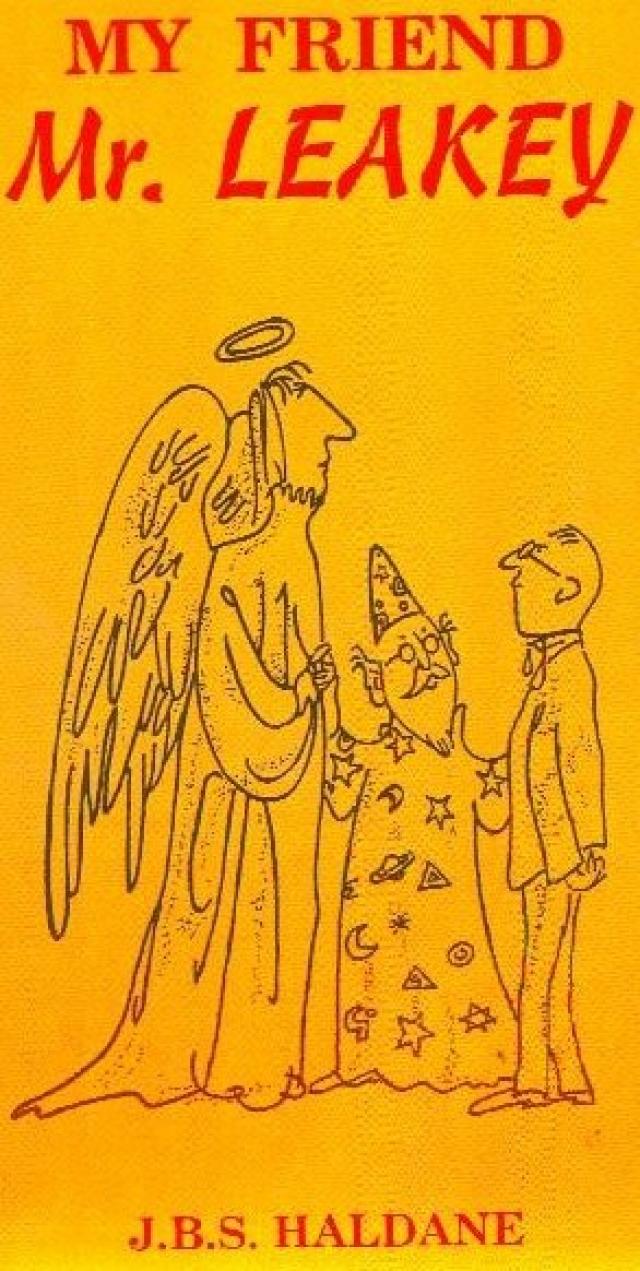


MY FRIEND MR. LEAKEY - J. B. S. Haldane
INTRODUCTION
I first became aware of the existence of his book MY FRIEND MR LEAKEY after going though the immensely readable biography of J.B.S. Haldane by Ronald Clark. I was in Pune at that time. The Pune University library did not have it. Some friends suggested that I try the British Council Library (BCL). The BCL, because of paucity of space, periodically weeds out old and dog-eared books.
As it is only the most popular books the ones which are repeatedly read that show signs of wear and tear, so it is precisely these titles which are thrown out. Such a fate, I suspect, must have befallen MY FRIEND MR LEAKEY, too.
I was able to obtain a Xerox copy of the book through Prof. D. Balasuhamaniun from the Haldane Collection which is now part of the Centre for Cellular & Molecular Biology, Hyderabad. After the death of Helen Spurway (Haldane's wife) his books were acquired by the Regional Research Laboratory, Hyderabad.
MY FRIEND MR LEAKEY first appeared in 1937. This was the only book Haldane ever wrote for children. Children could never forget the enigmatic character of Mister Leakey the magician created by Haldane. So, for the next 25 years, until his death in Bhubaneswar in 1963, Haldane was thronged by letters from children all over the world. Most of the stories in this collection have already been translated into Hindi and printed in the magazine CHAKMAK brought out by Eklayva. It has also been translated into Malayalam by the Kerala Sastra Sahitya Parishad (KSSP).
Haldane was a daring experimenter and on many occasions subjected himself to experimentation. Several times he shut himself in a chamber with a high level of carbon monoxide. Once he swallowed bicarbonate of soda and hydrochloric acid, to find a possible cure for convulsion. In his own words 'I suppose my scientific career began at the age of two, when I used to play on the floor of my father's laboratory and watch him play a complicated game called experiments, the rules of which I did not understand.'
A man of boundless imagination and phenomenal memory, he was equally at ease with literature, philosophy and science and picked up Indian religion with love and remarkable alacrity.
He was outraged at the British invasion of the Suez Canal and decided to move with his wife to India in 1957. He felt that the opportunities for the kind of research he wanted to do were better in India than in the West. He joined the Indian Statistical Institute at Calcutta but later moved over to Bhubaneswar. He died of cancer in Bhubaneswar in 1964. He donated his body for furtherance of medical research.
Three generations have already enjoyed MY FRIEND MR LEAKEY. Books like this are a delight forever. After this first Indian edition I'm sure it will be translated into many Indian languages.
Arvind Gupta
_____________________________________________________________________________________
I have had some very odd meals in my time, and if I liked I could tell you about a meal in a mine, or a meal in Moscow, or a meal with a millionaire. But I think you will be more interested to hear about a meal I had one evening with a magician, because it is more unusual. People don't often have a meal of that sort, for rather few people know a magician at all well, because there aren't very many in England. Of course I am talking about real magicians.
Some conjurers call themselves magicians, and they are very clever men. But they can't do the sort of things that real magicians do. I mean, a conjurer can turn a rabbit into a bowl of goldfish, but it's always done under cover or behind something, so that you can't see just what is happening. But a real magician can turn a cow into a grandfather clock with people looking on all the time. Only it is very much harder work and no one could do it twice a day, and six days a week, like the conjurers do with rabbits.
When I first met Mr Leakey I never guessed he was a magician. I met him like this. I was going across the Haymarket about five o'clock one afternoon. When I got to the refuge by a lamp-post in the middle I stopped, but a little man had crossed so far with me went on. Then he saw a bus going down the hill and jumped back, which is always a silly thing to do. He jumped right in front of a car, and if I hadn't grabbed his overcoat collar and pulled him back on to the refuge, I think the car would have knocked him down. For it was wet weather, and the road was very greasy, so it only skidded when the driver put the brakes on.
The little man was very grateful, but dreadfully frightened, so I gave him my arm across the street, and saw him back to his home, which was quite near. I won't tell you where it was, because if I did you might go there and bother him, and if he got really grumpy it might be very awkward indeed for you. I mean, he might make one of your ears as big as a cabbage-leaf or turn your hair green, or exchange your right and left feet, or something like that. And then everyone who saw you would burst out laughing, and say, 'Here comes Wonky Willie, or lopsided Lizzie,' or whatever your name is.
'I can't bear modern traffic,' he said, 'the motor-buses make me so frightened. If it wasn't for my work in London I should like to live on a little island where there are no roads, or on the top of a mountain, or somewhere like that.' The little man was sure I had saved his life, and insisted on my having dinner with him, so I said I would come to dinner on Wednesday week.
I didn't notice anything especially odd about him then, except that his ears were rather large and that he had a little tuft of hair on the top of each of them, rather like the lynx at the Zoo. I remember I thought if I had hair there I would shave it off. He told me that his name was Leakey, and that he lived on the first floor.
Well, on Wednesday week I went to dinner with him. I went upstairs in a block of flats and knocked at a quite ordinary door, and the little hall of the flat was quite ordinary too, but when I got inside it was one of the oddest rooms I have ever seen. Instead of wallpaper there were curtains round it, embroidered with pictures of people and animals. There was a picture of two men building a house, and another of a man with a dog and a crossbow hunting rabbits.
I know they were made of embroidery, because I touched them, but it must have been a very funny sort of embroidery, because the pictures were always changing. As long as you looked at them they stayed still, but if you looked away and back again they had altered. During dinner the builders had put a fresh story on the house, the hunter had shot a bird with his cross-bow, and his dog had caught two rabbits.
The furniture was very funny too. There was a bookcase made out of what looked like glass with the largest books in it that I ever saw, none of them less than a foot high, and bound in leather. There were cupboards running along the tops of the bookshelves. The chairs were beautifully carved, with high wooden backs, and there were two tables. One was made of copper, and had a huge crystal globe on it.
The other was a solid lump of wood about ten feet long, four feet wide, and three feet high, with holes cut in it so that you could get your knees under it. There were various odd things hanging from the ceiling. At first I couldn't make out how the room was lit. Then I saw that the light came from plants of a sort I had never seen before, growing in pots. They had red, yellow, and blue fruits about as big as tomatoes, which shone. They weren't disguised electric lamps, for I touched one and it was quite cold, and soft like a fruit.
'Well.' said Mr Leakey, 'what would you like for dinner?'
'Oh, whatever you've got,' I said.
'You can have whatever you like,' he said. 'Please choose a soup.'
So I thought he probably got his dinner from a restaurant, I said, 'I'll have Bortsch,' which is red Russian soup with cream in it.
'Right,' he said, 'I'll get it ready. Look here, do you mind if we have dinner served the way mine usually it? You aren't easily frightened, are you?'
'Not very easily', I said.
'All right, then, I'll call my servant, but I warn you he is rather odd.'
At that Mr. Leakey flapped the tops and lobes of his ears against his head. It made a noise like when one claps one's hands, but not so loud. Out of a large copper pot about as big as the copper you wash clothes in, which was standing in one corner, came what at first I thought was a large wet snake.
Then I saw it had suckers all down one side, and was really the arm of an octopus. This arm opened a cupboard and pulled out a large towel with which it wiped the next arm that came out.
The dry arm then clung on to the wall with its suckers, and gradually the whole beast came out, dried itself, and crawled up the wall. It was the biggest octopus I have ever seen; each arm was about eight feet long, and its body was as big as a sack.
It crawled up the wall, and then along the ceiling, holding on by its suckers like a fly. When it got above the table it held on by one arm only and with the other seven got plates and knives and forks out of the cupboards above the bookshelves and laid the table with them.
'That's my servant Oliver,' said Mr Leakey. 'He's much better than a person, because he has more arms to work with, and he can hold on to a plate with about ten suckers, so he never drops one.'
When Oliver the octopus had laid the table we sat down and he offered me a choice of water, lemonade, beer, and four different kinds of wine with his seven free arms, each of which held a different bottle. I chose some water and some very good red wine from Burgundy.
All this was so odd I was not surprised to notice that my host was wearing a top hat, but I certainly did think it a little queer when he took it off and poured two platefuls of soup out of it.
'Ah, we want some cream,' he added. 'Come here Phyllis.' At this a small green cow about the size of a rabbit, ran out of a hutch, jumped on to the tabl e, and stood in front of Mr Leakey, who milked her into a silver cream jug which Oliver had handed down for the purpose. The cream was excellent, and I enjoyed the soup very much.
'What would you like next? Said Mr Leakey.
'I leave it to you,' I answered.
'All right,' he said, 'we'll have grilled turbot, and turkey to follow. Catch us a turbot, please, Oliver, and be ready to grill it, Pompey.'
At this Oliver picked up a fish-hook with the end of one of his arm and began making casts in the air like a fly fisher. Meanwhile I heard a noise in the fireplace, and Pompey came out. He was a small dragon about a foot long, not counting his tail, which measured another foot. He had been lying on the burning coals, and was red-hot. So I was glad to see that as soon as he got out of the fire he put a pair of asbestos boots, which were lying in the fender, on to his hind feet.
'Now, Pompey,' said Mr Leakey, 'hold your tail up properly. If you burn the carpet again, I'll pour a bucket of cold water over you. (Of course I wouldn't really do that; it's very cruel to pour cold water on to a dragon, especially a little one with a thin skin)', he added in a low voice, which only I could hear. But poor Pompey took the threat quite seriously.
He whimpered, and the yellow flames, which were coming out of his nose, turned a dull blue. He waddled along rather clumsily on his hind legs, holding up his tail and the front part of his body. I think the asbestos boots made walking rather difficult for him, though they saved the carpet, and no doubt kept his hind feet warm. But of course dragons generally walk on all four feet and seldom wear boots, so I was surprised that Pompey walked as well as he did.
I was so busy watching Pompey that I never saw how Oliver caught the turbot, and by the time I looked up at him he had just finished cleaning it and threw it down to Pompey. Pompey caught it in his front paws, which had cooled down a bit, and were just about the right temperature for grilling things.
He had long thin fingers with claws on the ends; and held the fish on each hand alternately, holding the other against his red-hot chest to warm it. By the time he had finished and put the grilled fish on to a plate which Oliver handed down Pompey was clearly feeling the cold, for his teeth were chattering, and he scampered back to the fire with evident joy.
'Yes,' said Mr Leakey,' I know some people say it is cruel to let a young dragon cool down like that, and liable to give it a bad cold. But I say a dragon can't begin to learn too soon that life isn't all fire and flames, and the world is a colder place than he'd like it to be. And they don't get cold if you give them plenty of sulphur to eat. Of course a dragon with a cold is an awful nuisance to itself and everyone else.
I've known one throw flames for a hundred yards when it sneezed. But that was a full-grown one, of course. It burned down one of the emperor of China's palaces. Besides, I really couldn't afford to keep a dragon if I didn't make use of him. Last week, for example, I used his breath to burn the old paint off the door and his tail makes quite a good soldering iron.
Then he's really much more reliable than a dog for dealing with burglars. They might shoot a dog, but leaden bullets just melt the moment they touch Pompey. Anyway, I think dragons were meant for use, not ornament. Don't you?'
'Well, do you know,' I answered, 'I am ashamed to say that Pompey is the first live dragon that I have ever seen.'
'Of course,' said Mr Leakey, 'how stupid of me. I have so few guests here except professional colleagues that I forgot you were a layman. By the way,' he went on, as he poured sauce out of his hat over the fish, 'I don't know if you've noticed anything queer about this dinner. Of course some people are more observant than others.'
'Well,' I answered, 'I've never seen anything like it before.'
For example at that moment I was admiring an enormous rainbow coloured beetle which was crawling towards me over the table with a salt-cellar strapped on its back.
'Ah well then,' said my host, 'perhaps you have guessed that I'm a magician. Pompey, of course, is a real dragon, but most of the other animals here were people before I made them what they are now. Take Oliver, for example. When he was a man he had his legs cut off by a railway train. I couldn't stick them on again because my magic doesn't work against machinery. Poor Oliver was bleeding to death, so I thought the only way to save his life was to turn him into some animal with no legs. Then he wouldn't have any legs to have been cut off.
I turned him into a snail, and took him home in my pocket. But whenever I tried to turn him back into something more interesting, like a dog, it had no hind legs. But an octopus has really got no legs. Those eight tentacles grow out of its head. So when I turned him into an octopus, he was all right.
And he had been a waiter when he was a man, so he soon learnt his job. I think he's much better than a maid because he can lift the plates from above, and doesn't stand behind one and breathe down one's neck. You may have the rest of the fish, Oliver, and a bottle of beer. I know that's what you like'.
Oliver seized the fish in one of his arms and put in into an immense beak like a parrot's but much bigger, which lay in the center of the eight arms. Then he took a bottle of beer out of a cupboard, unscrewed the cork with his beak, hoisted himself up to the ceiling with two of his other arms, and turned over so that his mouth was upward. As he emptied the bottle he winked one of his enormous eyes. Then I felt sure he must be really a man, for I never saw an ordinary octopus wink.
The turkey came in a more ordinary way. Oliver let down a large hotplate and then a dish cover on to it.
There was nothing in the cover, as I could see. Mr Leakey got up, took a large wand out of his umbrella stand, pointed it at the dish cover, said a few words and there was the turkey steaming hot when Oliver lifted the cover off it.
'Of course that's easy,' said Mr Leakey, 'and good conjurer could do it, but you can never be sure the food you get in that way is absolutely fresh. That's why I like to see my fish caught. But birds are all the better for being a few days old. Ah, we shall want some sausages too. That's easy.'
He took a small clay pipe out of his pocket and blew into it. A large brown bubble came out of the other end, shaped like a sausage. Oliver picked it off with the end of one of his tentacles, and put it on a hot plate, and it was a sausage, because I ate it. He made six sausages in this way, and while I was watching him Oliver had handed down the vegetables. I don't know where he got them. The sauce and gravy came out of Mr Leakey's hat, as usual.
Just after this the only accident of the evening happened. The beetle who carried the salt-cellar round tripped over a fold in the tablecloth and spilled the salt just in front of Mr Leakey, who spoke to him very angrily.
'It's lucky for you, Leopold that I'm a sensible man. If I were superstitious, which I'm not, I should think I was going to have bad luck. But it's you who are going to have bad luck, if anyone. I've a good mind to turn you back into a man, and if I do, I'll put you straight on that carpet and send you to the nearest police station; and when the police ask you where you've been hiding, d'you think they'll believe you when you say you've been a beetle for the last year? Are you sorry?'
Leopold, with a great struggle, got out of his harness and rolled on to his back, feebly waving his legs in the air like a dog does when he's ashamed of himself.
'When Leopold was a man,' said Mr. Leakey, he made money by swindling people. When the police found it out and were going to arrest him, he came to me for help, hut I thought it served him right. So I said 'If they catch you, you'll get sent to penal servitude for seven years. If you like I'll turn you into beetle for five years, which isn't so long, and then, if you've been a good beetle, I'll make you into a man with a different sort of face, so the police wouldn't know you.' So now, Leopold is a beetle. Well, I see he's sorry for spilling the salt. Now, Leopold, you must pick up all the salt you've spilt.'
He turned Leopold over on his front and I watched him begin to pick the salt up. It took him over an hour.
First he picked it up a grain at a time in his mouth, lifted himself up on his front legs, and dropped it into the salt-cellar. Then he thought of a better plan. He was a beetle of the kind whose feelers are short and spread out into a fan. He started shovelling the salt with his feelers, and got on much quicker that way.


