Death Sentence, page 1
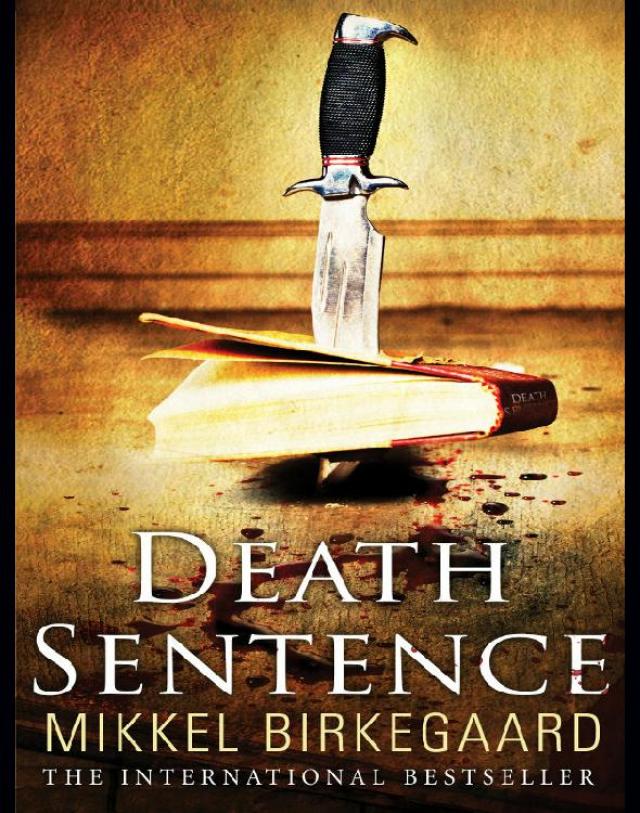


About the Book
A murder committed on paper, safely within the confines of a novel, is one thing. To see that same crime in the real wold, is something else entirely …
Frank Føns is a very successful crime writer. His novels, famed for their visceral desciptions of violent death, have made him a household name. But now someone is copying his crimes. For Frank what once seemed a clever, intriguing plot twist has suddenly become a terrifying, blood-spattered reality.
Frank unwittingly swaps his role of writer for detective. He must find out who is using fiction to destroy his life, and why. What had once been a game is now a matter of life and death.
In fiction, the bad guy always gets caught, but in real life there is no such guarantee. Fear becomes real. The knife cut hurts like hell. Our narrator may not survive. And as Frank knows, no one is promising him a happy ending …
Contents
Cover
About the Book
Title Page
Prologue
Tuesday
Chapter 1
Chapter 2
Chapter 3
Chapter 4
Chapter 5
Wednesday
Chapter 6
Chapter 7
Thursday
Chapter 8
Chapter 9
Chapter 10
Chapter 11
Chapter 12
Friday
Chapter 13
Chapter 14
Chapter 15
Chapter 16
Chapter 17
Chapter 18
Chapter 19
Chapter 20
Chapter 21
Chapter 22
Chapter 23
Chapter 24
Saturday
Chapter 25
Chapter 26
Chapter 27
Chapter 28
Chapter 29
Chapter 30
Sunday
Chapter 31
Chapter 32
Chapter 33
Chapter 34
Chapter 35
Chapter 36
Monday
Chapter 37
Tuesday
Chapter 38
Chapter 39
Chapter 40
Today
Final Chapter
Note
About the Author
Also by Mikkel Birkegaard
Copyright
Death Sentence
MIKKEL BIRKEGAARD
Translated from the Danish by
Charlotte Barslund
Prologue
Until recently I had only killed people on paper.
As it happened, I was good at it. Good enough to make a living from it and so experienced that I could refer to it as my job. Being able to write full-time in a country the size of Denmark is something of a privilege, but there are those who will argue that I’m not a ‘proper writer’ or what I write aren’t ‘proper books’.
I have had to put up with criticism, ridicule even, my whole career, and at times I have secretly agreed with my detractors. It’s not easy to admit, but when critics accuse me of laziness and cynicism, of resorting to shock tactics to make up for weaknesses in a plot, they are not altogether wrong.
But the story you’re about to read is something else entirely.
I know it will be unlike anything I have ever written. Normally I’m invisible, the anonymous narrator who reveals the story without drawing attention to himself. But this time I can’t hide. I have to reveal myself. And this introduction is primarily for my own benefit, a reminder of my project, a wagging finger, telling me what to do and on what terms. That’s what motivates me.
Because I must go on and I must do so alone.
I’m cut off from the world. There are no distractions. At night, the darkness and the silence are as dense as though I were in a bunker. No sounds or impressions can reach me.
But then again, I don’t need outside inspiration.
What follows here has already happened to me and merely needs communicating through my fingers and a keyboard to the computer. The events of the past week have forced me to train the spotlight on myself and document what’s happened while it’s still fresh in my mind and I have sufficient time left. There is no filter. No possible interpretation or perspective can show me or my role in the story in a better light. A shame, really, but no matter how tempted I might be to embellish the distressing and dreadful incidents I have taken part in recently, this time I can’t make it up.
In a way, it’s liberating.
I don’t need to lie.
The technique is different, too. I won’t have to resort to a range of literary devices to serve the plot or build the tension. I can write it as it is, without beating about the bush. The protagonist won’t need to look in the mirror to give the reader an idea of his appearance because the protagonist in this story is me, Frank Føns, a 46-year-old writer, of medium build and height, slim, with dark hair, a closely trimmed beard and a pair of steel-grey eyes which I have been told don’t blink very often.
There, that’s that out of the way.
Had it not been for the gravity of the situation, I would probably have relished my newfound creative freedom. I have some regrets I didn’t try this experiment earlier. Not that I haven’t launched into literary experimentation before, but I discovered early, too early perhaps, a formula that worked and I’ve stuck to it ever since.
But not now.
The rules of the game have changed.
I have been freed from my own and others’ expectations and conventions. I don’t need to worry about conforming to rules determining what a writer can or cannot do. Just as well, really, as I’m forced to start with one of the biggest clichés in the genre, the event that set everything in motion, a telephone call …
Tuesday
1
NO ONE DARES to ring me in the morning.
People who think they know me expect me to be hungover. Those who really know me know that I write in the morning and hate being disturbed. I was in ‘the Tower’, as my older daughter had once nicknamed our holiday cottage, and when the telephone rang, I wasn’t actually writing. True, I was at my desk, the computer was on and a mug of steaming hot coffee was next to the screen, but my thoughts were elsewhere. From my study on the first floor I had a view of the garden below. I was wondering if it was worth raking up the leaves today or whether I should wait until the autumn gales had shaken the last of them loose.
My gut reaction was to ignore the telephone. Calls at this time were never good news, or they would be unimportant, cold-callers or wrong numbers. I let the telephone ring five times before I grunted my name into the handset.
‘Your body has turned up,’ I heard down the other end.
It was Verner. He never introduces himself. Verner is one of the people who think they know me and yet hasn’t grasped that he can’t ring whenever he feels like it.
I was in no mood for games.
‘What do you mean?’
‘Someone has committed your murder.’
‘Which one?’ I asked, failing to suppress a yawn.
Verner worked for Copenhagen Police and he checked police procedures for me. He didn’t regard being a writer as a proper job, but he was still proud to contribute to the process. Sadly, pride had gone to his head and given him the impression he had the right to ring me at any time with ideas or suggestions.
‘The murder in the marina,’ he exclaimed. ‘They’ve found the body of a woman in Gilleleje Marina, mutilated and bound in chains.’
I closed my eyes and pressed two fingers against my temple. My mind was still drifting between thoughts of raking up leaves and guilt at not having produced that day’s quota of words. Verner’s news sank in only slowly.
‘Is this a joke?’ I asked, mostly to say something.
‘I’m telling you, this is your murder.’
‘What possible connection—’
‘The woman was alive and equipped with an oxygen tank when she went in,’ Verner interrupted me. ‘She has the same physique. Everything matches. Even the weight used to hold her down.’
‘A marble bust?’
‘Precisely.’
‘And you’re sure it happened in Gilleleje?’
‘Yes.’
My head started to ache. The murder Verner described did sound exactly like one of the killings in my new novel, In the Red Zone. It was the story of a psychopathic psychologist who subjected his patients to their greatest phobia, not in order to cure them, but to kill them in a way that realized their worst nightmare. Hence the murder in the marina involved a woman who had a fear of drowning. The psychologist dived down with her and studied the woman’s panic as she ran out of oxygen and suffocated. He got off on her terror in the cold dark water, her pupils widening and her screams muffled through her mouthpiece and the mass of water. I had murdered other characters via their fear of needles, tight spaces and spiders. Not one of my best efforts.
‘Frank?’ Verner’s tone was harsh.
‘Yes, I’m still here,’ I said.
‘What should we do?’
I shook my head. ‘It’s impossible. It must be a coincidence.’
‘She’s dead, Frank. That’s no coincidence.’
‘But the book has only just been printed,’ I protested. ‘It hasn’t even been published yet.’
Verner had to get back to work. He was on the beat in Copenhagen and dealt mostly with prostitution and petty crime. Murder wasn’t within
It seems to me now that not telling anyone about the possible connection to my book was an unfortunate decision. However, Verner had supplied me with confidential information for years and was probably panicking at the thought of the consequences if he was found out. I was probably too shocked to think straight, though for a moment I fantasized about how the publicity could boost sales. I quickly dismissed that idea, though. It was just as likely the police would stop publication out of respect for relatives or concern for the investigation, and I needed the money. In the last ten to twelve years, I had written a book every eighteen months, and I relied on the income. Not that I lived a life of luxury. Since the divorce, the cottage had become my permanent home – contrary to the terms of the lease – and although it was in reasonable nick, it wasn’t exactly a palace.
‘The Tower’ was one of the older holiday cottages in Rågeleje, third row from the beach, on the north coast of Sjælland, with a spacious garden consisting mainly of lawn surrounded by tall birches and spruces. It was only ten kilometres from Gilleleje Marina, where I regularly bought fish from stalls on the quay.
It was local knowledge that made me pick the marina as the crime scene in In the Red Zone, but now it felt like a mistake. I couldn’t imagine ever shopping at the marina again. In fact, I couldn’t even begin to understand why anyone would commit a murder in the sleepy little fishing village.
So I decided to potter around the cottage doing odd jobs in an attempt to forget that a woman had been killed. It wasn’t easy. I work with death every day. Not an hour goes by without me thinking about new ways to kill people or inflict pain and injury. I turn ordinary household articles and utensils into murder weapons or instruments of torture all the time, but only in my imagination.
Now someone had tried it out for real.
I never got round to raking up the leaves or writing the 2,500 words that constituted my daily target. An hour later, having given up on keeping thoughts about the murder at bay, I comforted myself with a whisky, even though it was only just gone eleven. I sat on the terrace and watched the autumn sun battle large drifting clouds. Piles of fallen leaves were spread around the garden. The wind took hold of the tall trees and shook them, and sometimes a cloud of birch seeds would scatter across the terrace. Several of the tiny three-leaved flakes landed in my drink. They floated around on the surface like pieces of a puzzle, and I studied how they sank to the bottom of the glass as they absorbed the liquid.
I have never quite understood the English phrase ‘copycat murder’. I assume it has nothing to do with cats. In Danish you say that a murderer ‘aped’ another, which makes more sense to me. I can imagine that apes, like children, enjoy mimicking someone else’s movements. The more I thought about ‘copycat’, the more absurd it seemed.
I had drunk my whisky and so I went to fetch another one, along with one of the advance copies of In the Red Zone I’d received a couple of weeks ago. Back on the terrace, I flicked through the book and found the place where the murder occurred. It was roughly two-thirds in and lasted seven pages. The murder was the book’s emotional climax, the scene I tended to plan most carefully.
Kit Hansen, the name of the fictional victim, is a beautiful 28-year-old redhead, slim and fit with large breasts. Her fear of water and of drowning stems from a tragedy in Sharm el Sheikh, where she and her boyfriend go diving by themselves only a few days after completing their training course. They get caught in a fishing net on the seabed. Kit manages to free herself and tries desperately to save her boyfriend, but he is helplessly entangled and she is forced to watch him drown. Bereaved, and laden with guilt, she has to return to Denmark and tell his family how he died, after which she suffers a breakdown. She loses her job with an advertising agency, withdraws from the world and becomes increasingly dependent on prescription drugs. Some time later her neighbour falls in love with her. He is the only person to look after the reclusive woman and slowly his love is noticed and reciprocated. With his help, she quits taking the pills. He also encourages her to see the psychologist, Venstrøm, who ultimately murders her. The story ends with the neighbour killing Venstrøm, but not before he has been subjected to a torture based on his fear of needles.
I flicked back in the book to the description of Kit Hansen and wondered to what extent she resembled the murdered woman – or, rather, vice versa. If it really was a copycat killing, did the real victim have red hair? Did she have a scar on her shin where the fishing net had cut right through to the bone when she struggled to free herself at the bottom of the sea in the Egyptian diving paradise? How far would the killer go to find a victim who matched the fictional character?
The alcohol was starting to take effect. My body felt heavier and it was getting harder to think clearly. I reread the chapter where Kit Hansen was murdered. Things seemed more and more unreal and I started to doubt if Verner had even called me. Perhaps it had all been just a daydream, a subconscious displacement activity to avoid doing any work.
I decided to go to Gilleleje to see for myself. I needed to find out if a murder really had been committed and, if so, try to establish how far the circumstances surrounding this murder matched mine – or if Verner was simply being paranoid.
2
THE TOYOTA HADN’T been exercised for several months and it protested loudly when I turned the key in the ignition. Finally, it surrendered and I drove along the coast to Gilleleje. Most of the road was flanked by holiday cottages and spruces, but in a few places there was a clear view of the sea. The waves had white crests and in several places the beach was reduced to three to four metres of shingle by the salty foam. It was high tide.
There were few people out and about. November is well outside the tourist season and the cafés and pubs had put away their outdoor furniture, leaving me room to park the Corolla on the marina, close to the quay.
The book didn’t state precisely where in the marina the murder was committed so I stayed in the car, peering out through the windscreen. The strong wind formed sharp crests on the waves in the basin. Many of the boats had already been put into dry dock for the winter. Those that remained ground restlessly into one another, producing the unpleasant squeal of rubber against rubber, drowned out only by the noise of steel wires lashing aluminium masts.
Five cars were parked on the far side of the basin; one revealed itself to be a police car. I suddenly felt dizzy and grabbed the steering wheel, closed my eyes and inhaled sharply. I sat like this for a while, breathing as regularly as I could. Relax, I told myself. There could be hundreds of reasons for the police to be in the marina; it didn’t have to mean that Verner was right.
After a few minutes I summoned up the courage to open my eyes. Some people were standing around the cars, but more had gone out on to the breakwater and were looking out to sea. There was no police tape as far as I could see.
I left my car and strolled to the far side of the basin as calmly as I could. As I approached I could hear voices and the crackle of police radios. A couple of divers in wetsuits were sitting at the back of an open van drinking coffee in silence. A uniformed officer followed me with his eyes as I passed them. I didn’t look at him, but carried on walking towards the breakwater. Out there twenty or thirty people had gathered, adults as well as children, all peering out to sea. Some had brought binoculars and cameras. I joined a group and followed their gaze.
A hundred metres out were two boats, a large yellow and red rescue boat and a black rubber dinghy. Four buoys with red flags marked out a square of twenty metres by twenty metres.
‘They fished out a woman this morning,’ a voice chirped up. ‘She didn’t have any clothes on.’
A red-haired boy of about ten, wearing a yellow raincoat and blue wellies, was standing on a bench next to me. Around his neck he had a pair of binoculars almost as long as his upper arms.
‘She was completely white,’ he carried on. ‘And red.’