Five Passengers from Lisbon, page 20


The trouble was that while she fully confirmed Josh’s surmise about Michel Banet, she denied any knowledge of murder, or a motive for murder.
Again, doggedly, she resisted their questions.
And rather curiously but obtrusively she reiterated her previous statement that she and Mickey had been together at the time following the murder of Para when the pseudo-patient in a red robe with his face bandaged and concealed had come down the stairway toward Marcia. Curiously, except it gave Gili an alibi, too.
The Captain, however, accused her flatly. “You murdered Banet,” he said. “You were jealous, you were afraid he’d leave you....”
Gili, then, laughed harshly and with frank scorn. “Murder the man who was going to provide me with—with food, and a home and clothes? What can I do in America? I worked in a barber shop in Berlin. That’s where I met him. I didn’t love him, but he loved me. He would have taken care of me. Murder him” said Gili and laughed again.
It was then that the Captain gave up. He turned to Colonel Wells. “Colonel, will you see to the disposition of these people that we discussed? Thank you. Colonel Morgan, I have to tell you that your movements about the ship are now restricted.”
“You mean I’m a suspect?”
The Captain said with a troubled, almost solemn gravity: “You had a strong motive—a comprehensible motive. By your own admission you tried once to kill Banet. But I do not believe that a dying man would attempt to deceive. I believe that a woman killed him.”
Daisy Belle got up and stood with dignity under the harsh light. “You mean obviously one of us.”
“I don’t know who else,” said the Captain plainly, and went away, tired and angry, hurrying back to the bridge.
The fog as always at night was deeper. It clung to the ports, it crept into the passageways, it misted the brass and the leather.
Colonel Wells said wearily: “He’ll question you further tomorrow. I do beg you to consider what he says. If anybody knows anything at all it would be better in the long run to let us know it.”
Luther got up wearily, too. He looked gray with fatigue. “Maybe the eyewitness will turn up. Somebody must have seen something. Banet couldn’t just have lain there on the deck for hours without anybody happening along.”
“Apparently,” said Colonel Wells, “that is exactly what he did. Now then...”
He went on briefly and quickly to explain. Their cabins were to be changed. The ship was full but it was not crowded; somehow, they had shifted people about. The Lerida survivors were to be separated. He would show them.
Josh, Marcia knew, wished to speak to her. He came close to her, touched her arm and started to speak, and Colonel Wells said: “Will you come now, please?”
Josh’s lips said mutely: “Later...”
Marcia probably by mere chance was allotted the cabin on B deck which, formerly, the three women had shared. Already Gili’s and Daisy Belle’s few clothes and cosmetics, all loaned or donated by the nurses, had been removed. She did not see to what cabins Gili and Daisy Belle were taken. She had an impression that Luther remained alone in the cabin he and Mickey had shared.
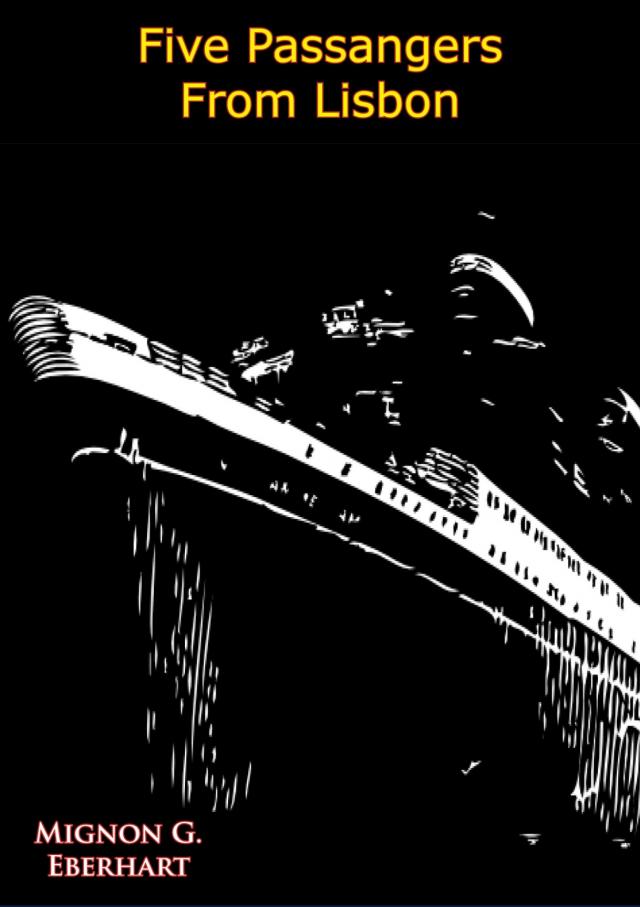
The ship seemed to stand still. It had, in fact, slowed almost to a stop, owing to the extraordinary thickness of the fog and the foghorn had resumed its monotonous, constant wail. Like a city, the U.S.A.H.S. Magnolia was in a state resembling that of siege.
Yet murder still apparently walked these slippery decks, amid the crimson haloes of shifting fog wreaths.
It was along toward morning that the ship slowed suddenly and hove to. Marcia did not hear the cries of “Man overboard!” and she knew nothing of the launching of the boats and the flashlights which strove vainly to pierce the fog.
A wakeful patient had seen an object resembling that of a man go past the port near him. He had heard, so still was the ship, the heavy splash in the water far below. He had given the alarm.
19
There is only one way a man can disappear from shipboard and that is into the sea.
There are, however, three causes for such a disappearance: it could be a matter of accident, suicide or murder. Neither accident nor suicide seemed as reasonable a hypothesis as the fairly unreasonable theory of murder.
And yet with the murder of Mickey Banet there had been a curious tacit conclusion that the ugly cycle of murder had now run its course.
No one had said so. The ship was, as Marcia had thought, like a city in a state of siege, guarded and alert. The troublesome and trouble-making passengers from the Lerida were separated. Each of them was under so heavy a burden of suspicion by the very fact of his presence in that doomed little lifeboat, that surely, one would have thought, and obviously the ship’s officers did think, that no one of them would dare to add further to the burden of suspicion against himself. Certainly no one of them now would commit a further murder.
Yet it had happened. No one had heard any commotion or altercation on the foggy, hazy deck. No one had seen anything except the ward patient. The corpsman on duty had given a quick alarm. The ship was stopped and the crew got out boats. A quick check of wards and passengers was made and Luther Cates was missing.
The probability was that even if he were still alive he would not be found. True, the ship had been traveling at a very slow speed and the alarm had been given instantly. Even so the Magnolia moved some distance before she could stop and before the small boats could be launched.
The fog, too, seriously hindered the search. The occasional glitter of waves below shifting gray wreaths reflected the lights from the ship in confusing glimpses of red and gold. The fog was the more impenetrable because of the rosy reflected glow near the ship.
It was still dark, in spite of approaching dawn, when Josh came to Marcia. She was awake and knew that the ship had stopped. She had heard the subdued echoes of commotion, but did not know the reason for it, or for the brief visit of Major Williams who, checking the whereabouts of the Lerida passengers, knocked on the door and called to her. When she replied he hurried away again.
She was wrapped in a red bathrobe, standing at the port listening and watching the misty flares in the fog. The search-lights were gleaming this way and that from small boats when Josh knocked. “It’s me,” he called. “Josh...”
She went then and opened the door which she had bolted.
He stood white-faced in the passageway, fully clothed, except that his collar wasn’t fastened. His head was bare and his dark hair shone with moisture. His overcoat shoulders were damp. He came in quickly. “It’s a man overboard. Luther. So far they’ve not found him.”
“Luther! What happened...?”
“Nobody knows.” From the open port, in the distance, a voice floated dismally over the water, eerily muffled by fog. Josh went to the port, looked out at the shifting wreaths of fog, the flares from the boats. “They’ll never find anybody in a fog like this,” he said. “But the chances are, of course, that he was dead before he struck the water.”
“Luther...” she said at his shoulder, whispering. “Why?”
Josh turned to face her. “I wanted to talk to you last night. I couldn’t. Marcia...” he said very gravely, “I’m sorry.”...”
“You mean about Mickey.”
“Even to you, Marcia, the cigarette case roused a sort of question. Do you remember telling me that you had been thinking of Mickey and Gili and the things that she had said and that something seemed somehow wrong to you—out of the picture? Wasn’t that it? Subconsciously, it seemed wrong to you as it did to me. Yet something happened just then, and you didn’t really pin the thing down.”
There were other things, she thought suddenly, too; excuses she had made in her mind for Mickey, things he had said and done, the way, even with the war over, he had seemed nervous and too wary; his insistence on taking passage on the Lerida to Buenos Aires, not home; his determination to use a false name.
She said slowly, staring out into the drifting fog: “There were always explanations—always reasons...”
A voice called again, eerily, across the water. Josh said: “Marcia, I believe it would have made no difference in Banet’s death if I had told the Captain earlier that I knew who he was and what I suspected.” The air from the port was raw and cold. She pulled the oversized red bathrobe closer around her throat.
“And I had to tell them about Mickey Banet, to save your life. Marcia, it was Banet who tried to murder you.”
“Mickey!” She stared at him in bewildered disbelief. “Mickey tried to murder me?”
“Yes.”
“But...Oh, no, Josh! Why would he do that? There’s no reason, no motive...”
“Oh, my dear, my dear. Don’t you see that there was a very real motive, a very strong one. Mickey was not really an important war criminal, but he thought he was. He thought that at any moment his name would be known everywhere—his name and what he had done. Probably it would have been known eventually. That’s true. He had a sort of fame before the war. Mainly, though, it was a case of the wicked fleeing where no man pursues. He was aware of his own guilt; he was afraid. He intended never to let anyone know that he was Michel Banet the traitor, the Nazi. But you knew his real name.”
“So did Gili! So did Gili...”
“But you insisted on telling the truth. He knew that you would continue to insist upon telling the truth about it.”
“Josh, he couldn’t have tried to kill me that first night on the Magnolia. He was unconscious. You saw him....”
“Wait, Marcia. This is what I think happened. I thought so,” said Josh soberly, “that first night on deck. I could see how he might have done it, but I couldn’t be sure. Let me tell you. I told the Captain, but I didn’t put it as fully or as truly, Marcia, as I’m going to now to you. The fact is, you see, that I couldn’t reconcile you and your love for him, with what I thought I knew of him. You being you, I didn’t see how you could love him if he was the heel that I thought he was. That”—he shrugged and watched her gravely and said—“that restrained my hand, there at first. I didn’t know what to do. And then I realized that I was in love with you. It happened just like that. One minute I just liked you. The next minute I knew that I...” He turned and seemed to look all around the cabin for a cigarette, found a package in his own pocket, drew it out and said: “The next minute I loved you. And you told me and you convinced me, Marcia, that you loved him, no matter what he was, and that you intended to marry him. So then I had to be so sure, you see, that he was a heel before I hurt you. And then...” He would not look at her now. His face was stern and white and tired. He said: “Then I knew beyond any doubt that he was trying to kill you. It was Michel Banet,” he said, “who accidentally dropped the gauze bandages here in your cabin.”
“But, Josh, it couldn’t have been Mickey then, either. Gili and he were together the first time I saw the patient, or whoever it was....”
“Marcia, Marcia!” He threw away the cigarette he had barely lighted. “Listen to me. Go back to that first night on deck. Go back to the moment when you sighted an American ship from the lifeboat, and knew she was American. Don’t you see that you were Banet’s danger? You knew who he actually was. He could never hide his identity so long as you were with him. And you were going straight to the United States where he was known. Castiogne’s murder suggested the whole thing, perhaps. That with the fact that Banet knew that in the end you would insist upon telling the truth. Did you insist?”
“Yes, yes...” she whispered.
“I don’t think,” said Josh, “that in the beginning he even thought of trying to kill you; but I do think that he intended, when you got to South America simply to stay there. Certainly he never intended to come to the United States. And then, after all his careful plans—and it must have been rather a chore, as a matter of fact, to keep Gili quiet—but anyway, after all his careful planning, think how he must have felt when he was suddenly hauled aboard an American ship, due for the United States. And then you would not be persuaded. You said he had to tell them who he really was. You insisted. And Castiogne had been murdered. Banet reasoned that if you were murdered, too, they would only hunt the harder for whoever killed Castiogne. Yes, I think that put it into his mind.”
“But it couldn’t have been Mickey that first night on deck,” she repeated. “He was unconscious....”
“Oh, was he?” said Josh, and shook his head. “I don’t think so. I didn’t think so then; I didn’t think I’d hit him hard enough. This is what I think happened. Perhaps we’ll never know, but”—he took her hand and doubled her fingers over, one at a time gently, as he talked—“I think that I did knock him out. Just for a minute or two. I think he came to, just about as you found him. He didn’t know what had happened. He must have been genuinely puzzled. That, or there’s somebody on board he expected to try to injure him. And in that case...” He paused for a moment, as if to explore some new but very tenuous and perplexing idea. Finally, he went on: “At any rate, he must have thought, here’s an alibi. Unconsciousness. And there you were. I think he planned quickly to follow you, to get rid of you—over the railing, quickly—and then he found himself presumably unconscious, with a bruise on his face which would tend to prove his alibi. You would have disappeared, and both of these things would appear to be linked up with Castiogne’s murder. And he would go free. I think he was always an opportunist, perhaps very luckily, and that’s the reason why his attempts to murder you failed.”
She must have made some motion to speak, for he went on quickly: “Let me finish. He picked himself up, if I’m right, as soon as you’d gone inside. Probably he thought of his little plan the minute you left him and regretted he hadn’t thought of it sooner. He knew that you’d come back with people and that that chance, which had seemed in a flash, so good, was gone. But there was still a bare chance of getting you alone. I think he must have thought of the whole thing very quickly. You went inside the ship. Could he have followed you?”
She thought back to the confusion of gray passageways and her sense of bewildering strangeness to the ship. “I think I’d have known he was there. I think I’d have seen him.”
“Are you sure? Couldn’t he have entered the ship without your known it? Watched you from some passageway or corner, so he saw it when you went to the deck again, but on the port side? Are you sure he couldn’t have done that?”
She thought back again to those swift and confused moments and said slowly: “He could have done that, I suppose. Yes.”
“He must have done it. He could have watched even from the starboard door directly opposite, keeping himself out of sight. Then, when he saw you go out on the port side of the deck, he ran quickly around the stern. And you came that way as he hoped, and in the shadow it was easy. He had a sort of an alibi; you were alone. So there was his chance again and he tried to kill you and heard me coming.”
“I can’t believe it was Mickey,” she whispered. But she did believe it.
Josh said: “Then he ran back to the starboard side to the spot where you’d left him—there to be found, later, still apparently unconscious. It wasn’t actually an alibi for the time of the attack upon you, but it had all the effect of one. Both of you presumably were attacked at almost the same part of the ship and almost the same time. Anybody would conclude that it was the same person who did it, and certainly it would be linked with the murder of Castiogne. At least”—he released her hand and said, looking now into her eyes, “at least I can’t figure it any other way. I think too that, on his way back to his cabin from the dispensary, he tried the door to your cabin, just tried it, just on the chance of your being alone, just on the chance of finding you there. I don’t know. But he need not have returned to his cabin where Gili was waiting for him more than a minute or two before you and I reached it.”
“Proof...”
“Your faith was very stubborn, darling, and very blind. The proof is that since Banet died, the attempts to murder you seem to have stopped. Whatever other link was between Castiogne and Para—whoever murdered Mickey and Luther, you are now safe.”
The air from the port was cold and misty on her face. Again the distant voices of men searching through fog and darkness for the body of a man overboard drifted eerily to their ears.
The ship was, in fact, in a turmoil. Wards, passageways, decks were, for the moment, unguarded. It was an orderly confusion, concentrated on the search which the Captain himself was directing, but it was confusion. Anyone could have gone quietly along those warm, gray passageways just then without being seen. Anything could have been done, just then, without being heard. But Mickey was dead.
So she was forever safe from those tortured and terrible hands.
Josh lifted his head and listened. “Murder at sea,” he said slowly, “is so horribly simple. A body sliding past a port, and then nothing. We’ll never know how unless Luther’s body is found, but a woman could have done that, too.”
A woman could have held the revolver that had been used to kill Mickey. Conceivably, a woman could have contrived to silence Luther forever in the black and foggy sea, but not Castiogne, not Para. She said: “Josh, do you mean that Mickey killed Castiogne and Para?”
Josh’s reply was not really a reply. He said: “It’s always possible Urdiola told the plain truth.”
“Do you mean that he killed Mickey? But Mickey said it was a woman....”
Josh, staring out into the graying fog, said slowly: “Certainly somebody killed Mickey. But I do think that it was Mickey who came to your cabin yesterday in another attempt to kill you. Those gauze bandages around his face made a simple and easy disguise. I’ve inquired about the gauze. Almost anybody could have managed to snag that from some supply closet or dressing tray. But when you came to the Captain with that horribly twisted thing, I knew beyond all doubt that Banet would kill you if he could. Up to then I hadn’t really been convinced. I’d told myself I must be wrong. My whole theory was based upon the character of a man you knew and loved so much that you were going to marry him.” “Who killed him?”