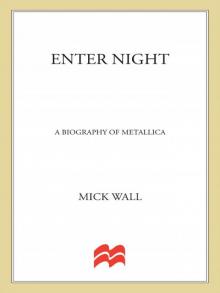
Enter Night, page 38


It was also, Lars confessed, ‘us getting pretty bored with the direction of the last three albums. They were all different from each other, but they were all going in the same direction. You know, long songs, longer songs, even longer songs…It was time to take a sharp turn. The only way to do that would be to write one long song to fill the whole album or write songs that were shorter than we had done before. And that’s what we did. I don’t need to tell you again how I feel about being pigeonholed with the whole thrash metal thing. But the new shit’s just got a whole new vibe and feel that I never knew Metallica were capable of.’ The key was to begin by making sure the songs stayed focused. Consigned to the bin were numbers that lasted nine and ten minutes and went through several ‘movements’: ‘I used to think it was cool, a sign of our fuck-you attitude to being commercial. Now I realise it was just basically because we couldn’t play. It wasn’t until we started with Bob that we really learned how to nail a riff or a rhythm or whatever. It’s actually a lot harder to do but you don’t know that until you finally try.’
Lars, in particular, would discover just hard that was when Bob insisted he simply wasn’t up to the job and should take lessons in order to bring him up to speed. A room at the studio was set aside for Lars to spend several hours a day ‘practising’, upon which James pinned a handwritten sign: ‘LARS’ CLOSET’. Getting the drums ‘right’ would, in fact, set the project back several weeks. In the meantime, Bob worked with James on getting the best of the near two-dozen songs he had written with Lars – and occasionally Kirk (as with Justice, Newsted would achieve only one co-songwriting credit on the album) – into what the taskmaster producer considered recordable shape. Initially, this proved almost as arduous as coaxing a decent drum track out of Lars. For the first time in his life James, who had never been told his lyrics were not good enough, found himself rewriting verses, sharpening up choruses. In particular, Rock worked hard on getting it into the singer’s head that it was easier – and better – to use one word where previously he’d been used to using several. Single words could be broken down into syllables that sufficed for entire lines in a song, as with the chorus of one of the potential singles, ‘Enter Sandman’, on which Hetfield’s original lines were broken down into single words, using the syllables to stretch and tease the melody out of them. En…ter…night…/Ex…it…light…
James also came armed with something he never had before: an actual from-the-heart love song. Written while on the road and missing Kristen, the key line ‘Never opened myself this way’ summing up a musical moment unlike any one might have expected from Hetfield or Metallica, even as they strived for a hit. Suddenly, it seemed, Everyteen had turned into Everyman.
Speaking of it nearly twenty years later, James admitted that at first he ‘didn’t even want to play it for the guys. It was so heartfelt, so personal to me. I thought that Metallica could only be these songs about destroying things, headbanging, bleeding for the crowd…I certainly did not think it was a Metallica song. When the guys heard it they were amazed at how much they, I guess, related to it. It turned out to be a pretty big song on that record [that] touched a lot of people.’ It was also, he reflected in another interview around the same time, more than the usual confessional power ballad. It was ‘about a connection with your higher power, lots of different things’. He recalled being invited to a Hell’s Angels Clubhouse in New York where ‘they showed me a film that they’d put together of one of the fallen brothers’ and the soundtrack for the film was ‘Nothing Else Matters’: ‘Wow. This means a lot more than me missing my chick, right? This is brotherhood. The army could use this song. It’s pretty powerful.’
Powerful yes, but made even more so by Rock’s last-minute addition of an orchestra, its score arranged by Michael Kamen. A production touch the band would never have considered themselves, their first reaction to it was negative. Listening back to it late one night, however, they suddenly saw the light. ‘I used to call James Dr No,’ Rock recalled. ‘Whenever I was about to make a suggestion that seemed even a little off the wall, he’d say no before I’d even finished the first sentence.’ It was the same when he also created a subtle bed of cellos for another sweepingly balladic track, ‘The Unforgiven’, underpinning the obvious Morricone influence with something even more impressive. Or the sitar-like guitar intro to ‘Wherever I May Roam’; the bugling refrain from Leonard Bernstein’s ‘America’ at the start of ‘Don’t Tread on Me’; the marching-band drums and bagpipe guitar at the start of ‘The Struggle Within’. Even on the more obvious thrash-derived numbers such as ‘Holier Than Thou’, ‘Through the Never’ or ‘The Struggle Within’, Rock’s influence meant the band now sauntered into view where previously they had simply battered at the door until it splintered; pedestrian thrash-templates transformed by the imaginative sum of the production into something greater than their otherwise predictable individual parts.
At other times, the producer simply insisted that they play together as a band live in the studio, as on the rhythm track to the monumental ‘Sad but True’. Recalled Kirk: ‘The energy coming off all of us playing was so intense and so locked into the groove, with so much attitude, that Bob Rock said, “We could take this track right here off the floor and put it straight on the album because all you guys played your asses off.”’ It was a musical adventurousness mirrored by Hetfield’s new boldness with his lyrics. No longer did the words come from watching CNN, as they had for much of Justice. Now they came from somewhere much closer to home. In ‘The God That Failed’, he addressed specifically his mother’s unnecessarily agonising death due to her devout, to the point of perversity, religious beliefs. ‘Don’t Tread on Me’, a ‘God Bless America’ for the Nineties, seemed shocking coming so soon after the anti-war stance of their till-then most famous song ‘One’. ‘Of Wolf and Man’, meanwhile, gloried in his love of the outdoorsman’s life, fishing and shooting: ‘I hunt / Therefore I am…’ Tellingly, the album’s weakest track is its longest and the one which harks back most to the band’s earlier days: ‘My Friend of Misery’, a mid-paced, blustering meditation on the ego-ravages of stardom. Buried at the back of the album, this was the only track on which Jason Newsted was given a co-credit, and it was saved only by its Who-like mid-section where Hammett’s guitar at least brings to it a certain poise. The bullying may have subsided now the band was off the road, but Jason’s part in the creative process was still extremely limited. He hoped this would change as time passed and his role naturally grew. He hoped in vain.
In fact, all the playing on the album – including the vastly improved drums – excels on every level but Hammett’s guitar, in particular, is exquisite throughout. Again, though, the biggest surprise comes from Hetfield, whose vocals take a quantum leap forward from the macho posturing of even his best Master- and Justice-era efforts, towards a more sensitive (his almost spoken-word outro on ‘Nothing Else Matters’), even sweet (his high vocals on the chorus of ‘The Unforgiven’) quality unheard of before in his work. Even his guitar playing betrays a tinkling, newfound delicacy, as on the superb acoustic and electric playing on ‘Nothing Else Matters’, including the achingly searching guitar solo – so much so, indeed, that Hammett does not feature anywhere on the track.
The stand-out tracks, however, are its opening brace: ‘Enter Sandman’ and ‘Sad but True’. The latter – a monolithic musical statement whose juddering rhythm had come suddenly while recording ‘Stone Cold Crazy’ for Rubáiyát– was destined for greatness from the moment an awestruck Rock, listening for the first time to the demo, told Lars and James he thought it could be ‘a “Kashmir” for the Nineties’. The former, an even more crowning jewel and the must-have moment of all such classic albums, was another first for Metallica: an old-fashioned, born-lucky hit single. Based on the same little cartwheeling riff as other rock classics such as ‘Smoke on the Water’ and ‘All Right Now’, Kirk later recalled how he’d been listening to Louder Than Love, an early album by a then-unknown Seattle band called Soundgarden, ‘trying to capture their attitude toward big, heavy riffs. It was two o’clock in the morning. I put it on tape and didn’t think about it.’ When he later played it to the others, however, Lars told him, ‘That’s really great. But repeat the first part four times.’ It was that suggestion, said Kirk, ‘that made it even more hooky’.
In the end, it took more than ten months to complete the album, would cost them than over $1 million, and sent them all, at various times, so crazy that nearly fifteen years later Rock would still describe it as ‘the hardest album I ever made’. The band felt the same way. ‘It was difficult with Bob,’ said Lars. ‘It was the hardest record to make with Bob because we didn’t know each other and there was no trust yet. So we were very wary of each other.’ They had pushed themselves so hard, ‘we all started hating each other by the finish’. When I visited, halfway through, I noticed a boxer’s punch-bag and gloves hanging up in one of the rooms. ‘For fucking tension!’ Lars guffawed when I pointed at it. ‘You know that shit, you’re trying to get something down and you can’t get it down right and you just need to hurt something. Then you receive the bill for it next week. You can hurt that and not have to pay for it.’ James, he added, had been using it a lot of late: ‘But now that Jason has started doing his bass he uses it a lot, too.’ It was, Rock concluded, ‘a very tough album to record from the point of view of what they were trying to achieve and where they had come from and where I had come from. So it took a while to work out the way it was to be done.’ More than just trying to make something accessible, this album was simply ‘the first time you really felt that there was some real human emotion behind the music’.
Speaking with Lars at the studio while James sat on the other side of the glass, guitar cradled on his lap, working through the cyclical guitar part to ‘The Unforgiven’, it was clear they had been working towards a very specific agenda from day one. He talked of how, when the band had started out, his favourite drummers were technically gifted craftsmen such as Rush’s Neil Peart and Deep Purple’s Ian Paice: ‘So for the next eight years I’m doing Ian Paice and Neil Peart things, proving to the world that I can play.’ Now, after absorbing the lessons their new father-figure producer had instilled, Lars’ two favourite drummers were Charlie Watts of the Rolling Stones and Phil Rudd of AC/DC – unflashy, solid as rock, foundation-builders. ‘I used to think that stuff was easy but it’s not, it’s hard…fucking hard.’
Another concession to the forthright commerciality of the new album was in its title – simply Metallica, eponymous titles being every major record label’s preferred option: uncontroversial, uncomplicated and easy to remember. It was ironic then that the album would quickly become known not by that name but for the nickname given to it because of its forbidding, all-black sleeve – The Black Album. It was like the photo negative of The Beatles’ White Album (itself actually titled simply The Beatles, but renamed by fans after its similarly featureless, all-white cover).
‘It was one of our first days in the studio,’ Lars explained, and he was browsing through a typically colourful heavy metal mag, noticing how the ads for various albums all looked the same. ‘All these cartoon characters and all this steel and blood and guts. It was like, “Let’s get as far away as possible from this.”’ As far away as they could get, they decided, was to have a completely bare, monochromatic sleeve, with no information whatsoever on the front, save the barely discernible image of a serpent coiled in one corner. (A symbol, perhaps, of the forbidden fruit they had now bitten into?) The colour they chose was inevitable. ‘The fact is that we all like black as a colour.’ Lars shrugged. ‘Sure, there have been some people who’ve thought it was rather Spinal Tap, but if it came down to a choice between black and pink, you know what I mean? People can throw all this Tap shit at me all day, it just reflects off me. I don’t give a shit.’ Or, as James put it: ‘Here it is, black sleeve, black logo, fuck you.’
Another, albeit more oblique, reference to the altered perspective of the new album, along with its more pronounced choruses and shorter tracks, were the bare minimum credits on the sleeve. Where in the past Metallica album sleeves had been crammed with credits and thank-yous – even occasional fuck-yous – the Black sleeve contained the lyrics to the songs, the names of the four band members and their instruments, and the barest production details.
Lars was sure, he said, that ‘we’re gonna get a lot of people saying we’re selling out, but I’ve heard that shit from Ride the Lightning on. People were already going, “Boo! Sell-out!” even back then.’ Just because the tracks were shorter ‘doesn’t mean they’re any more accessible’. It was already clear, however, that increased accessibility was the whole point. The subject matter may have been as dark as ever – ‘Sad but True’, he said, was ‘about how different personalities in your mind make you do different things and how some of those things clash and how they fight to have control over you’, while ‘The Unforgiven’ was about ‘how a lot of people go through their life without taking any initiative. A lot of people just follow in the footsteps of others. Their whole life is planned out for them, and there’s certain people doing the planning and certain people doing the following’ – but the music was now of many colours, all of them supremely eye-catching.
The best example of this was the track already designated the album’s lead-off single: the enticingly named ‘Enter Sandman’. ‘That song has been on the fucking song titles list for the last six years,’ Lars said in an attempt to waylay any suggestion it had been written specifically as a single for this album. ‘I’d always looked at “Enter Sandman” and thought, what the fuck does that mean? Me being brought up in Denmark and not knowing about a lot of this shit, I didn’t get it. Then James clued me in. Apparently the Sandman is like this children’s villain – who comes and rubs sand in your eyes if you don’t go to sleep at night. So it’s a fable [which] James has just given a nice twist to.’ He added: ‘Six years ago I looked at “Enter Sandman” and thought, “Naw, let’s write ‘Metal Militia’…Metal all the way, you know?”’ Not any more.
The most important thing now would be what their various record companies thought of the finished product. Elektra was ecstatic. This would be the kind of Metallica album the company could really get its teeth into – one with multiple hit singles, great production, broad-scale ideas; in short, something with what the business called ‘legs’. Working off that giant buzz, Mensch scheduled meetings with various heads of department at Phonogram across Europe, beginning with Dave Thorne and the team in London.
‘I don’t think anybody can honestly say that when they listened to that album they thought, “This is going to be the biggest-selling metal album in the history of music,”’ says Thorne now. But when Mensch first played them the album ‘we were just gobsmacked because it was an absolute quantum leap on from anything that we’d ever heard anybody do, frankly, on the metal scene. And I remember him saying, in typical Mensch style, “Elektra got this fucking crazy idea, you know, going on about three singles, maybe four singles, I don’t know what you guys think.” Then he said, “I don’t know which track you think should be the single.” And I can remember saying, “That’s the single, that track there – ‘Enter Sandman’.”’
Thorne was spot-on. Released in the UK ahead of the album, backed with a suitably phantasmagorical video (actually, a fairly ordinary, literal depiction of a ‘sandman’ haunting a sleeping child intercut with a band performance that made ‘One’ look like Gone With the Wind) and available in as many formats as Phonogram could devise – including regular seven-inch vinyl in black sleeve, with and without logo sticker; twelve-inch vinyl; three different CD versions; cassette-tape version; even box-sets, including limited-edition twelve-inch folder, plus the twelve-inch vinyl record and four ‘exclusive’ autographed Metallica photos, one of each member – ‘Enter Sandman’ reached Number Five, becoming along the way one of the best-selling singles of the year. The US release of ‘Enter Sandman’ was staged differently, timed to come after the album’s initial sales burst, helping push it back up the charts as the single broke into the Top Twenty, reaching Number Sixteen, the video becoming a regular feature of daytime MTV for months to come.
Aware more than most of the power of word of mouth, the band also made sure their fans got a chance to judge the new album’s merits ahead of release, holding special ‘listening parties’ in London, at the Hammersmith Odeon, and, most spectacularly, in New York at the 20,000-seater Madison Square Garden. Admission was free to Metallica fan club members and with the band also in attendance to introduce the album personally and sign autographs, both venues were packed. At the New York playback, James actually snuck into the audience during ‘Nothing Else Matters’ and was relieved to find ‘They were really attentive…really listening to what it said.’ In America it was also arranged for certain stores to open their doors at one minute past midnight on 12 August – the official release date of the album. Queues formed outside, in some cases, for up to eighteen hours before. A week later, Metallica – or the Black Album as it was already becoming known – debuted at Number One in both Britain and America. It also topped the charts in Canada, Australia, New Zealand, Germany, Switzerland and Norway.
The band was already out on tour in Europe when they got the news, at a hotel in Budapest, where they were appearing as ‘special guests’ – second on the bill – to AC/DC at that year’s travelling Monsters of Rock festival. Lars said he read the fax from Q Prime and for a moment wasn’t sure how to react. ‘You think one day some fucker’s gonna tell you, “You have a number one record in America” and the whole world will ejaculate. I stood there in my hotel room [and] it was, like, “Well, okay.” It was just another fucking fax from the office.’ At least, that’s what he later told Rolling Stone. In truth, this was the moment he’d fantasised over since his days of chasing around after Diamond Head records and reading about the NWOBHM in Sounds. Complete validation for the years when he was a tennis loser; an LA reject, with a funny accent who never quite belonged anywhere.