

The Wretch of the Sun, page 1


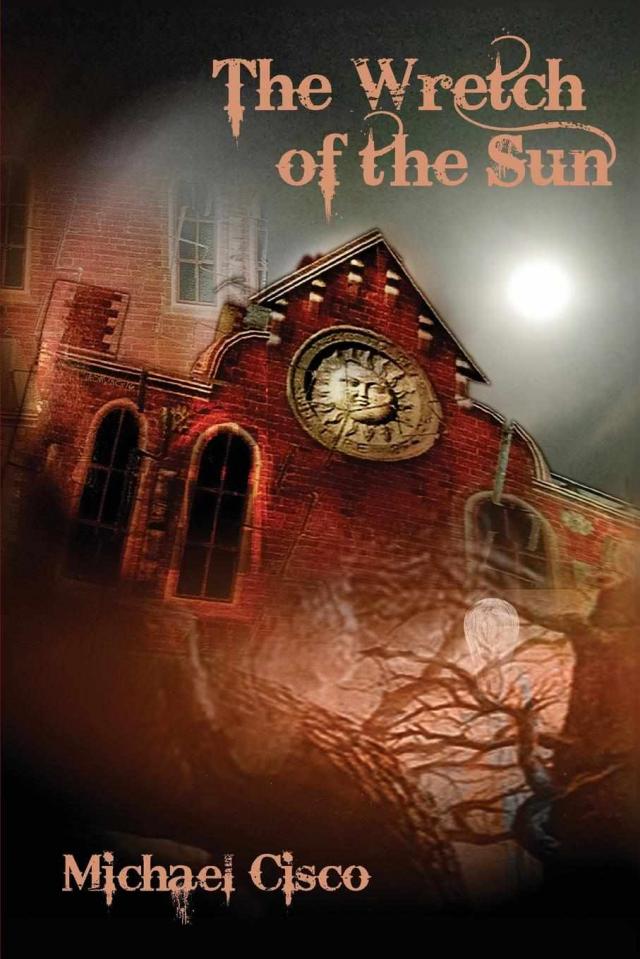
The wretch of the sun
By Michael Cisco
Animal Money
Celebrant
The Divinity Student
The Golem
The Great Lover
Member
The Narrator
The San Veneficio Canon
Secret Hours
The Traitor
The Tyrant
The wretch of the sun
Michael Cisco
hippocampus press
—————————
new york
Copyright © 2016 by Michael Cisco
Published by Hippocampus Press
P.O. Box 641, New York, NY 10156.
http://www.hippocampuspress.com
All rights reserved.
No part of this work may be reproduced in any form or by any means without the written permission of the publisher.
Cover art by Harry O. Morris.
Cover design by Barbara Briggs Silbert.
Hippocampus Press logo designed by Anastasia Damianakos.
First Electronic Edition, 2016
1 3 5 7 9 8 6 4 2
ISBN 978-1-61498-183-1
Preface
The haunted house is, among other things, a manifestation of the concept of secrecy, which encompasses both concealing and revealing. A house whose ethereal visitants and ethereal occupants are never discovered, whose secrets are kept perfectly, and whose invisible contents never become visible, will not acquire a haunted reputation. Maybe the most well-known haunted houses are the ones populated by the most incompetent ghosts. Does this mean that we only know the botched jobs? The blunderers who can’t keep a secret? If so, it would suggest that the really excellent haunted houses are the ones in which nothing out of the ordinary ever seems to occur. On the other hand, it might mean that a secret must be known in order to be a secret; a secret is precisely the known thing. The open secret is the thing that everyone knows without knowing that they know, and is the biggest of secrets.
To be known for haunting, a house must conceal a secret imperfectly, and it must be the secret itself that, by its very nature and not primarily through any other agency, persistently resists concealment. A haunted house draws attention to the existence of its secret and will even go so far as to provide some inquirers with what appear to be clues to the unraveling of its riddle. That riddle, however, can never be unraveled. It’s just activity, enjoyment. The Gothic novel took the form of a whirl of stories within stories, explaining one story by means of another, which then stood in need of an explanatory story of its own, and so on, building a house of cards with no foundation but storytelling. In the ghost story, the tale of an encounter with an apparition is followed by the explanatory story, recollected by the decrepit former servant or extracted from a suggestively incomplete archaic document, which identifies the lovers who committed suicide or the hanged man or the abandoned child. But knowing what these ghosts once were tells us nothing about what they are now, where and how they exist, or what their experience of events is like. Why should natural laws bend to serve what appears to be at least human justice? The story is explained by means of unexplained explanations, which only open out onto deeper mysteries.
A haunted house is a house with its own story. A ghost is someone about whom stories are told, who is unable to tell his or her own story. Death can be understood as the inability to tell one’s own story; whether that death is literal is another question. Ghosts exist in imagination, which is real. A story, to be a told story, needs a listener or reader. Ghosts, as I have been saying, appear to need someone to whom to appear. So we discover the story of the suicides, and we solve the riddle alongside the narrating busybody of the story, and bury the bones together in one grave; the disturbances cease. But a house once haunted will always be haunted; it isn’t the disturbance but the story that haunts it.
The haunted house draws attention to the secret it keeps like a master who teases his pupils with unanswerable riddles. Or like secret police, who can’t be entirely effective if they are entirely secret. These aren’t questions that contain their own answers, like math problems. I do not have the answer any more than you do, because the answer isn’t in the question, the answer is to leave behind the idea that a question is a door that an answer pulls finally shut. Once we’ve dutifully recited to the last syllable everything we know, we are chastened or even taken aback by the paltry incommensurability of what we’ve just said with the haunted wealth that extends within and without us in all directions. At that moment, the suggestive ambivalence of a story will have to seem truer than the abbreviation of a hollow answer.
The wretch of the sun
(O)
Public drunkenness, disturbance. The call comes in on the car radio halfway through the afternoon and A. and his partner respond. The streets dart by, the car lurching over the dips. B. pops out when they reach the plaza, a cold, nervous, flinching feeling inside him. They both made their man at once: dark skin, loose white shirt, standing on a bench, shouting, flourishing a handful of paper above his head. He made them, too, jumps down and tears off into the park where their car can’t follow and no time to drive around to the opposite side and anyway this park opens along its length to the outskirts of the modelsuburb. C.’s partner curses and the two of them start pounding after him on foot.
“Le-het’s sto-hop him be-he-fore h-e ge-hets t’the ro-hocks!” his partner says, running hard.
Now D. catches sight of two more officers on the right. Up ahead, the soles turn up one after another, so fast it doesn’t seem humanly possible. His shirt is a shimmering, jagged white flame in the air.
He gets clear of the park, across the macadam road, and into the rocks. E.’s partner curses some more, half-strangled. Two men in plain clothes are getting out of a car parked on the macadam. F. has never seen them before, but they’re obviously plainclothes. No driving after pamphlet boy now, not on those rocks. He’s angling toward the beach. The two weird plainclothesmen are running and pointing and yelling orders.
“Stop him!”
What is this? Six officers for a vagrant?
Their man zips down and out of a depression filled with air shimmer in the heat of the day, a mercury pond seething there, and his outline goes crazy, like a reflection in a flexible mirror. The sun keeps getting brighter and brighter, salt in G.’s eyes and his whole field of vision is turning into pink flash photos—the blood of his own eyes hues everything he looks at.
The weird plainclothesmen bark “Drop it!” over and over.
Which makes no sense—the guy isn’t carrying anything, his hands are up in the air as if he’s just kicked a goal. There’s a sound like popping stitches. H. glances to the side and nearly tumbles over the rocks, the two weird plainclothesmen, who had actually said “Drop him!” are firing at the back of an unarmed man with grease guns they must have kept slung round their backs. His partner is clumsily dragging out his revolver, too. What is this? Up ahead the man streaks across the ground—he seems to dance in place, as though his shaking outline dodged the bullets and his arms go higher and he stops, spins.
—They shot him!
—He whirls spinning with his arms in the air!
—The others rush up, stop, shoot, rush, stop, shoot!
—Now he sees it! He’s seeing it!
—She’s coming down in a pillar of sun! There’s thick dark hair, heavy bangs, and beneath them, the sun, where a face should be!
—Her body is a dress made of light shells!
—Her pink hands are floating down toward him!
—She’s embracing the vagrant!
—She’s four times his size!
—She’s got him! She’s carrying the vagrant off into the sky! Cradled in her arms like a toddler!
—He erupts in hysterical laughter and stutters taunts at the police “Putas! L-l-locos! Maricones!”
—Kicking out his legs fifty feet off the ground!
Bright as it was, the light gets a thousand times brighter it crashes down on him in waves like a million panes of glass smashing him in the head one after another after another and the pieces are flickering all around make a whirlpool of sparks their glints lance the brain like bullets and now white out like a snowstorm and he can’t hear anything but the whistle in his ringing ears . . .
“–n’t believe it. Hey!”
A blow to his shoulder, a voice from somewhere further behind him. His partner’s.
He starts groggily. He is lying on his side, on the ground.
“He fell!” his partner shouts back.
Rough hands half drag him upright, and his partner is muttering under his breath.
“Fainting. What are you, a little girl? What’s the matter with you? Walk.”
Shoves him in the direction of their man. The ground is searing white fractured by the dark edges of the rocks. A dazzle hangs in front of his eyes wherever he looks, regular pulsations shave it down like dust settling in sheets out of the air. I. follows his partner.
A smashed dead body, face down, sprawled, cratered back glistens in the sun. The other two regular police are there, outlines quivering. J. squints at the body. It seems he can’t quite lock his knees. He starts and looks all around suddenly.
“What happened? Why’d you shoot?” his partner is asking.
“I don’t know. I didn’t see it,” one of the others says.
The other other one sighs. “I guess I’ll call a van.”
They keep glancing at K. and scannin
Wind blows their voices around.
“They must have fired from over there,” the first one says to his partner. “Why don’t we go check for casings?”
“Yes,” his partner says strangely. He turns to L., looking him hard in the eye. Points to the corpse. “Search him.”
M. crosses over to the man numbly. He can hear first one, then, after a moment, another set of footsteps going away behind him, voices warbling in air buffets, like a burlap rag flapping against his ear. He looks down at the shimmering body, black spattering the blinding white shirt, dark hands half in the sand exposed roots. Turn the body by the shoulder, dark face crusted with sand, features slack. The image of a cackling, hysterical face nearly burned out in the sun swims in his mind. He lets his grip loosen. The dead man slumps onto his face again. Nothing in his pockets but an empty old wallet like a burst blister. He stands looking down at the dead man, drops the wallet.
His partner’s fist thuds lightly against his shoulder.
“Wake up,” he mutters in disgust. “What’d you find? A wallet?”
Picks it up and goes through it, flips it back to the ground.
“Nothing,” he nearly whispers. His next words are so faint that his partner misses them, drowned out by the other cop, who calls—
“Van’s here.”
just as he whispers—
“It’s not him.”
“Looks like your boy’s still a little green!” one of the cops says, says with forced joviality. “Never seen a stiff before?”
The voice comes through him, from the day. As if the day wanted to know.
His partner tells the other to shut up. “Sun’s got at him.”
Get in a car.
“You just sit there.”
N. sits by himself a few minutes. Then he whimpers, bends forward grabbing his head, and sobs once. Panting, looking around. Sees the body bobbing on the stretcher, going away. Covers his face a moment, his breath sounds hollow in the cupped space. The sun face is looking through him, as if he were an invisible man. Gigantic, transparent, ghostly hands hold him up.
Driving in to the station. O. stares at the dashboard out of a slack face. The glowing modelsuburb veers across the windshield.
“All right,” his partner brakes, jerking up the transmission bar on the steering column. Turns to him. “You had better think hard about how bad you want this job. Because I am not going out there again with a man who goes to pieces. I don’t . . . you—nobody gets used to seeing men get shot, nobody. Any man who does is crazy the other way, and he’s even—he’s an even bigger headache. But you’ve got to keep hold of yourself when you do see it. Or you’re just no use.”
P. entered the station in front of his partner, his eyes open a little too wide. As he strides past the barriers and into unique-coordinated-intersystem he holds himself with exaggerated attentiveness, looking sharply at everything, greets everyone he sees and does it first.
Now they sit side by side in front of the sergeant’s desk. His partner is doing all the talking. The sergeant is asking many questions right at the outset; their two voices are droning together. Q. peers at things on the walls, the foliage through the blinds, and each unique crushed paper in the wire waste basket.
“—then the other officers shot him.”
“What?” R. says abruptly. “Who? Which ones?”
He sounds almost indignant. His partner looks him in the eye.
“What do you mean who? You been daydreamin’? The guy!”
“Which guy, the runner?”
The sergeant is watching them both.
“Of course the runner which oth–”
His partner stops and addresses himself to the sergeant.
“There was only the one guy!”
“No, no, there was the runner and there was the other one.” S. looks at the sergeant now, too. “The man they shot was there already, I don’t know what he was doing there but he was there already—”
“There was nobody—” His partner presses a hand sideways on the sergeant’s desk, but T. doesn’t stop.
“He was there already. They shot him, the two officers in plainclothes. They shot him. They had submachine guns. They shot the man who was there already. The one we were chasing was taken into the sky.”
Why can’t he stop?!
“A woman came out of the sun and she carried him into the sky with her.”
They look at him.
“That man is still at large,” he says.
They look at him.
“I repeat, the dead man was not the man we pursued into the rocks. He was already—he already was there. The other guy got away. The guy we were chasing.”
The sergeant heaves himself ponderously out of his chair, goes to the door, bends around it, hand on the wall, and says something quickly to someone. Then he shuts the door.
U.’s partner is rubbing his hand over his forehead and eyes.
“Uh, Herman, you’d better get started on the reports,” the sergeant sniffs. He drags his forefinger under his nose briefly, not looking at anything but his chair as he crosses the small office. “If you want to get home at a reasonable hour.”
His partner leaves without a backward look.
The sergeant sits, hands on the arms of his chair, looking at V. in silence. W. still looks earnestly at the sergeant.
A moment later, the supervisor comes in.
“Yes, what is it?”
Sergeant flips a finger at X.
“Thought you might want to hear his statement.” His eyes switch to Y. “If you still want to make it.”
“Yes, sir.”
The supervisor stands by the sergeant’s desk, leaning back a little with his arms crossed all the way across his chest, right hand up on his shoulder, as if he’s hanging it there for the time being. Z. repeats his story, describing in detail the appearance of the solar woman. By the time he’s finished, the supervisor has drawn up a chair and sits, legs crossed, arms crossed, head forward toward A.
They thank him for his information and send him home.
B. lives in a subdivision on a narrow, undulating alley. It’s lined on one side with little gardens behind plastered walls, gates and paths and the houses a few feet recessed; all facing the backs of houses and a few small shops opposite. He takes June seriously by the hand, sits down facing her on the loveseat, and tells her about it. She listens, her eyes big and pale in the gloom, short rapid nods at intervals. June is unusually pretty, habitually cheerful. C. narrates in an even tone, calmly, but making big gestures with his hands, rising now and then a little from his seat. When he’s finished, he sits back in the chair like a statue.
“That’s amazing,” June says.
Later that night he is sitting alone drinking coffee at the kitchen table, in a little island of carrot-colored light. June is already in bed. He notices a low hum, a vibration coming from the street. He has to see what it is, because it seems as though it wants to slip into his consciousness unnoticed.
There’s a car, idling a little up from the house. It idles there for an hour. Its windows are dark.
As he’s shaving the next morning the phone rings. June answers, and a moment later appears in the doorway of the bathroom to tell him he’s to expect a visitor from the department in an hour, to stay home and wait. She relays this message to him with a neutral expression and goes back to her breakfast. When he steps out of the bathroom, face cold around the jaw, she is eating and scanning the newspaper, glances up at him and smiles briefly. As he dresses, D. seethes with nerves. He puts on a tie and a shined pair of shoes, changes his tie. He goes to comb his hair, but it is combed. The bell rings and June calls asking him if he could answer it.
Woodenly he goes to the front of the house. The door reveals a tall man with a round face, short brown hair, his hairline at the crown of his head, and glasses. He’s wearing a pale, light jacket, no tie, and he carries nothing in his hands.
“Hello—E., isn’t it?” he says, blinking. His voice is throaty, like an oboe. He holds out a hand with nails slightly too long.


